The Unveiling
Uses the speech voice supplied by your browser or device.

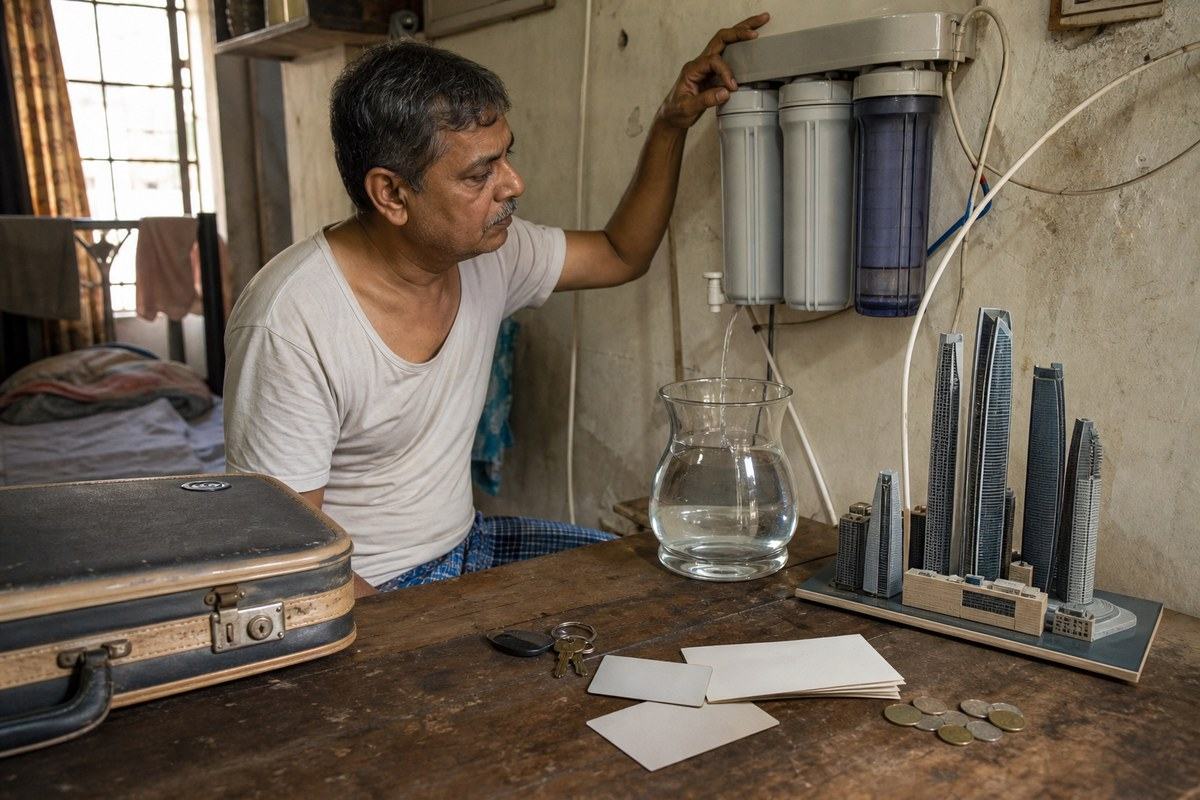
Outside my flat, the June heat has turned the tar roads into something viscous and almost alive, a black, sticky membrane that seems to breathe, and you could fry an egg on the hood of the Ambassador taxi stalled below my window, though no one has that experimental leeway anymore to waste food, because even that thought is a luxury and admission is a form of surrender.
It is Sunday, which means the Naukri algorithms are resting, or at least pretending to, and LinkedIn has paused its synthetic heartbeat of congratulations, those endless, saccharine bulletins announcing that someone is “thrilled to share” that they have begun a new chapter as Associate Vice President of Digital this or that, a company whose website is a single landing page generated by ChatGPT and whose registered address is a UPS mailbox, and I scroll past these performative miracles with the numb diligence of a man checking obituaries for his own name, because that is what the platform has become, a digital graveyard where the dead bury the dead with endorsements for human competencies that now feel as relevant as knowing how to shoe a horse.
But the synthetic LinkedIn crowd is a marvel of modern engineering, not the people themselves but the algorithmic ghosts that impersonate them, the absurd AI-generated comments that say cruel and cavalier “Congratulations! Well deserved!” routinely on posts announcing layoffs, or on mere frivolous everyday trite completions, the bot accounts that endorse you for skills you do not possess, the entire simulacrum of professional community that has replaced the old office canteen with a digital panopticon where everyone is watching and no one is present, and I have come to believe that the platform’s true function is not networking but narcotic, a carefully calibrated drip of dopamine and despair designed to keep us scrolling through the night, refreshing the feed like a hurt man checking a wound to see if it has stopped bleeding, which it never has, because the wound is the point.
The word apocalypse, I remind myself, does not mean catastrophe; it means unveiling, from the Greek apokálypsis, a lifting of the veil, and what is being unveiled now in the air-conditioned glass towers of Rajarhat and the converted colonial bungalows of Sector V is not the end of work but the end of its dignity, the slow, algorithmic revelation that the white-collar middle class of India was never economically necessary so much as it was administratively convenient, a vast holding pen for educated youth whose parents had sold ancestral land and melted down wedding gold to buy them degrees from institutions whose names sound increasingly like satirical inventions.
What many failed to anticipate when I was growing up, what no one in an early age of mechanical optimism could have foreseen, was that the machines would not liberate us but would instead learn to perform the cognitive tasks we had spent decades convincing ourselves were uniquely human—drafting contracts, debugging code, writing marketing briefs, analyzing quarterly reports, generating architectural drafts, reviewing legal discovery documents, composing the very emails that once justified our salaries—and thereby rendering obsolete not labor itself but as it stands now the very ladder by which the lower middle class climbed, rung by rung, from the diploma mills of Durgapur and Indore and the coaching centers of Kota to the open-plan offices of New Town, where the coffee was free and the existential dread was complimentary and the biometric attendance machine recorded your thumbprint as if it were a sacrament.
The economists and the tech evangelists will tell you, with the serene confidence of priests translating scripture, that AI is not replacing jobs but tasks, that it augments human capability rather than eliminating it, and this is technically true in the same way that it is technically true that a flood does not kill a village but merely displaces water, yet when the water enters your living room the distinction loses its academic charm, and I have watched this augmentation up close, watched a single senior analyst with access to Claude do the work of a dozen junior associates, watched the associates receive their “performance improvement plans” with the puzzled resignation of people who have not failed but have simply become algebraically unnecessary, and the companies do not fire them all at once, because that would be bad optics, but they stop hiring, they let attrition do the quiet work of execution, and the job boards continue to glow with their false promises, their ghost listings, their synthetic crowds. Behind every 12X performance adjective there is a reciprocal reduction in workforce.
Last week, on June 12, the Sensex jumped 1,695 points because the Americans declared they had ended their war with Iran, a geopolitical resolution that felt as abstract and distant to me as the Mughal conquests or the Treaty of Westphalia, and I watched the business channels celebrate this rally with the hollow enthusiasm of men cheering a winning cricket team while the stadium burns, because the market’s euphoria has decoupled entirely from the labor market’s reality, just as the warehouse in Taratala collapsed on June 24 with fifty workers inside, a physical catastrophe that made the news for forty-eight hours before being replaced by speculation about the Nifty’s next milestone, and I found myself obsessing over the symmetry: bodies trapped under concrete in one part of the city, while in another, thousands of us were trapped under the weight of phantom job postings, ghost listings that recruiters admitted they had no intention of filling, postings designed to harvest resumes, to gauge market salary rates before appraisal season, to perform corporate vitality for investors who never leave Palo Alto and who think Calcutta is a spelling error.
Forty percent of listings are fake. The recruiters confess this anonymously to the Economic Times, speaking on condition of anonymity, because even the architects of the illusion are afraid of the illusion’s collapse.
You may have applied to 127 positions in the last eight months, positions with titles like “Growth Hacker” and “AI Integration Specialist” and “Senior Content Catalyst” and “Prompt Engineer,” and you have probably received precisely eleven responses, all automated, all containing the same syntactic structure of regret—“unfortunately, we have decided to move forward with other candidates”—a phrase that has become the lullaby of insomnia, and you may have come to suspect that many of these roles never existed, that they were algorithmic chaff, decoys floated by HR departments to maintain the illusion of expansion in a season of contraction, because the truth that no one will speak aloud, not in the drawing rooms of Alipore nor in the spineless WhatsApp groups of your colleagues, is that agentic AI—that new breed of software that can independently identify tasks, execute them, and report back without human intervention—has already swallowed the entry-level jobs, the first-rung positions that once absorbed fresh graduates from Jadavpur University and Presidency and the private engineering colleges that presently bloom like feral fungi, and to admit this would be to admit that the social contract has been voided, that the equation of degree-plus-effort-equals-security was always a provisional arrangement, now expired, like a visa or a festival permit.
But we do not admit it. We cannot. The honor of the Indian middle class, that brittle, calcified thing we call izzat, depends on the performance of employment, on the careful curation of busyness, on the Sunday-morning lie told to neighbors in the elevator that one is “consulting” or “exploring opportunities” or “between projects,” as if the project is a physical object one could misplace like a house key or an umbrella, and I participate in this theater because the alternative is to confess that I spend my mornings rewriting my CV for algorithms that will never read it, afternoons in coffee shops on Park Street watching the ceiling fans rotate with the same exhausted persistence as my own thoughts, and evenings in this flat, calculating how many months of rent remain before I must return to the suburbs of Howrah and the suffocating charity of relatives who will ask, with well-meaning cruelty, why I did not study something more practical, or why I did not study harder, or why I returned from my cushy US life, as if any of these things would have insulated me from the great unveiling.
The denial is structural. It is also pathetic.
In 1991, when the economy opened its reluctant jaws, the white-collar job was a sacrament, a promise that the mind could earn what the back could not, and the IT sector became the new temple, the new zamindari, absorbing millions of English-speaking graduates into cubicles where they debugged code for American banks and answered customer service calls for British telecoms, and for three decades the middle class fed on this arrangement, built apartment complexes in New Town and Rajarhat, bought cars on EMI, sent children to private schools, and told themselves that the knowledge economy was immune to the rust that had consumed the jute mills and the steel plants, immune to the physics of decay, and we were wrong, of course, we were wrong about the immunity, because entropy does not recognize collars, white or blue, and the second law of thermodynamics applies to social structures as surely as it does to stars, and we are watching now the heat death of a particular kind of work, the dissipation of energy into an undifferentiated soup of gig labor and algorithmic management, and no amount of positive thinking can reverse this any more than positive thinking can reverse the monsoon.
David Graeber, before he died in 2020, wrote about bullshit jobs, but what we have now is something more insidious: the absence of jobs masquerading as their proliferation, the ghost economy of the subcontinent, where LinkedIn profiles are maintained with the manicured precision of bonsai trees, where every professional is a “thought leader” and every thought is a reposted infographic about resilience or a TED-talk platitude about “leaning into discomfort,” and I think sometimes of the Fermi paradox, of the Great Filter that prevents civilizations from reaching the stars, and I wonder if the filter is not nuclear war or climate collapse but this, the moment when a species creates tools that render its own cognitive labor redundant, when the accountants and paralegals and junior coders and content moderators and tax preparers who formed the backbone of the emerging economy are told, politely, that their pattern-recognition skills are now pattern-recognition liabilities, that the neural networks they helped train have graduated and no longer require their supervision, and that the future belongs to a smaller, sharper cohort of “AI whisperers” who will themselves be replaced by better AI whisperers, recursively, until the only human job left is the one who turns the server off, and even that will eventually be automated.
Calcutta feels this more acutely than Bangalore, perhaps, because Calcutta is a city that has already been abandoned once, by the British, by industry, by capital, and it knows the smell of obsolescence, the particular mildew of grandeur in decline, and walking past the decaying mansions of North Calcutta or the shuttered mills of Garden Reach, one senses that the current crisis is not an aberration but a continuation, that the city has been waiting for this unveiling, this apocalypse, for two centuries, and the new IT corridors in New Town were merely a brief, feverish exception, a digital gold rush that is now ending with the same tawdry inevitability as all rushes do, leaving behind empty co-working spaces with motivational posters still peeling from the walls and a generation of men and women who learned Python and Tableau and R only to discover that the machines have learned to learn faster, and that the certificate of completion from a Coursera course is not a credential but a condolence card.
The monsoon is late this year. The heat is a physical weight, a pressure on the temples.
The National Testing Agency has extended the NEET exam window by fifteen minutes this year, a small bureaucratic mercy for students who will compete for medical seats that may not exist by the time they graduate, and I think of these children, these seventeen-year-olds sweating in examination halls across West Bengal, their parents waiting outside with water bottles and prayers, and I wonder what they are being trained for, what white-collar future awaits them when the AI that grades their papers today will diagnose their patients tomorrow, and the cycle of obsolescence will have accelerated to the point where a career dies before the student loan is repaid.
Yesterday I met a man, a former business analyst from a firm in Sector V, now driving an Uber in the evenings and spending his mornings in the National Library, not reading but applying to jobs on a laptop with a cracked screen that displays the Naukri interface like a memory of a better god, and he told me, with the flat affect of someone reciting a weather report in a language he barely understands, that he had stopped telling his parents about the applications because his father, a retired postal worker in Berhampore, still believed that the degree meant something, still believed that the world was orderly, that merit was a currency accepted everywhere, and to tell him otherwise would be to kill something in the old man that the son could not bear to kill, and I recognized in his voice the same timbre I hear in my own, the quiet shame of the overeducated and underutilized, the specific grief of having been trained for a world that expired between your graduation ceremony and your first job interview, like a vaccine for a virus that has already mutated.
The job boards know this. Naukri, Indeed, LinkedIn, the portals with their candy-colored interfaces and their promises of “AI-matched opportunities” and “personalized career pathways,” they are not marketplaces so much as casinos, designed to extract hope rather than distribute it, and I have watched the language mutate over the years, watched “urgent hiring” become “pipeline building,” watched “entry-level” become “zero-to-one-year-experience-unicorn-sought,” watched the requirements bloat like corpses in water, three years of experience demanded for a role that pays what I would have made as an intern in 2000, and the scams, oh, the scams, the recruitment firms that charge “processing fees” for interviews that never happen, the fake WFH offers that harvest Aadhaar numbers and bank details and PAN cards, the entire parasitic ecosystem that feeds on the desperation of the precarious, because when the real economy withdraws, the unreal economy rushes in to fill the void, and the unreal economy is always hungry, and its hunger is infinite.
We are not unemployed. We are unmoored. There is a difference.
I read somewhere that the human brain evolved not primarily to solve abstract problems but to navigate social hierarchies and avoid threats, to predict the intentions of others, and perhaps that is why we are so good at this particular form of collective denial, this mass pretense that the LinkedIn congratulations are real, that the job boards are earnest, that the AI is a tool and not a replacement, because to acknowledge the truth would require a restructuring of our social architecture so profound that it would make the caste reforms look like a municipal boundary adjustment, and so we persist, we update our skills, we add “Prompt Engineering” and “Agentic AI Oversight”—which is a euphemism for babysitting software that no longer needs a babysitter—to our resumes, we attend webinars hosted by men in Bangalore who promise that the future belongs to the “AI-enabled professional,” and we do not ask what profession remains when the AI requires no enabling, when the oversight is automated by a higher order of machine, because the question is too large and the fan is still wobbling and the rent is still due and the electricity board does not accept questions as payment.
This morning, walking past the tram depot on Rashbehari Avenue, I saw a workman repairing the overhead wires, his body suspended in a harness above the snarled traffic, and he was working with a concentration so total, so unselfconscious, that I stopped and watched him for ten minutes, envying him the clarity of his task, the visible necessity of his labor, the way his hands knew exactly what the wire required, the tension, the torque, the precise angle of connection, and when he finished he descended and lit a cigarette and looked at me with neither hostility nor camaraderie, just the blank acceptance of one mammal acknowledging another in the heat, and I realized that this was the closest thing to meaning I had encountered in months, this wordless transaction between two people who had nothing to offer each other but the fact of their presence, and I walked home without checking my phone, which is not a resolution or a revelation but merely a pause, a held breath, and the clouds are gathering finally over the eastern horizon, dark and heavy and noncommittal, and I do not know if they bring rain or only more heat, and I suspect I will not know until tomorrow, or the day after, or perhaps never.
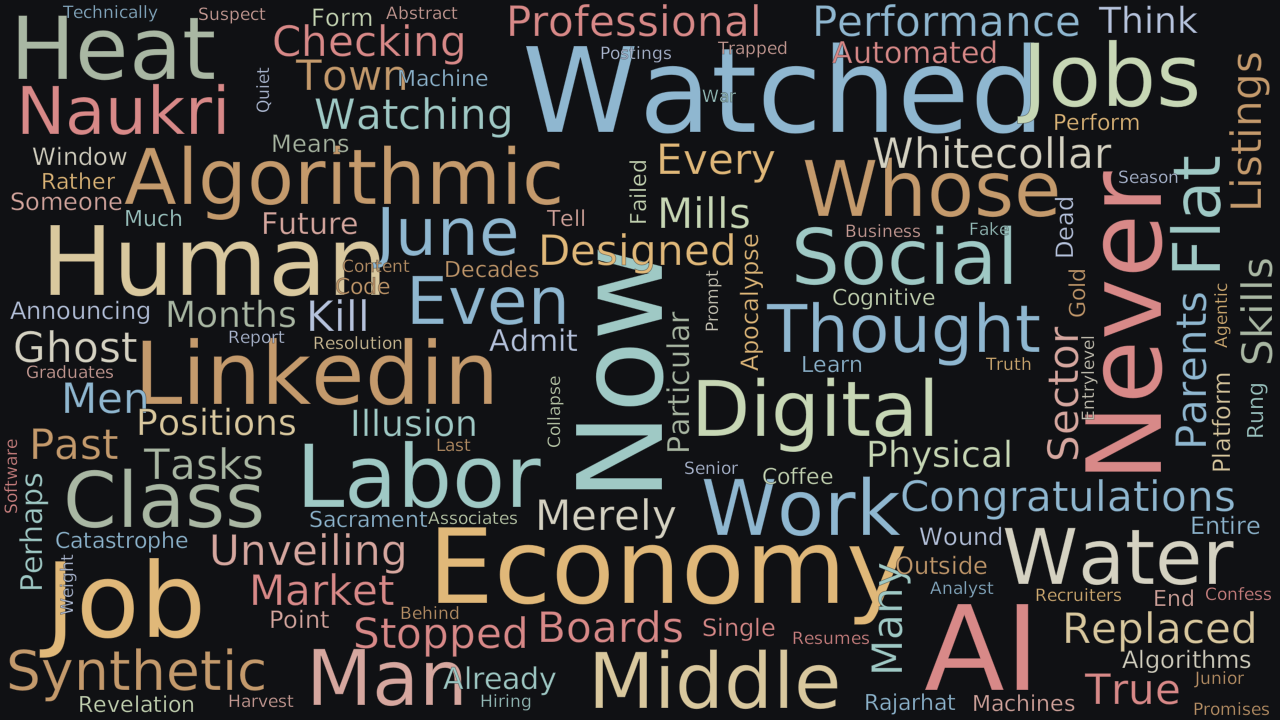
Word Cloud
Related reading
Selected by shared topics and section, with closer publication dates breaking ties.