Rice Cooker Bookkeeping
Uses the speech voice supplied by your browser or device.

Acronyms used in this post:
LPG: Liquefied Petroleum Gas, the cooking gas cylinder that runs out with a talent for theatrical timing.
UPI: Unified Payments Interface, the instant digital payment system in India that makes a phone ping feel like rainfall after drought.
EMI: Equated Monthly Installment, the polite monthly bite taken by loans from people who still pretend they are solvent.
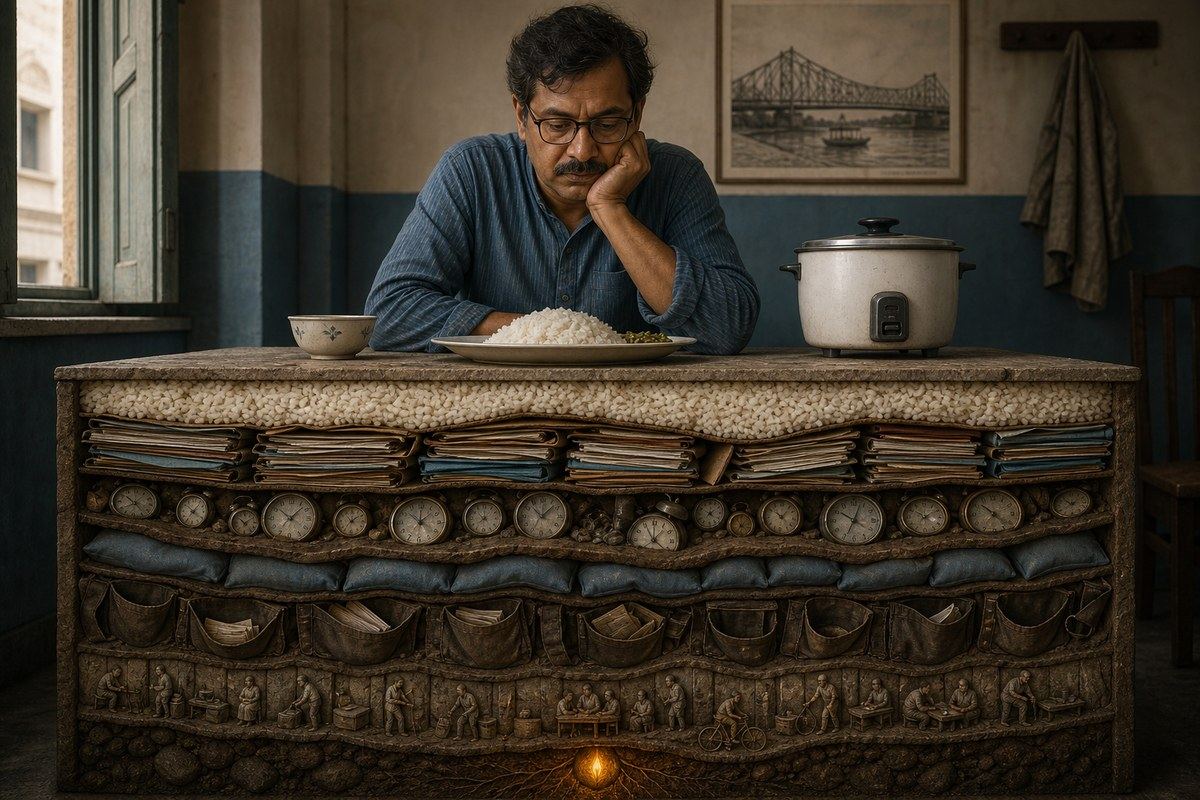
The rice cooker coughs in the corner like a minor relative who has discovered the family accounts and wishes to leave the room.
Not a whistle. Not steam with dignity. A damp little cough.
Inside, there is rice.
Outside, there is arithmetic.
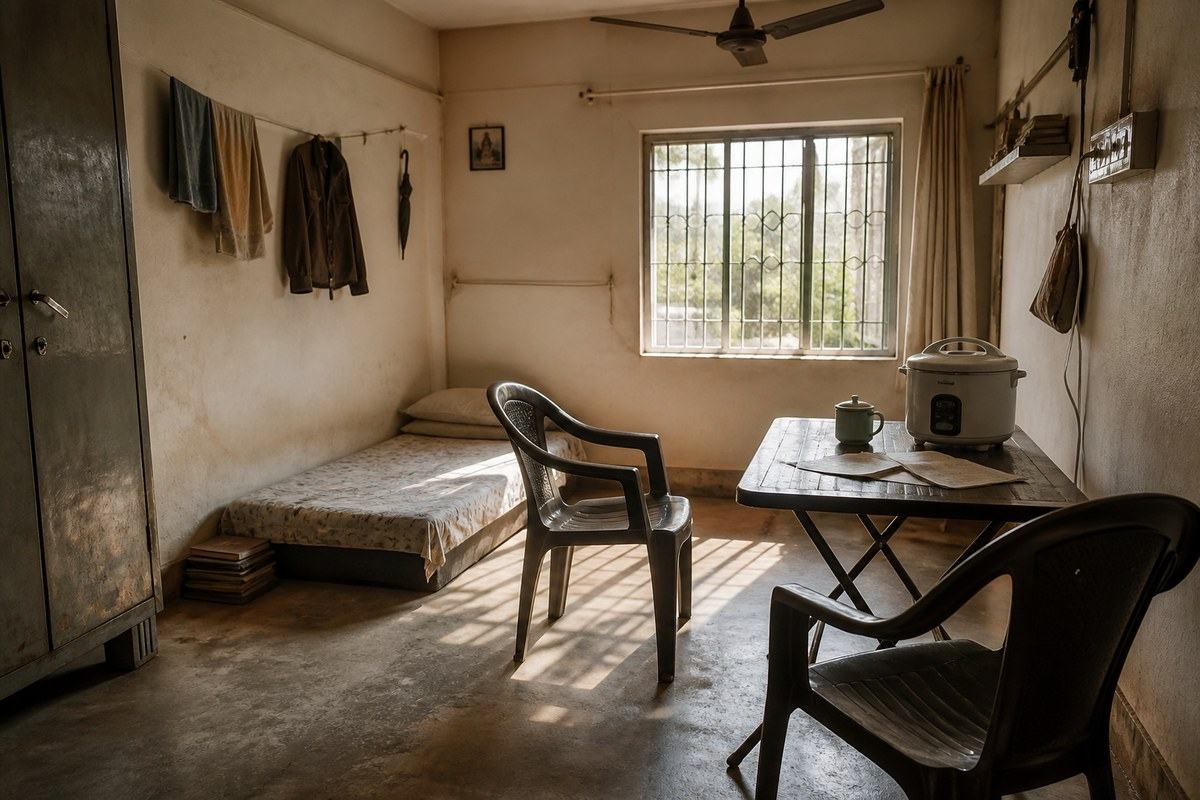
That is the whole matter. No grand theory. No heroic suffering. No background music. Just a small room on the Calcutta edge, a cooker with steam on its conscience, and a man checking his phone for a UPI notification as if civilization has been outsourced to one soft electronic ping.
You may think hunger begins when the plate is empty.
It starts much earlier.
It starts when the plate is still full, but you are counting how many plates are left.
This is the part respectable people dislike. Not because they are cruel, though plenty are. They dislike it because it makes a mess of their tidy categories. The poor are supposed to look poor. The middle class is supposed to complain about parking, school admissions, cholesterol, and the quality of fish. The very rich are supposed to appear on business channels explaining resilience while sitting in chairs that cost more than a widow’s cataract surgery.
But where does a lower-middle-class Bengali man fit, especially one with books, broken ambitions, old certificates, a cracked phone, unpaid invoices, and a rice cooker making moist noises of financial criticism?
Not poor enough for sympathy.
Not secure enough for sleep.
That is a bad address.
India has trained us to inspect suffering like exam invigilators. Show your torn shirt. Show your ration card. Show your village. Show your ribs. Show your tragic photograph in grayscale. If you speak English, stand aside. If you own a pressure cooker, do not exaggerate. If you once studied something difficult, kindly keep your hunger in good grammar.
But the stomach does not care for social classification.
The stomach is a very direct fellow. It has no respect for degrees, family history, or the once-glorious Bengali habit of discussing revolution over tea someone else paid for. It wants food. The landlord wants rent. The pharmacy wants money. The LPG cylinder waits like a fat metal philosopher under the stove, silent until the worst possible day, when it announces the collapse of household planning with a dead blue flame.
Actual poverty, in many middle-class homes, does not arrive with drums.
It arrives with subtraction.
Income minus rent.
Minus electricity.
Minus medicine.
Minus phone recharge.
Minus transport.
Minus the small repairs that breed in houses at night like mosquitoes.
Minus the family obligation you cannot refuse because blood relation in Bengal is often an unpaid subscription service.
Minus the dentist you postponed.
Minus the test you did not do.
Minus the shoe you repaired though the shoe has clearly resigned from public life.
Then accountancy puts on spectacles.
Then it begins the autopsy.
The middle class in India often lives not above poverty, but beside it, the way people in the suburbs live beside an open drain. You learn to step over it. You stop noticing the smell. You tell guests, “This area is improving.” Then one day the drain overflows, and all your careful respectability comes floating past the door with a coconut shell and a dead rat.
The distance between fed and hungry is not always class.
Sometimes it is timing.
A client pays on the 5th, and you are a citizen.
A client pays on the 25th, and you are a philosopher of despair.
The same man. Same shirt. Same rice cooker. Same mother’s medicines. Same damp towel refusing to dry in the bathroom. Only the date has changed, and with it the entire moral weather of the household.
This is why the middle-class budget is more suspenseful than most cinema. Will the payment come before the cylinder ends? Will the electricity bill arrive before the consulting money? Will the tooth remain merely painful, or will it become an expensive little volcano? Will the landlord’s face turn from ordinary stone to Himalayan granite? Will the phone survive another month with its screen looking like a map of defeated nations?
You think you are living a life.
Actually, you are managing a queue.
Rice stands in one line. Rent in another. Medicine in another. Repair, recharge, loan, transport, mother’s needs, old debt, new shame. Each item holds a token. Each item says, “Me first.” You stand behind the counter with no staff, no computer, no fan, and a ballpoint pen that stopped working in 2019.
This is what people miss when they say the middle class is not poor.
They are looking at objects.
Objects lie.
A flat may be mortgaged, disputed, crumbling, shared by six relatives and haunted by one ancestral insult from 1987. Gold may be not ornament but emergency oxygen, sold one bangle at a time until memory itself has been weighed on a jeweler’s scale. A degree may hang on the wall like a dead fish. English may open a door, but it does not pay the vegetable seller, though many Bengalis have attempted this experiment with tragic confidence.
A résumé is not rent.
A clever sentence is not dal.
A school prize from 1989 cannot be exchanged for cooking oil, even if the headmaster wrote “excellent” in blue ink.
Poverty in this zone wears ordinary clothes. It does not always sit dramatically on the pavement. It hides in delayed dental work. It hides in spectacles repaired with tape. It hides in the phrase “I’ll manage,” which is possibly the most dangerous sentence in Indian domestic life.
“I’ll manage” sounds brave.
It often means there is no plan.
It means money is being moved from one wound to another. It means the electricity bill has been paid by postponing the doctor, the doctor has been paid by delaying the rent, the rent has been paid by ignoring the phone repair, and the phone repair has been postponed because the phone, though cracked, still has the decency to pretend.
Everybody claps for management.
Nobody asks what is being managed.
Mostly, ruin.
There is a word for what disappears first: margin.
Not profit margin. Survival margin.
Margin is the small breathing space between what enters and what must leave. Margin is the balcony where life stands for five minutes without being slapped. Margin is the extra packet of medicine, the emergency taxi fare, the second pair of spectacles, the money for a blood test before the disease becomes a headline inside the body.
When margin disappears, the household does not collapse immediately.
That is the tricky part.
It continues.
Tea is made. Rice is cooked. The doorbell rings. Someone asks for change. The ceiling fan continues its tired helicopter routine. A neighbor quarrels. A pressure cooker whistles somewhere. A dog barks with the confidence of inherited property. From outside, life looks intact.
Inside, everything has become a negotiation.
Eggs are no longer eggs. They are protein strategy.
Fish is no longer fish. It is memory with bones.
Chicken is not dinner. It is an event.
Fruit becomes something doctors mention with the innocence of people who have not recently priced apples.
Milk becomes a debate.
Tea remains compulsory. Tea is stimulant, hunger postponement, mood repair, social mask, and morning ceremony in one dented saucepan. If Bengal ever collapses completely, the last functioning institution will be a man boiling tea in a blackened pot while explaining that conditions are temporary.
Hunger also has stages.
First, appetite.
Then delay.
Then substitution.
Then discipline, falsely named.
Then acidity.
Then irritation.
Then a strange intellectual fog in which the mind starts composing essays instead of meals, because the middle-class Bengali cannot merely suffer. He must annotate the suffering, cross-reference it, compare it with a Russian novel, and then wonder why nobody pays him for the insight.
This is not nobility.
It is habit.
The body knows before the mind confesses. The stomach tightens. The head grows hot. Sleep becomes shallow. Anger comes easily, like a stray cat that has found the kitchen. The whole body turns into a government office after rain: files swollen, chairs damp, fan dead, one clerk missing, and the public waiting outside with forms nobody can find.
And still you must behave.
That is the extra tax.
You must not look frightened while buying rice. You must not sound desperate while asking whether the client has processed the payment. You must not tell the landlord the full truth, because the full truth has no market value. You must not alarm your mother. You must not shout at the pharmacist. You must not slap the rice cooker, though frankly it has been asking philosophical questions in steam.
The poor are often described as people without money.
That is too simple.
Many people become poor because they have no buffer against timing. They are destroyed not by one large disaster but by small bites repeated with bureaucratic patience. Ten rupees here. Five hundred there. Penalty. Interest. Transport. Medicine. Repair. Ceremony. Obligation. Inflation. A late payment. A missed payment. A thing that broke because another thing was not repaired because another thing had to be paid first.
A million ants can eat a tiger if the tiger is tired enough.
The Indian middle-class tiger is now mostly dandruff, memory, and unpaid EMI.
In Bengal, we decorate this collapse with culture. That is our special talent. We call it refinement. We call it education. We call it bhadralok values, which often means the ability to discuss civilization while the ceiling drops plaster into your tea. We can convert unemployment into theory, hunger into metaphor, and unpaid bills into a debate about the decline of public taste.
We are magnificent at abstraction.
The ledger is not.
The ledger is a butcher with neat handwriting.
It has no nostalgia for your school, your family name, your father’s old acquaintances, your mother’s careful newspaper cuttings, or your promise. Promise is a bright little fraud issued to young people before life begins charging compound interest. You cannot pawn promise. You cannot boil it with rice. You cannot hand it to the gas delivery man and say, “Brother, this was once considered very impressive.”
So yes, when I say hunger, I mean hunger.
Not always the hunger of an empty plate tonight. Sometimes the hunger of next week approaching with a pencil behind its ear. The hunger of counting rice. The hunger of stretching a strip of tablets. The hunger of choosing between pain now and debt later. The hunger of staring at a bank balance and feeling the future shrink to the size of a cockroach behind the sink.
There is a peculiar shame in this, because middle-class life is built on the promise that education protects you from the raw edge. Study, behave, speak properly, save when possible, do not make a scene, do not get into trouble, do not fall too far. Then life quietly removes the railing.
You are still standing on the staircase.
The railing is gone.
People passing below say, “But you are on the staircase. Why are you complaining?”
That is the comedy.
That is also the trap.
A household budget is not just a financial document. It is a moral document. It shows what gets sacrificed first. Comfort goes first. Then repair. Then taste. Then preventive care. Then sleep. Then dignity. Then truth. Finally, the family begins cutting into the body itself: cheaper meals, fewer meals, untreated pain, postponed surgery, unpaid labor, unpaid self, unpaid future.
Nobody wants to call this poverty because the plate may still contain rice.
Fine.
Call it pre-poverty.
Call it suspended hunger.
Call it arithmetic weather.
Call it standing under a ceiling fan that still turns while the hook loosens.
I call it what it feels like from inside a small Calcutta room where the rice cooker has finished coughing, the phone has not pinged, the month has several teeth left, and the man beside the table is trying to look calm in front of his own life.
The rice is done.
The month is not.
Somewhere inside the ledger, a small digit is sharpening its spoon.
Word Cloud
Related reading
Selected by shared topics and section, with closer publication dates breaking ties.