Administratively Deleted
Uses the speech voice supplied by your browser or device.

Acronyms and short forms used in this post:
RIP — Rest in Peace, the standard public condolence phrase used after death.
PDF — Portable Document Format, the file format in which résumés go to become mummified.
MBA — Master of Business Administration, the degree that often teaches people to say simple things with upholstered confidence.
UPI — Unified Payments Interface, India’s instant payment system, now found on tea stalls, vegetable carts, medicine shops, and almost every surface not yet claimed by fungus.
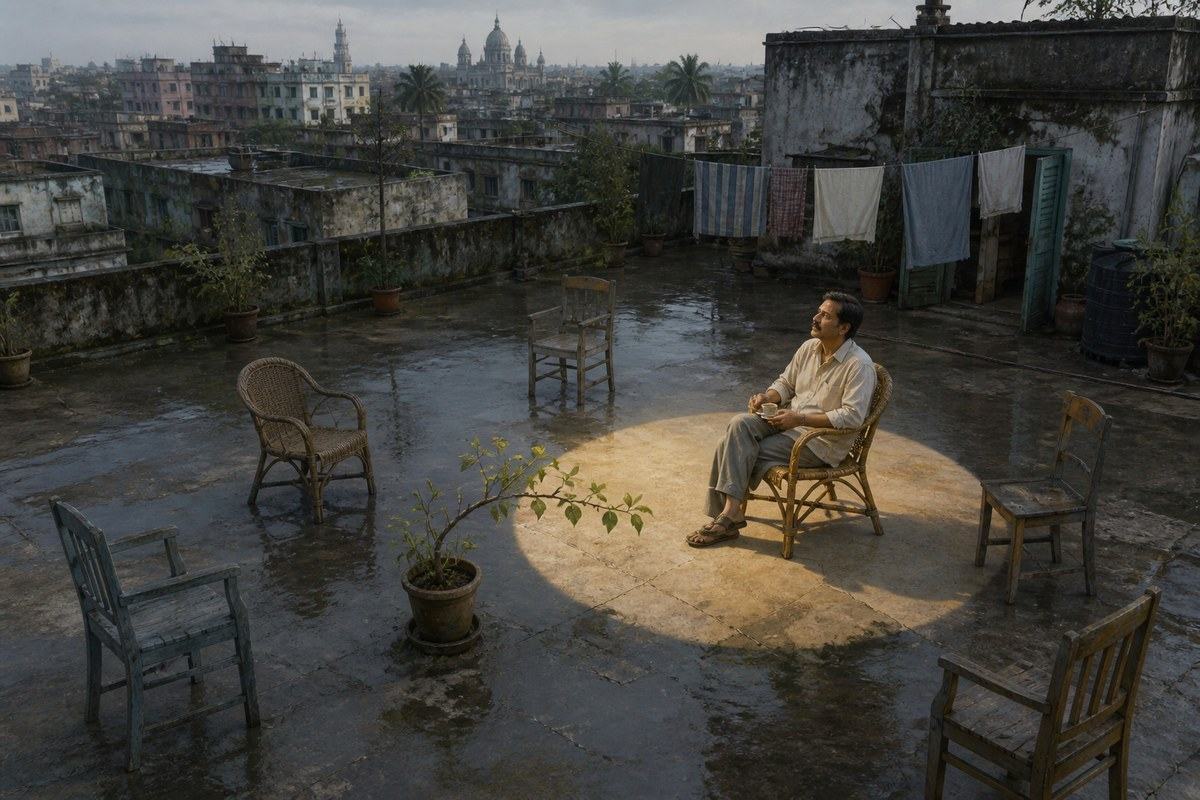
A man is not erased all at once. That would be too theatrical, too generous, almost cinematic. Calcutta does it more practically. It removes him in installments, like a bad appliance warranty.
First comes the wedding smell.
Not the wedding. Only the smell. Hot luchi, old oil, mutton gravy, perfume, wet hair, and that faint whiff of tuberose that makes every Bengali ceremony feel as if romance and indigestion have joined hands for the evening. It floats up the stairwell at ten in the morning while I am standing near the bathroom in an old undershirt, toothbrush in my mouth, bladder conducting a small public protest, and I realize I have not been invited.
Then comes the worse realization.
I have not even been forgotten.
To be forgotten is still to have existed in somebody’s notebook. A chair was almost counted. A plate was almost ordered. A name was almost written, then lost under the oily arithmetic of relatives, neighbours, school friends, office friends, and that strange Bengali category called “people who must be called or they will say things.”
But this is cleaner.
No chair.
No plate.
No almost.
This is deletion.
Not death. Death has a better public relations department. Death gets garlands, incense, WhatsApp messages, and someone saying, “He was very bright once,” while getting half the facts wrong. Death gets a photograph with sandalwood paste on the forehead and two elderly men discussing your career as if you were a tram route discontinued in 1992.
This is earlier.
This is the city beginning the paperwork while you are still alive.
Calcutta understands paperwork. It was practically breastfed on ledgers. The British built an empire here with ships, clerks, opium, files, stamps, and the moral flexibility of accountants in hot weather. Later we inherited the files, the stamps, the damp almirahs, and the habit of making a human life depend on one missing photocopy.
Nobody here disappears like a magician’s assistant.
He becomes a file.
First active.
Then pending.
Then old pending.
Then “please check with the other department.”
Then a lizard sits on him behind the wooden cupboard and contributes its opinion.
I used to be called. Not constantly. I was never the chandelier type, not one of those men who enter a room smelling of aftershave, success, and family money. Some people are born with the air of a sofa set already reserved for them. I was not. I entered rooms like a man looking for the switchboard.
Still, I was called enough.
A cousin’s rice ceremony. A batchmate’s adda. A wedding where I stood near the cold drink table pretending not to notice that the fish fry was better organized than most Indian institutions. A job lead from some friend of a friend who spoke in that famous Indian language of scented uncertainty: “Something may happen, dada. Your profile is very strong.”
Your profile is very strong.
In Bengal this means a goat has been tied near the butcher’s shop and told to remain optimistic.
For some years the calls continue. Then they thin out. Not dramatically. They thin the way hair thins, the way a savings account thins, the way enthusiasm thins after the third follow-up message. Nobody announces it. Nobody says, “You are now socially inconvenient, financially doubtful, romantically expired, and difficult to explain to people who still believe life is a merit-based examination.”
They just stop including you in the planning stage of reality.
There is a planning stage of reality. Young people do not know this. They think life is happening in the open, like a football match. It is not. Much of life is decided in side conversations, kitchen whispers, WhatsApp groups, balcony consultations, and those mysterious family calls where people lower their voices even when discussing potatoes.
When you are young, you are still in the brochure. Even if your room is damp, your shirt is cheap, and your future is held together with borrowed confidence, people still imagine a version of you that may arrive. Middle age is when the brochure is quietly withdrawn from circulation. The city no longer advertises you to others.
It does not even insult you loudly.
It lowers your resolution.
The job network goes next.
This part hurts in a more professional way. Social erasure is oily and emotional. Work erasure comes wearing formal shoes. There was a time when my name traveled through other mouths. It had some velocity. Someone would say, “Do you know a person who can handle this?” and somewhere, for a few years at least, my name could still wobble into the room like a late bus.
That is how work often happens. Not through merit, that bedtime story told to children and MBA students, but through the warm underground plumbing of familiarity.
Who remembers you.
Who trusts you.
Who can use you.
Who can recommend you without feeling they are bringing a leaking bucket into the drawing room.
Then the pipes close.
Messages become archaeology. You see the blue ticks and feel like a historian studying a vanished civilization. Calls are missed in both directions. Your résumé becomes a PDF-shaped fish left too long in the sun. You send it out. It does not return. Only the smell does.
The market does not reject you personally. That would require attention, and attention is expensive. The market behaves more like a building guard with a plastic chair and a suspicious stomach. Age? Gap? Wrong city? Wrong country? Too senior for cheap work? Too old for junior work? Too honest for cheerful lying? Too tired to perform hunger as enthusiasm?
Entry denied.
Even the word “network” begins to stink. It sounds like something an electrician has tied between two leaning poles over a lane where rainwater, sewage, and democracy are conducting a joint experiment. Network. Contact. Connection. Referral. All those crisp business words hiding the old village logic: who remembers you, who can digest you, who can place you somewhere without later needing antacid.
Then family usefulness begins to wobble.
In India, family is not simply affection. That is the brochure version. Family is also an unpaid logistics company, a small claims court, an ambulance service, a gossip exchange, a pension advisory cell, a crisis committee, and a food delivery system powered by guilt.
You are useful as long as you can earn, arrange, lift, pay, sign, accompany, recommend, repair, explain, mediate, or stand in a hospital corridor with the face of a man who knows where the billing counter is and which clerk must not be annoyed before lunch.
Lose enough functions and your designation changes.
Nobody says this aloud. They will still ask, “Have you eaten?” In Bengal that sentence can mean tenderness, habit, surveillance, diplomacy, or the last civilized piece of furniture left after affection has sold the rest.
But somewhere a ledger updates.
Son: limited.
Brother: uncertain.
Uncle: decorative.
Man: handle carefully.
The body understands these revisions before the mind admits them. The stomach tightens. The shoulders fold slightly forward, as if apologizing to the air. The bladder develops opinions. The bowel becomes a government department with irregular hours. Every morning on the commode becomes a minor hearing: the citizen versus the failing republic of the body.
Romance leaves with less paperwork.
Actually, romance does not leave. That would be graceful. Romance turns off the fan, takes the good pillow, keeps the security deposit, and sends no forwarding address.
There is a particular comedy in becoming invisible to desire while still having desire. The mismatch is obscene in the way old bills are obscene. It is like receiving an electricity bill for a house demolished before Google Maps learned your lane.
The city continues, without shame, to produce women.
Women with wet hair outside medicine shops. Women in autos adjusting dupattas with that casual movement that can damage a whole afternoon. Women buying coriander. Women laughing into phones. Women in faded nighties on balconies, throwing water from steel mugs onto potted plants with the authority of minor queens.
And the old animal brain, that stubborn, underfunded clerk left over from before agriculture, still says: look, possibility, warmth, life.
The world says: move aside, uncle. This counter is closed.
This is not tragedy in the classical sense. Nobody is stabbing anybody in a palace. It is more like trying to buy fish late in the morning. The best pieces are gone. The vendor is not cruel. He simply points to what remains.
Calcutta knows this feeling. The city itself has been passed over so many times that abandonment has become one of its municipal services. Once imperial capital. Then intellectual furnace. Then slogan factory. Then decaying family mansion. Then coaching-center corridor. Then flyover rash. Then app-delivery maze, where young men on bikes carry biryani through lanes where old houses drop plaster on history like dandruff.
A city that has been demoted learns how to demote others.
It does not need training.
Then comes the mirror.
Photographs are worse, of course. Photographs are police officers. They do not negotiate. They do not say, “Bad light.” They do not say, “You slept badly.” They do not say, “Today the face is under maintenance.” They present you as evidence.
So you avoid them.
Mirrors are more domestic. They live in the house and therefore become part of the conspiracy slowly. First you use them normally. Then quickly. Then only in emergency. You check whether civilization has made any urgent legal demand upon your face. Is there foam on the chin? Is the hair doing something criminal? Are the eyes presentable enough for the gas cylinder man?
Then you leave.
The face looking back is not exactly old, not exactly ugly, not exactly ill. It is something more Bengali and more bureaucratic: under-maintained. The cheeks have lost interest. The eyes seem to have moved inward, as if avoiding conversation. The hair has become a coalition government with several resignations and no clear prime minister. The mouth looks disappointed even when unemployed.
You begin to suspect your face has outsourced your life to a cheaper contractor.
The old self is not murdered. Murder has energy.
The old self is archived.
There must be some brain science behind this, because now there is brain science behind every insult, every craving, every bad mood, and probably every time a Bengali uncle says, “Actually, the real problem is discipline.” The hippocampus, amygdala, and prefrontal cortex keep updating the model. The brain is not a motivational speaker. It is a prediction machine. It watches the evidence.
Invitation not received.
Message unanswered.
Work not offered.
Desire not returned.
Family usefulness reduced.
Mirror avoided.
After a while the brain says, with the chilly politeness of a bank SMS: participation level revised.
That is depression’s nastiest trick. It does not always invent the darkness. Sometimes it simply takes dictation from the world and types very fast.
People think invisibility is peaceful. It is not. Peace has space in it. Invisibility has fog. A witnessed man has edges. Even dislike can draw an outline around you. Neglect is worse. Neglect does not argue. It leaves the room while you are still speaking.
You begin to carry yourself without witnesses.
That is heavier than it sounds.
You speak less because nobody is waiting. You dress worse because no room will reward the effort. You postpone shaving because the face has already lost the election. You stop making plans because plans require the future to reserve a seat, and the future has begun saying, “Please come after Durga Puja,” which in Bengal can mean October, next year, never, or do not disturb me again.
Meanwhile the city goes on with its usual shameless industry.
Tea boils black and sweet. Fish sellers slap hilsa on wooden boards like silver court judgments. Buses exhale smoke with ideological conviction. Boys with gym arms and no books lean on motorcycles. Aunties inspect vegetables with the severity once reserved for moral failure. A tea stall owner now accepts UPI with the calm of a central banker, though the bench under you still wobbles like coalition politics.
Somewhere in Salt Lake, a conference room is producing phrases like “strategic alignment” while polished men murder time and call it leadership.
Somewhere in South Calcutta, a middle-aged man opens his phone for the tenth time. Not with hope exactly. Hope is too expensive a word. More like checking whether the system has made a mistake. Whether some invitation, message, payment, affection, inquiry, apology, or human signal has arrived late, like a parcel stuck near Dankuni.
Nothing.
Still, not dead.
This is the joke, if one is honest enough to laugh badly. You can be removed from invitations, jobs, family importance, romantic weather, and your own reflection, and still have to buy onions. Still have to pay the electricity bill. Still have to answer the gas cylinder man. Still have to scratch a rash on the left thigh with the full concentration of a philosopher discovering mortality near the elastic of his shorts.
Life does not require dignity to continue. That is its most irritating feature.
Maybe the final erasure will not be grand. No music. No collapse. No dramatic chair falling backward. Just one evening during a power cut, sweat gathering under the chest, phone at five percent, mosquitoes circling with more professional interest than any recruiter in ten years.
One mosquito will whine near my ear.
I will raise my hand, miss, and for one absurd second feel grateful.
At least this tiny bloodsucking creature still has my current address.
Word Cloud
Related reading
Selected by shared topics and section, with closer publication dates breaking ties.