The Rent Spider
Uses the speech voice supplied by your browser or device.

THIS IS A WORK OF FICTION
On the evening Nirmal first tasted dust with the hairs on his wrist, the rain came down on Bidhan Sarani with the full civic incompetence of Calcutta: sideways, black at the edges, determined to enter every shoe.
The footpath near Hatibagan had become a slow brown argument. Fish scales shone in the gutter. A goat stood under a torn tarpaulin with the expression of a retired magistrate. Men in rolled-up trousers shouted over the price of hilsa as if the fish had personally betrayed Bengal. A tram bell clanged somewhere beyond the rain, patient and elderly, like an uncle who still believed letters should be answered. Political posters sagged on walls. Coaching-centre advertisements promised rank, success, migration, English fluency, government service, and other varieties of salvation.
Nirmal Banerjee stood under the awning of Ghosh Tea Cabin with his exercise books in a plastic packet and forty rupees in his pocket.
He had been owed three thousand for six weeks of mathematics tuition. The boy’s father had smiled at him, called him “Nirmal-da” twice, praised his sincerity, and then explained with great sorrow that their own situation was tight. Everyone’s situation was tight. In Calcutta, poverty had learned manners. It came with tea, apologies, and a request to continue from next month.
“Have tea,” said Tapan, pushing a glass toward him. “You look like a wet obituary.”
“I have money.”
“Then pay last Tuesday also.”
“I said I have money, not history.”
Tapan laughed. Nirmal tried to laugh, but his mouth felt padded inside, as if someone had stuffed cotton between his cheeks and teeth. The tea smelled of milk, iron, and old leaves boiled beyond mercy. He lifted the glass and noticed three black hairs standing upright on the back of his wrist.
They were not ordinary hairs. They were thick, jointed, and alert.
He rubbed them with his thumb. Pain shot up his arm, sharp enough to make his eyes water.
“You got current?” Tapan asked.
“Mosquito bite.”
“Mosquitoes here have union now. They bite with paperwork.”
Nirmal tucked his hand under his damp sleeve and walked home through rainwater that covered the broken paving stones like a dirty idea.
He lived with his mother in a second-floor rented room off a lane behind an old cinema that now stored plywood, paint, and the dreams of a promoter. Their house had green shutters, a cracked balcony, and a nameplate that still said Banerjee Lodge though no Banerjee had owned it since 1983. There were six families, two widows, one bachelor clerk who cooked only eggs, and a landlord’s nephew named Somnath who wore gold rings and spoke of redevelopment as if it were a religious awakening.
Their room smelled of damp clothes, talcum powder, old paper, and the faint medicinal bitterness of his mother’s pain balm. Minati Banerjee sat on the bed sorting rice on a steel plate, separating stones with the concentration of a jeweller.
“You got wet,” she said.
“It rained selectively on me.”
“Did they pay?”
He put the plastic packet on the table.
She did not ask again. That was one of her kindnesses. She had many small ones, all of them worn thin from use.
On the wall behind the almirah, a web had spread since morning.
It was not the floating grey lace of ordinary spiders. It was thick and blackish, like old thread soaked in oil. It ran from the window grille to the calendar, from the calendar to the nail where his father’s framed photograph hung, from the photograph to the corner above the bed.
Minati looked at it and became busy with the rice.
“I cleaned this yesterday,” Nirmal said.
“These old houses grow things.”
“Houses do not grow rope.”
“You eat first.”
“I am not hungry.”
“You are never hungry. A man cannot live on worry and tea.”
Nirmal wanted to say that a man could live on less. He had been doing field research. Instead he took the broom and swept the web down.
It resisted.
The broomstick bent. The web stretched, trembling with a low dry sound. When it broke, it snapped against his cheek and left a line of cold burning skin.
From behind the almirah something clicked.
Minati’s hand stopped over the rice.
“What was that?” he asked.
“Lizard.”
“That was not a lizard.”
“Then cockroach. In this city even cockroaches have engineering degree.”
Her joke came too quickly. Nirmal looked at her. She looked down at the plate.
That night his depression sat on him with unusual weight.
It was usually an old animal. Sullen. Familiar. It lay across his chest in the mornings and breathed hotly into his face. But now it had legs. He could feel them arranging themselves around him in the dark.
The ceiling fan turned slowly, chopping the humid air into useless pieces. His mother slept on the mat beside the bed, her breath thin and whistling. Rainwater ticked somewhere inside the wall.
Nirmal lay awake and thought of rent.
Three months pending.
He thought of the unpaid tuition fees, the schoolboys whose fathers called him “Sir” with the same voice they used for plumbers, the cousins who had stopped inviting him to weddings because failure was contagious if seated too near the sweets.
He thought of his father, who had left when Nirmal was twelve.
Not died. Not exactly. Left.
That was the family word. A thin word. A word with no blood on it.
His father had gone out one evening to meet someone about a job and had not returned. Police station, missing-person notice, whispering relatives, his mother’s dry eyes. After six months people began lowering their voices around them, then raising them again. Calcutta is sentimental, but not indefinitely. The missing become inconvenient. The living need fish.
Near dawn, Nirmal dreamed he was chewing a moth.
He woke with wings stuck to his tongue.
For three days he told himself illness. Fever. Nerves. Some reaction to fungus in the room. Calcutta offered many explanations before the supernatural had to be troubled.
The hairs spread first.
They rose along his wrists, his forearms, the backs of his knees. Not fur. Bristles. Each one seemed to possess a private intelligence. They felt air move, dust settle, the footfall of the egg-clerk downstairs, the tremor of a tram half a mile away.
Then came the appetite.
He could not eat rice. Fish made him gag. Tea tasted like boiled cloth. But when a fly struck the window glass, his mouth filled with saliva so abruptly he had to grip the table.
His student Rini arrived on Thursday with two exercise books, one broken pencil, and the exhausted seriousness of a child who knows her mother is counting coins in the next room.
“Sir, will you teach today?” she asked.
Nirmal had wrapped a gamchha around his neck and wore a full-sleeved shirt though the heat pressed on the room like a wet mattress.
“Yes. Fractions.”
“I hate fractions.”
“Fractions hate everyone equally. That is their democratic quality.”
She smiled. Rini was eleven, thin, sharp-eyed, and too polite. Her father drove an auto when it ran and borrowed when it did not. Her mother stitched falls on saris. They paid in pieces: two hundred now, one hundred later, sometimes a packet of muri or a bottle of mustard oil.
He never pressed them.
A black thread hung from the ceiling above her head.
Nirmal stared at it.
“Sir?”
“Move your chair.”
“Why?”
“Just move.”
She dragged the chair aside. The thread dropped onto the table where her hand had been and curled like something alive.
Rini leaned close. “Spider?”
“Old thread.”
“It is coming from your shelf.”
Nirmal followed the line. It ran from the ceiling to the bookcase, across old guidebooks, over a stack of unpaid bills, and into a crack behind his father’s photograph.
“Go home,” he said.
“But fractions?”
“Fractions will survive without us.”
When Rini left, Minati came in from the common kitchen, wiping her hands on her sari.
“You sent the girl away?”
“There is something in this room.”
“Everything is in this room,” she said. “Your books, my bones, your father’s photo, rent notice. What else do you want?”
“I want you to stop pretending.”
She sat down slowly.
The clicking came again from behind the almirah.
Not one click. Many.
Like fingernails tapping wood.
Minati closed her eyes.
“I thought we had more time,” she said.
The sentence opened under Nirmal like a trapdoor.
“More time for what?”
Before she could answer, someone hammered on the door.
Somnath stood outside in a white shirt tight over his stomach, hair shining with oil, two gold rings bright on his fingers. Behind him waited a mason carrying a measuring tape.
“Dada,” Somnath said, with the affectionate contempt of men who have property documents. “We are checking the wall. Small inspection.”
“No inspection today.”
“Why? You are hiding Victoria Memorial inside?”
“My mother is unwell.”
“Everyone’s mother is unwell when rent is due.”
Minati rose. “Somnath, come tomorrow.”
“Aunty, tomorrow promoter coming. This whole side will go. New flats, lift, tiles, proper drainage. You people will get compensation if papers are clean.”
“We are tenants.”
“Exactly. Not owners. That is why I am explaining politely.”
The mason lifted his tape.
Nirmal stepped into the doorway.
Somnath looked him up and down. “Why are you wearing full sleeves in June?”
“Fashion.”
“Move.”
“No.”
Somnath smiled. “You educated people are funny. No money, but full dignity. Dignity does not pay municipal tax.”
His hand came forward to push Nirmal.
Something came out of Nirmal’s mouth.
It happened without decision. A wet black cord shot between his lips and struck Somnath’s wrist. Somnath shouted. The mason dropped the tape. The cord tightened.
For one second all three of them stared.
Then Nirmal bit it off.
Somnath stumbled backward, clutching his wrist. A dark sticky thread clung to his skin.
“What filth is this?”
“Leave,” Nirmal said.
His voice had changed. It came from lower down.
Somnath’s face went pale with anger, then fear, then anger again because fear is expensive for men like him.
“You wait,” he said. “Tonight I will come with people. Then show me fashion.”
He left.
The mason left faster.
Nirmal shut the door and vomited into the bucket. Nothing came out except two dead flies and a length of black thread.
Minati held his shoulder.
Her hand was shaking.
“What is happening to me?”
She did not answer.
He turned on her. “You know.”
“I know only what I saw once.”
“With Baba?”
She looked toward the photograph.
In it his father stood beside a studio chair, narrow-faced, moustached, almost handsome, wearing a shirt too large at the collar. A schoolteacher’s face. A man who believed life would obey if approached with neat handwriting.
“He did not leave,” Nirmal said.
Minati covered her mouth.
The room seemed to listen.
“He became like this?”
“He fought it.”
“How?”
“He locked himself on the terrace.”
The old terrace room.
Nirmal knew it: a low brick chamber beside the water tank, always padlocked, supposedly full of broken chairs. As children in the house, they had dared each other to touch the door. His mother had forbidden him from going up there with such terror that he had obeyed even during adolescence, when obedience was otherwise a mild disease.
“Why did you not tell me?”
“What would I say? Your father became a spider because this city ate him badly?”
The cruelty of the sentence made them both silent.
Minati wiped her eyes with the end of her sari. “He was not weak. Remember that. He was ashamed, yes. Out of work. Cheated by his friend. Debt men came. Your school fees pending. He stopped sleeping. Then the hairs came. Then the thread. At first I thought some curse. Then I thought madness. Then one night he climbed the wall.”
Nirmal listened to the rain.
“He asked me to lock him in,” she said. “He said if I loved you, I must not open the door.”
“But you stayed in this house.”
“Where would I go? With a twelve-year-old boy and no money? Your uncles gave advice, not rooms.”
Contemporary Bengal had perfected that art: relatives who carried sympathy like visiting cards, handed over at the door, never redeemable for cash.
“What happened to him?”
“I heard him for some months. Then nothing.”
The clicking behind the almirah grew louder.
Nirmal moved the almirah before Minati could stop him.
The plaster behind it had split. Inside the crack, in the dark wet mouth of the wall, were bundles.
Not large. Not human. Rat-sized, cat-sized, perhaps larger deeper in. Wrapped in black silk. Between them lay objects: a brass pen cap, a broken spectacle frame, a child’s marble, rent receipts yellowed with age.
And a key.
It hung from a nail inside the crack, tied with red thread.
Minati made a sound.
Nirmal reached in. The bristles on his arm trembled. Something in the wall recoiled from him, then recognized him.
The key was cold.
By evening, his shoulder blades had begun to split.
There was little blood. The skin opened in four neat seams, two on each side, as if the body had kept the design folded there for years and was now reading instructions. From the wounds emerged jointed limbs, soft at first, then hardening in the air. They bent backward, then forward. They knew what to do before he did.
He stood in the bathroom, gripping the basin, while four black legs unfolded behind him.
His human legs weakened.
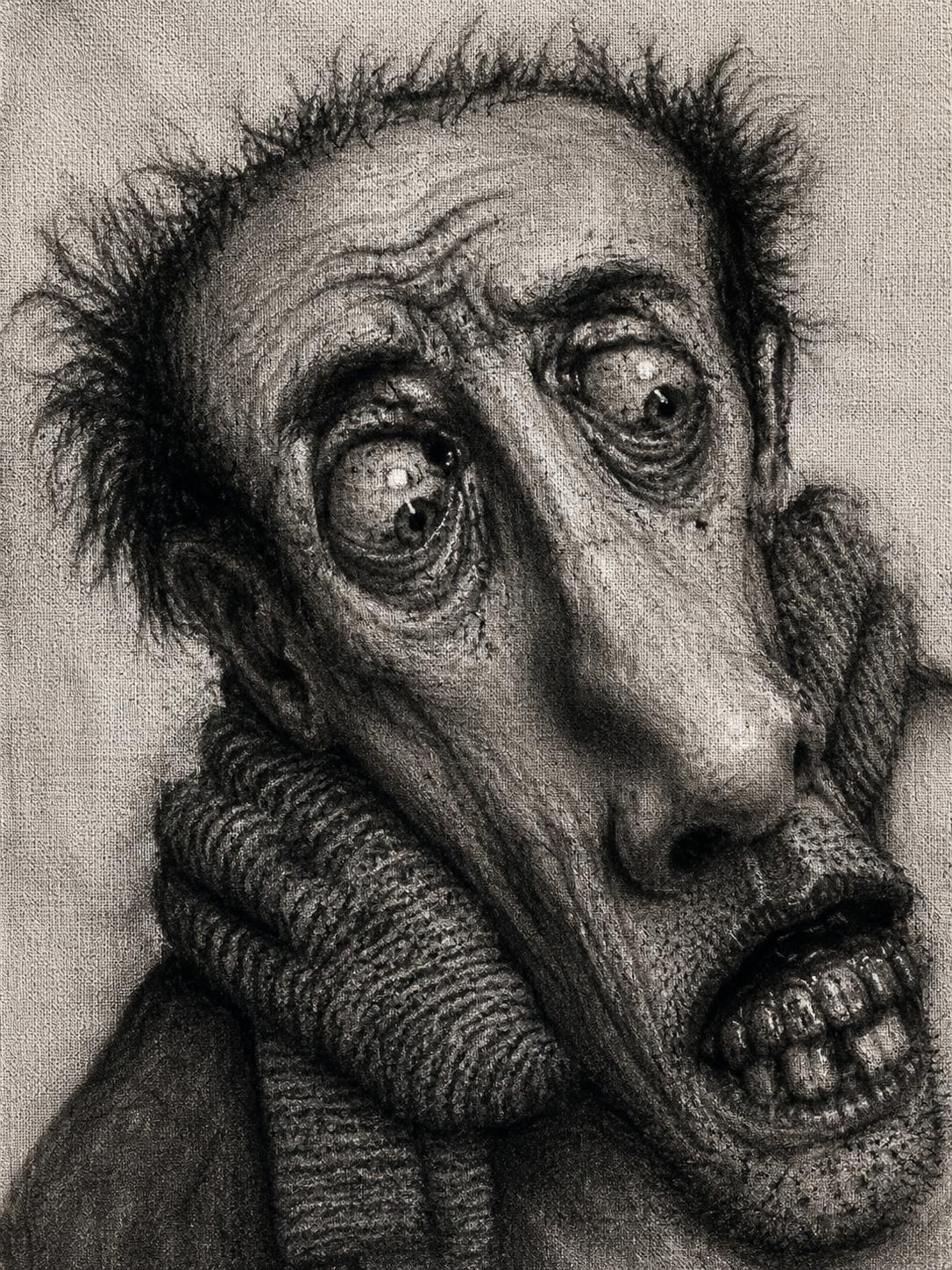
His face remained his own. That seemed the worst of it. A monster should receive the mercy of anonymity. But the mirror gave him Nirmal Banerjee’s tired eyes, Nirmal’s thinning hair, Nirmal’s swollen cheeks, Nirmal’s mouth now crowded with palps that flexed like wet fingers.
Minati stood outside the bathroom door, crying without sound.
“Ma,” he said.
The word came tangled.
“I am here,” she said.
“Lock me upstairs.”
“No.”
“I can smell you.”
That frightened her more than the legs.
He could. He smelled the salt of her fear, the sourness of old pain, the faint sweetness of love. He smelled Rini downstairs solving fractions badly. He smelled Somnath somewhere in the lane, chewing paan, gathering men, nursing revenge. Human beings had become lamps in a dark field.
Some burned brighter.
The defeated ones burned sweetest.
That was the horror.
Not hunger. Preference.
He understood then that the thing he was becoming was not merely a predator of flesh. Flesh was common. Calcutta overflowed with it: buses, markets, queues, funeral ghats, marriage halls, government offices. No, this hunger wanted the softest meat inside a person—the little collapsed chamber where hope had once lived.
Depression had not vanished from him.
It had become an organ.
At nine, the lights went out.
A power cut passed through the lane. People groaned from windows. Someone cursed the electricity board with admirable range. In the dark, Somnath’s voice rose from the courtyard.
“Nirmal-da! Come down. We will discuss politely.”
Men laughed.
Something struck their door.
Minati whispered, “Go.”
“Where?”
“Terrace.”
He took the key.
He climbed not by the stairs but by the wall of the corridor. His new legs found cracks, nails, damp patches, old paint. The house opened itself to him in textures. He passed the egg-clerk’s door, the widow’s tulsi plant, the landing where rainwater collected in a broken bucket. Below, Somnath kicked their door again.
The terrace smelled of moss, wet brick, and old lightning.
The padlock on the terrace room was rusted but surrendered to the key with a small ashamed click.
Inside, darkness hung in layers.
Nirmal entered.
The room was larger than he remembered from outside. Or perhaps the inside had been pulled wider by years of webbing. Silk covered the walls in thick black sheets. Bundles hung from the rafters. Some were small. Some were the size of men.
At the far end, near a broken chair, something moved.
It unfolded slowly.
A human face emerged from the dark, long and dry, framed by bristles.
The moustache was gone. The cheeks had hollowed. But Nirmal knew the eyes.
His father watched him from the body of a spider.
Neither of them spoke.
Then the thing that had been his father lifted one thin limb and tapped the floor three times.
Click. Click. Click.
The sound from behind the almirah. The sound in the walls. Not threat.
Answer.
Nirmal’s childhood returned with savage clarity: his father carrying him asleep from a taxi; his father arguing with a man in the courtyard; his father’s hand on the back of his neck one night, pressing something cold there; a sting; his mother crying; his father saying, “Better him than them.”
Nirmal touched the small scar at the base of his skull. He had always thought it was from chickenpox.
His father had not been the first either.
The room was full of faces.
Old tenants. Clerks. Tutors. Accountants. Failed shopkeepers. Men who had been told they were heads of families until the families needed feeding and the heads found no work for their hands. The city had not killed them. It had stored them.
Predators made from prey.
Below, Somnath broke through the door.
Minati screamed.
Nirmal turned.
His father blocked him with one limb.
For a moment Nirmal thought the old creature meant to keep him there. To make him join the ceiling, the bundles, the patient brotherhood of ruined men.
Then his father leaned close. His mouthparts moved with great effort.
“Choose,” he whispered.
That was all.
Nirmal dropped through the stairwell like a black umbrella blown inside out.
Somnath had Minati by the arm. Two men stood behind him with bamboo sticks. Rini, foolish brave child, had come into the corridor and was shouting, “Leave Mashima!”
Somnath turned at the sound above him.
He saw Nirmal on the wall.
His mouth opened.
Men like Somnath know many categories: tenant, owner, servant, voter, police, party, fool. They do not have a category for the man they humiliated arriving from the ceiling with eight legs and his own wounded face.
That delay saved them all except him.
Nirmal spat silk.
Not one cord this time. A net.
It covered Somnath’s mouth, chest, rings, shirt, paan-stained teeth, redevelopment dreams. He thrashed. The two men ran so hard one fell down the stairs. Rini stood frozen, eyes round, pencil still tucked behind her ear.
“Go,” Nirmal tried to say.
It came out as a wet clicking.
Minati understood.
She pulled Rini away and shut the room door.
Somnath writhed in the corridor. His fear filled the house, rich and hot. Under it was something better: his certainty breaking. Nirmal smelled the little chamber inside him where, for the first time in years, Somnath understood that ownership did not extend to the ceiling.
The hunger rose.
Nirmal lowered himself.
Somnath’s eyes pleaded above the silk.
Nirmal saw himself reflected there: not victim, not teacher, not son, not failed man. A face in a spider’s body. A Calcutta miracle of the unpleasant sort, born from arrears, shame, damp walls, and the old civic talent for postponing disaster until it grew legs.
He bit Somnath once.
Not deep enough to kill quickly.
Deep enough to carry.
At dawn, the lane found Somnath gone. Men gathered. The mason said he had left early. The egg-clerk said promoters were unreliable. Tapan at the tea stall said people vanished all the time in Calcutta; some to Mumbai, some to debt, some to relatives, which was worse.
Minati told everyone Nirmal had gone to a cousin in Krishnanagar for work.
Rini came in the afternoon and left a mathematics exercise book outside the door.
On the first page she had written:
Sir, I finished fractions. Please check when better.
Under it she had drawn, very carefully, a spider with a human face and spectacles.
That night Minati climbed to the terrace with a bowl of milk, two boiled eggs, and the rent receipt book Somnath had dropped in the corridor. Her knees hurt. Halfway up she had to sit and breathe. Old houses are full of stairs because architects once believed suffering built character.
The terrace room door stood open.
Inside, in the rafters, her husband watched from one corner and her son from another. Between them hung Somnath, wrapped in black silk, alive enough to understand delay.
Nirmal lowered himself until his face was level with hers.
For a second he was five years old with fever. Twelve years old without a father. Forty-nine with unpaid rent. Her decent, defeated boy.
Then the legs shifted behind him, eager and many.
Minati placed the bowl on the floor.
“I brought your student’s book,” she said.
One long limb came down and touched the exercise copy.
The pages fluttered though there was no wind.
Below them, Calcutta woke into another day of tea, tram bells, wet laundry, coaching promises, unpaid bills, and men practicing dignity before mirrors. In the terrace room, Nirmal opened Rini’s notebook with the tenderness of a teacher and began marking the fractions correct or incorrect, while behind his human face the new mouthparts clicked softly, learning patience.
Word Cloud
Related reading
Selected by shared topics and section, with closer publication dates breaking ties.