Body Rent
Uses the speech voice supplied by your browser or device.

THIS IS A WORK OF FICTION
The first thing Arindam noticed that morning was that the tram wire above Gariahat looked like a torn vein.
It sagged between poles in the white June light, useless and black, while buses coughed below it and men in damp shirts argued with the theatrical despair of people who had nowhere urgent to go and yet were already late. The city had been sweating since dawn. Fish scales glittered near the market drain. A tea stall boy rinsed glasses in water the color of old decisions. A woman with two shopping bags scolded a rickshaw-puller for charging ten rupees extra, both of them knowing that ten rupees now had the moral weight of a national scandal.
Arindam stood at the crossing with his jhola stuck to his hip, waiting for the auto to the southern fringe where the city thinned into lanes, ponds, half-built flats, political flags, and dogs sleeping like defeated philosophy. He had gone out to buy lithium, rice, and shaving blades. He had returned with only rice.
The medicine shop had smiled at him.
That was the worst part.
“Dada, tomorrow maybe,” the boy had said, as if tomorrow were a respectable institution and not a rumour with painted shutters.
Arindam had smiled back. He was fifty-one, bankrupt in the ordinary Indian way, which meant not dramatically ruined but daily humiliated. He had one rented room in a three-storey house at the edge of Boral, a mother in a relative’s flat who thought he was still “doing work,” two shirts good enough for public use, and a mind that sometimes rose like a festival balloon and sometimes sank like a corpse in pond water.
No one in Calcutta believed in mental illness until it made noise. Silence, they preferred. Silence could be called laziness, ego, bad habit, bad upbringing, too much English education, or lack of marriage.
The auto came already full. A boy shifted half an inch, granting Arindam a strip of metal and human heat. As the vehicle lurched south, the city changed its clothes without changing its smell. Shops gave way to shuttered coaching centers, then cement godowns, then new apartment blocks named after flowers they had murdered. On a wall someone had painted a political slogan over an old cinema poster. The hero’s eye remained visible beneath the party symbol, watching the road with a patience Arindam envied.
Halfway home his left palm began to itch.
He opened his hand.
A small red line ran across it, horizontal, neat, as if someone had drawn it with a clerk’s pen. Under it, in thinner lines, appeared three Bengali letters.
ভাড়া
Rent.
He stared until the auto jerked and his rice bag slid from his knee. The boy beside him caught it.
“Dada, careful. Rice also wants to escape nowadays.”
Arindam closed his fist.
At home the lane smelled of wet cement, kerosene, mango skins, and the drain that nobody owned but everyone discussed. Children had drawn a cricket pitch in chalk across the entrance. On the landing, Minati-di from the second floor was pouring water over tulsi and pretending not to wait for him.
“Market?” she asked.
“Yes.”
“Fish?”
“No.”
“Good. Fish now costs like kidney.” She lowered her voice. “Nirmal-babu came.”
Arindam’s stomach tightened.
“Again?”
“Again means? Three months rent, Arindam. He is also not running charity. His son wants to sell this place to promoter. Lift building will come. Parking. Gym. All modern disease.”
“I’ll speak to him.”
“You always speak. Try paying also. Speaking is free only until people stop listening.”
It was cruel, but not false. Minati-di’s cruelty had the domestic efficiency of a pressure cooker whistle. She had once sent him khichuri during fever and later told everyone he ate like a widower, though he was divorced, which in para arithmetic was worse because someone had inspected the goods and returned them.
His room was on the third floor under the terrace. It had one window, one ceiling fan that rotated like a legal case, a narrow bed, a wooden table, two steel trunks, and damp patches on the wall shaped like continents no school atlas had the courage to print. The June heat lived there permanently. Even when he opened the window, air entered only to die.
A folded paper lay under the door.
NOTICE
Three months pending. Vacate if unable.
Nirmal-babu’s handwriting had the grand wounded loops of a man who owned old property and newer grievances.
Arindam sat on the bed. His left palm throbbed. He opened it again.
The word had faded.
He laughed once, softly. Not because it was funny. Because the alternative was to start howling, and in Calcutta howling attracted advice.
He cooked rice in the afternoon and ate it with salt and a green chilli. The ceiling fan chopped the heat into smaller, more insulting pieces. From below came the thin music of a television serial, then the bark of Nirmal-babu’s voice, then Minati-di’s answering bark. The house was full of people performing respectability with peeling paint, unpaid bills, borrowed sugar, and fierce opinions about other people’s failures.
After lunch, depression sat down beside him.
That was how he had come to think of it. Not sadness. Sadness had literature, violins, dignity. This was a large damp man occupying the bed, pressing Arindam sideways until he had no room inside his own ribs. It did not speak. It did not need to. Its body was made of gravity.
He lay down. The room darkened though the sun was still outside. A fly walked on his forearm. He wanted to brush it away and could not. His own hand seemed far off, a tenant in another building.
At four, someone knocked from inside his chest.
Three taps.
He opened his eyes.
Again.
Tap. Tap. Tap.
Not heartbeats. Not gas. Not imagination, though he had been accused of imagination in tones usually reserved for theft.
The knocking came from behind the breastbone, polite but firm.
“Who?” he whispered.
The answer arrived in his left palm.
This time the skin bulged as if a blunt pencil pressed from underneath. Lines reddened, curved, settled.
OPEN TERRACE
He sat up so sharply the room swayed.
There had always been one locked door on the terrace. A small storage room, Nirmal-babu said, full of broken furniture, old puja things, and rats with ancestral rights. Children claimed a woman had hanged herself there. Minati-di claimed children had no syllabus now and so invented.
Arindam had never cared.
The knocking resumed.
Tap. Tap. Tap.
He stood because fear, unlike depression, had practical habits. It made the legs work. He went to the basin in the corner and splashed water on his face. In the mirror nailed above it, his reflection looked borrowed. His cheeks had hollowed. His hair stood in damp grey curls. His eyes had the exhausted suspicion of a man who had read the terms and conditions of existence and found hidden charges.
He locked his room and climbed the last stairs.
The terrace was a rectangle of cracked concrete under a sky the color of boiled tin. Clothes hung on lines like surrendered flags. Pigeons strutted near the parapet, rich with private corruption. The locked room stood at the far end, its wooden door swollen by years of rain. A rusted padlock hung from a hasp.
The knocking inside his chest became harder.
Tap. Tap. Tap.
“Stop,” he said.
The door answered.
Tap. Tap. Tap.
He fled downstairs.
At dusk, Nirmal-babu arrived.
He was a narrow man with a white moustache, always dressed in a vest under a thin shirt, as if permanently halfway between sleep and litigation. He stood in Arindam’s doorway with the notice in his hand.
“I don’t like this,” he said.
“Neither do I.”
“Don’t joke. I am not your college friend.”
“I wasn’t joking.”
Nirmal-babu looked around the room, at the rice pot, the books stacked under the table, the medicine strips, the damp wall. His expression softened by one degree and hardened by two, because pity is expensive.
“Your father was a gentleman,” he said.
Arindam hated that sentence. In Bengal the dead are used as unpaid character witnesses.
“He paid on time,” Nirmal-babu added.
Arindam looked at his feet.
“I need one month.”
“You said that one month ago.”
“I may get some work.”
“May get, may not get. Shall I tell the promoter may demolish, may not demolish?” Nirmal-babu sighed. “Listen. My son says throw everyone out. I said no, these are old tenants, known people. But known people also become unknown when money is not coming.”
Known people also become unknown.
The sentence entered Arindam like a splinter.
From inside his chest came one small knock.
Nirmal-babu stopped. “What was that?”
“Fan.”
“Fan is above.”
“Pipe then.”
“There is no pipe there.”
They looked at each other.
A red line appeared on Arindam’s palm. He closed his fist, but Nirmal-babu had seen.
“What happened?”
“Nothing.”
“Show.”
“No.”
The landlord’s face changed. Not fear. Recognition.
He stepped back.
“You went to the terrace?”
“No.”
“Don’t go.”
“Why?”
“Because it is my house.”
“You lock rent defaulters inside walls also?”
Nirmal-babu slapped him.
It was not a hard slap. It was worse, almost careful, a slap calibrated for social correction rather than violence. Arindam tasted salt. For one second mania flared in him, bright and savage. He imagined throwing the old man down the stairs, imagined shouting every truth in the lane, imagined becoming finally loud enough to be believed.
Then he saw Nirmal-babu’s hand trembling.
The old man whispered, “Do not open that room.”
He left.
That night the power went. The whole lane sank into hot darkness. Generators coughed in richer houses. Somewhere a baby cried with the pure rage of the newly arrived. Mosquitoes sang at Arindam’s ears.
He sat by the window, bare-chested, his skin shining. Without the fan, the room seemed to move closer. The walls breathed damp. Plaster bubbles swelled and flattened.
At midnight, writing appeared on his left forearm.
NOT HOUSE
BODY
He watched the letters form one by one.
Below them came another line.
HE MADE ROOMS
The knocking began in different places then. Chest. Thigh. Shoulder. Skull. Not random. A pattern. The house answering through him.
Tap from the ceiling.
Tap from his ribs.
Tap from the stairwell.
Tap from his knee.
He took the hurricane lamp from the trunk, the one his mother had insisted he keep because useful things should not be thrown away, only sons. He lit it with shaking hands.
In the yellow light the damp patch above his table looked different. He had always thought it resembled a map. Now he saw ribs. A curved cage. In its center, a small dark door.
He pressed the wall.
Soft.
Not wet-soft. Flesh-soft.
He jerked back.
A voice outside whispered, “Arindam?”
Minati-di stood in the corridor holding a candle and a steel plate like a shield.
“You also heard?”
He nodded.
She came in without asking. In crisis, Bengali privacy vanishes faster than municipal water.
The knocking moved around them.
Minati-di’s face lost its gossiping sharpness. She touched the wall, then snatched her hand back.
“You opened something?”
“No.”
“Your hand?”
He showed her.
The letters had changed.
ASK HER
Minati-di read them and sat on the bed.
For once she did not speak immediately.
“What do you know?” Arindam asked.
She looked toward the staircase. “Nirmal-babu’s elder brother lived in that terrace room. Not lived. Was kept.”
“Kept?”
“Mad, they said. These things were not named then. He shouted, sang, removed clothes, spent money, then slept for days. Family shame. Before Nirmal-babu’s marriage they locked him upstairs. Food through window. The old mother cleaned. Then one monsoon he became quiet.”
“He died?”
“They said he ran away.”
The room knocked once.
Minati-di flinched.
“My mother worked here as maid then,” she said. “She said there were others before. A cousin. A widow. One boy who failed exams three times. Whoever became inconvenient, they put upstairs for some days. Some came down. Some became stories.”
Arindam felt cold despite the heat.
“And you never said?”
“In this city we all live on top of something,” she snapped, then her voice broke. “Drains, bodies, debts. You think people tell? We tell recipes.”
The lamp flame bent though there was no wind.
On Arindam’s palm new words rose.
KEY IN TULSI POT
Minati-di began to cry.
“No,” she said. “No, no, don’t involve me.”
But she had already told him enough, and shame has its own momentum. She led him downstairs. The house slept badly around them. On the first floor someone muttered. A dog barked outside. Nirmal-babu’s door was shut.
At the landing, beside the tulsi plant, Minati-di dug into the soil with two fingers and brought out a small black key wrapped in plastic.
“My mother gave me,” she whispered. “Said never use. Said some rooms remain closed because opening them doesn’t free the dead, only embarrasses the living.”
Arindam took it.
The key was warm.
At the top of the stairs his body resisted. Not fear now, but weight. His legs turned to old wood. Depression returned with bureaucratic timing, stamping forms inside his bones.
Lie down, it said without words.
Tomorrow.
Nothing will change.
You are making drama.
You will be laughed at.
You will lose the room.
You have already lost.
He climbed anyway.
The padlock opened with a small satisfied click.
The terrace room smelled of dust, old urine, incense ash, and something medicinally sweet. The lamp showed a low ceiling, trunks, a broken chair, rolled mats, a cracked portrait of a woman with stern eyes, and walls covered in writing.
Not chalk. Not paint.
Scratched into plaster.
Names.
Dozens.
Some in Bengali. Some English. Some only initials. Beside each name: dates, amounts, reasons.
D. Mukherjee — unpaid dowry loan — two months.
Khokon — failed matric — until quiet.
Bela — speaks to strangers — seven days.
S. Bose — drinks — until shame passes.
The last full entry was older, written deep enough to cast shadows.
Sadhan Ghosh — hears knocking — no release.
Arindam’s father’s name.
His breath stopped.
At the far end stood an iron almirah. Its mirror was covered with newspaper. The date on the paper was from 1987.
His father had not been a tenant here. He had brought Arindam to this house as a child once, Arindam remembered suddenly. A blurred afternoon. Rain. A locked terrace. His father speaking to Nirmal-babu’s father. The smell of fear and damp.
Another memory opened under it like a trapdoor.
He was twelve, feverish, talking too fast for days, then crying because ants were marching inside the clock. His mother afraid. His father ashamed. A visit. Men murmuring. The terrace door. His father saying, “Only one night. He must learn control.”
Arindam backed into the wall.
No.
Not me.
The room answered through his palm.
YOU WERE FIRST TO RETURN
He tore the newspaper off the mirror.
There was no mirror behind it.
Only a narrow opening into darkness.
From that darkness came the knocking.
Tap. Tap. Tap.
Then a child’s voice said, “Baba?”
Arindam dropped the lamp. It did not go out. The flame rolled sideways and showed the floor beneath the trunks. Scratch marks. Small ones. Fingernails. A child’s.
He remembered the door closing. His own fists beating wood. His father outside, weeping quietly, saying, “Arin, don’t make me helpless.” Rain hammered the terrace. Somewhere below, people ate dinner. He had screamed until his throat tore. In the morning they found him silent. Good boy. Controlled boy. After that he learned the first great Bengali lesson: pain that inconveniences the family must become character.
His father had paid Nirmal-babu’s family to use the room.
Not rent for shelter.
Rent for containment.
The knocking had never been a ghost asking entrance.
It was his younger self asking exit.
Behind him Minati-di whispered, “Come away.”
But the room had begun to close. The ceiling lowered by an inch. The walls pulsed. On every scratched name, red moisture gathered. The house groaned below, an old animal disturbed in digestion.
Arindam understood then with the calm that sometimes comes when terror stops negotiating. The house had not merely hidden inconvenient bodies. It had learned from the living. It had taken their shame, packed it into walls, and rented the emptied spaces back to the next generation. A decent arrangement. Very Calcutta. Nothing wasted. Even suffering sublet.
Nirmal-babu appeared at the door in a vest, hair wild, face grey.
“You fool,” he said. “You don’t know what you opened.”
“I know enough.”
“No. If names are cut, they come back into the house. Into people. My father fed it. His father also. Every family has some madness, some disgrace. This house kept it manageable.”
“Manageable?”
“For everyone else!” Nirmal-babu shouted. “You think only you suffer? I had a brother. My mother had reputation. My father had debts. What should people do? Society is not poetry.”
The child’s voice from the dark said again, “Baba?”
Nirmal-babu covered his ears.
Arindam picked up a broken chair leg.
“Don’t,” the landlord pleaded. “If you remove your name, it will take another. That is how it balances.”
“My name isn’t there.”
Nirmal-babu looked at him with terrible pity.
Minati-di raised the lamp.
On the wall behind the door, scratched low, almost at child height, was a name Arindam had not seen.
Arin — talks too much, sees things — one night.
No amount. No date.
A child had scratched it himself.
His own handwriting, before it became adult and apologetic.
The room tightened around his lungs. In his chest the knocking became frantic.
He thought of his mother calling him difficult. His father, dead now, carrying that one-night decision like a coal under the tongue. Nirmal-babu preserving the room because a house built on shame cannot sell itself honestly, only redevelop. Minati-di keeping the key in tulsi soil, watering it every morning like a sin disguised as devotion.
And he thought of his own life, reduced to rent pending, medicine pending, work pending, dignity pending. A middle-aged man treated as failed property. A body as a bad neighborhood nobody wished to visit.
He struck the wall.
The plaster cracked.
Everyone screamed.
A smell burst out, not rot exactly, but trapped breath. The scratches widened. Names split. The house shook from roof to foundation. Below, doors opened. Voices rose. Someone shouted earthquake. Someone shouted thieves. Someone shouted the name of a god with the irritation of a man woken from sleep.
Arindam struck again.
The word Arin broke in two.
Pain tore through him. He fell to his knees. His left arm twisted inward, fingers clawing at his own chest as if something inside tried to hold on.
Nirmal-babu rushed forward, not to stop him but to help him up.
That saved him.
From the dark opening behind the false mirror, a small hand shot out and gripped Nirmal-babu’s wrist. The landlord’s mouth opened. No sound came. His skin wrinkled as if years were being pulled through a straw.
Arindam grabbed him.
For one second he wanted to let go.
It was not hatred. It was arithmetic. One old landlord against one ruined life. One keeper of the room against one kept child. The world often balances itself with uglier sums.
Then Nirmal-babu looked at him, not as landlord, not as creditor, but as a frightened boy who had also once heard a brother crying upstairs.
“Please,” he said.
Arindam pulled.
Minati-di seized his waist. Together they dragged Nirmal-babu free. The small hand withdrew into darkness.
Arindam lifted the chair leg one last time and smashed the mirror frame.
The terrace room exhaled.
All the names peeled from the walls like scabs. They rose in the hot air, red and bright, then vanished into the open night above Calcutta. For a moment the whole city seemed to pause: dogs, fans, quarrels, trains, the soft machinery of millions pretending they were fine.
Then the storage room collapsed inward without noise.
Not with bricks falling, not with dust billowing. It simply became smaller, folding into itself until only a shallow alcove remained, with one broken chair leg on the floor and a patch of clean plaster where Arin had been.
Dawn found them on the terrace.
People came up in waves. Tenants, neighbors, relatives summoned by fear, all carrying questions like steel plates. Nirmal-babu sat with his back to the parapet, older by years. Minati-di told everyone a gas cylinder had exploded in the old room, which made no sense but had the advantage of being ordinary.
By afternoon the promoter’s men arrived, sniffed around, declared the structure unsafe, and began speaking in numbers. Money returned to the world like a fat priest after a famine.
Arindam went downstairs to his room.
The damp patch above the table was gone.
So was the knocking.
His body felt light for the first time in years. Not happy. Happiness would have been vulgar under the circumstances. But spacious. As if someone had opened a window inside bone.
He packed slowly. Two shirts, books, rice, medicine strips, father’s fountain pen. He had nowhere to go yet. That was frightening, but it was a clean fear. Almost honest.
At the door he noticed Nirmal-babu’s rent notice lying on the floor.
The paper had changed.
Not the handwriting. The word.
RECEIPT
Paid by: Sadhan Ghosh
For: One night, never returned
Balance: Collected
Arindam folded it and put it in his pocket.
Outside, the lane had resumed its business of survival. A milkman cursed. Children argued LBW. Minati-di watered the tulsi with one bandaged hand and did not look at him.
He stepped into the morning heat carrying everything he owned.
At the corner, where the lane met the larger road, his left palm began to itch again.
He stopped.
Slowly, unwillingly, he opened his hand.
A single line appeared, faint as old pencil.
VACANT
Arindam looked back at the house.
From the clean third-floor wall, behind the place where his room had been, someone knocked once.
Not asking to come out.
Asking to come in.
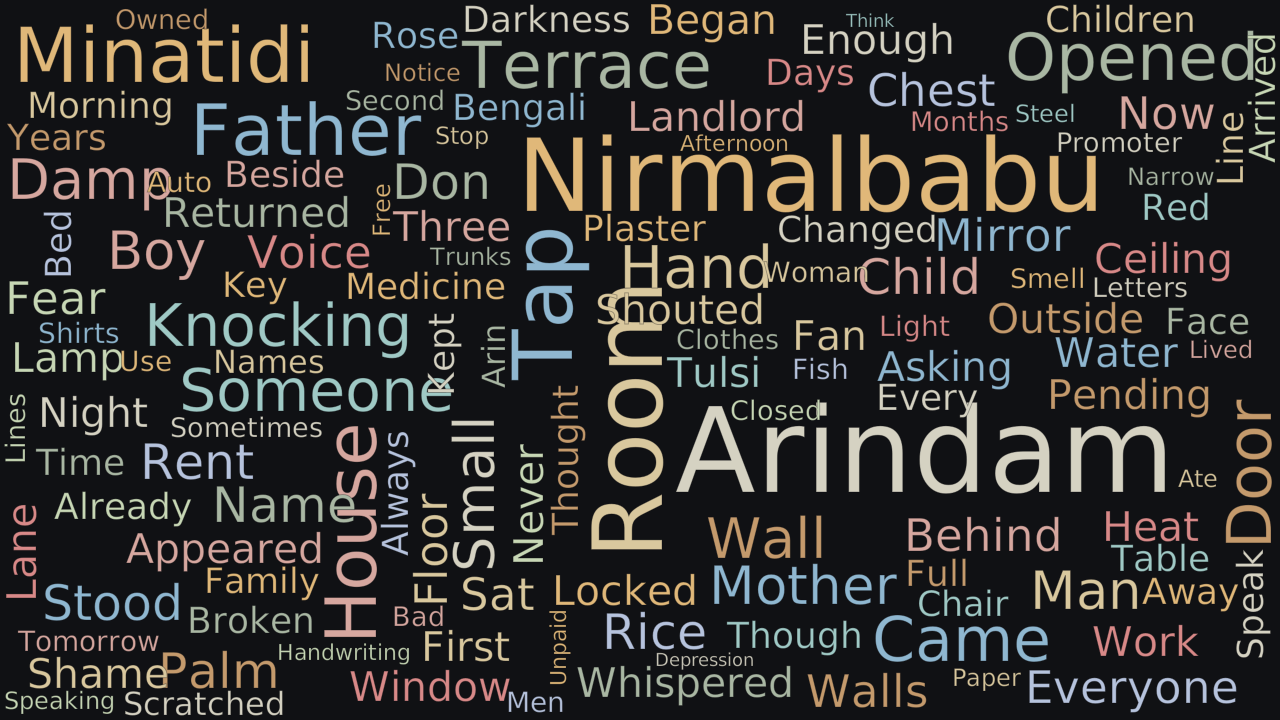
Word Cloud
Related reading
Selected by shared topics and section, with closer publication dates breaking ties.