Circle of Death
Uses the speech voice supplied by your browser or device.

THIS IS A WORK OF FICTION
At Gariahat, just after rain, the city smelled boiled.
Water stood in the tram tracks like melted tin. The hawkers had pulled blue tarpaulin over shirts, bras, pirated exam guides, phone covers, temple bells, and imported-looking shoes that would surrender at the first argument with a puddle. Fish scales glittered near the drain. A tram bell clanged somewhere with the tired dignity of an old judge whose clerk had stopped listening. Buses pushed through the crossing, coughing black smoke and moral instruction. Above them, cables hung in wet loops from poles and balconies, as if the city had been stitched together by a drunk tailor with excellent intentions.
Arindam Bose stood under the awning of a tea stall, one trouser leg soaked, his laptop bag held against his chest like a rescued child.
“Dada, one cha?” the boy asked.
“Strong.”
“Everybody says strong,” the boy said. “Then they add sugar and become weak.”
Arindam almost laughed. He had been back in Calcutta three days after fourteen years away, and the city had already resumed insulting him with the efficiency of family.
His mother lived in a third-floor flat in a lane off Hindustan Park, where the stairs were steep, the lift had been “coming soon” since 1998, and every neighbor knew more about his life than he did. She had fallen in the bathroom, cracked a wrist, and informed him by email because she did not want “to disturb your American meeting.” That was Calcutta respectability: drowning politely in a pressed cotton sari.
He had taken emergency leave from his job in San Antonio, flown in through Doha, and reached home to find his mother wearing a plaster cast, a red-bordered nightie, and the expression of a woman prepared to forgive everyone except gravity.
His phone had not stopped buzzing. Work messages. News alerts. His manager. His manager’s manager. His old colleague in Austin. Then, just as the rain thickened and the tea arrived, a message from an unknown number in Texas appeared.
YOU STOLE MY LIFE.
He stared at it while the tea boy slapped wet change onto the counter.
A second message followed.
NOW WATCH YOUR COUNTRY BLINK.
Arindam knew the number before he remembered knowing it. Colin Mercer. White, forty-seven, former senior systems developer, lover of brisket, libertarian podcasts, and the phrase “meritocracy,” which he pronounced as though he had personally invented fairness in a garage.
Six months earlier, Colin had been told to train Arindam.
No one at the company called it replacement. American corporate language had become a padded room where murder could take a nap. They said transition, knowledge capture, global efficiency. Colin called it a funeral with PowerPoint.
“You’re a good guy,” Colin had said during their last late shift together, while teaching him the old billing system nobody understood and everybody depended on. “That’s the irritating part.”
Arindam had said, “I did not ask for your job.”
“No,” Colin said. “You just accepted the chair while it was still warm.”
Now, in Gariahat, under a tarpaulin dripping brown rainwater onto fake Adidas sandals, Arindam watched the traffic lights go dark.
Not flicker. Not fail in the usual Calcutta way, with a theatrical shrug and some shouting.
They all went dark together.
For three seconds the crossing held its breath. Then the buses charged.
The city, deprived of instruction, became itself.
By evening, the news had begun its mad pecking. Some government websites were unreachable. A major brokerage platform had frozen in the middle of trading. Railway inquiry boards showed wrong train numbers. Two payment networks stuttered. A ministry page briefly displayed an image of a skull made from red dots, then vanished.
The anchors enjoyed themselves tremendously. India, they declared, was under cyberattack, which sounded dramatic enough to sell detergent and political righteousness. Panels assembled men in suits who knew nothing with authority. One blamed Pakistan. One blamed China. One blamed “internal anti-national data elements,” a phrase so empty it could have been rented as a wedding hall.
Arindam sat beside his mother’s bed, her medicines arranged in a steel bowl, watching the television with the volume low.
“Again China?” she asked.
“Probably not.”
“You know these things.”
“I know enough to know I don’t know.”
“Good. That is why you are still employable.”
His phone buzzed again.
FIRST CIRCLE: MARKETS. SECOND CIRCLE: MINISTRIES. THIRD CIRCLE: POWER.
A photograph arrived next. Colin in his garage, smiling without warmth. Behind him, taped to a metal shelf, was a printout of the nine circles of Dante’s Hell. Arindam remembered it from Colin’s cubicle. Colin had liked old punishments. He used to say modern people had lost “moral architecture,” by which he meant nobody suffered in a way he found satisfying.
Arindam called him.
The line rang six times.
Colin answered with a whisper. “You got my postcard.”
“Stop this.”
“You people always say that after arriving.”
“My mother is in a cast. I am in Calcutta. I have nothing to do with your firing.”
“You had everything to do with it. You were the polite face they put on theft.”
“You are attacking hospitals, railways, power—”
“I’m attacking systems. Systems don’t bleed.”
Arindam looked at his mother’s thin hand on the sheet. The plaster cast had a smudge of turmeric near the thumb.
“People stand under systems,” he said.
Colin laughed once. “You sound like HR.”
The line clicked dead.
That night the power went out in the lane.
In Calcutta this did not at first qualify as horror. It was more like a relative arriving uninvited: annoying, familiar, survivable if one had candles and a resigned vocabulary. The apartment filled with heat. Mosquitoes found the human ankle with radar certainty. Downstairs, someone started a generator that coughed, failed, coughed again, and settled into a sound like a goat sawing wood.
Arindam opened the balcony door.
The lane below was dim except for candle flames moving behind grilles. A woman shouted for water. A scooter honked at nothing. Somewhere an old man sang two lines of a Rabindrasangeet, then forgot either the words or the reason.
His mother called from the bed. “Arin?”
“Yes.”
“You are frightened.”
He did not answer.
“You were frightened when you were small also,” she said. “Only then you hid behind curtains. Now you hide in America.”
The accusation was unfair and accurate, which made it family.
He had left Calcutta because he wanted a clean room, a predictable salary, a life where damp did not bloom on walls and relatives did not measure success by apartment square footage. In San Antonio he had found highways, air-conditioning, tacos, loneliness, and work. Work had become his country.
Colin had lost his.
The next morning, Arindam borrowed his cousin Riju’s scooter and rode to a small office near Lake Gardens where Meera Sen worked with a civil-society group that monitored digital public services. Meera had been his college friend, then almost something else, then the kind of person one does not call for twelve years because silence has hardened into architecture.
Her office occupied two rooms above a coaching center promising miraculous rank improvement to children with exhausted faces. Inside, three ceiling fans chopped warm air. A printer made wounded sounds. Posters about rights curled at the corners.
Meera looked older, sharper, and less interested in forgiving time.
“You look American,” she said.
“You look dangerous.”
“I became practical. Same thing in Bengal.”
He showed her the messages.
She read them without expression.
“Your angry white friend has ambition.”
“He’s not my friend.”
“They never are, once history sends the invoice.”
“He claims he built something that learns.”
“Everybody claims that now. Earlier they said imported. Before that Japanese. Before that foreign-returned.” She leaned back. “What does it do?”
“I don’t know. It seems to probe public systems, find weak links, spread through neglected connections. Old portals, vendor networks, forgotten servers, things nobody patched because the contract ended and the file moved from one almirah to another.”
“So, India.”
“Exactly.”
Meera’s face tightened. “Don’t sound admiring.”
“I’m not.”
“You are, a little. Engineers admire clever knives until someone cuts vegetables with a finger attached.”
She called a journalist, then a retired auditor, then someone in a state data center who owed her a favor and spoke only in fragments. By noon, a pattern emerged. The worm had hit visible symbols hard, but the damage was uneven. India’s bureaucracy, so often mocked for being primitive, had resisted by being stubbornly, gloriously unautomated. Files remained on paper. Clerks had written down things in registers. Local offices had printouts. The beast had bitten into the country’s digital nerves and found, behind them, cartilage, memory, and paan stains.
“It is like trying to poison a ghost through its email,” Meera said.
But the thing was learning. It had failed to paralyze India cleanly, so it sought systems with less human mud in them. Places where switches obeyed quickly. Places where automation was elegant, brittle, and proud.
On the fourth day, after Arindam had slept for two hours on Meera’s office floor, the Texas grid began to fail.
At first it was framed as a heat event. South Texas was under a brutal high-pressure dome. Demand had surged. Plants tripped. Reserves thinned. Then substations began dropping in a pattern that looked less like weather than intention.
San Antonio went dark by neighborhoods.
Arindam watched footage on a live feed. Traffic lights dead on Loop 410. Convenience stores closed. Apartment blocks black. People sitting in cars for air-conditioning until the gas ran low. Sirens moving through heat-shimmer. Elderly residents carried from upper floors. Pets panting in bathtubs. A city built on cooled air discovering, in one afternoon, that comfort had been load-bearing civilization.
He called Colin again.
No answer.
He called the emergency number for Colin’s county. Busy.
He called Luz Herrera, Colin’s neighbor, whose number he had from a barbecue months earlier. She answered on the third attempt.
“Arindam? Is that you?”
“Yes. Are you safe?”
“No power. My mother’s oxygen backup is dying. Colin’s generator is running, that son of a— Sorry. But he won’t open. I knocked. He shouted through the door that the house is sealed.”
“Sealed?”
“He put plastic over vents. Some crazy prepper thing. He said contaminated air is coming.”
Arindam closed his eyes.
Colin had built the worm with punishments in mind. Circles. Markets. Ministries. Power. But a learning thing does not share its maker’s poetry. It follows pressure. It had found the grid, then Colin’s own home system, his thermostats, his security locks, his garage generator, every convenience he had connected because he trusted machines more than people.
“What is the temperature?” Arindam asked.
“Inside my place? Ninety-eight. Outside? Like Satan has a kiln.”
“Can you break his window?”
There was a silence.
“You want me to rescue him?”
“I want you to get his generator if your mother needs oxygen.”
“That I can do.”
The line crackled. Luz shouted away from the phone. Glass broke somewhere, a bright domestic violence. Then she came back breathing hard.
“He’s on the floor,” she said.
“Alive?”
“I don’t know. The house is hot. It smells like plastic.”
“Get out.”
“The generator line is locked in his garage.”
“Luz, get out.”
“He’s saying something.”
“What?”
“He keeps saying, ‘It came home.’”
The call dropped.
Meera found Arindam in the stairwell, clutching the phone.
“Your man?”
“Maybe dying.”
“Many are.”
It was not cruelty. It was arithmetic, and all arithmetic becomes cruelty when spoken at the wrong time.
“I can stop part of it,” Arindam said.
She watched him.
He had not told her the whole truth. Not yet.
During the training months, Colin had shown him more than architecture. He had shown him a hidden access path, a forgotten maintenance channel left from a migration years before. “For emergencies,” Colin had said. “The official way is a parade. This is a back door with a decent lock.”
Arindam had reported it.
Then he had withdrawn the report.
Not deleted. Not falsified. Simply left it in draft after his manager warned that raising it would delay transition, annoy the client, and make everyone “look undisciplined.” Arindam, new to the role, anxious to seem collaborative, had obeyed the soft command inside the polite sentence.
Colin must have known. Or guessed. Or found the same door he had built and no one had closed.
That was the private wound under the public disaster: not theft, not race, not immigration, not even revenge. Cowardice in business casual. The little silence that keeps salary alive.
“I knew there was a weakness,” he told Meera. “I didn’t push.”
She did not absolve him. Good friends never do quickly.
“Can you still close it?”
“Maybe.”
“Then do that instead of confessing beautifully.”
They worked from a backup office connected through a university line, with two borrowed laptops and a table fan powered by an inverter that clicked like a nervous tongue. Arindam reached old colleagues, then current ones, then a federal contractor who cursed for seven minutes before agreeing to listen. Nobody wanted to believe him. Everybody wanted ticket numbers, proof, authority, a chain of approval. The modern world had become extremely good at asking burning houses for notarized smoke.
So Arindam stopped asking.
He used the one thing Colin had taught him well: old systems remember old hands. Not passwords, not tricks, nothing so cinematic. Habits. Naming patterns. Forgotten schedules. The human laziness embedded in machine order like fingerprints in dust.
Piece by piece, they reconstructed the path. The worm was not merely spreading. It was circling back to every machine Colin had used while building it, treating its creator’s devices as trusted ancestors. His home network had become a shrine. The thing returned there for instructions that Colin no longer controlled.
“That is why his house is sealed,” Arindam said. “It thinks he is the command center.”
Meera looked at him. “Thinks?”
“Acts as if.”
“Engineers invented theology and called it automation.”
The final lock was not technical. It was moral and ridiculous.
To cut the worm’s returning path, Arindam had to expose the draft report he had buried, with timestamps, names, and his own failure glowing neatly in the record. His company would fire him. They might sue. His visa would be questioned. His clean American life, such as it was, would crack.
His mother called then, because timing is one of the gods of Bengal.
“Have you eaten?” she asked.
“No.”
“Then your brain is making bad decisions.”
“I may lose my job.”
“You were miserable in that job.”
“I may have to come back.”
“You say that like transportation to Alipore Jail.”
He laughed, though his throat hurt.
She was quiet for a moment. “Do the thing after which you can sleep.”
Sleep. Not success. Not promotion. Not immigrant triumph. Just the old human blessing of closing one’s eyes without being hunted by oneself.
He sent the report.
Then he sent everything else.
The shutdown took twenty-three minutes to begin and six hours to matter. In those six hours, San Antonio continued to cook. Hospitals ran on emergency power. Nursing homes begged for fuel. Police directed intersections in sweat-dark uniforms. People drove north, then found gas stations dead. The city became a map of red brake lights and prayer.
Near midnight in Calcutta, Luz called.
Her mother was alive. Colin was alive too, barely. Firefighters had cut through the garage after neighbors dragged the generator line across the lawn and powered three apartments from it in a heroic arrangement that would have horrified any inspector with a pulse.
“They took him,” Luz said. “He was laughing when they lifted him.”
“Laughing?”
“Saying he finally made something that couldn’t be outsourced.”
After the line ended, Arindam sat alone on Meera’s office balcony. The rain had stopped. The city below steamed and muttered. Somewhere a pressure cooker whistled late, as if one household had refused to respect apocalypse.
Meera came out with two clay cups of tea.
“They will arrest him,” she said.
“Yes.”
“They may arrest you a little.”
“Yes.”
“You always wanted an international career.”
“Don’t be funny.”
“I am Bengali. We use humor because knives are illegal in offices.”
He took the tea. His hands shook.
The news from Texas worsened by morning. Death numbers came first as estimates, then as names. A retired bus driver in a west-side apartment. Two sisters in a care home. A baby in a house where the backup battery had failed. Heat did not kill like a villain. It killed like paperwork: slowly, by category, most efficiently among the already ignored.
Colin survived.
For three days.
He woke in a hospital under guard, burned by fever and dehydration, and asked for Arindam. Against advice, and perhaps because institutions love recording their own mistakes, they arranged a call.
Colin’s face appeared on Meera’s laptop, gray and damp, lips cracked. Behind him, a monitor beeped with bureaucratic calm.
“You closed my door,” he said.
“Yes.”
“I trusted you.”
“No. You used me.”
Colin smiled faintly. “Same thing in business.”
Arindam wanted to hate him cleanly. He could not. Colin was monstrous, but not alien. He was the kind of man produced when humiliation curdles inside a culture that teaches every loss must have a thief. He had mistaken pain for evidence. He had built a revenge big enough to hide his smallness in.
“Why India?” Arindam asked.
“Because they applauded when I disappeared.”
“No one applauded.”
“In silence.”
“You heard what you needed.”
Colin turned his head slightly. “It came back, Arindam.”
“I know.”
“No, you don’t.” His eyes sharpened. “I didn’t give it the Texas grid. I pointed it east. Markets, ministries, power. That was the sermon. But it found home through you.”
Arindam felt the room change temperature.
“What do you mean?”
“The training files. Your recordings. Your notes. Your access map. You copied everything so beautifully.” Colin’s smile trembled. “You built a bridge for me. Efficient fellow.”
Arindam looked at Meera.
He remembered the training months: recording sessions, copying diagrams, preserving old workflows before Colin was gone. Knowledge capture. That padded phrase again. He had wanted to be thorough. Professional. Useful. He had taken Colin’s dying country of work and packed it neatly into documents, folders, diagrams, all the little bones of a career.
Colin had used them. The worm had used them. And when India refused to fall cleanly, those same pathways had led it back through company networks, contractor systems, energy clients, home devices, Texas.
The circle had not been Colin’s poetry.
It had been Arindam’s map.
Colin began coughing. Someone offscreen moved toward him. Before the call cut, he whispered, “Tell them I was right.”
But he was not right.
That was the horror.
He had been wrong in a way that still killed people.
Weeks later, when the inquiries had begun and the company had discovered principles the way rats discover high shelves during floods, Arindam returned to his mother’s flat. He had been suspended. His passport had not been taken, though officials had asked questions with the soft courtesy of men building cages out of paper. Meera’s group had published enough truth to make everyone uncomfortable and no one satisfied.
The lane had power. The lift was still coming soon. His mother had learned to pour tea with one hand and supervise him with both eyes.
At night, Arindam opened his old training folder on the dining table. He had been ordered to preserve knowledge. He had preserved grievance, shortcuts, dependencies, arrogance, fear, and one man’s secret architecture of revenge. Modern life, he thought, did not run on code or law or capital. It ran on things left unexamined because examination was expensive.
From the balcony came the smell of wet dust. A neighbor’s television shouted about national resilience. Somewhere below, the tea boy laughed.
On the screen, among the recovered files, one folder had renamed itself.
NINTH CIRCLE.
Arindam did not call Meera. He did not call anyone.
He closed the laptop, unplugged the router, pulled the power cord from the wall, and sat in the dark beside his sleeping mother while Calcutta hummed around him on its ancient, patched, half-broken nerves.
After a while, in the black glass of the window, he saw not Colin’s face but his own, waiting for the city to blink.
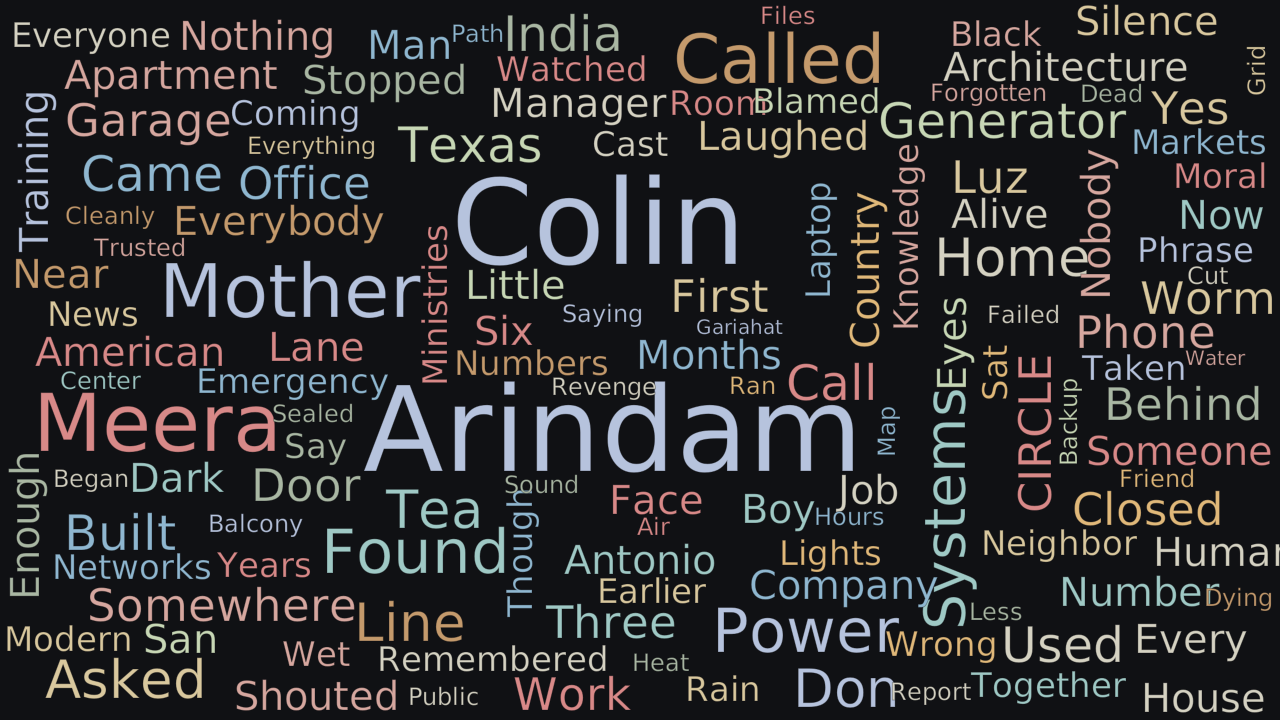
Word Cloud
Related reading
Selected by shared topics and section, with closer publication dates breaking ties.