The Ninth Tap
Uses the speech voice supplied by your browser or device.

THIS IS A WORK OF FICTION
In Delhi, water arrived like a minor government officer: late, important, offended by scrutiny.
Every morning at five, before the sky had peeled itself from black to a dirty pigeon gray, the colony came awake to the iron cough of taps. Buckets were dragged, plastic drums thudded, slippers slapped wet staircases, and respectable people in nightclothes became animals around a forest pool. Nobody called it panic. In middle-class India panic is what other people do; one’s own behavior is “adjustment.”
Anirban Chatterjee stood in the kitchen of Flat C-17, Sarojini Nagar Extension, holding a steel lota under the tap and listening to the pipes groan inside the walls. The first water came brown, then gray, then clear enough to deceive a magistrate. It smelled of damp rope and old coins.
He had grown up in North Calcutta, where the lanes near Belgachia held rainwater for days after the clouds had gone and old men discussed politics from balconies that looked ready to resign from architecture. There, water had its own personality. It sulked in municipal pipes, leapt from hand pumps, collected in mossy courtyards, and carried, on bad mornings, the perfume of drains, fish scales, temple flowers, and human compromise. Delhi water was supposed to be sterner, chlorinated, administrative. You did not expect poetry from it. You expected it not to kill you.
Behind him, his daughter Tara said, “Don’t fill Ma’s bottle from that.”
Anirban turned. Tara stood barefoot at the kitchen door, hair loose, exam notes clutched under one arm, face pale from too little sleep and too much coaching-center ambition. Seventeen, clever, sharp enough to cut rope, and preparing for medical entrance as if the future were a fortified city and she had one rusted spoon with which to dig under the wall.
“Your mother’s not here,” he said.
Tara’s mouth tightened. “I meant the blue bottle.”
He looked at the blue bottle on the counter. It had belonged to Mitali, who had died two years earlier of fever and dehydration in a private hospital that billed like a jeweler and explained like a thief. Even now, they kept her bottle by the sink. No one had decided to do it. It simply remained, acquiring sanctity by inconvenience.
Anirban shut the tap.
From outside came the morning chorus: pressure-cooker whistles, temple bells, a scooter refusing to start, the phlegmy auctioneer’s cry of the vegetable seller, and Mrs. Khanna from B-12 shouting, “Again smell is coming! Again! What are they supplying us, Yamuna chutney?”
Someone laughed. Someone else said, “Madam, boil and drink. Why making drama?”
Drama, Anirban had learned, was the word used when suffering had not yet reached the speaker’s own house.
For three months the colony had complained. First politely, then in typed letters, then in WhatsApp forwards printed out for the elderly, then in a residents’ march to the local office of the water board, where a junior engineer named B. P. Yadav had received them beneath a portrait of a national leader and a ceiling fan distributing despair.
“Samples are within permissible limits,” Yadav had said.
“Permissible to whom?” Anirban had asked.
“To standards.”
“Do standards drink this?”
Yadav had stared at him with the tired suspicion of a man who knows that truth, once allowed indoors, will sit down and ask for tea.
The smell worsened in May. A sweetness came into it, especially from the tap in the bathroom, a festive rot, like overripe guava fallen into a drain. Children developed stomach cramps. The old men at the park stopped walking. A rumor spread that sewage had entered the potable line near Ring Road after roadwork for a luxury tower whose name, The Imperial Verdure, sounded like something invented by a committee allergic to both empire and greenery.
At first, the colony performed outrage with great stamina. There were calls to television channels, videos of muddy water in glass tumblers, hashtags, accusations, counter-accusations, one retired colonel who promised public-interest litigation and then vanished to his son’s house in Gurugram where, according to gossip, water came from a private tanker and morality from bottled mineral water.
Then cholera arrived.
It began in the jhuggi cluster behind the flyover, because catastrophes in India have impeccable manners and visit the poor first. Children folded over their own bellies. Women carried plastic bags of stool samples to clinics. Men stood outside pharmacies asking for ORS sachets as if buying contraband hope. Within a week, hospitals overflowed. Within two, the city had become a map of vomiting, grief, barricades, and official reassurance.
The news anchors called it “a public health situation.” By the time the word epidemic was allowed out, wearing a helmet and escorted by statistics, the dead had already filled the municipal crematoria, private crematoria, improvised pyres, cold rooms, freezer vans, lists, whispers, and the mouths of people saying, “Did you hear?”
Tara stopped going to coaching class. Anirban boiled water, cooled water, filtered water, chlorinated water, and distrusted water with the full attention of a man who had once failed to save someone from a body’s simple arithmetic: not enough fluid in, too much fluid out.
Mitali’s last night returned to him in pieces. Her lips white. Her fingers tugging weakly at the hospital sheet. The junior doctor saying, “We are trying.” The nurse asking for a signature before moving her to ICU. Anirban fumbling with a pen. Mitali whispering something he had never told Tara.
Not “Take care of her.”
Not “I love you.”
She had whispered, “Don’t drink from the ninth tap.”
At the time he thought fever had scrambled her. There was no ninth tap in their flat. Kitchen, bathroom basin, shower, toilet jet, balcony wash point. Five. Six if one counted the old capped pipe behind the washing machine. He had almost smiled, even then, because grief makes lunatics of the living before it takes the dead.
But three weeks into the cholera, Anirban found the ninth tap.
It was in the basement.
C-Block’s basement was less a basement than a damp confession beneath the building. Old paint tins, cracked flowerpots, retired suitcases, electrical boxes, a broken exercise cycle, and the colony’s collective belief that anything unseen had become someone else’s problem. Anirban went down after noticing a line of wet footprints on the stairs though no one had come up. The power had gone. His torch cut a cone through warm darkness.
He heard water.
Not dripping. Running.
Behind the old noticeboard, below a tangle of cable and cobweb, was a narrow service alcove he had never properly examined. Inside it, green with corrosion and crusted with lime, protruded a brass tap fixed into the wall. It was small, old, and shaped differently from the others, with a round handle like a flower.
Water streamed from it into an open drain in the floor.
The smell was unbearable. Not sewage exactly. Sewage is vulgar and honest. This was sewage after education, sewage that had learned manners, dressed for a wedding, and come smiling with sweets.
Anirban covered his nose.
“Who opened you?” he whispered.
Behind him, a voice said, “You also heard it?”
He spun.
Naseem stood at the foot of the stairs with a plastic toolbox in one hand and a mask pulled below his chin. He was the colony plumber, electrician, lift-rescuer, leak-explainer, and unofficial carrier of every secret that passed through pipes. Thirty or so, thin, with an anxious moustache and the permanent look of a man who was paid late by people who considered politeness a substitute for money.
“You frightened me,” Anirban said.
“You frightened yourself, dada. I only came.”
“What is this tap?”
Naseem looked past him at the running water. “Old connection. From before renovation. Should be sealed.”
“Then seal it.”
“I did.”
“When?”
“Twice.”
The water slapped steadily into the drain.
Anirban’s torch shook. “Who opened it?”
Naseem did not answer.
From overhead came the muffled life of the building: pressure pumps, footsteps, a chair dragged, someone coughing. Below, in the alcove, the ninth tap ran with a cheerful, intimate malice.
“Naseem,” Anirban said.
The plumber rubbed his forehead with the back of his wrist. “Please don’t make complaint against me.”
“I am asking what you know.”
“I know nothing.”
“Then why are you afraid?”
That irritated him. Fear, when named, becomes insult. “Because everybody is afraid! But only poor people must explain properly. Rich people say ‘system failure’ and go to farmhouse.”
“We are not rich.”
Naseem gave him one look, not cruelly. Simply accurate. Anirban, with his pension from a public-sector bank, his government colony flat allotted through his late wife’s department, his daughter’s coaching fees paid by selling Mitali’s bangles, was not rich. But poverty has levels like an old building, and everyone knows which landing they are standing on.
Naseem said quietly, “There are pipes under this colony not in map.”
“What pipes?”
“Old lines. From hospital that used to be here before housing. Isolation ward, they said. British time first, then government. Cholera ward, maybe. My father worked nearby. He told stories.”
Anirban almost snapped at him. Superstition was what came in when accountability fled. It was also, he knew, sometimes the only archive available to people denied paper.
“Stories don’t contaminate water,” he said.
“People do.”
“Who?”
Naseem swallowed. “Yadav sahib knew. Contractor knew. They laid new line through broken drain. Residents complained. File went up. File came down. Sample taken from safe point only. You understand.”
Yes. Anirban understood. The clean sample, the dirty city, the honest lie in a labeled bottle.
“Then tell the media.”
Naseem smiled without happiness. “With what protection? You will stand with me when police ask why I damaged public trust? When contractor’s boys come? When madam-sirs say plumber is spreading rumor? Dada, I have two children and one mother with sugar disease. Courage is expensive.”
The tap gurgled.
Anirban stepped closer. In the torchlight, something pale moved inside the stream. He thought it was a worm. Then it flattened, widened, became a ribbon of whitish mucus, and slid down into the drain. For a moment the drain water stirred upward against gravity.
Both men stepped back.
Naseem whispered a prayer.
“Cholera is bacteria,” Anirban said, because facts were furniture and he needed something to hold. “Not ghosts.”
“Then bacteria has learned our address.”
They sealed the tap with wrench and cloth and wire. Naseem tightened it until the metal shrieked. The running stopped. The silence after it felt accusatory.
That night Tara developed fever.
It was small at first. 99.8. Then cramps. Then vomiting. Anirban mixed ORS with boiled water, measuring like a priest. She drank, grimaced, vomited again. Outside, an ambulance wailed along Africa Avenue, then another, then silence, which was worse.
“I’m fine,” Tara said.
“Liars become doctors,” he said.
She managed a smile. “Then I’ll top.”
By midnight she was weak enough that he phoned every hospital number he had. Beds full. Corridors full. Come only if severe dehydration. Define severe. Sir, no need to shout. I am not shouting. Sir, everyone is shouting.
At two in the morning, as Tara slept in fits, Anirban heard the kitchen tap turn on.
He went cold.
The kitchen was dark. Water poured into the sink from a tap he knew he had closed. It ran clear. It smelled of Mitali’s hair oil.
He turned it off.
From the bathroom came water.
He turned that off too.
Then the balcony tap.
Then the wash point behind the machine, which had not worked in years.
One by one the taps opened, not violently, not like a film, but with the casual persistence of someone entering rooms they owned.
When he reached the hallway, he saw wet footprints leading from Tara’s bedroom to the front door.
Small feet.
A woman’s feet.
He followed them.
The door was bolted. The footprints ended there. On the floor lay Mitali’s blue bottle, full to the brim, though he had left it empty.
Inside the bottle, suspended in water, was a curl of black hair.
He did not scream. Screaming belonged to a healthier nervous system.
He took the bottle to the sink and held it over the drain. Then he stopped.
Don’t drink from the ninth tap.
Not “Don’t open.” Not “Don’t touch.”
Drink.
In the morning, Tara’s fever broke. By afternoon, she sat up and demanded muri with mustard oil, which he refused on grounds of civilization. Outside, the colony shouted at tankers. Two men fought over a hose. Mrs. Khanna accused the managing committee of hoarding packaged water. The managing committee accused residents of panic. Panic, promoted, became civic concern.
At dusk, Naseem came to the flat. His eyes were red.
“My son,” he said.
Anirban brought him inside.
The boy was nine. Diarrhea since morning. No bed. No doctor except a clinic compounder who had fled after people slapped him for running out of saline. Naseem spoke quickly, shame and fear tripping over each other.
“You have contacts. Hospital people. Please.”
Anirban had no contacts worth the name. He had numbers. In India, a number is often mistaken for power until dialed.
He made calls. He argued. He begged. He mentioned old colleagues, dead bosses, committees that no longer existed. At last a small nursing home near Lajpat Nagar agreed to “see” the child if they came immediately and paid cash.
Naseem gripped his hand. “God will—”
“Don’t bring God. Bring your son.”
When Naseem left, Tara watched from the sofa. “Will the boy be okay?”
“I don’t know.”
“You never say comforting lies.”
“Your mother did. That was her department.”
Tara looked toward the blue bottle. “Last night, when I was sleeping, I saw Ma.”
Anirban sat down slowly.
“She was standing by the door,” Tara said. “Wet sari. Very angry. Not at me.”
“What did she say?”
“Nothing. She pointed down.”
“To the basement?”
“I think so.”
He should have told her fever dreams were common. He should have protected her from the old machinery of grief restarting in the house. Instead he asked, “Did you see her feet?”
Tara stared. “How did you know?”
The city worsened.
The numbers became monstrous, then political, then disputed, which is the usual route by which the dead are made to behave. Millions sick, said one report. Exaggeration, said another. Unverified, said a ministry note. Isolated clusters, said a spokesperson whose lips moved with the smooth caution of a man drinking imported water off camera. Bodies were counted, recounted, renamed, misplaced. A hundred thousand deaths became a rumor, then an accusation, then an anti-national exaggeration, then, later, when it no longer mattered, a conservative estimate.
The colony received tanker water under police supervision. People arrived with drums, bottles, cooking vessels, paint buckets, anything that could hold liquid and status. A woman in gold bangles tried to push ahead of a domestic worker and was slapped by another woman in better gold bangles. For one glorious second, class war came dressed for kitty party.
That evening Anirban went to the basement alone.
The ninth tap was sealed. Dry.
Beside it, on the wall, something had appeared in dark damp patches. At first he thought it was fungus. Then his torch made sense of it.
Letters.
Not English. Not Hindi.
Bengali.
জল ধার নেয়, জল ফেরত নেয়।
Water borrows. Water takes back.
He touched the wall. It was cold.
A sound came from the drain.
A child coughing.
Then another cough, lower, older.
Then many.
Anirban dropped the torch. It rolled, lighting the alcove from below. The sealed tap trembled. A bead of water formed at its mouth, swollen and black.
He backed away and struck someone.
Yadav, the junior engineer, stood behind him in a white shirt gone transparent with sweat.
“You,” Anirban said.
Yadav raised both hands. “Listen. Please listen.”
“How did you get in?”
“Gate guard knows me.”
“You knew.”
Yadav’s face folded. Without the desk, the portrait, the ceiling fan, he looked young and exhausted, a clerk promoted into catastrophe by cowardice.
“I sent file,” he said. “Three times. Marked urgent. They said don’t create panic. Contractor said line will be corrected after monsoon. Samples were…” He swallowed. “Samples were arranged.”
“Arranged.”
“Sir, I have parents. Daughter. Loan. They said sign. Everyone signed.”
“Now everyone is dying.”
Yadav nodded as if accepting a bill.
From the tap came a thin metallic click.
Yadav flinched. “You saw writing?”
Anirban said nothing.
“My grandmother told,” Yadav whispered. “In old cholera hospitals, they made separate drains. Lime pits. Bodies washed. Water carried everything. Then city built over it. But ground remembers. This is nonsense, I know. I am engineer. I know.”
“Do you?”
Yadav began to cry, which angered Anirban more than denial would have. Tears arrived too late, after papers, after signatures, after children on saline drips.
“My daughter drank,” Yadav said. “She is in ICU.”
There it was. The promotion of tragedy from file to family.
The ninth tap opened.
Not by degrees. Not with a hand. It opened fully, and water burst out, black and shining. It struck the drain and splashed their trousers. The smell filled the alcove, the basement, the lungs.
In the water Anirban saw faces.
Not floating. Not reflected. Implied.
Mitali’s face among them.
Not peaceful. Not accusing. Working.
Her mouth moved.
This time he understood.
The ninth tap was not the source.
It was the return.
He grabbed Yadav and dragged him back as the drain overflowed. Water spread across the basement floor, carrying flower petals, hair, paper labels, a child’s red thread bracelet, bits of lime, a hospital wristband yellowed with age.
“Where does this connect?” Anirban shouted.
Yadav pointed, sobbing, toward the wall behind the noticeboard. “Main valve chamber. Old bypass. If closed, colony line stops. But pressure will reverse to trunk line.”
“To the city?”
He nodded.
Anirban saw it then, not as a diagram but as a moral machine. The colony had complained because its own water stank. The officials had lied because the poor first sickened out of sight. The contractor had saved money because buried pipes do not appear at inauguration ceremonies. Everyone had borrowed from the unseen: from drains, from laborers, from old hospitals, from the dead, from future children. Now the water had come to collect.
“What if we open it?” Anirban asked.
Yadav stared.
“The bypass.”
“It will flood here.”
“And?”
“Maybe pressure drops. Contaminated feed stops to some zones.” Yadav wiped his nose with his sleeve, suddenly engineer again, cowardice briefly stunned by usefulness. “Maybe. Or maybe nothing. We need tools.”
Anirban thought of Tara upstairs, sleeping under a damp towel. He thought of Naseem’s son, small and thirsty in some corridor. He thought of Mitali’s blue bottle filling itself in the dark.
“We have tools,” he said.
Naseem arrived twenty minutes later with his toolbox and a face emptied by fear. His son had been admitted. Alive. For now.
When he saw the flooded basement, he said, “Oh good. Indoor swimming pool.”
No one laughed. Yet the joke helped. It proved the world had not fully become a funeral.
They broke the noticeboard. Behind it, under plaster and brick, was an iron wheel valve nearly as large as a cartwheel, painted over, rusted, half buried in wall. Yadav found the line with his hands, muttering measurements. Naseem hammered. Anirban held the torch. The water rose to their ankles, then calves. It was cold, impossibly cold.
At the first turn of the wheel, the building groaned.
Lights flickered above.
At the second, something screamed in the pipes. Not metaphorically. A sound came through the walls, high and human and furious, traveling upward floor by floor, so that residents began shouting, doors opened, children cried, and somewhere Mrs. Khanna yelled, “Earthquake!”
At the third turn, the wheel spun free.
Water erupted from the wall.
It hit Yadav first, knocking him sideways. Naseem grabbed him. Anirban grabbed both. The basement filled with black water and faces and the smell of every unadmitted death in the city. In the torrent, Anirban saw Mitali clearly.
She stood in her old cotton sari, hair wet against her cheek, one hand raised.
Not warning.
Counting.
One. Two. Three.
He understood too late that she was not saving them from the water.
She was deciding whom the water could spare.
The flood stopped at dawn.
By then the colony had been evacuated to the park. Tankers arrived. Police came. Cameras came. Officials came with expressions manufactured overnight. The main contamination feed had “unexpectedly depressurized,” preventing further spread in several zones. That was how the bulletin put it. Unexpectedly. A beautiful word. In India, even miracles are asked not to embarrass administration.
Yadav was found against the basement wall, alive but senseless, muttering valve numbers.
Naseem survived with a broken wrist.
Anirban was discovered sitting on the staircase, soaked, holding Mitali’s blue bottle. Tara ran to him and struck his chest with both fists until he answered.
For two days he slept.
On the third, news came that Naseem’s son would live. Yadav’s daughter too. The city, being expert at survival and poor at memory, began the slow business of converting horror into inconvenience, inconvenience into debate, debate into fatigue.
Only the taps in C-17 remained dry.
Plumbers came. Engineers came. Even a senior official came, wearing perfume over fear. They checked the line, pressure, meter, storage tank. Nothing. Every other flat had water. Only Anirban’s did not.
“Airlock,” someone said.
“Sentiment,” said Mrs. Khanna, who had promoted herself to philosopher.
That evening Tara found her father in the kitchen, standing before the sink.
The tap was open.
Nothing came.
“Baba,” she said softly, “leave it.”
He nodded.
Then, from inside the wall, came a small sound.
Not water.
A woman clearing her throat impatiently, as Mitali used to do when he was being especially dense.
A single drop fell from the dry tap into the steel sink.
Clear.
Perfect.
Anirban stared at it. Tara came beside him. In the drop’s curved surface, father and daughter appeared upside down, tiny and trembling. Behind them stood a wet woman in a cotton sari, not reflected exactly, but included, as if the water had made room.
Tara reached for the tap.
Anirban caught her hand.
On the brass mouth, where no writing had been before, nine small marks had appeared. Like tally marks. Or fingers.
The drop slid toward the drain.
This time it smelled faintly of Calcutta rain.
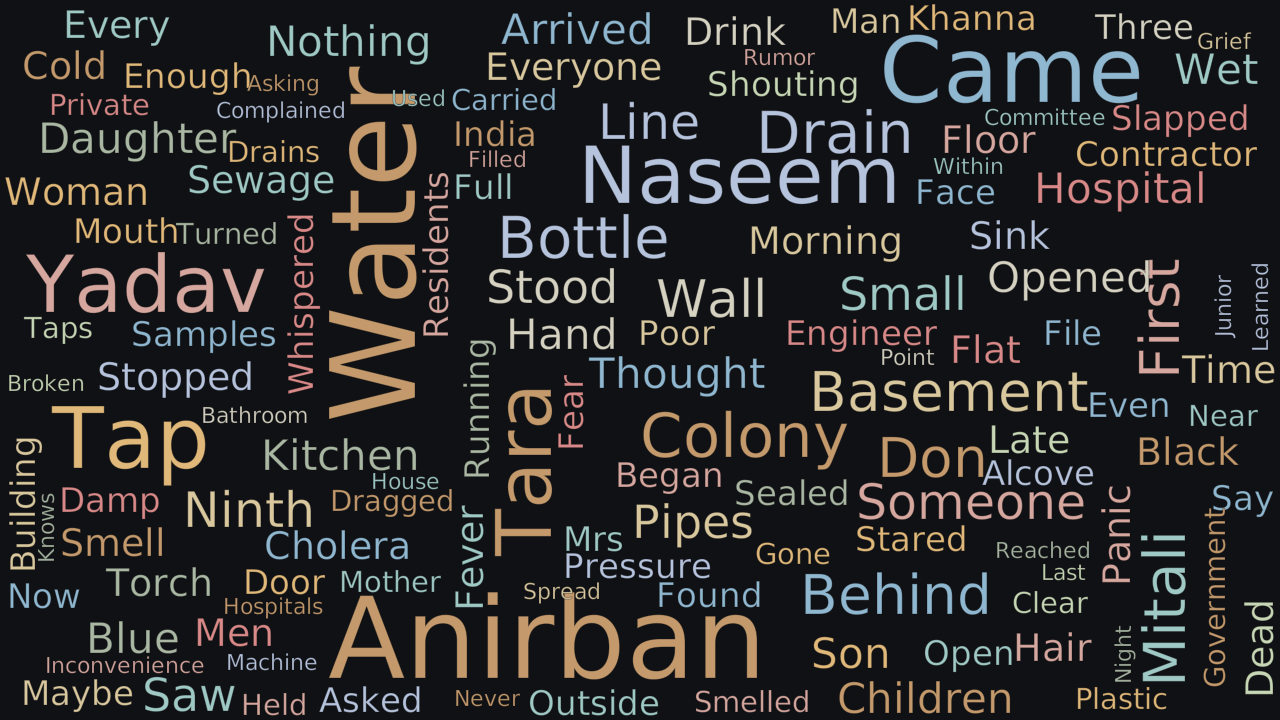
Word Cloud
Related reading
Selected by shared topics and section, with closer publication dates breaking ties.