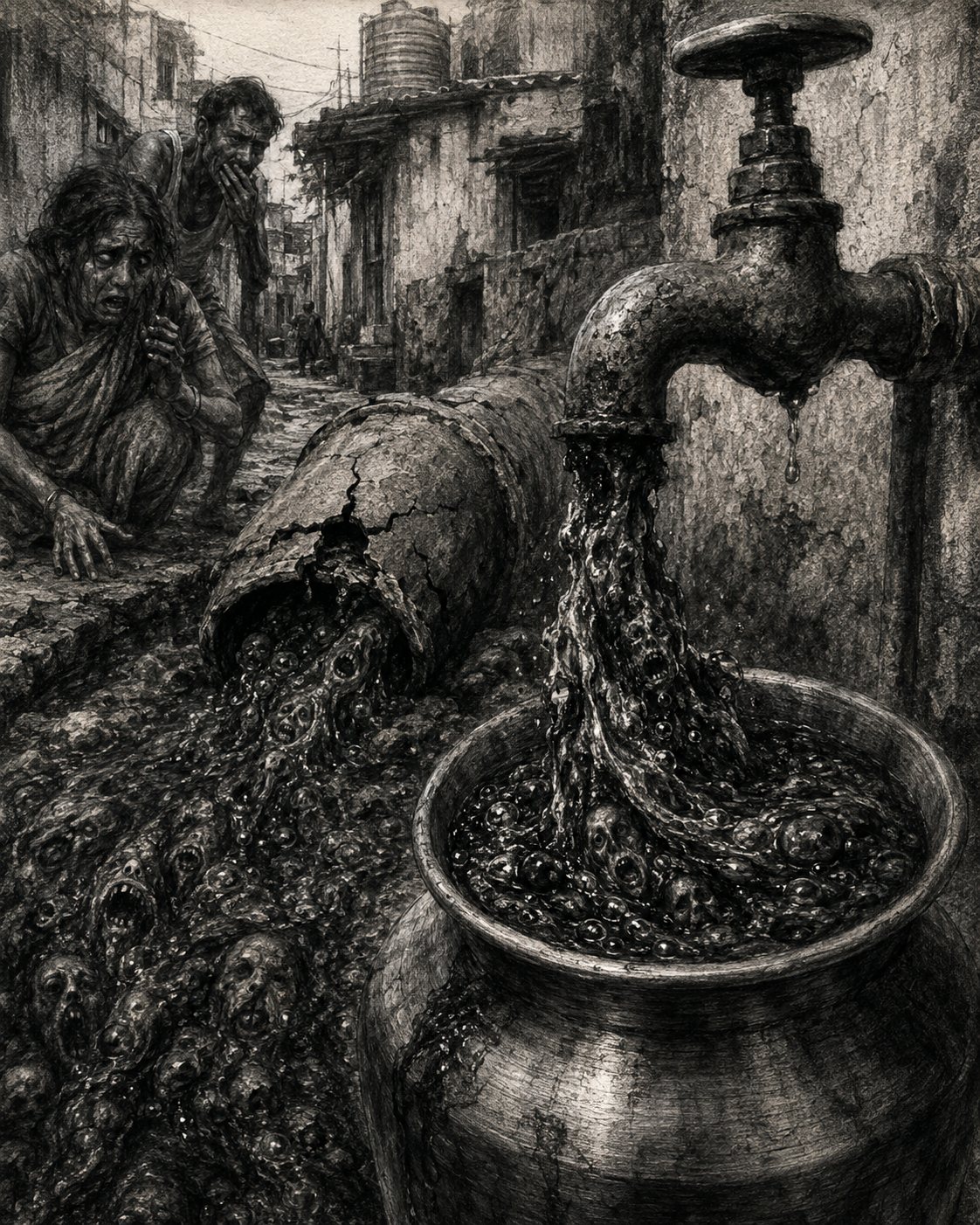
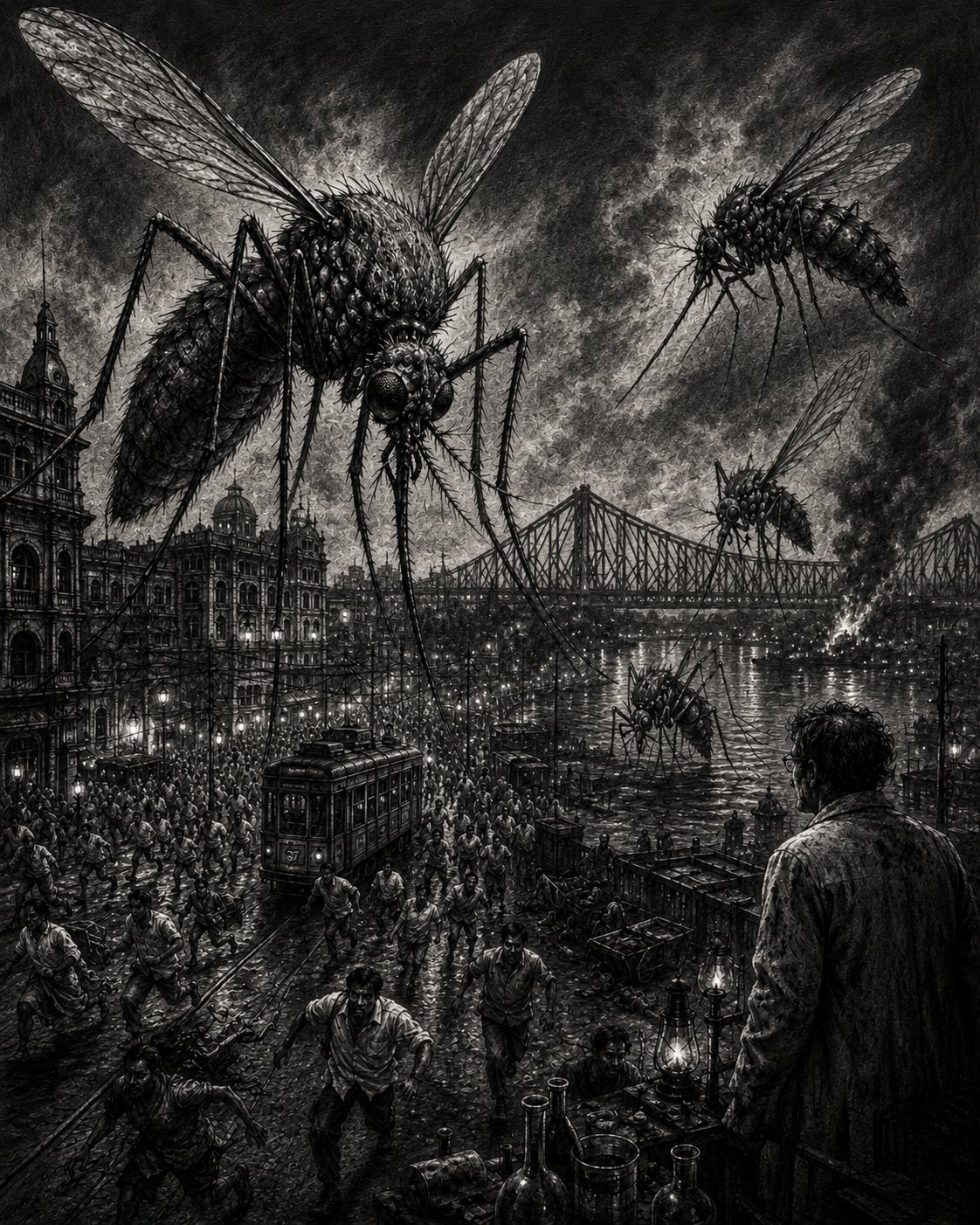
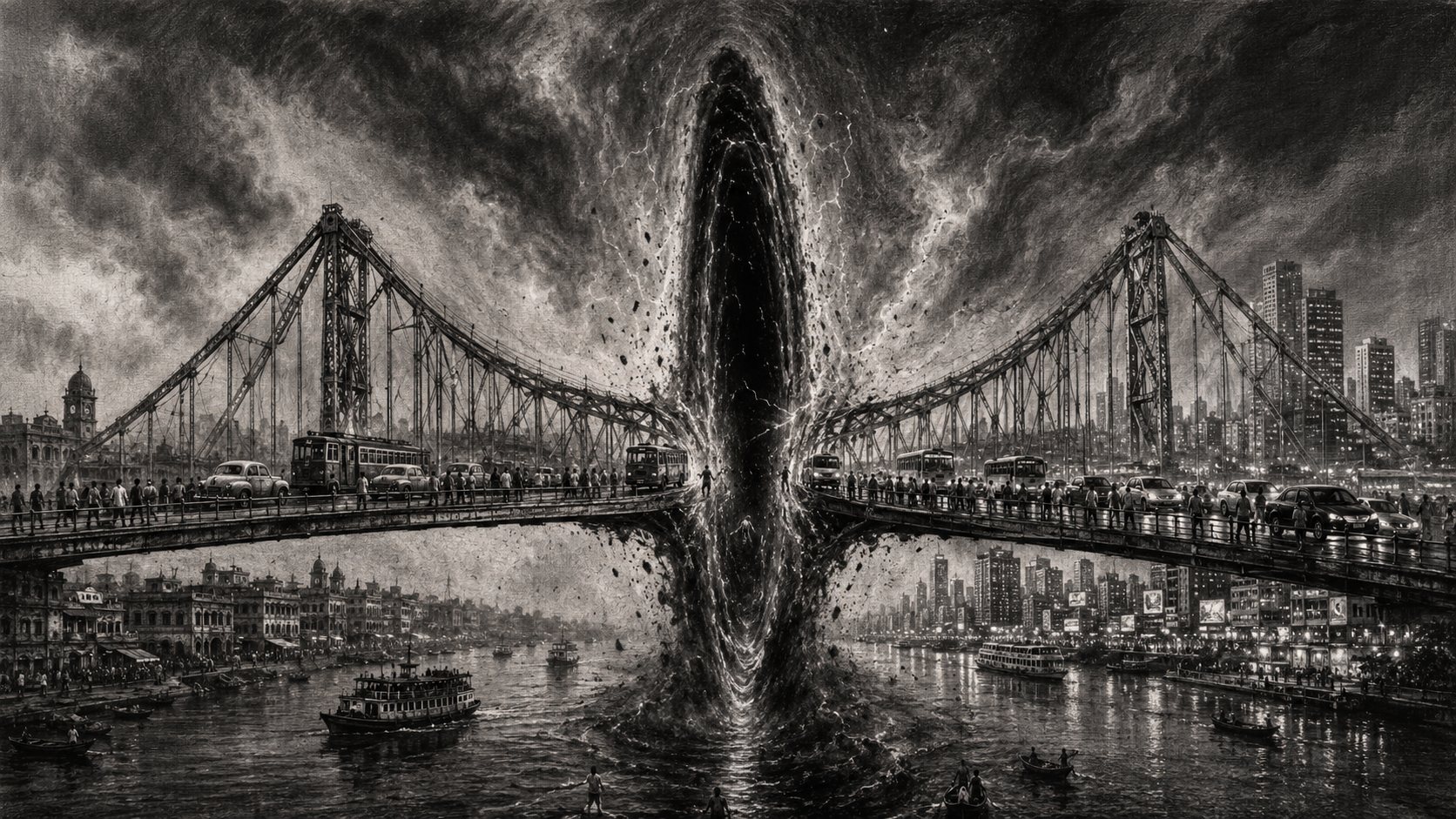
The Seasonal Crop
Uses the speech voice supplied by your browser or device.

THIS IS A WORK OF FICTION
The first mosquito that came through the window asked Professor Anirban Chakraborty whether he had been watered.
It did not ask in words.
Words would have been comforting. Words belonged to tea stalls, marriage negotiations, power bills, blood pressure medicine, retired men arguing with newspapers, and the daily national sport of saying “system” with grave disgust. This thing asked with its legs.
It landed on the back of his wrist at 2:17 in the morning, under the trembling blue light of the homemade apparatus he had suspended above the pond behind his Beliaghata house. Its six legs tapped his skin in a pattern.
Tap tap. Pause. Tap tap tap. Pause. Tap.
The old professor froze.
He had spent forty-one years explaining to students that the universe was under no obligation to make itself comfortable for human brains. This was, in his view, the only sentence in physics worth embroidering on a pillow. Still, when a mosquito the size of a betel nut tapped a question into his wrist, he felt personally insulted.
The pond below him gave off the smell of rot and green water. Frogs had gone quiet. The night air was thick enough to chew. Somewhere beyond the boundary wall, a late motorcycle coughed along the lane, then vanished into the dark like a guilty thought.
Anirban wanted only one thing.
Sleep.
Not glory. Not a Nobel Prize arriving thirty years late with a polite apology. Not vindication before the department boys who had called his last paper “creative but not useful,” which in academic language meant “mad but printable if your uncle knows someone.”
He wanted six hours of sleep without mosquitoes drilling into his ankles.
That had been the beginning of the whole disgrace.
At seventy-two, sleep had become a shy animal. It came near him, sniffed his hand, then bolted at the first ceiling fan click, bladder signal, barking dog, electricity cut, distant puja drum, memory of his dead wife, or the high theatrical whine of mosquitoes conducting their midnight blood symposium around his ear.
So he had built the window.
Not to defeat mosquitoes. That would have been vulgar engineering. He had built it to prove something elegant and private: that the pond, because of its layered surface, decaying organics, mineral film, bacterial mats, and perfect everyday ugliness, could hold coherence for a fraction longer than laboratory systems ever allowed. A shabby pond, if correctly persuaded, might behave like a mirror with depth. Not reflecting this world, but admitting the pressure of nearby ones.
“Adjacent histories,” he had written in his notebook.
Then, in smaller letters, because honesty sometimes arrived like a clerk with a stamp:
Maybe I only want to see where Mira did not die.
The apparatus was not impressive in daylight. Three steel hoops. Two salvaged induction coils. A cracked oscilloscope. Copper wire wrapped around bamboo poles. A refrigerator compressor. A laser pointer bought from a boy near Sealdah who said it was “imported German,” though the label said “Happy Power Cat.” At night, however, when the coils began to hum and the pond surface tightened into a shining black membrane, the machine had presence.
It looked less like science than a municipal ghost had opened a shop.
Anirban watched from the veranda with a torch, a notebook, and one cup of tea gone cold. On the pond, a circle of air stood upright.
That was the window.
It rose from the water like a transparent coin. Inside it was not a reflection of his backyard. It showed another pond, another night, another Calcutta breathing against the glass of possibility.
At first the differences were small. His neighbor’s wall was not painted blue there, but a dull clay red. The coconut tree leaned the wrong way. The distant skyline had no apartment towers, only high, ribbed shapes like termite mounds made by architects who hated straight lines.
Then something moved across the other sky.
Anirban leaned forward.
A dragonfly passed above the pond on the far side, large as a bicycle, its four wings beating with the dry clatter of playing cards in a fan. Beneath it hung a human body in a net.
He did not scream. That came later, in installments.
The mosquito on his wrist tapped again.
Tap tap. Pause. Tap tap tap. Pause. Tap.
Anirban, being a physicist and therefore unable to leave even terror unmeasured, whispered, “Base five?”
The mosquito’s abdomen pulsed. It inserted its proboscis into him.
Pain ran up his arm like boiling thread.
He slapped it.
His palm struck his own wrist with a flat, elderly sound. The mosquito lifted away untouched, offended perhaps, or amused. A bright bead of blood rose from his skin. Not red. Too pale. Pinkish, diluted.
On the far side of the window, something enormous noticed.
It was standing at the edge of the other pond. At first he mistook it for a tree because it had the patience of a tree. Then it unfolded.
A praying mantis, twelve feet tall, green-black and jointed, with a triangular head that turned too smoothly. Its eyes held the window. Its forelegs were folded as if in prayer, but Anirban had lived long enough to know that folded hands often meant appetite wearing manners.
Behind it, the other Calcutta began to wake.
Not with horns and buses and men clearing their throats into the gutter.
With wings.
The sound rose from the far side like dry rain. Wings in millions. Wing against wing. A city rubbing its knives together.
Anirban stepped back and hit the wooden chair. It fell, loud enough to bring his neighbor’s dog into furious commentary.
The mantis did not startle. It leaned closer.
On its chest, grown or tied or grafted there, hung a small board. The board had marks burned into it. Not Bengali. Not any script he knew. But beneath the marks was a drawing so simple a child could understand it.
A soft human shape.
A cloud.
A drop of water.
A calendar moon.
Then a row of small white ovals.
Eggs.
Anirban’s mouth went dry.
The mosquito returned, this time to his cheek.
Tap tap. Pause.
“Crop,” he said, though nobody had taught him the word.
The pond membrane trembled.
Something thin pushed through.
It was not the mantis. It was not a monster’s claw. It was a piece of paper, or what served as paper there. Pale, fibrous, damp. It slipped from the window and floated down onto his veranda tiles.
Anirban did not pick it up.
He was a brave man in theoretical matters. In practical matters, he had once avoided opening a bank envelope for nine days because he could feel bad news through the glue.
The paper lay there, wet and breathing slightly.
His house smelled suddenly of raw cucumber and old blood.
The mosquito settled on the paper. Its legs arranged themselves. It waited.
“Fine,” Anirban said.
He fetched his tongs from the kitchen, the ones Mira had used for frying papad. The sight of them hurt him, as ordinary objects do when they survive their owners and continue being useful without shame.
He lifted the paper.
It was not paper. It was skin.
Human skin, cured thin.
On it were rows of marks. Dots and slashes. Repeating groups. Mathematics, maybe. Or an invoice.
At the bottom was another drawing. A pond. A ring. A man standing beside it. From the ring came arrows. Toward the man.
Under the man were three symbols, repeated.
Water.
Salt.
Keep warm.
Anirban laughed once.
It was not a good laugh. It sounded like a drawer breaking.
“You have mistaken me,” he told the mosquito. “I am not agriculture.”
The mosquito cleaned its front legs.
The window brightened.
Across the pond, the mantis raised one foreleg. Not threatening. Demonstrating.
Two smaller insects dragged a human into view.
He was naked, brown, hairless except for a strip on his head. His limbs were plump and pale in places where the sun had not touched him. His face was covered by a net, but his mouth moved under it. He looked neither hunted nor surprised. He looked like a clerk being transferred.
The insects positioned him under a hanging frame. A beetle the size of a goat climbed onto his chest and pressed its abdomen against his belly.
Anirban understood too late that he was being shown a procedure.
The man on the far side began to shake.
White eggs slid from the beetle and stuck to his skin in neat rows.
Anirban dropped the skin sheet.
He ran to the switchboard and killed the current.
The coils died. The blue light vanished. The window folded into the pond with a soft gulp.
Darkness returned.
The ordinary Calcutta night rushed in, delighted to be normal again. A taxi honked somewhere. A television laughed through a wall. The neighbor’s dog, satisfied it had defeated metaphysics, stopped barking.
Anirban stood with his hand on the switch, breathing hard.
Then something tapped his wrist from inside the dark.
Tap tap.
By morning the bite had become a raised pearl.
He sat at the kitchen table under the fan, watching it swell. The fan chopped the heat but did not reduce it. On the wall, the calendar showed a smiling god with four arms and excellent dental alignment. Below it, Mira had once written the number of the gas cylinder man in blue ink. The ink had faded, but not enough.
Anirban had not told anyone about the window.
A discovery is a baby at first. You do not take it to the bazaar and ask strangers to hold it.
Now it had become something else. A baby with mandibles.
He opened his old laptop. It wheezed awake, offended by existence. He typed notes.
Observation 1: Cross-world biological transfer confirmed.
Observation 2: Arthropod dominance in adjacent history.
Observation 3: Humans domesticated?
He paused.
Domesticated was a polite word. It had a clean shirt on.
He typed: cultivated.
The pearl on his wrist pulsed.
He searched his shelves for his student’s old dissertation on insect cognition, then remembered he had returned it in 1998 and had spent the next twenty-eight years being mildly proud of this. He made tea. He did not drink it.
At 9:30, the doorbell rang.
He nearly spilled the cup.
At the door stood Bappa, the local electrician, thin as a broomstick and wearing a yellow T-shirt that said MIAMI FITNESS though he possessed neither Miami nor fitness.
“Dadu, current problem?” Bappa asked.
“No.”
“Your pond light was going on and off last night. People saw. Blue-blue. Like police raid.”
“No problem.”
Bappa craned his neck toward the side passage. “You made machine?”
“I made a mistake.”
“Same thing sometimes,” Bappa said, with the wisdom of a man who had rewired half of Beliaghata using tape and optimism.
Anirban tried to close the door.
Bappa put one finger on the frame. “Also mosquitoes very bad today. My mother got one bite. Whole arm swelling. New dengue?”
Anirban’s stomach tightened.
“Show me,” he said.
Bappa lifted his sleeve. On his forearm was a pearl.
Smaller than Anirban’s, but unmistakable. Glossy. Almost beautiful.
“When?” Anirban asked.
“Morning only. Big mosquito. Sat like landlord.”
The professor looked past him into the lane. A vegetable seller pushed his cart through mud. A schoolgirl adjusted her backpack. A man in a lungi brushed his teeth beside an open drain with the solemnity of ritual. Life continued, which is the most frightening thing life does.
“How many people bitten?”
Bappa shrugged. “Mosquito biting everyone, Dadu. This is Calcutta. You want list?”
Anirban closed his eyes.
Inside his wrist, something moved.
Not metaphorically.
A soft pressure turned under the skin.
He shoved Bappa out, locked the door, and went to the bathroom. The bathroom mirror was spotted with old toothpaste and age. In it he saw a retired man with white hair, loose cheeks, and the startled eyes of a goat at Eid.
He took Mira’s sewing needle from the tin box.
He heated it over the gas flame until it glowed.
Then he pressed it into the pearl.
The pain made him bite his tongue. Fluid burst out, clear at first, then cloudy. In the tiny wound lay a seed-like oval, white and ridged.
An egg.
He stared at it.
The egg twitched.
Anirban did what any civilized man of science would do. He screamed, dropped the needle, slipped on the bathroom mat, banged his elbow against the bucket, and cursed the entire evolutionary enterprise.
Then he picked up the egg with tweezers and put it in a glass jar.
By noon, the jar had begun tapping from the inside.
He placed it on his study table beside his notebooks. The egg was no longer an egg. A larva no bigger than a grain of rice pressed against the glass and tapped.
Tap tap. Pause. Tap.
Anirban wrote down the rhythm.
He forgot fear for twenty minutes.
This was the old disease returning. Curiosity. The itch that had made him waste his life in the most magnificent way. The larva tapped again. Not random. Never random.
He marked the intervals.
2-3-1.
2-3-1.
Then 4-1.
Then a long scrape.
He compared it to last night’s pattern. The first mosquito had asked whether he had been watered. Or marked him. Or counted him. Assumption was a dangerous drunk. It drove beautifully until it hit a tree.
The larva tapped faster when he moved near.
It was not speaking to him.
It was measuring the jar.
At 3:00, the first phone call came.
It was Bappa. His voice shook.
“Dadu, my mother’s bite opened.”
“What came out?”
Silence.
“Bappa.”
“Small thing,” he whispered. “White. Moving. We put phenyl. It jumped.”
“Burn it.”
“With what?”
“Fire.”
“My mother is crying. It is inside her sari also. More bites.”
Anirban gripped the phone.
From outside came a new sound. Not the usual mosquito whine. Lower. Organized.
Like a hundred tiny ceiling fans.
He went to the window.
Above the lane, insects moved in a loose black net. They did not swarm randomly. They hovered above doorways, drains, water tanks, flowerpots, the damp places of human carelessness. Each mosquito carried a bright dusting of pond-blue light on its wings.
His machine had not merely opened a window.
It had made a bridge small enough for the first farmers.
He looked at the pond.
The surface was calm.
Too calm.
At the center, where the window had stood, water bulged upward in a perfect circle, as if something underneath pressed its face against the world.
Anirban thought of calling the police. This produced a brief mental picture of explaining adjacent evolutionary histories and parasitic cross-world crop management to Sub-Inspector Ghosh, who still had not returned his stolen water pump complaint from 2019.
He thought of calling the university. Worse. Half of them would laugh, one quarter would steal the apparatus, and the remaining quarter would form a committee.
He thought of calling his son in Bangalore.
That thought he put away quickly, like touching a hot pan.
They had not spoken properly in three years. Not because of a dramatic quarrel. Dramatic quarrels are at least alive. Theirs was a quieter Bengali failure. A sediment of missed calls, money tension, Mira’s hospital bills, remarriage advice nobody asked for, and two men too proud to say the small thing first.
The phone buzzed in his hand.
Unknown number.
He answered.
For a moment there was only wind. Then a woman’s voice, thin and far away, said, “Baba?”
His knees weakened.
It was not his son. He had no daughter.
“Who is this?” he whispered.
“Do not open the water again,” she said.
The line crackled.
“Who is this?”
“Your window is not first. They teach us your machines in breeding season. They wait for lonely men.”
The words came in Bengali, but wrong. Old-fashioned in places. Childish in others. As if the language had been preserved badly in a jar.
Anirban sat down.
“Where are you?”
“North side. Under shade cloth. They cut our nails so we don’t scratch the eggs.”
Outside, the insect net thickened.
The woman breathed into the phone. “Do you have salt?”
“Yes.”
“Put it in all standing water. Burn blue wings. Do not let them count your houses.”
“Who are you?”
A pause.
Then she said the one thing that opened the floor under him.
“You named me Mira because she was dead there too.”
The call ended.
Anirban held the phone until the screen went black.
The room seemed to move away from him. Shelves, papers, cup, calendar, the stain on the wall shaped vaguely like Assam. All of it retreated, leaving him in the center of a fact too large to hold.
In some adjacent Calcutta, he had opened the window earlier. Or later. Or another Anirban had. He had found not his wife, but a child. A human crop-child from the insect city. He had named her after the woman he failed to save.
And the insects had learned.
Not merely to enter.
To wait for grief.
The larva in the jar tapped.
Tap tap. Pause. Tap tap tap. Pause. Tap.
This time Anirban understood nothing, which was worse than fear. Fear had edges. Ignorance was a pond at night.
He rose.
His body hurt in twelve places, all of them original. He fetched sacks of salt from the kitchen, the emergency bleaching powder from under the sink, kerosene from the storeroom, and the rusted garden sprayer he had used during the last dengue panic. The sprayer leaked. Of course it leaked. Bengal had survived empires but could not produce one rubber seal that behaved decently after monsoon.
He went outside.
The afternoon sky hung low and white. Heat pressed on his head. The pond waited behind the house, green and innocent, the way criminals look in family photographs.
On the far wall, three mosquitoes watched him.
Not sat. Watched.
He sprayed kerosene across the pond surface. The smell rose sharp and oily. He poured salt until his arms shook. Fish bellies appeared. A frog kicked once, then floated.
“I am sorry,” he said to the pond, because he had been raised properly.
The bulge in the center trembled.
The mosquitoes lifted.
Anirban struck a match.
It went out.
He struck another. His fingers were wet with sweat. The second match flared, tiny and heroic.
The phone rang.
He almost ignored it.
Almost.
The screen showed his son’s name.
For three seconds he was only a father. Not a physicist. Not a fool with a pond. A father looking at a name.
He answered.
“Baba?” his son said. “Are you all right? Bappa called me. He said something about infection.”
Behind his son’s voice was airport noise. Announcements. Wheels. A public world.
“Listen carefully,” Anirban said.
“What happened?”
“Do you have a child?”
“What?”
“In any sense. Hidden from me. Adopted. Anything.”
“What are you talking about?”
The match burned close to his fingers.
On the pond, the kerosene film shivered. From beneath it, something tapped upward.
Not one thing.
Many.
His son said, softer, “Baba, I’m coming tomorrow.”
“No,” Anirban said.
That small word cost him more than any equation.
“No. You will not come. You will stay away from water. You will buy salt. You will tell others nothing unless their bites open. If they open, burn what comes out.”
His son was silent.
Then, in the old wounded tone, “You sound unwell.”
Anirban looked at the dead fish. The waiting mosquitoes. The blue shimmer gathering under the pond like a second moon.
“Yes,” he said. “But accurately.”
He dropped the match.
Fire ran across the pond with a soft whomp. Heat slapped his face. The mosquitoes shrieked.
He had not known mosquitoes could shriek.
The pond burned blue at the center and orange at the edges. Smoke climbed past the coconut tree. Neighbors shouted. Someone yelled for water, which proved that human beings are often defeated by vocabulary.
The bulge in the pond split.
For one glorious second, Anirban saw through.
Not the small window. A tearing. A mouth of world.
Beyond it stood the insect Calcutta in daylight.
The sky was amber with wings. High towers of chewed mud and resin rose where Beliaghata should have been, banded with human balconies. On those balconies hung people in soft white nets, rows and rows of them, their skins glossy with oil, their hair shaved, their bellies marked with chalk. Children crawled in shallow trays under shade. Old people sat in warm pits, fed by tubes, their eyes covered against panic.
And everywhere insects worked.
Ants carried salt blocks. Beetles rolled waste. Wasps inspected limbs. Dragonflies patrolled the air. Mantises stood above it all like priests pretending not to be butchers.
At the edge of the other pond stood a woman in a torn net.
She was perhaps thirty. Thin. Bald except for gray stubble. Her arms were striped with scars where eggs had been removed or inserted. In her hand she held a stolen device made of shell and wire.
She saw Anirban.
Not just looked. Saw.
“Baba!” she shouted through the fire.
The mantis behind her turned.
Anirban stepped toward the pond.
The heat shoved him back. His eyebrows curled. His lungs filled with burning chemical stink.
The woman lifted something in her arms.
A baby.
No. Not a baby.
A bundle of human skin, folded and stitched into a pouch. Inside it, dozens of white eggs writhed.
The woman threw it.
It passed through the tear and landed at Anirban’s feet with a wet slap.
He stared.
The woman screamed, “They marked your city already!”
Then the mantis took her head in one clean motion.
The tear collapsed.
The pond exploded upward in steam, mud, fish, fire, and the ancient smell of things that should have stayed buried.
Anirban woke on the veranda with his neighbor slapping his face.
Not gently. This was Calcutta. Resuscitation came with judgment.
“Professor! Professor! Are you mad? Burning pond? Whole para came!”
Smoke smeared the sky. The apparatus had fallen sideways, hoops twisted, coils blackened. The pond was a charred pit with water hissing at the bottom.
Anirban sat up.
The pouch lay beside him.
Nobody else looked at it.
That was the first impossible mercy.
“Don’t touch,” he said.
His neighbor, who had been about to touch, withdrew his hand and looked offended.
The pouch moved.
Anirban crawled to it. His palms scraped the tiles. He tore it open with the garden trowel.
Inside were eggs, yes. But each egg had a mark burned onto its shell.
Not insect script.
Bengali numerals.
Not eggs.
Counters.
Seeds of enumeration.
The insects did not need to invade with armies. Armies are expensive. They had sent accountants.
The mosquitoes had counted households. The larvae measured containers. The bites marked bodies. The eggs were not offspring but numbers waiting to hatch into instructions.
Cultivation begins with a census.
Anirban understood, with the cold clarity of late life, that humans rarely lose because they are weak. They lose because some other creature learns paperwork.
He burned the pouch in a steel bowl.
The neighbors watched from a distance, muttering. Someone recorded video. Someone said the professor had finally gone. Someone else said old people should not be left alone with science.
By evening, the fire brigade had come, done nothing useful, and left with signatures. The police took his statement and improved it beyond recognition. “Electrical short circuit causing pond ignition” entered official reality, where it would live a long and peaceful life.
Anirban sat alone in his kitchen.
His wrist wound had stopped moving. He had dug out two more eggs from his shoulder and one from his neck. He burned them on the gas stove until they popped.
Outside, Beliaghata buzzed.
Some of it was normal. Some of it was not.
At 8:40, power went out.
The fan slowed, clicked, stopped.
Darkness filled the room like water.
Then the tapping began.
Not from his wrist.
From the walls.
Tap tap. Pause. Tap tap tap. Pause. Tap.
From the sink.
From the overhead tank.
From the flower vase where Mira’s last plastic marigolds stood gathering dust.
From the lane outside, rising house by house.
Tap tap. Pause.
Bappa screamed somewhere.
A child laughed, then cried.
Anirban took his notebook and turned to a clean page. His hand shook, but the letters were clear. He wrote what he knew. Salt. Fire. Burn blue wings. Do not let them count your houses.
Then he stopped.
At the top of the page, in handwriting that was not his, a line had already been written.
Water the crop before moonrise.
He looked at the calendar.
The smiling god watched him with four competent hands.
Behind the calendar, something small chewed through the wall and pushed out one delicate leg, jointed and blue with light.
Anirban picked up the kettle.
For a moment he held it like a weapon.
Then, from the dark pond outside, in a voice made of wings and his dead wife’s patience, something called his name.
Word Cloud
Related reading
Selected by shared topics and section, with closer publication dates breaking ties.