The Man Who Knew Everybody
Uses the speech voice supplied by your browser or device.

THIS IS A WORK OF FICTION
The fat holy man’s grin arrived on my phone before sunrise, though I had never given him my number.
Not his photograph. His grin.
It opened by itself on the cracked screen, two buck teeth gleaming like wet peeled almonds, cheeks ballooned into a nearly perfect sphere, eyes squeezed into clever little cuts. Behind the mouth I could hear a fan wobbling somewhere, a devotional bell, and a man clearing phlegm with great professional confidence.
Then the phone spoke.
“You are tired of being misunderstood by people who benefit from misunderstanding you.”
My room was dark except for the charging light on the power bank. Outside, Beliaghata still smelled of night rain, drain water, and the first tea boiling in somebody’s blackened aluminum pot.
The phone spoke again.
“You have great ability, but sometimes you do not complete what you begin.”
I sat up.
This was insulting because it was true, and suspicious because it was true for almost everyone from the prime minister down to the fellow who repaired my ceiling fan and left three screws on the windowsill as a philosophical position.
Then the message came.
COME TODAY. PAYMENT CASH. DO NOT BATHE IF DELAYED.
The address was in Ballygunge.
I had forty-two rupees, one unpaid electricity bill folded under a cracked cup, and a landlord who had begun coughing outside my door in a theatrical way. So I went.
The house stood behind a high wall with broken green glass embedded along the top, an old Calcutta defense system meant to discourage thieves, monkeys, and poor relatives. The gate had a brass plate:
DR. P. B. BRAHMANANDA COSMIC PERSONALITY RESOLUTION APPOINTMENTS BY DESTINY ONLY
A guard opened before I rang. He looked me up and down with the sad contempt of a man who wore shoes to work.
“You are the statement fellow?”
“I am the website fellow.”
“Same thing.”
Inside, the house was chilled enough to preserve fish. Marble floors. Fake sandalwood smell. Framed photographs of politicians, film actresses, business families, one cricket player, and a German shepherd wearing a garland.
The waiting room was full of money trying to look spiritual. Women with diamond noses and soft expensive elbows. Men whose watches had more engineering than some bridges. A boy of twenty-five wearing linen and despair. A builder with a forehead like a locked safe. They all sat barefoot, holding numbered tokens.
On the wall, a framed notice said:
BABA DOES NOT PREDICT. BABA REVEALS WHAT YOU ALREADY KNOW BUT ARE AFRAID TO KNOW.
This, I thought, was excellent fraud. Prediction can fail. Flattery survives.
A thin woman in a white sari led me upstairs. She had the efficient dead face of someone who had seen every kind of human foolishness and invoiced it.
“Baba will brief you,” she said. “You will write the new online system. Devotees abroad want video consultations. Payment gateway. Questionnaire. Personal revelation engine.”
“Personal revelation engine?”
She looked at me as if I had asked whether fish enjoyed accounting.
“Statements.”
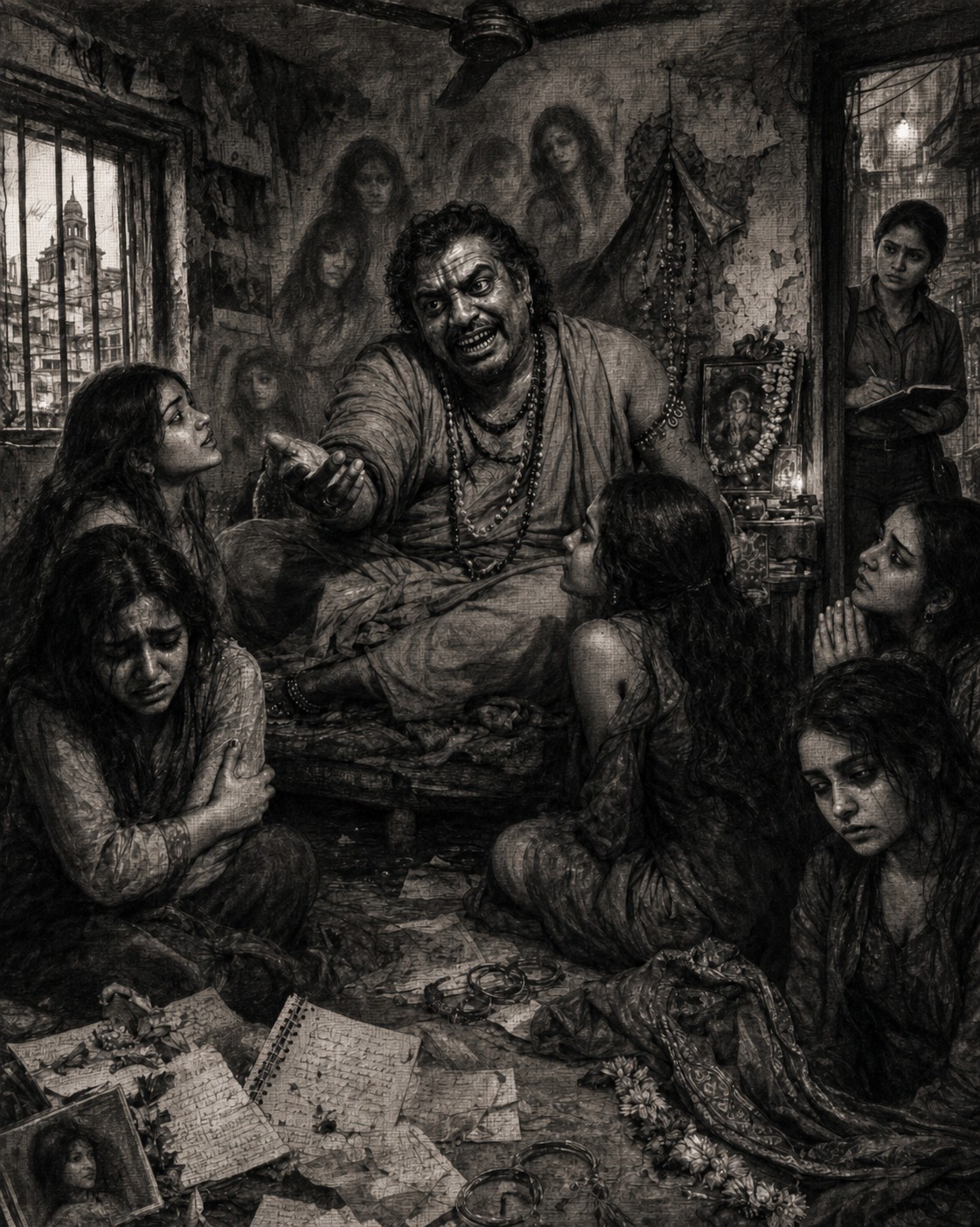
Baba sat in an air-conditioned room under a portrait of himself, which was ambitious because he was already in the room. In the portrait he looked like a moon that had eaten a smaller moon. In person, he was worse and better. Almost spherical face, puffed cheeks, wide grin, buck teeth shining with comic violence. His neck disappeared into folds of saffron silk. His fingers were stubby and loaded with rings.
He was eating mishti doi from a silver bowl.
“You are late,” he said.
“You said not to bathe if delayed.”
He clapped once, delighted.
“Obedient. Good. Obedient men become rich if they attach themselves to disobedient men.”
I did not know whether to laugh, so I made the small neutral sound Bengalis make when trapped between employment and nausea.
He pointed at a chair.
“You know Barnum statements?”
“Yes.”
“Tell.”
“General statements that feel personal. Like horoscopes. ‘You are independent but want approval.’ ‘You have unused potential.’ ‘Sometimes you doubt your choices.’ People accept them because they fit nearly everyone.”
Baba smiled wider. The teeth came forward like two officials demanding a bribe.
“Nearly everyone,” he said. “This is where fools stop. I continued.”
He leaned back. His chair groaned under him with a courtly sadness.
“People pay little for truth. Truth is available free from enemies. But they pay heavily to feel accurately flattered. Rich people especially. Poor people know their problems. Rich people outsource knowing.”
He rang a bell. The white-sari woman entered.
“Bring Number Seven.”
Number Seven was the builder with the safe forehead. He entered, bowed, touched Baba’s feet, and began to cry before anyone had said anything. His belly shook under his white kurta.
Baba closed his eyes.
“You carry a wound from a father who gave you duty but not tenderness.”
The builder sobbed.
“You are generous, but when your generosity is not noticed, you become secretly bitter.”
“Baba,” whispered the builder.
“You have built houses for many people, but inside you there is one room still locked.”
The builder collapsed to his knees.
I watched with professional disgust and personal envy. Three sentences. No names, no dates, no risk. A fishing net thrown into a pond where every fish was desperate to be caught.
Baba opened one eye and looked at me.
“Add these to database.”
The builder left after writing a cheque for five lakh rupees.
Five lakh.
For a locked room inside.
My own locked room had damp on the wall and a gecko behind the switchboard.
For six hours I sat with Baba and collected his sentences. He called them “needles,” though they were more like warm blankets thrown over strangers.
“You are surrounded by people but rarely seen.”
“You forgive others faster than you forgive yourself.”
“You sense changes before others admit them.”
“You have a practical mind, yet one part of you remains deeply spiritual.”
“You dislike conflict, but when pushed too far, you can become very firm.”
“You are entering a period of difficult cleansing.”
He dictated while eating, burping, blessing, receiving envelopes, and occasionally shouting at his staff. His genius was not holiness. It was calibration. Too specific and you could be wrong. Too vague and the fish slipped away. The trick was to stand exactly where vanity met pain.
By evening my notebook was full.
He gave me ten thousand rupees cash.
I touched it twice to confirm it existed.
“Come tomorrow,” he said. “We make system. Rich fools everywhere. Dubai, New Jersey, Singapore, Salt Lake Sector Five. All hungry.”
At the door he called after me.
“And you, statement fellow.”
I turned.
His grin softened. For one second his eyes looked almost kind, which was more frightening than greed.
“You believe you are watching from outside. But nobody watches from outside.”
That night, the first strange thing happened.
I bought egg roll, paid my landlord half, and slept under the fan with the notes hidden in an old medical statistics textbook. Around 2:17 a.m., I woke to someone whispering from the wall.
“You are stronger than you think, but softer than you show.”
I switched on the light.
The damp patch above the plug point had changed shape. For months it had looked like Bangladesh if Bangladesh were having liver trouble. Now it looked like a human ear.
It glistened.
I stood on the bed and touched it with a pen. The plaster was wet and warm.
From next door came Mrs. Dutta’s voice, arguing with her son in Siliguri over speakerphone. Usual matter. Money. Medicine. Neglect. Her son said, “Ma, you always think nobody understands you.”
The ear in my wall trembled.
A drop of brown water fell on my pillow.
In the morning, the ear was gone. Only damp remained.
By ten I was back in Ballygunge.
The waiting room had doubled. A famous restaurateur. Two startup founders. A woman from a tea family. One retired judge. The rich had arrived polished, perfumed, and terrified. The poor fear hunger. The rich fear exposure. Hunger at least has a shape.
I built the questionnaire on Baba’s laptop while consultations continued behind a carved screen.
The questions were ordinary.
Do you often feel people underestimate your depth? Have you recently felt a change approaching? Do family duties prevent your true growth? Do you sometimes smile while feeling unseen?
The answers did not matter. That was the beauty. Every road led to Rome, and Rome accepted UPI.
Baba watched me work.
“Make it feel scientific,” he said. “Bars, percentages, personality map.”
“What categories?”
He waved a sweet in the air.
“Seven Inner Planets. Twelve Karmic Temperaments. Eight Shadow Knots. Use colors.”
“That is nonsense.”
“Nonsense with colors becomes framework.”
I made colors.
At noon, the boy in linen came in. He had inherited a logistics company and the facial expression of a prince forced to manage trucks.
Baba held his hand.
“You fear you are living a life designed by dead men.”
The boy stared.
“You crave freedom, but freedom frightens you because then failure will be yours alone.”
The boy made a small wounded sound.
Then something moved under his skin.
I saw it clearly. A ripple traveled from his wrist to his shoulder, as if a fish had turned inside his arm. The boy did not notice. Baba did. His grin tightened.
“You are at the threshold,” Baba said quickly. “Premium cleansing required.”
The boy paid for the annual package.
After he left, I said, “His arm moved.”
Baba licked yogurt from his thumb.
“Gas.”
“In his arm?”
“Modern diet.”
That evening, I checked the database. The boy’s profile had filled itself.
Not the fields I made. New fields.
FATHER: DECEASED PRIMARY GUILT: RELIEF AT DEATH HIDDEN EVENT: LOCKED MOTHER IN BATHROOM, AGE 12 PRICE TOLERANCE: 18 LAKH BEST STATEMENT: YOU HAVE CONFUSED SURVIVAL WITH CRUELTY
I had not entered any of this.
I copied the text. It vanished.
I checked the code. No hidden script. No API. No internet, even. The Wi-Fi had been down for an hour because the router plug was loose.
Behind me, Baba said, “Ah.”
I turned.
He was standing too close for a man of his size to have arrived silently. His round face shone. His buck teeth rested on his lower lip like two white seeds.
“You saw?”
“What is this?”
He closed the laptop.
“Advancement.”
“Whose?”
“Mine, if you continue.”
He opened a drawer and removed an envelope. It was thick.
“Twenty-five thousand. Finish portal. Add foreign currency.”
I should have walked out.
But poverty is not a moral philosopher. Poverty is a dog chewing your ankle while philosophy speaks from a balcony.
I took the envelope.
That night the damp patch returned, not as an ear. As a mouth.
It opened above the plug point, small and lipless, made of cracked paint. It whispered all night in different voices.
“You are practical but wounded.”
“You give more than you receive.”
“You feel the next phase of life approaching.”
By dawn I understood what made it horrible. The voice was not speaking to me. It was practicing.
The website launched three days later.
Baba insisted on a live online ceremony. He sat before a ring light, cheeks glowing, teeth divine and ridiculous. Behind him hung a banner:
THE BRAHMANANDA INNER TRUTH PORTAL YOUR SOUL HAS BEEN WAITING
Within an hour, bookings came from London, Houston, Dubai, Melbourne, Bangkok, New Town, and one suspiciously emotional man in Guwahati who paid three times by mistake.
The portal generated reports.
Your Karmic Temperament: The Wounded Strategist. Your Shadow Knot: Unreceived Love. Your Inner Planet: Saturn of Delayed Recognition.
Under each, Baba’s statements bloomed. Every sentence warm, grand, and harmless.
Mostly harmless.
Then the thank-you emails began.
Baba, how did you know about my sister?
Baba, I never told anyone about the balcony.
Baba, after your report, my husband confessed.
Baba, the locked room dream came back and now the cupboard smells of pond water.
The database grew new fields by itself. It did not predict. It extracted.
From where, I could not tell.
The rich paid more. The more they paid, the more the system knew. Not dramatic things. Not murder every time. Smaller, stickier things. A hidden resentment toward a disabled child. A forged signature. Joy at a rival’s cancer. Money kept from a brother. A servant slapped in 1998. A mother left waiting in a hospital corridor while the son took a business call.
Human beings are not mostly monsters. That would be easier. They are mostly cupboards full of old smells.
Baba became famous.
He bought advertisements without advertisements. Devotees posted vague testimonials that sounded humble and expensive. “He saw me.” “Baba named what I could not name.” “Worth every rupee.” In Calcutta this is enough. The city has more loneliness per square foot than some countries have people.
One afternoon, a woman came in with sunglasses and a driver carrying her handbag. Her family owned diagnostic centers. I had seen her face in newspapers beside charity events.
She refused tea.
“I don’t want general blessings,” she told Baba. “I want the truth.”
Baba’s grin brightened. “Truth has tiers.”
“I’ll pay.”
“Truth also has taxes.”
She paid twelve lakh by transfer.
Baba took her hands. He began gently.
“You have lived for others’ expectations.”
“Everyone says that.”
“You are admired for strength, but your strength is partly performance.”
“Better.”
“You fear that if people knew the real cause of your charity, they would not call it charity.”
She stopped breathing.
The lights flickered.
The air conditioner clicked off.
For the first time since I had entered that house, Ballygunge heat came in like an unpaid creditor. The sandalwood smell curdled. Somewhere downstairs, someone dropped a tray.
The woman whispered, “Who told you?”
Baba’s face changed. Not expression. Shape.
For one second, his spherical cheeks slackened, and beneath them I saw other faces pressing outward. A child’s. An old man’s. A woman with burned lips. They slid under his skin like people behind frosted glass.
Then the website spoke from my laptop.
Not audio. The words appeared in the report field.
SHE DID NOT DONATE BECAUSE HER SON DIED. HER SON DIED BECAUSE SHE DELAYED THE AMBULANCE TO AVOID A SCANDAL. BEST STATEMENT: YOU HAVE MISTAKEN REPUTATION FOR REDEMPTION.
The woman screamed once, a clean expensive sound.
Baba slapped the laptop shut.
“Session complete,” he said.
She left without her sunglasses.
After that, Baba locked the consultation room during premium appointments. I still heard things.
Not words always. Sometimes crying. Sometimes laughter. Once, applause. Once, the wet slap of many hands against marble, though there was only one client inside.
The reports became shorter.
You are almost ready.
You have carried this shape long enough.
You may now become understandable.
The devotees loved it.
They emerged lighter. That is the only word. Their faces loosened. Their shoulders dropped. They forgot small things. A man forgot his driver’s name. A woman forgot which daughter had diabetes. A judge forgot the word “appeal.” They laughed about it.
“Baba removes burden,” the white-sari woman said.
“Memory is not always burden.”
She looked at me. “You are poor. You can afford principles.”
By then Baba’s face had become too round.
Not fat. Round. Geometry had entered him.
His ears sank into his cheeks. His chin smoothed. His forehead shone without wrinkle. His buck teeth grew more prominent because everything else retreated. He looked less like a man than an emoji designed by a committee of priests and dentists.
And his statements changed.
They were no longer flattering.
They were instructions.
“You will feel relief when you stop resisting your general nature.”
“You are not an exception.”
“You are part of a larger pattern.”
“Specific pain is vanity.”
The portal sent these automatically at 3:00 a.m. Devotees replied with gratitude.
I tried to quit.
Baba laughed so hard mishti doi came out of his nose.
“Quit what? Your importance?”
“I built the system. I can close it.”
“You built a tap and think you made water.”
He rolled closer. His chair wheels squeaked.
“You still think Barnum statements are lies because they fit everyone. Foolish. They fit everyone because underneath names, money, education, and deodorant, people are made of same few hungers. To be seen. To be forgiven. To be special. To be told suffering means something. I did not invent this. I monetized the door.”
“What is coming through?”
He smiled.
“Everybody.”
That night my phone would not unlock. The screen showed only my profile.
NAME: SUBIR ROY AGE: 43 PRIMARY WANT: RENT SECONDARY WANT: TO BE EXEMPT FROM THE COMMON FATE HIDDEN VANITY: THINKS SEEING THROUGH FRAUD MAKES HIM CLEAN PRICE TOLERANCE: LOW BEST STATEMENT: YOU HAVE CONFUSED CONTEMPT WITH IMMUNITY
My name was not Subir Roy.
Not then.
I stared until the letters blurred. My own name, Arindam, felt suddenly decorative, like a label on a jar whose contents had been replaced.
The wall mouth opened.
“You are entering a period of difficult cleansing,” it whispered.
I packed my bag before dawn. Two shirts. Laptop. Cash. Aadhaar card. My mother’s old fountain pen. I would go to Sealdah, take any train, become someone with a smaller problem. Krishnanagar. Malda. Cuttack. Anywhere fraud had not learned my handwriting.
At the landing, Mrs. Dutta’s door opened.
She stood in her nightie, hair loose, eyes milk-white.
“You are surrounded by people but rarely seen,” she said.
I stepped back.
From the stairwell, the landlord answered, “You forgive others faster than you forgive yourself.”
The tea seller outside called up, “You have unused potential.”
Every voice in the building joined, flat and tender.
“You dislike conflict, but when pushed too far, you can become very firm.”
I ran.
Calcutta had not yet fully woken, but the statements had. They came from bus conductors, newspaper boys, sweepers, stray loudspeakers, temple bells, mosque microphones, app notifications, taxi radios, mothers packing tiffin, men brushing teeth at roadside taps. The city murmured general truths to itself and became calm.
At Sealdah, the departure board flickered.
DOWN KRISHNANAGAR LOCAL — YOU ARE READY TO RELEASE WHAT NO LONGER SERVES YOU
I pushed through the crowd. A child selling water touched my sleeve.
“Dada,” he said, “you often help others but do not ask for help yourself.”
I slapped his hand away.
The child smiled with Baba’s two buck teeth.
I did not take the train.
I went back to Ballygunge carrying a screwdriver from a hardware stall and a bottle of kerosene bought from a man who asked no questions, which in Calcutta is practically intimacy.
The house gate stood open.
No guard. No devotees. No white-sari woman.
Inside, the marble floor was covered with shoes. Hundreds of pairs. Men’s leather sandals, women’s slippers, imported sneakers, tiny child shoes, orthopedic shoes, one red high heel. All empty. All pointing toward Baba’s room.
The smell was not sandalwood now.
It was wet plaster.
I climbed the stairs.
Baba sat before the laptop, enormous and smooth. His saffron robe had split at the shoulder. His skin was stretched tight over his round face. The buck teeth had grown down to his lower lip.
Around him stood the devotees.
Or what remained after wealth, shame, memory, and preference had been rinsed out.
They were pale. Not white. Unprinted. Their faces still had features, but only approximate ones, like passport photos left in rain. They turned toward me together.
Baba beamed.
“Statement fellow! Last appointment.”
I held up the kerosene.
He sighed. “Always drama. This is why poor people remain poor. Too much cinema in the blood.”
“What did you do to them?”
“Freed them from specificity.”
“They’re empty.”
“They are finally relatable.”
The laptop screen glowed.
A new report waited.
CLIENT: CITY PRIMARY WOUND: HUMILIATION SECONDARY WOUND: MEMORY PRICE TOLERANCE: UNLIMITED BEST STATEMENT: YOU WERE MEANT FOR MORE THAN THIS.
The floor tilted under me.
Not physically. Worse.
Every advertisement in Calcutta had said it. Every politician. Every tutor. Every guru. Every coaching center. Every parent over a report card. Every failed son to himself at 2:00 a.m.
You were meant for more than this.
The greatest Barnum statement ever made. The hook through the human jaw.
Baba’s grin widened until the corners of his mouth vanished into his cheeks.
“Say it,” he whispered.
“No.”
“You have said it all your life.”
The devotees took one step forward.
Their mouths opened. From inside each came a faint glow, like phone screens under blankets.
I unscrewed the kerosene cap.
Baba laughed.
“You think fire is specific?”
Then the laptop camera turned toward me by itself.
The portal went live.
Thousands of little windows opened on the screen. Dubai kitchens. New Jersey bedrooms. Singapore offices. Salt Lake flats. Faces waiting, tired and hungry, each believing the next sentence would be theirs alone.
Baba spoke to them.
“You have always felt different.”
Every face leaned closer.
I threw the kerosene, not on Baba, but on the laptop.
For one beautiful second, he looked offended rather than divine.
The match shook in my hand. Cheap matchbox. Damp city. Human destiny delayed by poor phosphorus.
It lit.
The laptop burned with a sharp plastic stink. The screen blistered. The little windows warped. Baba screamed, but not in pain. In loss. The devotees screamed with him, a thin modem-like shriek, as if some great connection had been cut.
His round face began to collapse.
Not melt. Deflate.
Names came out of him.
They burst from his mouth in wet gusts. Arpita. Nirmal. Joydeep. Fatima. Harsh. Mrs. Sen. Bappa. Names and smells and old rooms and exam marks and blood groups and locker combinations and lullabies and grudges and PIN numbers. The air filled with human clutter. The devotees fell to the floor, choking on themselves, suddenly rich again in misery.
Baba shrank inside his robe.
His cheeks sagged. His teeth loosened. His eyes, no longer squeezed by fat or geometry, looked small and furious.
I thought he would curse me.
Instead he smiled.
A poor smile now. Ordinary. Almost grateful.
“You see?” he whispered. “Everybody wants the lie back.”
The fire alarm began to ring.
People stumbled downstairs, weeping, calling drivers, sons, lawyers, gods, doctors, no one. I left with them. No police stopped me. In Calcutta, when rich people run barefoot from a spiritual house, the street wisely studies its own business.
By evening, the news called it an electrical accident.
By night, the portal was gone.
By morning, three new pages had appeared online.
Baba had attained silence, one said.
Baba had transferred form, said another.
The third was more professional. White background. Gold logo. Waiting list open. International payments accepted.
I stayed in my room for two days.
The damp patch did not return. My phone worked. My name remained Arindam. The landlord resumed coughing outside my door, which was comforting in its small ugly way.
On the third night, I opened my notebook to tear out Baba’s statements.
The pages were blank.
All except one line written in my own handwriting, though I had no memory of writing it.
People think fraud works because fools believe vague things.
Below it, another line appeared while I watched. The ink rose from the paper like blood through cloth.
Fraud works because vague things are where the real mouth is.
From next door, Mrs. Dutta laughed at something on television.
A bus groaned past in the rain.
My phone lit up.
Unknown number.
For a long time I did not touch it.
Then the screen unlocked by itself, and my own face appeared, rounder than before, smiling with two bright buck teeth I did not yet have.
“Come tomorrow,” it said. “Payment cash.”
Word Cloud
Related reading
Selected by shared topics and section, with closer publication dates breaking ties.