Shortchanged From Dollar To Paise
Uses the speech voice supplied by your browser or device.

WWA: WWA Cossipore English School, my childhood school in north Calcutta.
ISC: Indian School Certificate, a higher secondary school qualification.
CA: CA block in Salt Lake Calcutta.
UTSA: University of Texas at San Antonio, where I studied in the United States.
I-35: Interstate 35, the highway between San Antonio and Austin that became one of the dullest roads in my private mythology.
AI: Artificial Intelligence, software that performs tasks usually associated with human reasoning, language, pattern recognition, or prediction.
QR: Quick Response code, the square barcode now pasted on tea stalls, shops, bills, temples, taxis, and nearly every surface willing to be monetized.
My crotch stinks now.
This is not the sentence with which Bengali literature expected me to enter the room, but Bengali literature will have to manage its disappointment. It has survived worse. It survived committee speeches, puja souvenirs, and men in cotton kurtas using the word “civilizational” after two cups of tea.
When I was in America, at least sometimes, I smelled of Calvin Klein Be. Some imported liquid fiction sprayed from a bottle by a lonely man trying to inform the universe that he remained administratively presentable.
Now I smell of heat, cheap soap, damp underwear, power cuts, stale ambition, and that special Kolkata sweat which does not evaporate. It sits on the body with tenancy rights. You cannot remove it. You can only negotiate.
This is not a motivational story.
Nobody rises here with a violin.
No monk appears. No founder’s journey begins. No inspirational music swells while a thin young man in glasses looks across the Hooghly and whispers, “I will build the future.”
The future, in my case, asked for an advance payment, failed to send a receipt, and switched off its phone.
I was not a popular kid in school.
WWA did not tremble when I arrived. No girl wrote my initials behind her notebook. No boy said, “This fellow has leadership.” I existed in the way a broken tube light exists: technically visible, emotionally ignored, and mentioned only when it flickers at the wrong time.
Then came the temporary 1 month Salt Lake CA school ISC/HS indecision period, where I remained invisible, now with more syllabus and cleaner shoes around me.
Then St. Xavier’s, Park Street.
There the confident boys and polished girls moved through the corridors as if self-esteem had been issued to them at birth, along with a good surname, straight teeth, and the correct understanding of how to stand near a canteen counter without looking grateful to be alive.
I floated around like a misplaced library card.
Useful in theory.
Unclaimed in practice.
University at Jadavpur (JU) was worse. If there is something below invisible, something less dramatic than failure and less interesting than scandal, that was me. Not villainous slime. Villainous slime has presence. It enters the plot. It changes the lighting.
I was side-margin slime.
Footnote slime.
Slime that did not alter the story.
Then America.
You may imagine that America changed everything.
It did not.
America did not open its golden arms and say, “At last, the Bengali prince of Cossipore has arrived. Bring him a scholarship, a convertible, and a woman with excellent dental insurance.”
No. I remained small there too.
But I was busy-small.
That matters.
Busy-small has motion. Busy-small has rent, tuition, groceries, visa, gas, dignity, sleep, work, and the daily immigrant arithmetic of not collapsing before Friday. You divide anxiety by paycheck, subtract loneliness, multiply by weather, and hope the answer is not ruin.
Still, slowly, at work, something changed.
I became visible.
Not glamorous. No miracle happened to my face. No sudden jawline appeared. No cinematic masculinity descended from the Texas sky. I did not become one of those men who lean against glass buildings holding coffee and using words like “strategy” without being bitten by shame.
Something simpler happened.
I could do certain things. I could sit with detail. I could keep working after enthusiasm had gone home and changed into shorts. I could read the ugly instructions nobody wanted to read. I could follow the pipe behind the wall.
And I had another defect, which in the right room becomes a feature.
I could not pretend.
My atheism was not fashionable café atheism, the sort that wears black and quotes Nietzsche badly. It was irritation. Plain irritation. Irritation with incense waved over ignorance. Irritation with piety used as air freshener. Irritation with the Indian habit of placing a flower on top of a broken machine and calling it culture.
Against the usual masala background of inherited belief, family pressure, social obedience, public performance, and private cowardice, my refusal to nod began to stand out like color on a black-and-white television.
Not much.
But enough.
In India, especially among Bengalis, everyone claims to be intellectual until actual work enters the room and sits down with a notebook. Then the adda develops back pain. We can diagnose capitalism, colonialism, cinema, cricket, and the collapse of civilization, but ask someone to send one clean email by 5 p.m. and suddenly the soul requires rest.
America has nonsense too. Let nobody misunderstand me. America has corporate embalming fluid, smiling sociopaths with LinkedIn hair, and meetings where language is murdered under fluorescent lighting. But competence, once demonstrated, could still make a small clearing around you.
A patch of ground.
A place to stand.
Not paradise.
Just room.
And then I left.
This is where a sensible person slaps the table and says, “Why?”
Because I was bored.
That is the honest answer. Not the noble answer. Not the answer one gives relatives over tea. Not “I returned to contribute to the nation.” Not “I wanted to serve my roots.” Not “India was the next frontier.”
I was bored.
The I-35 drive between San Antonio and Austin had started boring holes into my head. Three times a week, sometimes both directions in one day, depending on the madness of schedule and work. At first it had felt magnificent.
A car.
A highway.
Texas sky.
No tram conductor. No bus conductor hanging from the door like a half-employed bat. No stranger pressing his elbow into your liver while discussing politics into your ear.
For a boy from Calcutta, the first American highway is cinema.
Then repetition enters.
Repetition is a thief with soft feet.
Same road. Same exits. Same gas stations. Same coffee. Same radio murmur. Same sun flattening Texas into a chapati left too long on the tawa. Same self, transported daily from one form of unease to another.
A good car becomes ordinary.
A better apartment becomes ordinary.
A pretty girl, if you are lucky enough to be near one and foolish enough to think beauty cancels human boredom, also becomes ordinary.
This is the dirty little joke inside the nervous system. Human beings can get used to almost anything except the absence of change. Pleasure arrives with band party and leaves like a clerk after lunch.
The only thing that stays good is good change.
So I, being a genius in the way certain people are geniuses only after the autopsy, exchanged good boredom for bad change.
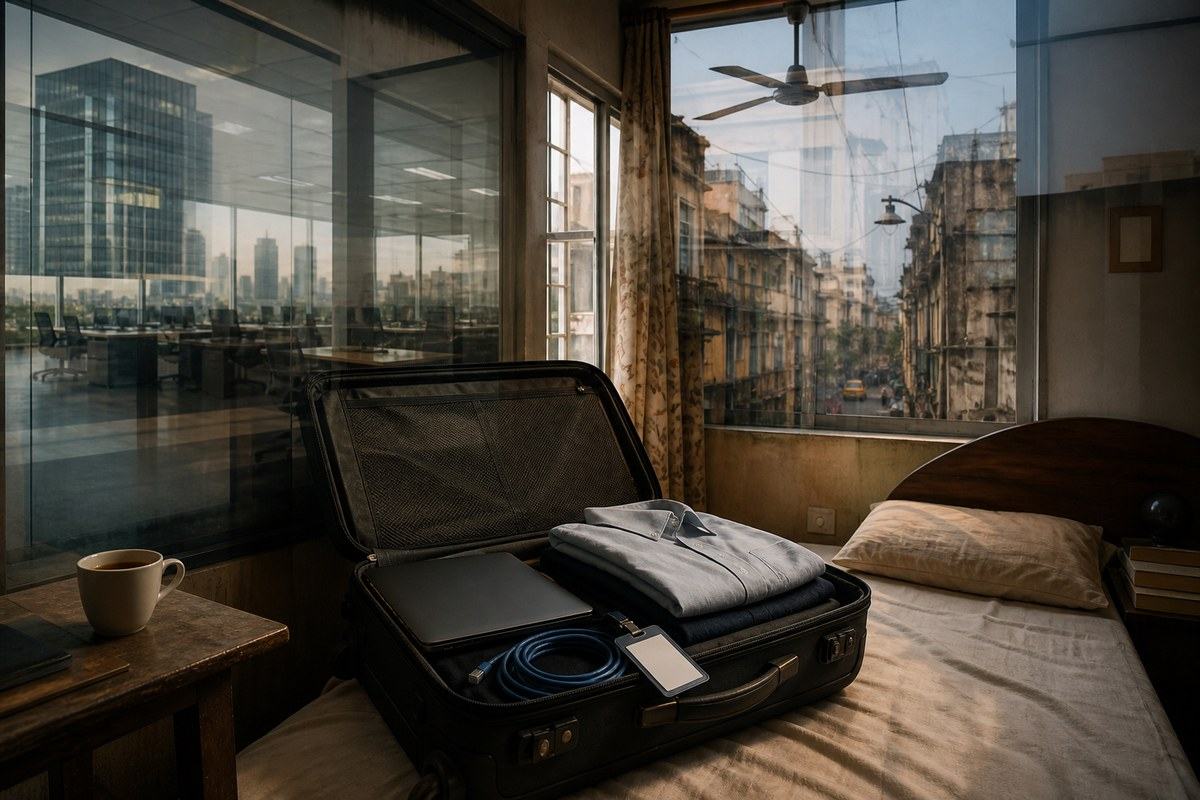
I shortchanged myself from dollar to paise.
In 2014, I was still impressible. Not stupid exactly, though life reveals the difference only after taking payment. I thought India was changing. I thought the country had turned some corner. I looked at the noise, the slogans, the new confidence, the development talk, the startup talk, the leaderly chest-thumping, and mistook theatre for structure.
I mistook swagger for spine.
I mistook a campaign mood for civilization.
I mistook gentrification for progress.
A mall came up. A café opened. A glass building reflected the same old sewage at a better angle. People started saying “ecosystem” while standing in places where the drain cover had been stolen.
And I thought, perhaps, perhaps, the village is becoming a country.
No.
India was still a village.
India is still a village, now with QR codes.
Before patriotic blood pressure rises, let me be precise. I do not mean villages are bad. Villages contain memory, kindness, cruelty, vegetables, gossip, music, illness, intelligence, superstition, debt, tea, and goats with better survival instincts than most entrepreneurs.
I mean the village mind.
The cousin network. The uncle. The fixer. The baba. The party man. The envelope. The shortcut. The man who knows a man. The hatred of process. The worship of jugaad. The suspicion of competence unless competence arrives with a convoy.
That is what survives inside the smartphone.
Old feudal stupidity now has broadband.
For an Indian entrepreneur without family money, political shielding, inherited influence, criminal appetite, or a supernatural tolerance for humiliation, this place is not an ecosystem. It is a snake pit.
Not even a clean snake pit.
A damp, devotional, invoice-swallowing pit full of gods, slogans, piety, piss, bliss, cheap liquor, holy men, holy scams, someone’s cousin, someone’s nephew, someone’s party contact, someone’s horoscope, someone’s mother’s opinion, and probably someone’s pubic hair floating in the tea.
This is where the reader may pause and say, “Surely he exaggerates.”
Yes.
Slightly.
For hygiene.
But only slightly.
Because if you try to build something here without protection, you will discover the true national animal is not the tiger. The tiger at least has dignity. The true national animal is the man who says, “Send me a proposal,” and then vanishes with it into a swamp of silence.
Someone will praise your vision.
Someone will ask for a meeting.
Someone will ask for a cheaper version.
Someone will say payment is not an issue, which means payment is already an issue.
Someone will introduce a nephew.
Someone will say, “We should definitely collaborate.”
Someone will use the word “definitely” as a burial cloth.
And you, poor hopeful idiot, will keep thinking work matters.
Work matters.
But here work alone is a bicycle trying to overtake a truck full of influence.
That is the part nobody puts in the inspirational video.
Do not repeat my mistake.
This is not advice from a winner. Winners are unbearable. They convert luck into philosophy. They stand on stages with collar microphones and describe starvation as “a learning phase.” They say “journey” with the confidence of people whose parents owned land.
This is advice from a man who has lost enough skin to identify the machinery.
If you have a boring corporate or research role in the West, keep it. Be bored. Boredom with salary is a sofa with bad upholstery. Boredom without salary is a medical condition.
Buy better curtains. Take up swimming. Learn the cello badly. Grow tomatoes in a balcony and speak of them as if you personally invented agriculture. Read a Russian novel and abandon it honorably on page 143. Develop a mild red-wine problem if you must, but make it imported and manageable.
Do anything except romanticize returning to India to build something unless you have money, backing, family armor, and the patience of a crocodile in winter.
I am not saying my life is a failure.
I am alive.
That still counts, though some mornings the difference between me and furniture seems mainly legal.
Anything can happen. Life is vulgar that way. It keeps a side door open even in buildings condemned by the municipality.
But certain mistakes become architecture.
At twenty-five, a wrong turn is a lane.
At fifty-one, it is a municipality.
You do not simply correct it. You live inside it. You pay rent to it. It develops water problems. It grows fungus. It acquires political posters and a tea stall where men discuss your decline with professional interest.
The younger man in America thought boredom was death.
The older man in Calcutta knows better.
Boredom in an air-conditioned car on I-35 is not the same as boredom in a room where the fan stirs hot air like a tired cook reheating yesterday’s dal. Boredom with health insurance and a paycheck is philosophical. Boredom with unpaid invoices becomes physical. It enters the stomach, the scalp, the sleep, the jaw, the laundry basket, the afternoon breath, the crotch.
There, we have returned to the crotch.
Every serious essay needs a structure.
But I understand why I left.
I wanted to become visible.
That is the rat behind the cupboard.
Entrepreneurship, nation-building, innovation, roots, return, solving problems, building systems, shaking things up—yes, yes, all that respectable furniture was in the room.
Underneath it was this: I wanted to stop being slime.
I wanted my mind to matter somewhere.
I wanted my refusal to conform to become a tool instead of a private deformity.
I wanted work to turn into identity.
Instead I returned to a country where seriousness is punished unless seriousness arrives with power. You may be right. You may be useful. You may know the problem and the fix. You may have stayed up late and done the work properly. But a confident mediocrity with connections will glide past you like a cockroach blessed by the municipality.
And Bengalis, my own people, must not be spared.
Affection without contempt is tourism.
We are gifted at converting intelligence into vapor. We read, argue, quote, smoke, diagnose, historicize, and then do nothing with such refinement that laziness begins to resemble culture. We can discuss revolution for three hours and fail to send one email. We can identify decay with doctoral precision while standing knee-deep in our own leaking plumbing.
We are not stupid.
That is the tragedy.
If we were stupid, one could forgive the mess. But we are often bright enough to understand exactly how we are failing, then cultured enough to give the failure a literary reference.
So here I am.
Not dead.
Not redeemed.
Not wise.
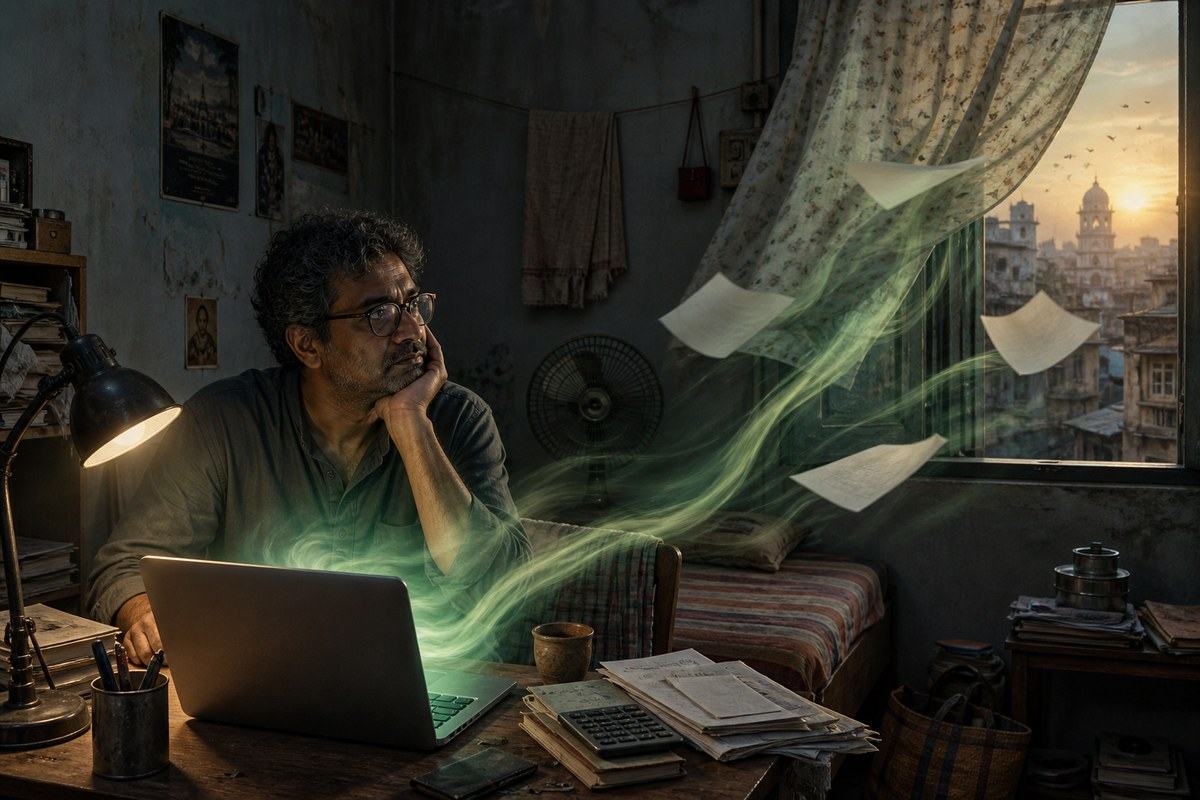
Just a middle-aged man in a hot room on the edge of Calcutta, smelling of humidity, bad decisions, cheap soap, and the sour chemistry of hope after exchange-rate damage.
The I-35 drove me mad, yes.
But at least it went somewhere.
Word Cloud
Related reading
Selected by shared topics and section, with closer publication dates breaking ties.