Fractal Geometry of a Half-Lived Life
Fractal geometry: the mathematics of rough, branching, self-repeating shapes that refuse to behave like neat circles, squares, and triangles.
Mandelbrot set: a famous fractal discovered through a simple repeated equation, producing a shape of astonishing complexity.
Self-similarity: when a small part of a shape resembles the larger whole, like a fern leaf resembling the fern.
Fractal dimension: a way of describing shapes that live between ordinary dimensions, more than a line but less than a full surface.
Cantor dust: a mathematical set made by repeatedly removing the middle third of a line, leaving scattered points that are still mathematically present.
Topology: the study of shape by asking what remains unchanged when something is stretched, bent, or deformed.
Iteration: doing the same operation again and again, where each result becomes the input for the next step.
Attractor: a pattern or state toward which a system tends to move, even when the path looks chaotic.
Uses the speech voice supplied by your browser or device.

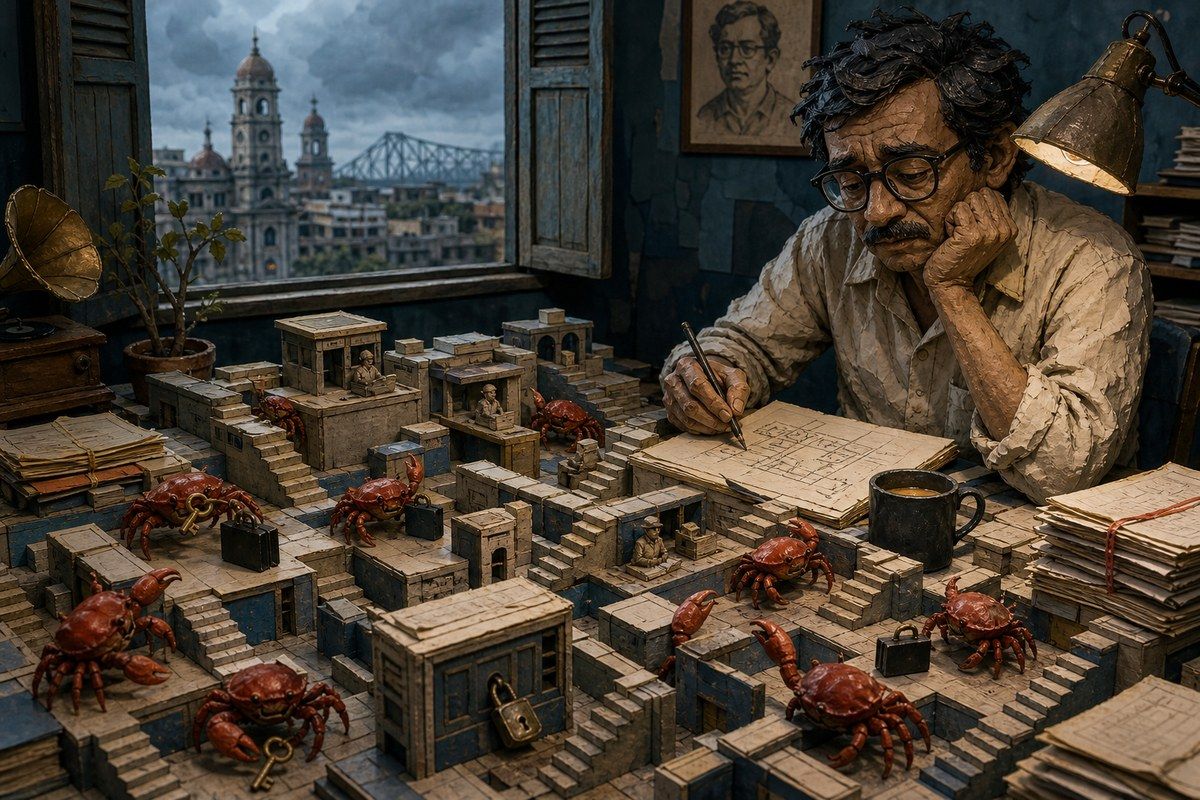
The tea stain on the cheap plastic table has branched again.
Yesterday it was only a ring. Today it has become a family. From its damp brown border a smaller stain has appeared, then a thinner one beside it, then one suspicious little peninsula pointing toward the biscuit crumbs like it has geopolitical ambition. If you look carefully, which is always dangerous in a rented room, the thing begins to resemble a map of some bankrupt coastal nation where the national bird is the mosquito and the finance minister has escaped with the pressure cooker.
This, I suspect, is how fractal geometry enters ordinary life. Not through a classroom. Not through a glossy science documentary where a calm foreign voice says “complexity” while colored shapes bloom on the screen like psychedelic broccoli. It enters through tea, dust, sweat, milk residue, cheap furniture, and the mildly tragic fact that a man who once studied serious subjects now spends ten minutes examining a stain because it has more career momentum than he does.
Fractal geometry begins with a simple insult to neatness.
School geometry gives you circles, triangles, rectangles, straight lines, clean angles. Very disciplined fellows. Hair combed. Shoes polished. Geometry-book children of good families. The real world is not like that. The real world is a broken footpath after rain, a peeling wall, the edge of a burnt roti, a line outside a government office, a political promise after three months, a Kolkata drain trying to swallow civilization one plastic packet at a time.
Nothing has a clean edge.
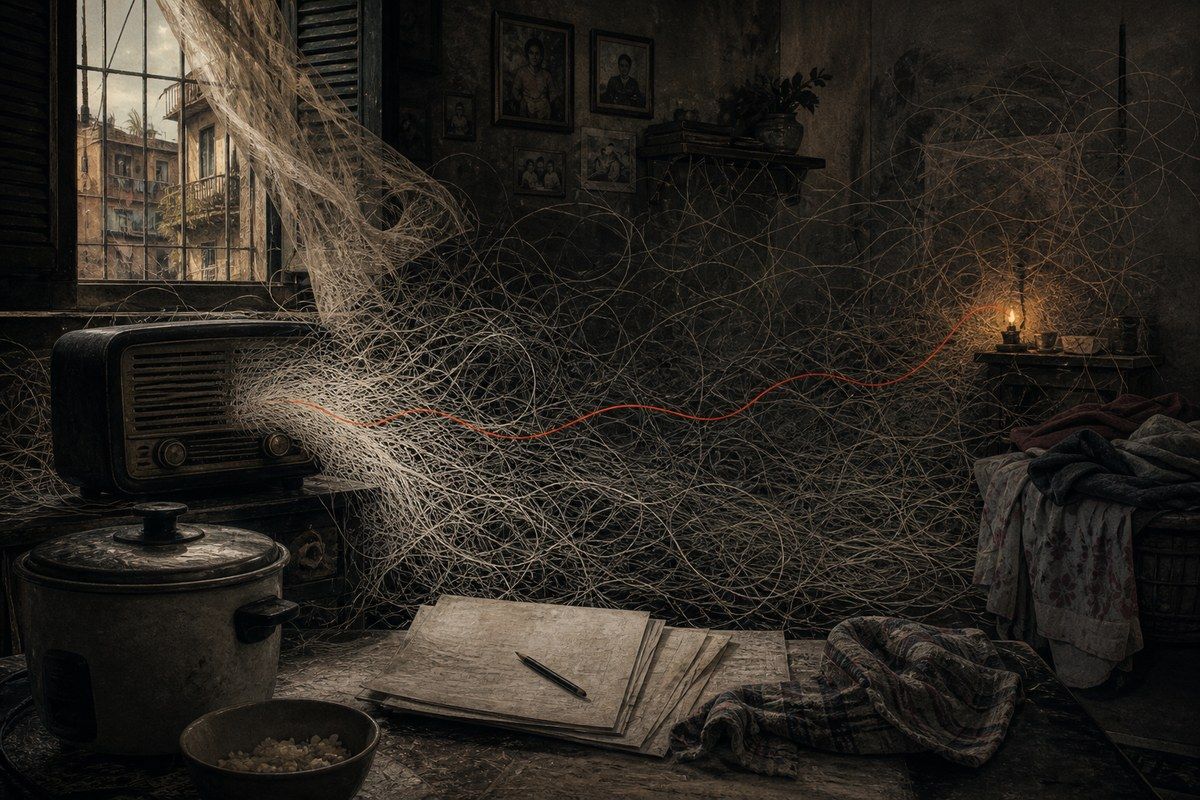
Look at a cauliflower. Look at lightning. Look at a tree. Look at the crack on an old wall. Look at the map of India, then Bengal, then Kolkata, then your para, then your lane, then that one corner near the tea shop where the pavement gives up and becomes philosophy. The same roughness keeps returning at smaller and smaller scales. The big mess has little messes inside it. The little mess has still smaller messes inside it. Reality is not a smooth billiard ball. Reality is puffed rice spilled on a newspaper in front of a fan.
Benoit Mandelbrot asked a famous question: how long is the coast of Britain?
It sounds like a school question. It is actually a trap.
Measure the coast with a long ruler, and you get one answer. Use a shorter ruler, and you catch more bays, nicks, bends, inlets, and little coastal tantrums. Use a still shorter ruler, and more detail appears. Smaller ruler, longer coastline. Smaller still, longer still. The coast keeps producing new edge, like an old Bengali family argument where every solved point reveals three elderly witnesses and one retired uncle with documentary evidence from 1978.
There is no final answer because the answer depends on the scale of measurement.
Now bring that ruler to a life.
From far away, my life can be summarized very efficiently, which is why far away is such a cruel distance. Failed man. Middle-aged man. Single man. Bipolar man. Lower-middle-class Bengali man in the Calcutta boondocks. Some over-read under-employed fellow with an aging laptop, a rice cooker, a nervous stomach, and a website that behaves more reliably than his income.
That is the long-ruler version.
Now use a smaller ruler.
There is the morning headache. There is the unpaid invoice. There is the client who praises your work as if praise were legal tender. There is the body becoming heavier in the wrong places and weaker in the useful places. There is the old American life flickering in memory like a laptop screen before death. There is the humiliation of having known competence and now living among people who treat competence as a decorative accessory, like a plastic flower in a bank lobby.
Use a smaller ruler still.
There is the towel not picked up. The cup not washed. The email not answered. The WhatsApp message opened and then fled from like a police raid. The mother’s frailty. The molar pain. The heat. The fan. The gas cylinder. The electricity bill. The small panic before shaving. The insult remembered from 2019 that suddenly arrives at 2:20 in the afternoon with no appointment, no shame, and no refreshments.
This is the fractal truth of depression. It is not one large black cloud hovering over the room. That would almost be elegant. Depression is a coastline. From a distance it is despair. Closer in, it is not bathing. Closer still, it is not having the strength to take the towel from the chair. Closer still, it is standing before the bathroom door and feeling as if the entire universe has formed a committee to prevent one tired Bengali man from washing his armpits.
And because committees are the most successful species in India after mosquitoes and unsolicited advice, the bathroom door wins.
Bipolarity has its own fractal behavior. It repeats, but never politely. A mood is not born fresh each morning like a lotus in a calendar poster. A mood is yesterday’s mood fed back into today’s machine, mixed with sleep, debt, hunger, weather, medicine, memory, irritation, old shame, new shame, and that mysterious chemical chutney the brain makes without showing anyone the recipe.
Some days the mind is a dry well.
Some days it is a pressure cooker that has lost respect for physics.
The old mathematicians would call this iteration: take one value, put it through a rule, take the output, feed it back again. Simple. Innocent-looking. Like making tea. Except in nonlinear systems, small changes can grow teeth. A little less sleep, a little more heat, one unpaid bill, one foolish message, one mosquito whining near the ear at 3 a.m., and the whole day bends.
People like to say, “Just change your mindset.”
Very good. Also please change the monsoon.
This is where mathematics becomes useful, not as consolation, but as a better language for insult. Fractals say something ordinary moral language often misses: irregularity is not the same as meaninglessness. A broken pattern is still a pattern. A rough life is not necessarily a random life. Even collapse has structure. Ask any old building in North Kolkata. It may lean, flake, cough plaster, grow moss, host pigeons, and threaten every passerby with architectural opinions, but it is not shapeless. It has history in its cracks.
So does a man.
This is not the sentimental line that suffering makes you deep. That is a very popular lie, especially among people who have not recently suffered. Suffering often makes you boring, repetitive, frightened, irritable, unhygienic, and difficult to invite to a birthday party. It does not automatically turn you into Dostoevsky. Sometimes it turns you into a man staring at a tea stain while the rice cooker clicks and a neighbor’s television announces breaking news at the emotional volume of a minor war.
But suffering does leave traces. Repeated traces. Avoidance loops. Shame spirals. Anger bursts. Hunger rhythms. Sleep ruins. Tiny islands of reading. Sudden disgust. Sudden tenderness. A stray dog limping outside the lane. An old song from childhood. A headline about another scam, another bridge, another heroic announcement by people who have apparently never stood in a ration queue or waited for a payment that everyone agrees is due but no one wishes to pay.
A country also has fractals.
The large disorder repeats in the small disorder. Institutions decay into offices. Offices decay into counters. Counters decay into files. Files decay into signatures. Signatures decay into “come next week.” The national drama becomes the local drain. The local drain becomes the room’s damp wall. The damp wall becomes the black patch near the switchboard. The black patch becomes the mood of the afternoon.
Nothing stays in its department.
Politics enters the bathroom. Economics enters the underwear drawer. Biology enters the mattress. History enters the English sentence. Family enters the blood pressure. Market forces enter the price of onions. Global affairs enter the cost of fuel. Some war far away, some election far away, some billionaire’s machine far away, and suddenly the small man in the Calcutta boondocks is paying more for a cylinder, a medicine, a train ticket, a packet of tea. The world is very large until it touches your wallet. Then it becomes personal.
This is why the old idea of a biography feels suspicious. A biography says: born here, studied there, worked there, returned here, declined afterward. It sounds like a railway timetable. But a life is not a timetable. A life is more like a damp handkerchief left in a pocket during monsoon. It changes shape. It keeps the smell.
The deeper question is not what happened.
The deeper question is what kept repeating.
For me, the repeating shape has many names: loneliness, illness, class humiliation, wasted skill, shrinking possibility, unpaid labor, the ridiculous persistence of dignity, and the comic fact that the mind continues to produce thoughts long after the market has marked the thinker as unsold inventory.
Fractal dimension gives another useful slap to common sense. A line has one dimension. A sheet has two. A box has three. Then fractals arrive with their suspicious luggage and say: here is a shape whose dimension is 1.26 or 1.58. More than a line, less than a surface. Neither this nor that.
I understand this too well.
I am not nothing. That would be clean. I am not fully socially real either. That would require money, circulation, invitations, paid invoices, a reliable shirt, and perhaps a face that does not look like it has been negotiating with humidity since birth. I occupy some strange middle space. More than a statistic. Less than a citizen in good standing. A fractional man. An irregular object with non-integer dignity.
A salaried man is Euclidean.
A rich man has volume.
A bankrupt man becomes dust.
Not ordinary dust either. Cantor dust. In mathematics, you take a line, remove the middle third, then remove the middle third of what remains, and continue forever. What is left is not nothing. It is still there. But it is scattered, strange, full of gaps, impossible to walk across.
That feels familiar.
First the career thins. Then the marriage. Then the savings. Then the friendships. Then the daily rhythm. Then the public face. Then the future, that once-important fellow, stops visiting without explanation. Something remains, yes. But it is not continuous. It is not a road. It is a set of points. A man can be mathematically nonzero and still humanly difficult to locate.
Abstraction is cruel because it can make ruin look elegant.
A chalkboard can turn anything into a clean diagram. Poverty becomes distribution. Loneliness becomes social isolation. Depression becomes symptom burden. Failure becomes outcome. Everything gets a nice label. The label wears a tie. The man wearing the label is still sitting in old shorts wondering whether bathing at 4 p.m. counts as a comeback.
And yet, I will give mathematics this much: it does not lie to cheer you up.
It does not say, “Everything happens for a reason.” It does not say, “Your best days are ahead.” It does not place one soft hand on your shoulder and pick your pocket with the other. Mathematics says: here is the pattern, here are the rules, here is the strange result of repeating a simple operation long enough.
That is more honest than most people.
Self-similarity is the idea that the part resembles the whole. A fern leaf resembles the fern. A branch resembles the tree. A small piece of cauliflower resembles the larger cauliflower, which is either beautiful or an elaborate vegetable warning.
My life has self-similarity too, though no one will put it on a science poster. The whole life is waiting for money that may not come. The morning is waiting for tea to boil. The whole life is failed migration. Each email is a tiny failed migration from thought to action. The whole life is interrupted ambition. Each unread book is a little monument to interruption. The whole life is recurrence. Each mood swing contains the entire biography in miniature: hope, acceleration, shame, crash, silence.
This is why ordinary objects matter.
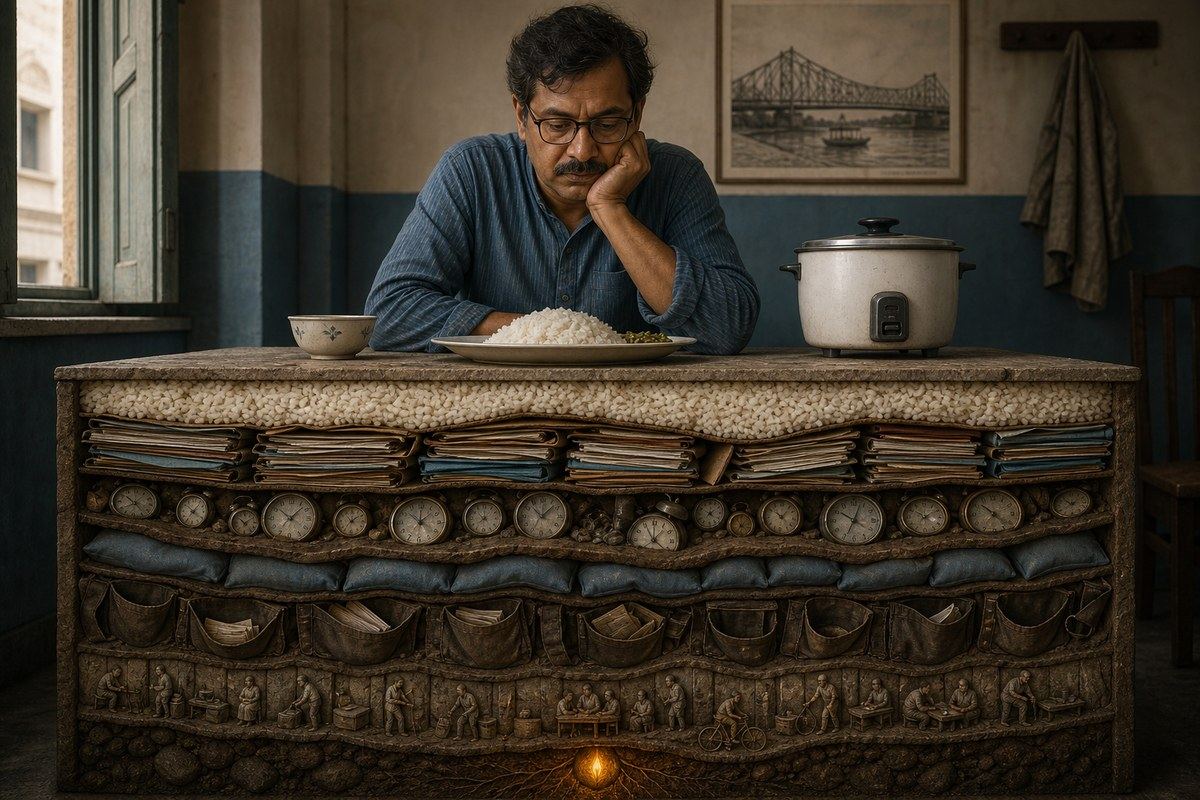
A cup is not just a cup when you live alone. It is evidence. A plate is not just a plate. It is a report. The bed is not furniture. It is a political settlement between the body and despair. The chair holding the drying underwear is not a chair. It is a small defeated embassy of hygiene. The rice cooker is not a machine. It is the last functioning ministry.
Outside, Calcutta continues its daily opera. A scooter coughs. Someone shouts into a phone as if volume will settle the legal dispute. A dog objects to another dog with excellent procedural confidence. The vegetable seller drags out the word “begun” like a sad classical note. Somewhere a child is being sent to tuition. Somewhere a young man is promising artificial intelligence will solve everything, possibly after solving his hairstyle. Somewhere a political poster is peeling off a wall with more dignity than most speeches.
Inside, the fan turns.
The fan is offensively Euclidean. A clean circle above a messy life. Round and round it goes, calm as an accountant, making its tired argument with the heat. It has no unpaid invoice, no middle-aged longing, no bipolar pharmacy, no mother’s frailty, no memory of America, no shame, no gas problem, no inbox full of small knives. Just rotation. Pure, stupid, admirable rotation.
One almost envies it.
Then comes the dangerous question: if life is iterative, if today is yesterday fed back into the machine, if illness bends choice, if poverty narrows the corridor, if memory keeps returning like an old creditor, where does freedom live?
Not in speeches.
Not in heroic declarations.
In actual life, freedom may be very small. A decimal-place rebellion. Today I washed one cup. Today I read two pages. Today I did not send the poisonous reply. Today I cooked rice before hunger turned me into a tragic public monument. Today I noticed the tea stain looked like a coastline, and for three minutes the mind was not only a sewer but also an observatory.
Three minutes is not salvation.
But it is data.
And data, unlike hope, does not wear perfume.
There is also the boundary problem. A fractal is often mostly boundary, all edge and complication. That is the depressive social life too. You are not fully inside society, not fully outside it. People remember you when they need technical help. They forget you when payment is due. They call you brilliant in the same tone used for an elderly dead relative who once knew Sanskrit. Then they disappear into their better-lit lives.
You become coastline.
You touch many things but belong to none. America, India, software, books, illness, family, poverty, mathematics, Calcutta, memory. Each touches you. None contains you.
So perhaps after enough disappointment a man does not become a tragedy, a lesson, or even a proper failure. He becomes an irregular set: finite in area, infinite in perimeter, impossible to measure without producing more complication.
The tea stain dries darker at the edge.
Inside that edge are smaller edges.
Inside those, perhaps, smaller ones still.
I get up to urinate and halfway to the bathroom forget why I stood up, which is either neurological decline or metaphysics. Since I am still vain enough to prefer metaphysics, I stand there in my old shorts, holding my bladder like a philosopher holding a broken theorem, while the fan turns overhead with the cold repetitive genius of a universe that has absolutely no plan to apologize.
Word Cloud
Related reading
Selected by shared topics and section, with closer publication dates breaking ties.