The Pressure in Sinthee
Uses the speech voice supplied by your browser or device.

THIS IS A WORK OF FICTION
The first belly burst beside the tea stall opposite Sinthee More, under the tram wires that no tram had used in years but which still hung there like black veins remembering a body.
It was eleven in the morning. The rain had stopped half an hour ago, leaving the street bright and dirty, the way Calcutta becomes after rain: every broken brick outlined, every paan stain refreshed, every drain persuaded to speak its mind. Autos shuddered at the crossing. A delivery rider in a yellow raincoat argued with a fish seller whose hilsa had fallen into the gutter and was now regarded by both parties as evidence in a criminal case. Political posters peeled from a wall behind them—faces smiling with that waxy optimism known only to candidates, funeral photographers, and coaching-center toppers.
At Nagen’s tea stall, six men were drinking tea in small glasses and discussing the price of LPG when Bappa Das began to rise.
Not stand. Rise.
His shirt tightened first. The cheap blue fabric strained over his abdomen. He put one hand on his stomach and laughed, embarrassed.
“Gas,” he said.
Everyone laughed too, because gas was one of the city’s minor gods. It visited every household, crossed class barriers, defeated English-medium education, and made a mockery of office manners.
Then Bappa’s belt snapped.
The buckle flew across the stall and struck the biscuit jar. He made a small surprised sound, like a child caught stealing sugar. His belly pushed forward, round and hard and shining under the shirt. Something moved beneath the skin.
Nagen, who had poured tea for three decades and seen everything from knife fights to exam results opened in the rain, said, “Hospital. Now.”
Bappa tried to answer, but his mouth filled with foam.
The sound came next. Not an explosion exactly. More intimate. A wet tearing sigh, as if a sack of boiled rice had been dropped from a height.
His body opened across the middle.
Tea glasses fell. Men ran. The fish seller crossed himself in a Christian way despite being a devoted Kali man, because terror makes excellent ecumenists of us all.
A strip of intestine landed on the red plastic stool where Bappa had been sitting. Steam rose from him in the damp air. His stomach cavity, impossibly inflated a second before, was suddenly emptying itself onto the pavement.
And from that bright red ruin, something pale and long wriggled into the drain.
By noon, the video had reached every para WhatsApp group from Dum Dum to Behala.
By two, the police had covered the body with a blue tarpaulin.
By four, the official message said: “Possible food poisoning. Public requested not to panic.”
In Calcutta, this was as close to panic as the government ever got.
Dr. Anirban Sen saw the video on his mother’s phone.
He was sitting in their second-floor flat in South Sinthee, in an old apartment building with cracked balconies and green shutters that no longer fully closed. His mother, Minati, lay on the wooden cot by the window, her thin white hair spread over the pillow, her breathing shallow from years of asthma and medicines taken irregularly because regularity was expensive.
“Look,” she said. “Near our crossing.”
“I don’t want to look at these things, Ma.”
“You were a doctor.”
“I was never that kind of doctor.”
This was true in the legal sense and false in the moral one. Anirban had an MBBS degree, an unfinished MD, and a decade of work in a private pathology chain where he had become very good at looking at numbers instead of people. Blood counts, liver panels, stool reports, infection markers. He had left after a scandal involving altered lab results for a nursing home that catered to families who used the word “package” more often than “care.” He had not changed the results himself. He had only built the reporting dashboard that made the change invisible.
In Calcutta, sin often came with a login password.
Now he worked freelance for clinics, cleaning data and writing discharge summaries for doctors too busy to spell. His mother still told neighbors he was “attached to medical line,” which sounded respectable and indistinct, like a politician’s promise.
She thrust the phone closer.
He looked.
Bappa’s belly opened on the small screen. Around the body, ordinary Calcutta continued for half a second: one man lifting his tea glass away from the splash, a scooter braking late, a woman in a red sari turning not toward the horror but toward the person filming it.
Anirban watched the pale thing slide into the drain.
He paused the video.
“What is that?” his mother whispered.
“A worm.”
“Worms do not do that.”
“No,” he said. “They don’t.”
That evening, power went out across three blocks. The old building groaned into darkness. From the lane came the usual orchestra: pressure cooker whistles, an infant crying, someone cursing the electricity board with admirable anatomical detail, a generator coughing to life in the gated tower that had replaced the Mukherjee mansion. Once, their neighborhood had measured status by bookcases and balcony plants. Now it measured it by backup power.
Anirban went downstairs with a torch.
At the entrance, he found Riju, the delivery rider from the morning video, sitting on his bike, helmet on the handlebar. He was twenty-two, thin as a matchstick, with wet hair plastered to his forehead.
“You are doctor-da, no?” Riju said.
“No.”
“But you know.”
“That is not the same thing.”
Riju swallowed. “Bappa-kaku ate from my packet yesterday.”
“What packet?”
“I delivered biryani to him. From Shyambazar side. He said he ordered, but address was wrong. Then he said, leave it, I will eat. Food is food.”
“Which restaurant?”
Riju checked his app. His fingers trembled against the cracked screen.
The order had no restaurant name. Only a ghost kitchen ID: BELLYFUL_44.
“Customer?”
“No name. Cash on delivery. But paid online.”
“Show me the address.”
The address was three lanes away, behind the old Kali temple, where the corporation drain ran uncovered beside a row of rooms built into what had once been a garden house. Anirban knew the place. Migrant workers lived there now, nursing attendants, sweepers, coaching-center boys, one family who ironed clothes for the entire para.
“Did you eat any?” Anirban asked.
Riju shook his head too quickly.
“Tell me the truth.”
“A little. Rice stuck to the foil.”
“When?”
“Night.”
“Any pain?”
“Only gas.”
The word stood between them like a match in a petrol pump.
Anirban took him upstairs.
His mother objected on principle, then gave the boy ajwain water and asked if his parents knew he drove in the rain. Riju said his parents were in Malda, which in Calcutta meant both far away and financially present.
Anirban examined him under the torchlight. Abdomen soft. Pulse fast. Fear could do that. So could infection.
“Stool sample,” Anirban said.
Riju stared.
“Bathroom. Use the old jam bottle under the sink.”
“Doctor-da—”
“Go.”
There are indignities so practical they become kindness.
Under the microscope, the sample looked ordinary at first. Anirban had kept the old microscope from his pathology days, partly for work, partly because unemployed men preserve instruments the way shipwrecked sailors preserve rope.
Then the field swam.
Something uncoiled.
It was translucent, threadlike, with dark nodes along its body. A nematode, perhaps. But not one he knew. Its gut pulsed with bubbles. The bubbles gathered, merged, and passed outward through its skin like breath through wet paper.
Anirban adjusted the focus. The worm’s head turned toward the light.
It had no eyes.
Still, he felt seen.
By midnight, three more cases appeared.
A retired schoolteacher in Dum Dum Park. A mason near Seven Tanks. A girl of nineteen at a paying guest accommodation behind a nursing home on BT Road. All complained first of gas. All developed swelling. All ruptured before reaching hospital.
In every video, someone screamed. In every video, someone filmed.
By morning, the word had spread.
Not cholera. Not food poisoning.
Pet-phata rog.
Belly-burst disease.
The Health Department announced a helpline. Hospitals filled with people clutching their stomachs, half of them terrified, half genuinely sick, all united by the ancient Indian conviction that if one did not reach the doctor first, disease would take a token and wait.
At RG Kar, the emergency ward overflowed. At private hospitals, security guards kept out anyone who looked unable to pay deposit. Chemists sold antacids, deworming tablets, probiotics, digestive enzymes, activated charcoal, homeopathic globules, and one packet of Japanese seaweed whose medical purpose nobody could explain but which cost seven hundred rupees and therefore inspired confidence.
By the second day, the bodies began appearing in clusters.
A family of four in Paikpara.
Seven passengers in a bus near Shyambazar, bellies swelling under office shirts and salwar kameezes while the conductor shouted for them not to dirty the seats.
An entire coaching-center classroom near Sovabazar, where the boys had been preparing for government jobs that no longer seemed to exist in sufficient quantities even for the living.
The city learned the stages.
Burp.
Cramp.
Distension.
Prayer.
Burst.
The worm spread through food, then water, then perhaps touch. No one knew. Rumors bred faster than parasites. It came from imported chicken. From illegal meat. From tanker water. From a Chinese lab. From a curse buried under the new metro work. From 5G. From Muslims. From migrants. From politicians. From God’s anger. From atheists. From everything except neglect, because neglect was too familiar to fear properly.
On the third night, Anirban traced the deliveries from BELLYFUL_44.
Riju had given him access to the rider app after vomiting twice and weeping once. The orders formed a pattern around South Sinthee: wrong addresses, paid online, cheap meals delivered to people likely to accept them. Old men at tea stalls. Security guards. Tuition boys. Nursing attendants. People who could not afford suspicion.
The ghost kitchen location was listed as “Sinthee Cloud Foods Unit B.”
There was no Unit B.
There was, however, an abandoned godown behind the temple, beside the open drain.
Anirban went there at dawn with Riju, who insisted on coming because fear, like love, sometimes mistakes proximity for control.
The lane behind the temple smelled of wet flowers, diesel, urine, and incense. Puja lights from last year still hung across the entrance, dead bulbs trembling in the breeze. The old godown door was half open.
Inside were plastic tubs. Food containers. A rusted sealing machine. Sacks of rice split by rats. On one wall, a calendar from a diagnostic lab showed a smiling child holding a stethoscope.
In the corner stood a blue water tank connected by a pipe to the drain.
Riju gagged.
Anirban opened one tub.
Inside lay hundreds of pale worms in a slurry of rice and something black-green. They rose together, not crawling but swelling, each body inflating with tiny silver bubbles.
On a wooden table lay printed labels.
BELLYFUL_44.
ANNAPURNA EXPRESS.
MA’S KITCHEN.
PROTEIN TIFFIN.
Different names for the same hunger.
“Who did this?” Riju whispered.
Anirban saw the ledger then.
It was wrapped in plastic and weighted with a brick. Inside were names, dates, delivery zones, payments. Not a corporation. Not a villain with a laboratory and a cat. A small criminal enterprise, probably making cheap meals from drain water, expired rice, and whatever protein paste could be bought by the drum. The sort of thing everyone knew existed and nobody chased unless someone important died.
Then he saw another column.
TRIAL AREA: S. SINTHEE.
DOSAGE: LOW.
OBSERVE GAS.
His throat dried.
The handwriting was familiar.
Not because he knew the writer personally. Because he had seen the same block capitals on hundreds of lab intake forms.
S. PAL.
Dr. Subhajit Pal.
His former boss at the pathology chain.
A man with soft hands, rimless glasses, and the ability to say “quality protocol” while billing typhoid tests to patients with dengue. Anirban had last seen him two years ago, after the scandal, when Pal had told him over coffee at a cheap café near Lake Town, “You are too emotional for systems work. Systems require flexibility.”
Anirban photographed the ledger.
Something moved in the drain behind them.
Riju turned.
The drain water bulged.
Not rose. Bulged.
A long pale mass surfaced, thicker than a rope, then another, then dozens twisted together in a braided muscular knot. Bubbles covered them. The water hissed.
“Run,” Anirban said.
They ran.
Behind them the godown breathed.
By then, Calcutta had begun to pop.
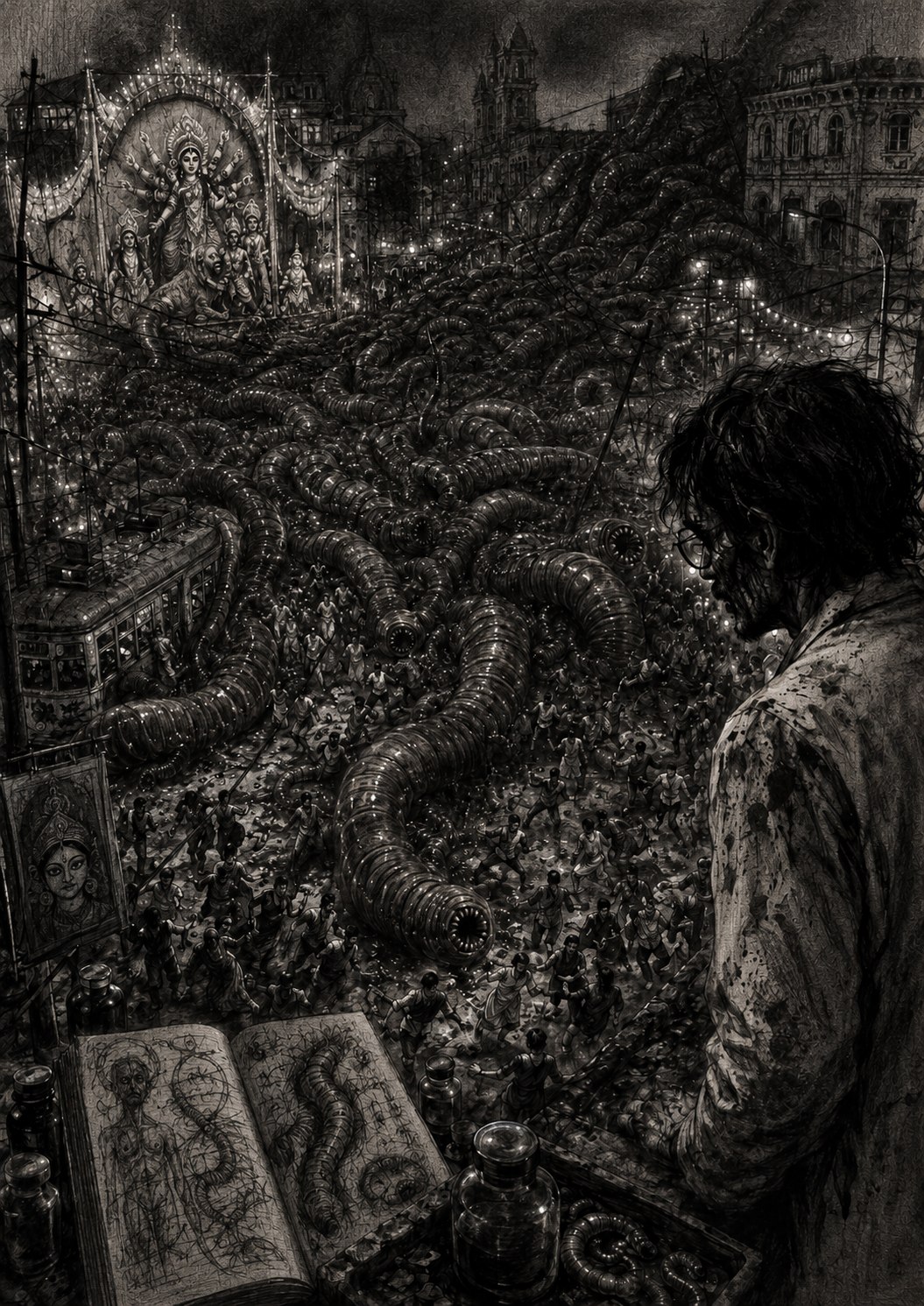
The word was obscene and accurate. Bodies popped in ration lines, in taxis, in hospital corridors, in mall food courts where shoppers pressed themselves against glass storefronts and watched a man rupture beside a mannequin wearing a linen summer collection. Bodies popped in the metro, forcing trains to stop between stations while trapped passengers listened to the swelling groans of those infected in the dark. Bodies popped in gated towers, where residents first blamed housekeeping staff, then delivery boys, then the municipal water they had bribed officials to supplement. Bodies popped in old houses where parents had kept adult sons alive through decades of exams, disappointments, and rice measured carefully in steel bowls.
The city became a map of pressure.
At night, from rooftops, the sound traveled.
Distant, wet, irregular.
Like Diwali heard underwater.
Hospitals failed first. Then garbage collection. Then police movement. App notifications continued longer than electricity, offering discounts on meals no one would eat and rides no one would take.
Anirban kept his mother inside. He boiled water until the LPG ran low. He taped the windows. He mixed oral rehydration salts for Riju, whose belly remained flat but whose eyes had become old.
On the fifth day, Minati said, “I have gas.”
Anirban froze.
She sat on the cot, one hand on her abdomen, almost apologetic.
“Maybe from dal,” she said.
He examined her. Slight distension. Tenderness. Pulse irregular. No fever.
He told himself elderly stomachs did many things. He told himself fear inflated symptoms. He told himself lies with the calm expertise of a man trained in reports.
At 2:20 a.m., her belly tightened visibly under the cotton sari.
“Baba,” she whispered.
She had not called him that since he was a child. In Bengali households affection often travels backward at the end, all the way to the first name love gave you.
Anirban gave her albendazole, simethicone, antibiotics, everything useless in the cupboard. He wanted to take her to hospital, but the lane outside was full of people walking without destination, holding their stomachs, calling for ambulances that would never come.
Minati gripped his wrist.
“Don’t let me burst.”
There is no cruelty like a request that cannot be fulfilled.
He thought of the ledger. Pal. Trial area. Observe gas.
He called every number he had. One rang.
Pal answered on the sixth ring.
“You found it,” Pal said.
No surprise. Only fatigue.
“What is it?”
“A nematode variant. Engineered? Mutated? Depends how much blame you enjoy. We were testing waste-to-protein fermentation. Cheap nutrition. Gut-colonizing organisms to reduce methane, improve digestion. Very elegant idea until it wasn’t.”
“You put it in food?”
“Not me personally.”
“South Sinthee was a trial area.”
A pause.
“Low-income mixed-density neighborhoods are statistically useful.”
Anirban looked at his mother’s swollen abdomen and felt a hatred so clean it was almost refreshing.
“Tell me how to stop it.”
“You can’t.”
“Tell me.”
“The worms generate gas in response to suppression.”
“What suppression?”
“Peristaltic suppression. Chemical suppression. Certain antacids worsen it. Opioids worsen it. Fear may worsen it. We don’t know.”
“My mother has it.”
Another pause. This one had something human in it, though not enough.
“Then don’t give her anything that slows the gut.”
“She’s already swelling.”
“Listen carefully,” Pal said. “There is one anomaly. Some infected hosts don’t rupture. They expel.”
“How?”
“They vomit or pass the colony after intense abdominal contraction. We don’t know the trigger.”
“Find it.”
“We think it may be sound.”
“What sound?”
“The organism responds to vibration. Low-frequency. Rhythmic. Like chanting perhaps. Or machinery. There were lower mortality reports near metro construction zones before the network collapsed.”
Anirban almost laughed. After science had finished poisoning the city, it handed him a folk remedy with a straight face.
“What frequency?”
“I don’t know.”
“You don’t know.”
“Anirban—”
“You used hunger as a petri dish.”
Pal sighed. “Everyone uses hunger. I only measured it.”
The line died.
Outside, someone screamed for Ma.
Anirban searched the flat like a madman. The old mixer grinder did not work without power. The ceiling fan was dead. His mother’s belly rose another inch. Her skin shone.
Rhythm, he thought.
Low vibration.
From the lane came the slow beat of a dhak.
At first he thought he was hallucinating. Then it came again, dull and deep, rolling through the buildings.
Dhoom.
Dhoom.
Dhoom.
Somewhere, absurdly, someone had brought out a puja drum.
Anirban lifted his mother. She weighed almost nothing except for the terrible swollen middle of her. Riju helped. Together they carried her downstairs into a lane lit by phone torches and emergency lamps.
At the crossing, beside Nagen’s abandoned tea stall, a group of men stood around a dhaki from Cossipore. His drum hung from his shoulder. He beat it with shaking hands while infected people crouched nearby, retching.
One woman vomited a mass of pale worms onto the road.
Another collapsed, belly softening.
The drumbeat continued.
It was not faith. It was acoustics wearing borrowed clothes.
“Here!” Anirban shouted.
They laid Minati on a plastic sheet. The dhaki came closer. His face was wet with sweat and terror. He beat harder.
Dhoom.
Dhoom.
Dhoom.
Minati arched.
Her mouth opened.
For one grotesque second, Anirban thought she would rupture from the throat.
Then she vomited.
The worms came out in a shining rope, alive and knotted, splashing onto the road. Riju poured kerosene over them. Someone lit a match. They burned with a smell like rotten eggs and wet hair.
Minati breathed.
The lane cheered, not loudly, because joy had become shy.
By morning, the method spread faster than the disease.
Drums. Bass speakers. Temple bells. Metro machinery where it still worked. People beat buckets, doors, water tanks, old almirahs. Across Calcutta, the city became percussion. From Sinthee to Sealdah, from Garia to Howrah, from balconies and rooftops and market lanes, people hammered rhythm into the air. Some survived. Many did not.
The official channels later called it “community sonic intervention.”
The para called it beating the gas out.
For two days, hope returned in fragments.
Then the worms changed.
On the eighth day, the first silent bursting occurred.
No swelling. No warning. A man in College Street simply opened while buying an old physics guide. By evening, bodies were rupturing without distension. The parasite had learned not to announce itself.
Calcutta fell inward.
There were corpses at bus stops, bodies in puja pandals half-built for a festival that would not come, bodies in the lobbies of private hospitals where billing counters remained locked behind glass. Dogs grew fat and then died swollen. Crows burst on electric wires. The Hooghly carried pale threads in its brown water.
Anirban, Minati, and Riju survived in the flat for eleven days.
They drank boiled rainwater. They ate puffed rice and salt. They did not speak loudly. Speech seemed to vibrate the gut. Or perhaps fear had become religious and was inventing rules.
On the twelfth day, Pal came to South Sinthee.
He arrived in a white SUV with no driver, the windshield cracked, one side smeared with blood. Anirban watched from the balcony as Pal stepped over bodies in the lane wearing an N95 mask and carrying a metal case.
He had lost weight. His rimless glasses were gone.
Anirban opened the door with a kitchen knife in his hand.
Pal looked at it and nodded, as if knives were now part of professional etiquette.
“I have an inhibitor,” he said.
“Does it work?”
“In rats.”
“There are no rats left.”
“In principle, then.”
Minati coughed from the cot. Riju stood behind her with the iron rod used to jam the balcony door.
Pal placed the case on the table.
“Three doses,” he said.
“Why bring them here?”
“Because this is where it started.”
“No. It started with you.”
Pal flinched, but only slightly. “No. It started before me. In drains. In cheap food. In the belief that some people’s bodies are acceptable places to test the future.”
Anirban wanted this to be cowardice. It would have been easier. But Pal sounded like a man describing weather.
The case contained three syringes.
Anirban stared.
Three doses.
Three survivors in the room.
Pal smiled faintly.
“Don’t look heroic. I’m infected.”
Only then did Anirban see Pal’s abdomen.
Flat.
Too flat.
The skin beneath his shirt moved with delicate internal ripples.
“The new form doesn’t swell,” Pal said. “It hollows. Fills the spaces. Learns the host.”
“What does that mean?”
“It means I haven’t been alone inside my body for two days.”
His voice changed on the last word. Not much. Just a doubling, as if another speaker stood behind him in a narrow corridor.
Riju raised the rod.
Pal held up one hand. “Kill me after I tell you.”
“Tell what?”
“The inhibitor won’t save the city. It makes the host unsuitable. The colony leaves.”
“Leaves where?”
Pal looked toward the drain outside.
“Everywhere.”
From below came a sound like rain, though the sky was clear.
Anirban went to the balcony.
The drains were moving.
All along the lane, from every cracked opening and gutter mouth, pale worms flowed upward in a thick living foam. They covered the bodies first. Then the steps. Then the wheels of abandoned scooters. They moved with purpose, not toward food, but toward shelter.
Toward houses.
Toward breath.
Behind him, Pal said, “They learned from us.”
Anirban turned.
“Learned what?”
Pal’s mouth opened.
For a moment, Anirban saw the man he had hated: vain, clever, corrupt in the polished way of modern professionals who never touch blood but profit from its movement. Then Pal’s lips stretched too wide.
The voice that came out was soft and wet.
“To live in the middle class, you must not burst. You must adjust.”
Pal’s abdomen split without sound.
Not outward.
Inward.
His body folded around the opening like a door being politely closed. From him poured no blood, no theatrical spray, only a pale braided mass that slid across the floor toward the metal case.
Riju screamed and brought down the iron rod.
Anirban grabbed the syringes.
One for Minati.
One for Riju.
One left.
Outside, the worms reached the first stair.
Minati watched her son with eyes that had seen him feverish at five, proud at twenty-five, unemployed at forty-eight, and now standing at the last small arithmetic of the world.
“Take it,” she said.
He injected her first.
Then Riju.
The third syringe felt cold in his palm.
The worms entered under the door.
Riju shouted. Minati cried out. Anirban climbed onto the table, though there was nowhere to climb after that.
The pale mass touched Pal’s collapsed body, recoiled from it, and turned toward Anirban.
He looked at the syringe.
Then at his mother.
Then at Riju, who had a whole poor impossible life ahead of him if any world remained to hold it.
Anirban laughed once.
It surprised him. A dry, rude sound. Very Calcutta.
He plunged the last syringe not into his arm, but into the floorboards, where the worms had gathered thickest.
For a second nothing happened.
Then the colony convulsed.
The worms fled the spreading liquid, not dying, only refusing. They surged toward the balcony, over the sill, down the wall, into the lane already white with them. The flat cleared as if a tide had withdrawn.
Minati whispered, “Baba?”
“I’m here,” he said.
But he was not entirely.
A single worm had reached his ankle before the injection hit the floor. It had entered through a small cut he had not noticed. He felt it now inside his calf, then knee, then thigh, traveling upward with the patience of a local train.
He did not tell them.
Some secrets are cowardice. Some are mercy. Most are both.
Weeks later, when the army entered what remained of Calcutta, they found survivors in pockets: people living above ground floors, people who had learned to drum water tanks at dawn and dusk, people whose bodies had rejected the parasite by luck, chemistry, or stubbornness. The death count was called provisional because millions is a number that embarrasses paperwork.
South Sinthee was sealed.
The official report blamed illegal food networks, microbial mutation, civic infrastructure failure, and misinformation. It did not mention hunger as a distribution channel. It did not mention Pal. It did not mention that the first trial zone had been chosen because people there complained loudly but could be ignored safely.
Anirban was listed among the missing.
Minati and Riju were evacuated to a camp near Kalyani. She told everyone her son had saved them. Riju said little. At night he beat a plastic bucket softly beside her cot, not because the doctors advised it, but because sleep required rhythm now.
In the abandoned flat in South Sinthee, rain entered through the balcony and darkened the floor. Political posters outside melted into paste. The tea stall remained closed. The drains were quiet.
Under the table, in the cool swollen wood, Anirban waited.
He had not burst.
He had adjusted.
And when the rescue workers finally broke the seal on the lane, when they stepped carefully past the ruined stall and called out for survivors, he opened his mouth with all the politeness his city had taught him and released, from deep inside his borrowed belly, the first small answering burp.
Word Cloud
Related reading
Selected by shared topics and section, with closer publication dates breaking ties.