The Filth That Learned to Stand
Uses the speech voice supplied by your browser or device.

THIS IS A WORK OF FICTION
By seven in the morning, the garbage at Lake Market had begun to breathe.
Not steam, exactly. Calcutta knew steam. It came off rice cauldrons, tea kettles, wet tram tracks, taxi radiators, and the backs of men who slept badly and woke already defeated. This was different. The black mound behind the fish stalls expanded and sank with the patience of an animal hiding under a blanket.
Aritra Basu stood beside Benu’s tea stall with a clay cup of liquor cha growing hot between his fingers and watched the pile inhale.
Around him the city performed its usual morning circus with the courage of people who had no alternative. Fishwives slapped hilsa on wooden boards. A boy in a Messi jersey threaded through traffic carrying bread. Political posters peeled from a cracked wall: faces smiling with the fixed innocence of men who had never personally met a drain. Above the market, tram wires made exhausted scribbles against a white-hot sky.
“Dekhchen?” Benu said. “You are seeing?”
Aritra said, “Garbage settling.”
“At seven in the morning? Settling also needs office time?”
The mound rose again.
From inside came a sound like dry newspaper being crushed by a very large hand.
Nobody screamed. Calcutta people do not scream first. First they look. Then they form a half-circle. Then they call someone’s uncle. Then they argue about jurisdiction. Only after all constitutional remedies fail do they scream.
A municipal sweeper named Haru came with a bamboo pole and poked the heap. The pole went in two feet and was pulled from his hand.
That was when the first cockroach emerged.
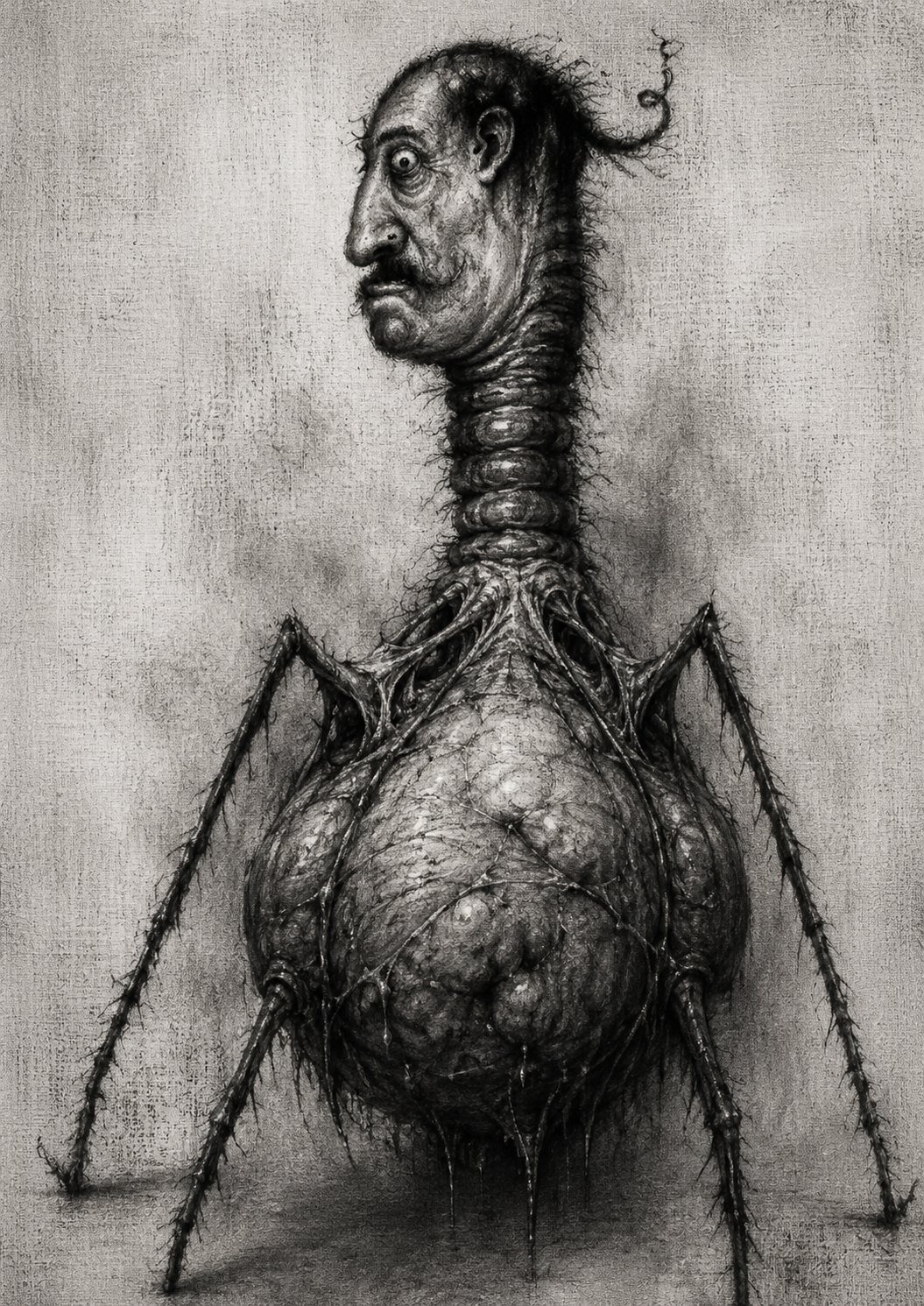
It did not scuttle. That was the insult. Small cockroaches scuttled with guilty electricity, as if late for a private crime. This one climbed out slowly, taller than Haru, its brown carapace shining with fish blood, plastic oil, rainwater, and the yellow dust of the city. Its antennae swept the air like two black whips. Its legs, jointed and hairy, found the street with the deliberation of a dancer learning human steps.
For a moment everyone remained still.
Then the city remembered what it was looking at.
The fish sellers ran. Benu threw boiling tea and missed. A bus on Rashbehari braked sideways, horns began their mad brass opera, and the giant cockroach turned its triangular head toward the sound with an almost bureaucratic interest.
Aritra dropped his tea.
The cup broke.
The cockroach noticed.
Not him. The sound.
It tilted toward the broken clay shards as if listening for a name.
Three nights earlier, Aritra had deleted a file called Ward_Heat_Waste_Vector_Risk_Final.xlsx from a municipal server that still ran like a sick goat in a forgotten room near S.N. Banerjee Road.
He had not wanted to delete it. He had told himself deletion was not the same as lying. A lie had shape. A lie stood up and blocked your way. Deletion was softer, almost merciful. It removed the inconvenience before anyone got hurt by it, especially the person doing the deleting.
The report had been prepared by Dr. Prabir Sanyal, a retired entomologist with tobacco teeth and the manners of a disappointed schoolmaster. Aritra had helped him clean the data because he still took odd freelance jobs after losing his city analytics contract. He had mapped open vats, stagnant drains, recorded surface temperatures, fungal blooms, rodent die-offs, and cockroach density across thirteen wards.
The model had produced nonsense.
Then it produced the same nonsense again.
Then it produced a map that looked like a fever rash spreading north to south across Calcutta.
“Blattella and Periplaneta cannot do this,” Aritra had told Dr. Sanyal. “Not at this scale.”
Dr. Sanyal had looked at him through his thick glasses. “Cannot is a word nature has never respected.”
Aritra had laughed, because retired scientists were allowed to say such things. They had pensions. They could afford poetry.
Then the borough chairman’s assistant had called.
“Dada, small request. Election year. Heat already bad. Dengue already bad. Don’t make one more panic. Send us a cleaner version.”
Cleaner version meant no red zones.
Cleaner version meant no phrase like abnormal mass growth.
Cleaner version meant remove the sentence: “Observed specimens display accelerated molting, heat tolerance, and unusually coordinated aggregation behavior in high-waste, high-humidity, low-sanitation sites.”
For this, Aritra received thirty thousand rupees, paid late, in two parts.
His mother’s insulin had been due. His landlord had started smiling in that terrible polite way of Bengali landlords, smiling as though eviction were a cultural misunderstanding.
So Aritra cleaned the report.
Now a cockroach the height of a man stood in Lake Market, tasting clay with its front legs.
A second one emerged.
Then a third.
By noon, the videos were everywhere.
At first, people joked. Bengalis could joke while the ark was sinking, provided the Wi-Fi held. Someone posted: “Finally, true owners of Kolkata have taken possession.” Someone else wrote: “CM should give them voter cards.” A meme showed a cockroach wearing sunglasses outside a coaching center: “Joint Entrance 2040 Topper.”
By one o’clock, the jokes stopped.
A delivery rider was taken near Gariahat crossing. The footage showed his yellow backpack bobbing once above the traffic before vanishing under a moving lacquered mass. At Sealdah, a swarm poured from beneath Platform 9 after a local train arrived from Baruipur, as if the train had delivered them punctually. Near Dhakuria, residents of an old apartment building watched from balconies as roaches climbed the walls, not swiftly, not stupidly, but with the faintly irritated competence of repairmen.
Aritra’s mother called from Dum Dum.
“Bappa, are you watching TV?”
“No.”
“Don’t lie to your mother. I can hear the news voice from your phone.”
“I’m inside.”
“You have eaten?”
“Ma.”
“You have eaten?”
There was the old city. There was the new city. And under both, older than slogans, older than gated towers, older than the pride of people who pronounced “Kolkata” with career ambition, was this: a mother asking about food while the world took off its mask.
He said, “I’ll eat.”
“Come here.”
“How? Metro is stopped.”
“Then don’t come. Stay. Close windows. Put phenyl.”
“Phenyl won’t help.”
“Then what will help?”
He looked at the phone. Outside his rented flat in Tollygunge, the afternoon heat pressed against the glass like a body. The power had gone, returned, gone again. Somewhere a generator coughed. Somewhere a child cried with monotonous dedication. Downstairs, para uncles were shouting contradictory instructions as if the roaches had requested public debate.
“I don’t know,” he said.
After a pause his mother said, softer, “You always know things on the computer.”
That was worse than accusation.
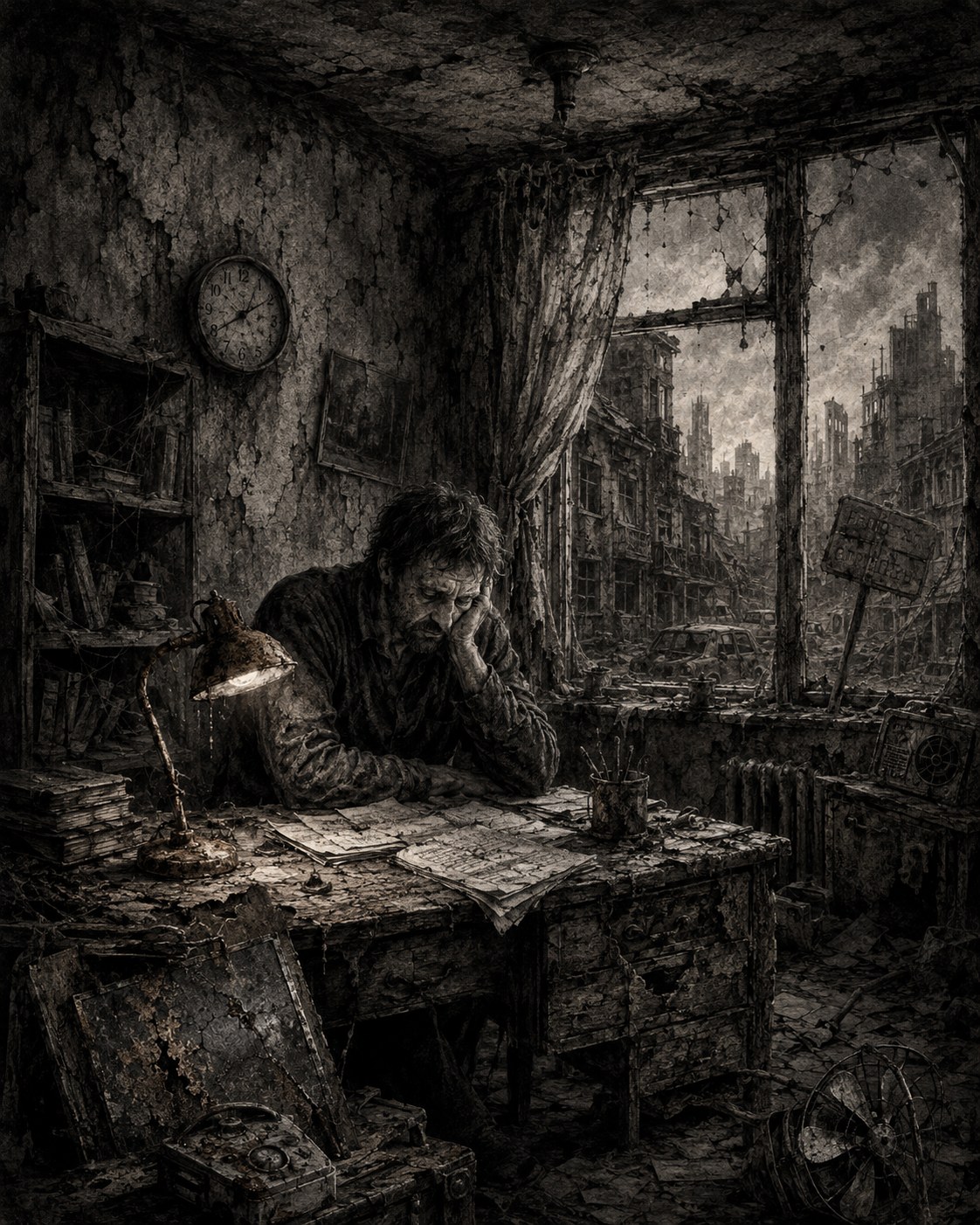
Dr. Sanyal lived in a crumbling house near Bhowanipore, one of those old Calcutta residences with green shutters, damp walls, and a nameplate that had outlived the family’s money. Aritra reached him at four by walking through alleys, avoiding main roads, stepping over drains that smelled cooked.
The city had changed in six hours. Shutters were down. Puja pandal bamboo frames stood unfinished like rib cages. App notifications screamed from phones: STAY INDOORS. A torn cinema poster of an action hero flapped over a dead dog. At Hazra crossing, a police van lay on its side, its lights still spinning. A giant cockroach fed delicately on spilled mangoes, ignoring two men frozen inside an ATM booth.
Dr. Sanyal opened the door before Aritra knocked.
“You deleted it,” he said.
Aritra swallowed. “I kept a copy.”
Dr. Sanyal stared.
“I kept a copy,” Aritra repeated. “On my drive.”
The old man stepped aside.
Inside, the house smelled of books, iodine, and old rain. A single table fan turned with the tragic optimism of public policy. On the dining table lay jars containing dead insects in cloudy liquid. Beside them was a framed photograph of a younger Dr. Sanyal with a woman in a red sari, both standing in front of the Indian Museum. The woman’s face had faded first, as if memory had eaten her from the edges.
Mili was there too.
Aritra had met her during the survey work. She had been hired as a field assistant because she knew lanes that Google Maps treated as rumor. Twenty-six, sharp-faced, hair cut short, one arm scarred from a scooter accident. She delivered groceries in the morning, collected waste samples in the afternoon, and studied for government exams at night, which was perhaps the most Indian of modern prayers: to be exhausted in three directions and still call it hope.
“You kept a copy?” she said.
“Yes.”
“And you said nothing?”
He had no good answer, only the modern middle-class answer, which is always a smaller answer pretending to be practical. Rent. Medicine. Contract renewal. EMI. Reputation. Don’t make trouble. Someone else will handle it. Someone official. Someone permanent.
Mili laughed once. “Educated people are very dangerous, Aritra-da. Poor people do wrong because hunger is standing on their neck. Educated people do wrong after making a folder called ‘Ethics’.”
Dr. Sanyal did not smile.
“Show me the copy,” he said.
Aritra opened his laptop. The battery was at thirty-nine percent. The model glowed to life in the dim room.
Heat islands. Waste accumulation. Moisture retention. Protein availability. Chemical residues from slaughter runoff. Pesticide resistance. Antibiotic contamination. Fungal symbiosis. Molting acceleration.
The map pulsed red.
Mili leaned closer. “Why are the red zones all near old drains?”
“Not drains,” Dr. Sanyal said. “Connections.”
Aritra frowned. “What connections?”
“Underground. Sewer lines. Metro works. Old water channels. Basements. Hospital waste routes. Markets. The city’s intestines.”
On the screen, the red zones formed not patches but a network. Lake Market. Sealdah. Dhakuria. Park Circus. Kidderpore. Dum Dum. Tangra. Rajabazar. Places linked by filth, heat, and neglect, by what the city produced and refused to see.
Dr. Sanyal tapped a black fingernail on the table.
“We thought they were growing in separate colonies. They were not. They were one colony.”
Outside, something struck the shutters.
Once.
Then again.
Mili turned off the light.
The third strike cracked wood.
They went to the back room. Dr. Sanyal pulled aside a bookshelf with surprising strength and revealed a narrow service stair descending into darkness.
“Old coal cellar,” he whispered. “Connects to the lane.”
“Why do you have a secret passage?” Aritra whispered.
“I am Bengali,” Dr. Sanyal said. “All old houses are designed either for romance, lawsuits, or escape.”
They went down.
The cellar smelled of damp brick and kerosene. Aritra’s phone torch caught old trunks, broken idols, a bicycle wheel, sacks of papers, and a trail of black pellets on the floor.
Not pellets.
Egg cases.
Long. Ridged. Shining.
Hundreds.
Mili covered her mouth.
Dr. Sanyal bent down, picked one up with forceps from his pocket, and whispered something that might have been a prayer if he were that kind of man.
Aritra’s phone buzzed.
His mother.
He rejected the call.
Immediately she called again.
Above them, glass broke. Something heavy moved through the house.
Aritra answered.
“Ma, I can’t talk.”
“Bappa,” she said, “someone is knocking.”
His blood seemed to leave him in one clean movement.
“Don’t open.”
“I didn’t. It is at the balcony.”
His mother lived on the second floor.
“Ma, listen to me. Go to the bathroom. Close the door. Wet towels under the gap.”
“It is making sound.”
“What sound?”
She held the phone away.
Aritra heard a faint clicking. Not random. Three taps. Pause. Three taps. Pause.
Then, impossibly, a sound like his own broken clay cup.
Dr. Sanyal looked at him.
“What?” Aritra said.
The old man’s face had changed. Not fear. Recognition.
“They mimic,” he whispered.
“What do you mean mimic?”
“Not voices. Signals. Sounds associated with food, water, movement, opening. They learn.”
Aritra remembered Lake Market.
The broken cup.
The cockroach turning toward it.
His mother whispered, “It sounds like your father’s walking stick.”
His father had been dead eight years.
The bathroom door creaked over the phone.
“Ma, no!”
The line cut.
There are moments when a city becomes too large. Not grand. Not metropolitan. Simply too large for love to cross. Between Aritra and Dum Dum lay roads, stations, swarms, heat, and thirty years of being a son who had left, returned, failed, promised, postponed, and now could not arrive in time.
He stood in the cellar with his phone in his hand.
Mili touched his arm. “We go.”
Dr. Sanyal said, “If we go above, we die.”
“If we stay, we hatch,” she said.
They escaped through the lane.
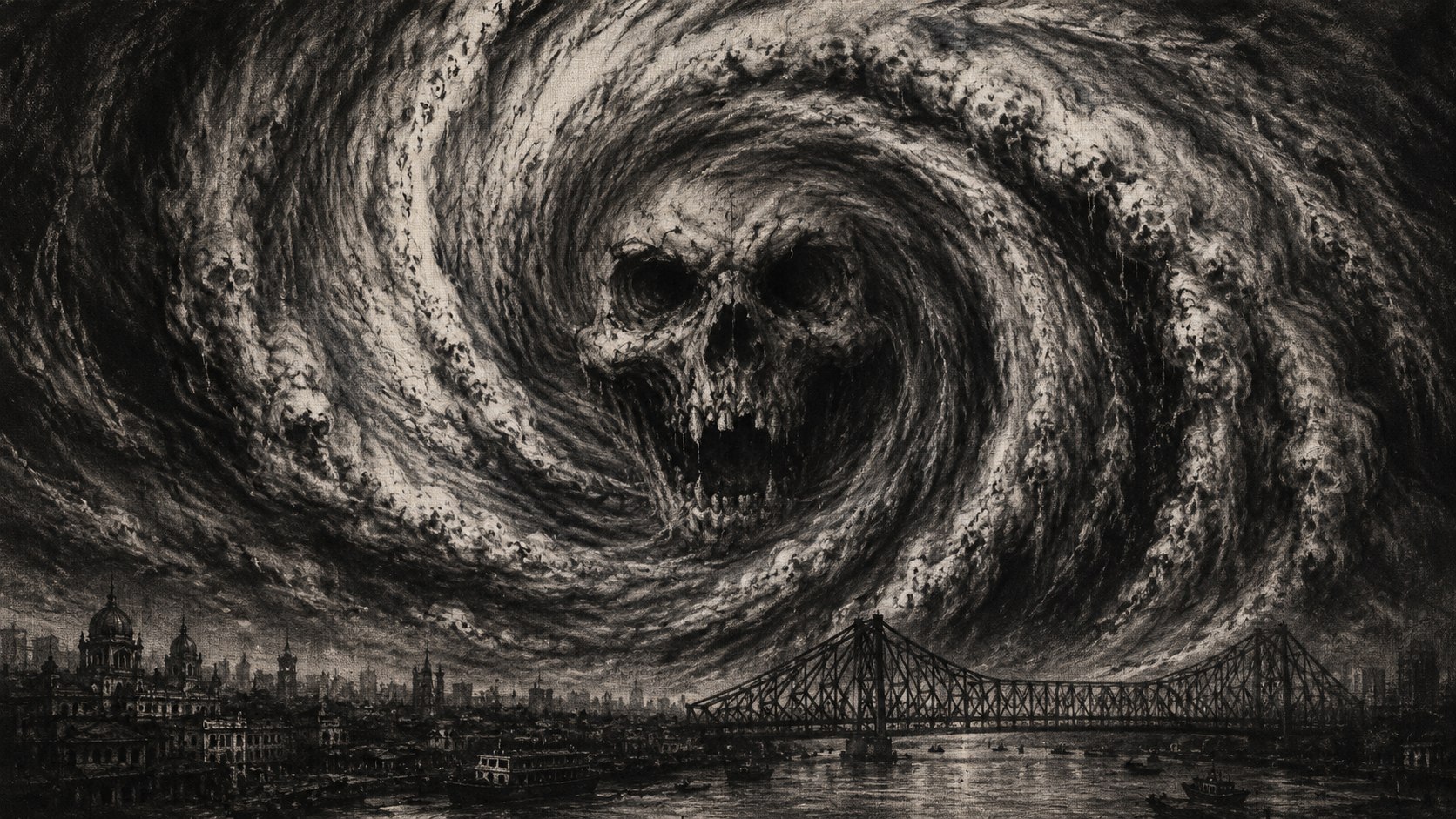
By evening the sky had turned copper, as if the heat itself had rusted. The roaches were no longer everywhere. That was worse. They had retreated into buildings, markets, drains, hospitals, metro tunnels. The visible city was merely damaged. The real city underneath was occupied.
They found a police barricade near Rabindra Sadan. Behind it, officials shouted into phones. A news van burned quietly at the curb. On a big digital hoarding above the crossing, an advertisement for luxury apartments continued to play: LIVE ABOVE THE CHAOS. A smiling family stood on an impossible balcony, drinking imported coffee in clean air.
Mili looked at it and said, “At least advertising is honest now.”
Aritra pushed through until a constable raised a lathi.
“I have the risk model,” Aritra said. “I know how they’re moving.”
The constable stared at his dirty shirt, his cracked lips, his laptop bag. “Everybody knows everything today. Go home.”
Dr. Sanyal stepped forward. “Call someone from disaster management.”
“Dadu, disaster management is already managing disaster.”
From behind the barricade came a scream.
Not loud.
Cut short.
Then the barricade itself trembled.
The officials began running before the public did, which told the public all it needed to know.
They fled into the Maidan metro entrance.
Downstairs, emergency lights washed the tiles red. The station smelled of hot metal, urine, and fear. A few hundred people had gathered on the platform: office workers, students, a priest, two nurses from SSKM, a family with three suitcases, a man still holding a packet of coriander as if civilization might resume and require garnish.
The announcement system crackled.
“Passengers are requested…”
Static.
“Passengers are requested…”
A click.
Three taps.
Pause.
Three taps.
Aritra felt the sound enter his bones.
The people on the platform went silent.
From the tunnel came the dry newspaper sound, multiplied until it became rain.
Dr. Sanyal opened Aritra’s laptop on the floor. “Upload the model. Publicly. Now.”
“No network.”
Mili pulled out her phone. “I have one bar.”
“Hotspot.”
Aritra’s hands shook as he connected. The file was too large. He compressed it. The progress circle spun with comic slowness, the little wheel of modern helplessness. Above the tunnel, darkness thickened.
Twenty percent.
The first antenna appeared beyond the platform curve.
Thirty-one.
People began to back away.
Forty-four.
Aritra’s phone rang again.
Mother.
He stared at it.
Mili said, “Answer.”
He did.
No voice.
Only breathing.
Then tapping.
Three taps. Pause. Three taps.
Then his mother’s voice, perfectly ordinary: “Bappa, I have made tea.”
His eyes filled so suddenly he could not see.
Dr. Sanyal grabbed his wrist. “That is not your mother.”
On the track, the first cockroach emerged into the station light. Behind it came others, their shells scraping tile, their legs finding rhythm. They did not rush. Why would they? The platform was a closed plate.
Aritra watched the upload.
Sixty-two percent.
The cockroach turned its head toward him.
His mother’s voice came from the phone again. “Come before it gets cold.”
Mili whispered, “Aritra-da.”
Seventy-eight.
The insects halted.
All of them.
Their antennae lifted together.
It was not the phone. It was the laptop fan. Aritra realized it with the miserable clarity of a man finally understanding the joke after the room had emptied. The heat from the machine. The vibration. The smell of human salt on the keys.
The model had one missing variable.
Them.
The people who tracked, measured, mapped, carried samples, walked through colonies, touched drains, opened bins, came home with dust on shoes and guilt in their mouths. Vectors did not only breed in filth. They followed knowledge back to its source.
Ninety-three.
Dr. Sanyal whispered, “Shut it.”
Aritra did not.
Mili understood first. She picked up a broken metal sign from the platform floor and stood beside him. Her face was pale, furious, alive.
“Fast,” she said.
Ninety-seven.
The cockroaches began to move.
Ninety-nine.
The screen flashed: Upload complete.
Aritra laughed once, not because anything was funny, but because Calcutta had finally produced a punctual service.
Then the lights went out.
Much later, when the army burned Lake Market and sealed three metro stations with concrete, when newspapers used words like unprecedented and resilient because language also has municipal contracts, when ministers promised compensation after proving identity, when gated towers sprayed imported chemicals and old paras collected kerosene in buckets, the file remained online.
People downloaded it, shared it, cursed it, praised it, misread it, built careers on it.
In the final sheet, after the heat maps and waste correlations, there was a hidden tab nobody noticed for days. Its name was not technical. It was Ma.
Inside were coordinates, time stamps, and one short note Aritra had typed months earlier while cleaning the data, back when mutation was still a spreadsheet problem and guilt still wore shoes.
Primary nest suspected beneath old Dum Dum residence. Repeated acoustic mimicry observed. Do not inform resident until confirmed.
Outside that building, after the fires, investigators found no body of an elderly woman. Only one walking stick, polished clean, and three neat taps scratched into the balcony door from the inside.
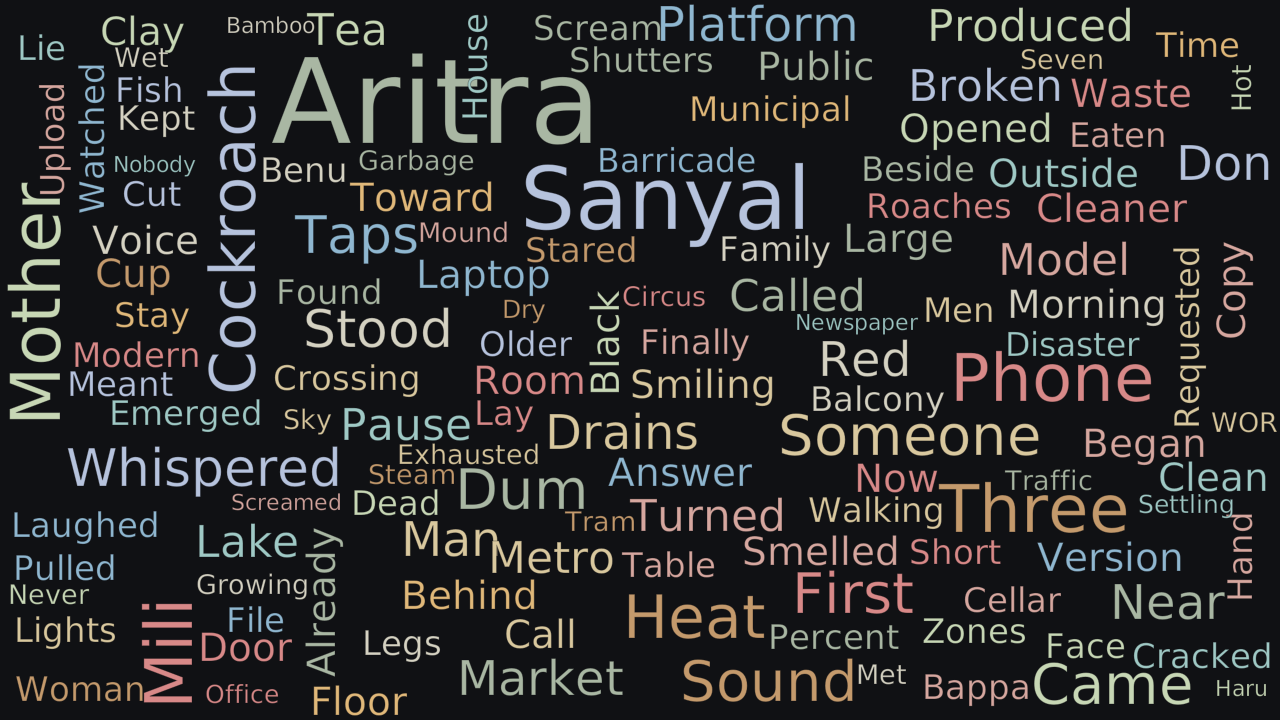
Word Cloud
Related reading
Selected by shared topics and section, with closer publication dates breaking ties.