Saturday Mathematics and the End of Usefulness
Uses the speech voice supplied by your browser or device.

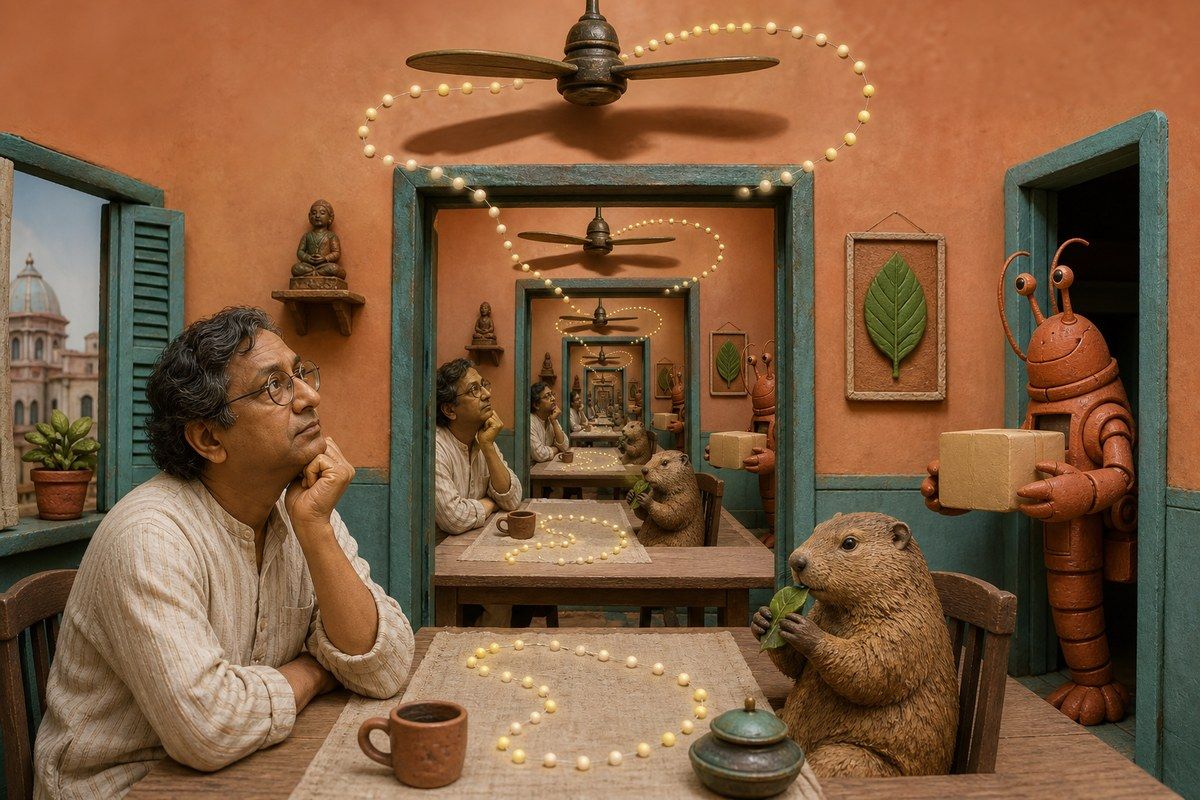
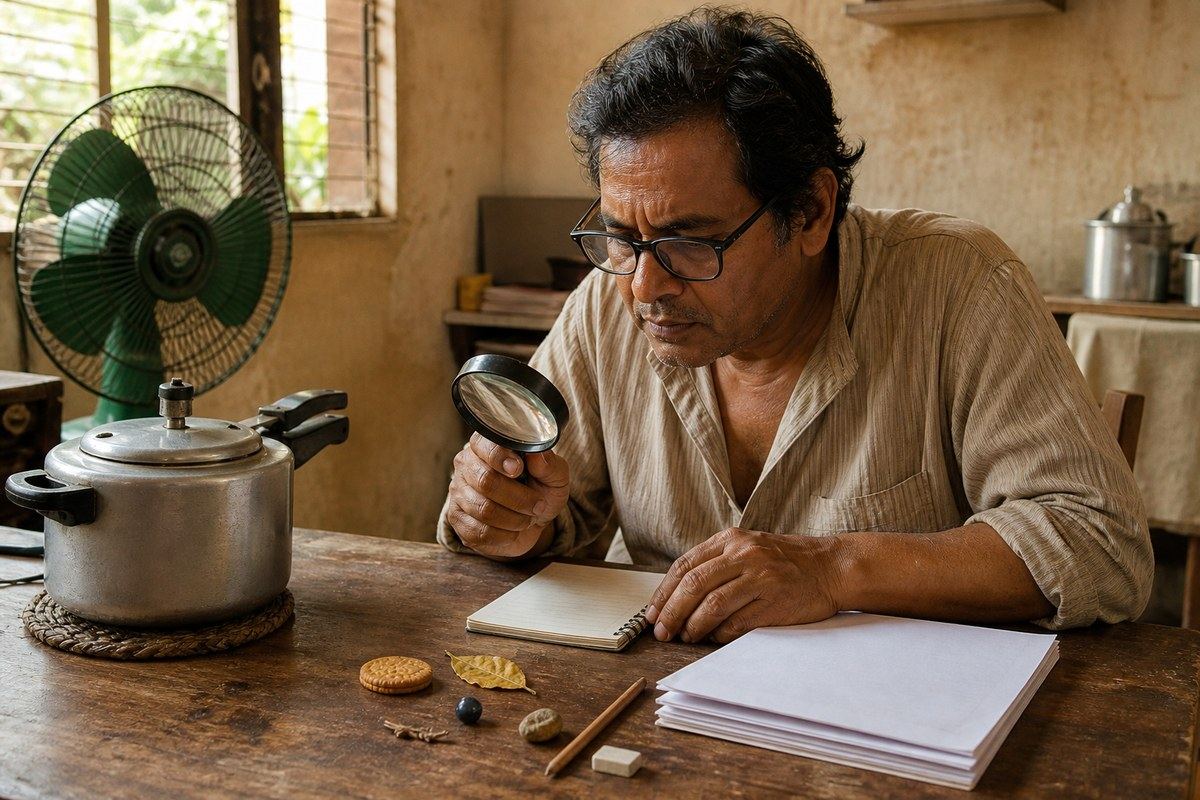
The purple book rests upon my thighs like a contusion that has somehow mastered the art of typography, its cover the precise shade of a bruise transitioning from violet to necrotic yellow, and I am staring at its promises—that mathematics can be gentle, that numbers have a human face, that equations can be approached without the trembling terror of a schoolboy who has just been asked to recite the multiplication table while the class snickers and the ceiling fan whirs overhead with the indifferent periodicity of a cosine wave that has given up on ever completing its cycle—on this Saturday afternoon when the Calcutta heat has transformed my apartment into a convection oven specifically calibrated for the slow roasting of ambitions that were already well-done to begin with, and I am trying to understand, with the desperate concentration of a man attempting to thread a needle while riding a roller coaster, why a negative quantity multiplied by another negative quantity should magically transubstantiate into something positive, as if this algebraic optimism might somehow metastasize into my bank account, my career prospects, or the slowly collapsing soufflé of whatever professional credibility I mistakenly believed I once possessed.
Meanwhile, in the hallucinatory fever dream that we have agreed to call the technology sector, Apple has apparently decided to sue OpenAI for the theft of trade secrets, a legal tantrum involving four hundred former employees who have defected from the fruit company to the church of artificial intelligence like apostles fleeing a sinking orchard, and the timing is exquisite because OpenAI is apparently preparing to launch an Initial Public Offering, which is Wall Street’s elegant euphemism for selling shares in the apocalypse to pension funds and day-traders who wouldn’t know a neural network from a fishing net but are absolutely certain that the future belongs to algorithms, and I am sitting here in my underwear—which has adhered to my buttocks with the tenacious intimacy of a second skin made of shame and synthetic fiber—trying to comprehend basic geometry while the RAM crisis continues to drive the cost of personal computers into the stratosphere, which is a particularly vicious irony because my own random-access memory is depreciating faster than a Maruti 800 with a cracked engine block, and I cannot afford new RAM for a machine let alone new RAM for the biological hard drive inside my skull that seems increasingly prone to catastrophic read-write errors every morning between the hours of six and nine.
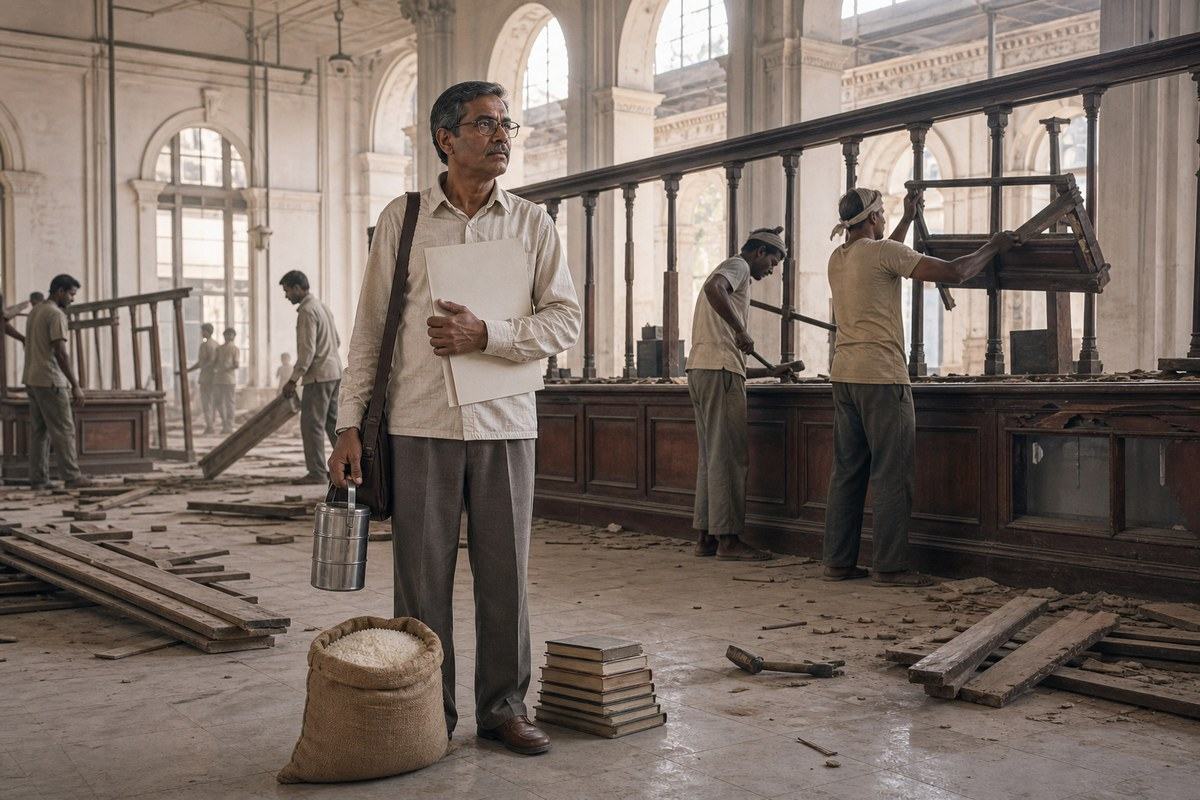
I am fifty-one years old, which translates to approximately one hundred and four in technology years, or perhaps three thousand in the accelerated dog-years of Silicon Valley, where a twenty-six-year-old who has mastered the art of writing Python scripts that generate slightly more coherent spam is considered a veteran and a thirty-year-old is asked, with genuine concern, whether they are planning to retire soon to make room for someone who can still metabolize energy drinks without cardiac incident; my neurons have calcified into Victorian-era infrastructure, my synapses are tram lines from the Raj era, still technically functional but nobody wants to ride them anymore because they don’t have Wi-Fi or air conditioning or the capacity to process machine-learning frameworks, and the young people are all speaking in TensorFlow and PyTorch while I am still fluent in the dead languages of effort, patience, due diligence, and actually comprehending what the infernal abyss you are doing before you do it, competencies that have about as much market value in the current economy as a certificate in bullock-cart repair or expertise in the maintenance of manual typewriters.
The Indian milieu, if one can call this gargantuan, sweating, honking, spitting organism a milieu and not an endurance test designed by a malevolent deity with a particularly grotesque sense of humor, is precisely analogous to standing beside an open drain on Chowringhee Avenue and attempting to appreciate the subtle notes of an imported eau de toilette purchased in a moment of fiscal irresponsibility in 2019; the drain steams with the effluvial deposits of a thousand broken municipal promises, and your cheap polyester shirt sticks to your dorsal region like a layer of adhesive shame, and for exactly three seconds the fragrance rises—a ghost of optimism—and then the miasma swallows it, digests it, and excretes it as a municipal laugh that sounds remarkably like the annual budget presentation of a corporation that has given up on potholes, streetlights, and the electrical grid, and this is exactly what it feels like to attempt a career pivot into artificial intelligence or robotics or healthcare informatics or any of the other anointed sectors that are currently receiving the gilt-edged torrent of venture capital attention, because the infrastructure is not there, the mentorship is not there, the oxygen is not there, and you are expected to bootstrap yourself into relevance using nothing but the slowly dwindling reserves of your own desperation.
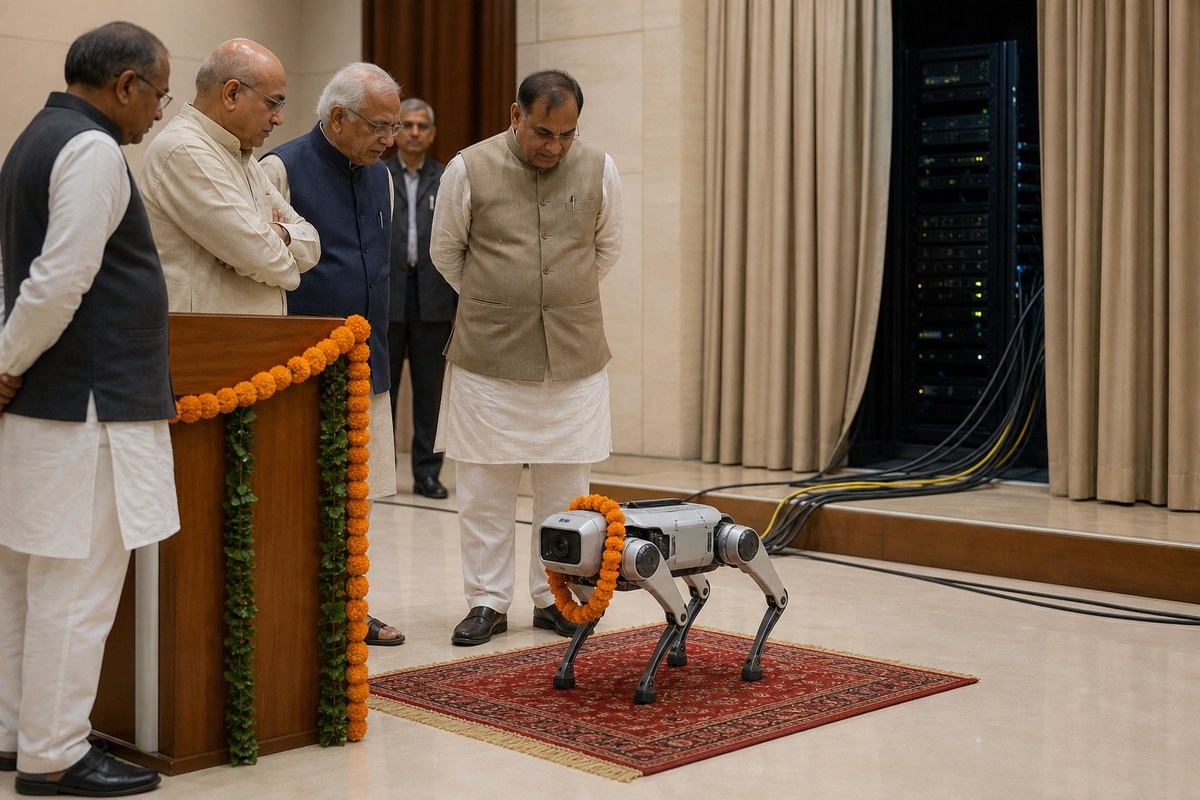
They say—“they” being the faceless chorus of LinkedIn influencers and tech bloggers and the floating robot friends that are now available for pre-order according to the gadget websites that I read with the masochistic compulsion of a man picking at a scab—that this year and the next represent the final window, the last call, the closing doors of the professional saloon before the train leaves the station carrying all the worthwhile careers into the sunlit uplands of the algorithmic future, and if you do not already possess a foothold in AI or robotics or the direct application of machine learning to medical diagnostics or autonomous warfare or predictive policing or whatever other dystopian carnival ride is currently attracting the venture capital, then after that point it will be approximately as easy to convince an employer of your utility as it would be to convince a Bengal tiger to adopt vegetarianism through the power of rational discourse; and this deadline, this Sword of Damocles fabricated from recycled circuit boards and PowerPoint presentations, hangs above my head with a pendulous menace that makes me want to void the contents of my upper gastrointestinal tract into the aforementioned municipal drain, because deadlines are for journalists and software updates and terminal patients, and I am all three but not in the correct chronological order.
But wait—perhaps I am being too hasty in my despair, perhaps there is still time to metamorphose, to pupate, to emerge from the chrysalis of obsolescence as something with wings, even if those wings are made of recycled PowerPoint slides and desperation; perhaps I could become a prompt engineer, a professional designation that sounds like an occupation involving the encouragement of racehorses immediately prior to competition, except the horse is a large language model and the race is the total obsolescence of human cognition, and I could acquire a hoodie, and learn to drink overpriced coffee, and say things like “let’s iterate on that” and “we need to leverage the synergy” while my soul iterates into nothingness, version 1.0 followed by version 1.1 followed by version 1.2, each release more buggy and less feature-rich than the last, a recursive function with no base case, an infinite loop of self-improvement that improves the self right out of existence, round and round, until the stack overflows and there is nothing left but a core dump of memories and a notification from LinkedIn congratulating me on my work anniversary at a company that laid me off three years ago.
The word “robot,” I recall from some half-remembered article read in the waiting room of a dentist who charged too much, derives from the Czech “robota,” signifying forced labor or corvée, a etymological origin that would be deliciously ironic if irony were still a flavor I could taste without the accompanying gastric reflux, because I have performed exactly that—forced labor in the salt mines of institutional mediocrity, the corvée of committee meetings and quarterly reports and performance reviews conducted by people who couldn’t find their own gluteal maxima with both hands and a flashlight—and now the robots have come for the forced laborers, which is a species of poetic justice if poetry were currently being composed by venture capitalists in Patagonia vests rather than by dead Russians with consumption and magnificent beards; and the algorithm, that word we sling around with the casual reverence once reserved for angels and demons, traces its lineage to al-Khwarizmi, the ninth-century Persian polymath whose treatise on algebra gave us the very equations I am currently failing to find solace in, and I suspect that the old man would weep, or perhaps laugh, or more likely do both simultaneously in the manner of a schizophrenic prophet, to witness his beautiful abstractions transformed into mechanisms for predicting what species of deodorant I wish to purchase before I myself have achieved consciousness of the desire, or for determining whether my face resembles a potential shoplifter with sufficient probability to justify my preemptive ejection from a convenience store.
Saturday, the day itself, is a conspiracy against the unemployed and the underemployed and the misemployed and all the other categories of failure that I have cycled through with the restless energy of a manic-depressive hamster on a wheel that is accelerating toward escape velocity; Saturday was invented by people who have weekends, who have brunches, who have futures that extend beyond the immediate horizon of the next electricity bill, and I have instead this ceiling fan and this purple book and this body that communicates with me through an increasingly specific vocabulary of threats regarding blood pressure, prostate dimensions, and the various other betrayals that middle age stages with the solemn theatricality of a Shakespearean tragedy performed in an empty auditorium where the only audience member is my own reflection in the darkened screen of my smartphone, which itself is a species of mirror, a reflective surface that returns an image I no longer recognize, a face that resembles a topographical map of a country that has been devalued, declassified, and deleted from the United Nations of relevance.
Forty degrees Celsius.
The heat is not merely meteorological but metaphysical, a theological argument made by a sadistic demiurge who wants to remind us that we are, at our core, moist tubes of protoplasm struggling to maintain homeostasis in a universe that is trending toward entropy; the sweat pools in the declivities of my clavicles like brackish water in the potholes of Diamond Harbour Road, and I can smell myself, an aroma that combines the fungal notes of unwashed laundry with the sharp, ammoniac urgency of a biological system that has begun to compost itself while still technically alive, and I think, with the clarity that only true despair can provide, that this is what failure smells like—not the grand, operatic failure of the bankrupt tycoon or the disgraced politician, but the small, domestic, incremental failure of a man who has metamorphosed into the precise grotesque his childhood self would have crossed the street to avoid, a biological placeholder, a warm body occupying space that could be better utilized by a server rack or a vending machine or one of those floating robot friends that CNET assures me will revolutionize companionship by eliminating the need for actual humans, who are, after all, notoriously difficult to scale and prone to unexpected emotional downtime.
I check the news again, because self-flagellation requires fresh material, and I see that iPadOS 27 has apparently achieved some new synergy with Siri, that digital sibyl who has never once understood my accent but remains perpetually eager to direct me to restaurants I cannot afford in neighborhoods I do not visit, and Samsung has unpacked something, presumably another rectangle of glass and rare earth minerals that will render last year’s rectangle obsolete, and the whole carnival spins on, the RAM crisis deepening, the AI detectors proving themselves to be garbage—as garbage as the detectors of human worth that currently screen my job applications—and the inflation still high, higher than my blood pressure, higher than the ceiling fan, higher than the mathematical probability that I will ever again feel the sensation of being necessary, of being contiguous with the future, of being anything other than a rounding error in the great calculation of global progress.
The purple book falls shut with a sound like a sigh, or perhaps like a small animal expiring, and I am left with the equation still unresolved, the negative multiplied by the negative still somehow, insultingly, miraculously positive, while every other indicator in my life trends negative with the relentless certainty of gravity; and I realize, with the slow-dawning horror of a man who has just discovered he has been speaking to a corpse for the last hour, that the mathematics does not apply to me, that I am the exception that proves no rule, the outlier that the algorithm discards, the data point that gets smoothed over in the name of a cleaner trend line, and the ceiling fan continues its orbit, indifferent as pi, irrational and infinite and utterly unconcerned with whether I am comforted by its circulation or crushed by its indifference.
On the screen of my phone, which is already two generations behind and therefore approximately as desirable as a typewriter at a hackathon, a notification blooms: OpenAI’s IPO is oversubscribed by four hundred percent. Apple has hired three hundred additional attorneys. CNET informs me that the home AI features which actually make daily life easier now include the capacity to schedule my obsolescence, that a floating robot friend is available for pre-order, that iPadOS 27 has taught Siri to ignore my accent with unprecedented efficiency, and that Samsung has unpacked another rectangle of glass which renders last year’s rectangle emotionally uninhabitable, while the AI detectors continue to be garbage and the RAM crisis deepens and the inflation remains higher than my blood pressure. I look at my hands, which have never built anything that floats, never coded anything that learns, never optimized anything except perhaps the route to the cheapest liquor store in Bhowanipore, and I smell, very distinctly, the last evaporating molecules of optimism surrendering to the humid afternoon, overpowered by the olfactory reality of my own skin giving up, cell by cell, protein by protein, a slow deflation that makes no sound but somehow fills the room.
I am, when all the adjectives have evaporated, merely a biological entity that once attempted competence, which is, in the final calculus, approximately as useful as a chocolate teapot or a screen door on a submarine or a manual typewriter in the age of the floating robot friend, and the worst part—the truly grotesque, cosmically hilarious part—is that I still have the gall to feel disappointed about it, as if the universe had ever promised me anything other than this slow, warm, Saturday afternoon dissolution into the same effluvial matter from which we all emerged and to which we must, with or without dignity, return.
P.S. The book says a negative times a negative equals a positive. I have just checked my bank account. The mathematics, it seems, remains non-transferable.
Word Cloud
Related reading
Selected by shared topics and section, with closer publication dates breaking ties.