Why I Write on Small Things
Uses the speech voice supplied by your browser or device.

People may ask me why I write about small things. Actually, no one asks. That is important. One must not begin an essay with a lie unless one confesses immediately, like a thief returning the fish before the cat gets blamed.
Nobody asks because almost nobody reads my blog. But I imagine, with the majestic self-deception available to unemployed middle-aged men in hot rooms, that if people did read it, one or two might wonder: why does this fellow write about ceiling fans, bad teeth, cheap food, sweating walls, unpaid work, old anger, dead ambition, and the general comedy of being alive in Calcutta with insufficient money and too much nervous system?
Because I am a small subject myself.
There. Mystery solved. No Nobel committee need be disturbed.
Today is hot. Not the common household hot of May, where the bedsheet sticks to your back and the tea tastes like a clerical error. This is June hot. This is extra hot. The heat sits on my chest like a landlord who has come to collect rent before breakfast and has brought two cousins.
In Calcutta, June does not arrive like weather. It arrives like a notice pasted on your door.
The room sweats before I do. The wall sweats. The plastic chair sweats. Even the bucket in the bathroom looks spiritually defeated. The ceiling fan turns above me with that old Bengali government-office sincerity: always in motion, never producing a result measurable by science. Outside, the clouds gather with great political ambition. Black belly. Swollen face. Big speech prepared. They look ready to overthrow summer, capitalism, municipal failure, and possibly my electricity bill.
Then they do what most grand promises do here.
They hang there.
Nothing bursts.
Nothing changes.
Only the air becomes thicker, like rice starch left too long in a steel bowl.
And I lie under this sky like a dismissed clerk of existence, sweating into my own biography.
This is why I write about trivial things. Because trivial things are never trivial when they sit on your chest. A ceiling fan is not trivial when it fails to move enough air. A medicine strip is not trivial when you count the tablets like a miser counting coins. A tooth is not trivial when it begins issuing threats at 2:40 in the morning. Heat is not trivial when it turns your skull into a pressure cooker and your thoughts into overcooked dal.
People who call things trivial usually have air-conditioning.
I have philosophy.
Philosophy is cheaper, but much worse at removing humidity.
Depression, too, is badly understood by people who have only met it as a word. They say “depression” as if it is a sad shirt you accidentally wore to office. No. Depression is biology with boots on. It is the nervous system shutting down the factory because management has fled with the pension fund. Dopamine leaves. Curiosity leaves. Desire leaves quietly, without taking its shoes from the door. Even anger, my last loyal employee, comes late to work, scratches its head, and says, “Again? Today also?”
You think sadness is dramatic.
Actually, the worst sadness is not dramatic at all. It is administrative.
It cancels things. Bathing. Tea. Phone calls. Bills. Work. Hope. Appetite. Music. It puts a rubber stamp on the morning: rejected. Then another on the afternoon: pending. Then another on the evening: no action taken.
By night, you are not tragic. You are paperwork.
I am fifty-one now, which is a polite way of saying the body has started sending legal notices by registered post.
The face is not improving. The bank balance is not improving. The market is not improving. The hair has emigrated like bright Bengali boys going to Bangalore, Canada, Texas, Germany, anywhere except this damp ancestral maze of complaint and compromise. The teeth are filing separate petitions. The belly has developed foreign policy. The knees hold closed-door meetings. The eyes need negotiation. The back has become a retired trade union leader: stiff, suspicious, and ready to strike without notice.
And inside all this damaged furniture sits one ridiculous mind, still wanting respect.
Still wanting meaning.
Still wanting someone to say, “No, no, you were not completely wasted.”
How touching.
How absurd.
How very middle class.
The middle class has a beautiful religion, and no temple is required. It worships success after it has already happened. If money arrives, people discover that you were visionary. Disciplined. Practical. Focused. Possibly blessed, though I am an atheist and would prefer the gods to remain out of my financial paperwork.
If money leaves, your character begins to smell.
The same man who would be called “eccentric” in Singapore becomes “unstable” in South Calcutta. The same bluntness that would be admired in a founder with funding becomes a personality problem in a rented room. The same sleeplessness that looks heroic beside a large invoice looks defective beside rice, egg, and a pharmacy bill waiting three days for payment.
That is the trick.
Success deodorizes everything.
Failure makes even honesty look unhygienic.
I learned this late, because I am not a clever man in the useful sense. I am educated, yes. I worked in the United States for years. I have seen clean roads, hospital systems, data systems, managers who said “circle back” with the solemnity of temple priests, and coffee machines more reliable than many Indian institutions. I have written code. I have repaired broken systems. I have sat in meetings where adults used the word “synergy” and were not immediately arrested.
But useful cleverness is different.
Useful cleverness knows when to bend.
When to flatter.
When to laugh at a joke before it becomes a joke.
When to say “excellent point” to a point that has entered the room wearing only underwear and confidence.
I never learned that part properly.
This is not because I am noble. Please. Let us not create one more unemployed saint in Bengal. We already have enough men with high ideals and low bank balances. I am vain, resentful, frightened, desirous at inconvenient hours, and sometimes as foolish as a goat near a vegetable stall. But I cannot perform that oily little dance where a man folds his spine into a question mark before power, then comes home and calls it networking.
Something in me refuses.
Something stupid, maybe.
Something expensive.
Perhaps survival requires a kind of moral cartilage I was not issued at birth. Perhaps every respectable life has a hidden flattery department, properly staffed, HR-compliant, tea served twice daily, biscuits on Fridays. Perhaps the world is not run by talent, truth, intelligence, or even hard work, but by people who know exactly when to bend, when to smile, when to say “sir” with the correct amount of warm butter in the voice.
And me?
I stand there like a defective Bengali ceiling fan, making noise and moving heat from one corner of failure to another.
This is where profanity enters the room wearing slippers.
People hear a bad word and think it means lack of vocabulary. Nonsense. Profanity is what happens when vocabulary is evicted from polite society and returns with a brick. Sometimes a word bursts out because the pressure has nowhere else to go. It is not elegance. It is not strategy. It is not even courage. It is a steam valve on a cracked boiler.
Better a dirty word than a dirty deed.
Better I curse the afternoon than fold my rage into a polite little smile and become one more civilized monster.
Because humiliation accumulates. It does not disappear because you explain it nicely. It settles in the joints. It salts the tongue. It turns the stomach into a parliament of tiny shouting fools. Class humiliation, professional humiliation, sexual humiliation, the special humiliation of being educated enough to understand your own decline in technical language—these things ferment.
After a while the soul begins to smell like an unwashed pressure cooker.
And yet, the funny thing is, the world keeps asking for presentation.
Comb your hair. Smile. Update your profile. Network. Be positive. Be concise. Be market-friendly. Remove friction. Be digestible. Become a nice packaged biscuit of a man, rectangular, sealed, barcode-ready.
But what if the packet is torn?
What if the biscuit has seen things?
What if the biscuit has bipolar depression, unpaid invoices, dental anxiety, and a fan that sounds like a helicopter with asthma?
Then what?
This is why I write on small things. Because the big things have become dishonest. Nation. Market. Success. Career. Progress. All these words arrive wearing perfume. They sit in studios, conferences, and LinkedIn posts. They grin with polished teeth. Meanwhile, the real life of a man is happening in smaller units: one glass of water, one missed call, one medicine strip, one unpaid bill, one afternoon heat rash, one egg curry stretched over two meals, one sudden memory of who he used to be before the world chewed slowly.
The small things do not lie.
A sweating wall is honest.
A broken tooth is honest.
A fan that achieves nothing is honest.
Even my despair is honest, though it has terrible manners.
In the news, somewhere, some large person is making a large statement about growth, development, investment, confidence, youth power, national destiny. Very good. Let them. Here in my room, a lizard has just crossed the wall with more strategic clarity than most committees I have known. A scooter coughs outside. A pressure cooker whistles from another flat. Someone’s television is shouting about politics with the confidence of a drunk uncle at a wedding. A child cries, stops, then starts again, having apparently reconsidered the matter.
Life continues.
This is the insult.
This is also the mercy.
I do not know what lies ahead. That is the honest line. Not motivational poster nonsense. Not “the best is yet to come,” that sugary fraud sold to people whose electricity has not gone off during summer. I do not know whether work will return. Whether dignity will return. Whether I will become useful again. Whether I must become smaller, sweeter, quieter, more obedient, more socially digestible. I do not know whether the future is a door, a wall, or another unpaid bill wearing shoes.
Some days I feel like an idiot. A broken Bengali specimen. A man beaten by timing, temperament, chemistry, bad luck, bad judgment, and a country where every transaction feels like wrestling a slippery fish in a drainage canal.
But even then, even in the lowest ditch of the mind, I object to the final verdict.
I am not only my collapse.
I am also the witness to it.
That may not sound like much to the winners. The LinkedIn peacocks. The folded-arm consultants. The spiritual taxidermists. The men with clean shoes and dead eyes. But witnessing is not nothing. To know you are being crushed and still name the machinery—that is something.
Not redemption.
Not triumph.
Do not insult me.
Just something.
The clouds are still hanging there, fat with rain and bad intentions. The room is still hot. My body remains a badly managed municipality. I still do not know how to reboot a life without selling the remaining scraps of my face.
So I lie here, sweating, muttering, alive in the most insulting technical sense, waiting for rain like a fool waiting for justice.
And from the corner of the room, even my despair has started laughing.
At least someone is entertained.
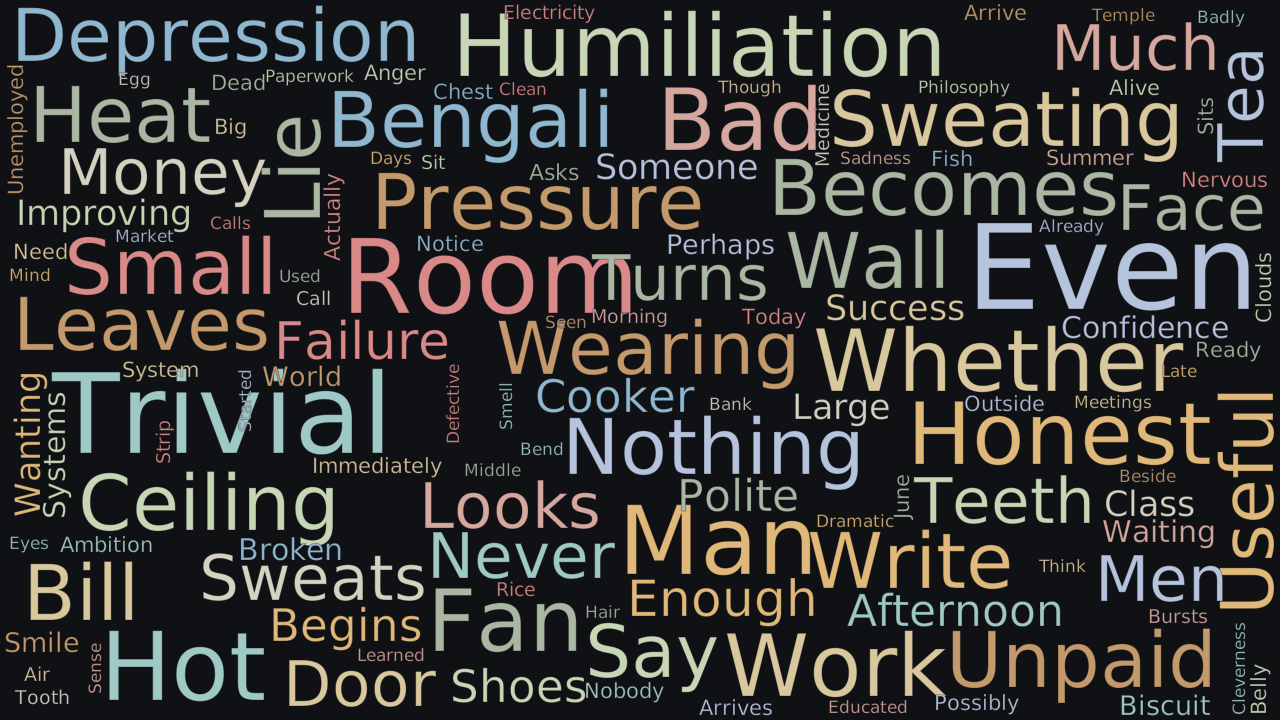
Word Cloud
Related reading
Selected by shared topics and section, with closer publication dates breaking ties.