Complexity in Calcutta
Uses the speech voice supplied by your browser or device.

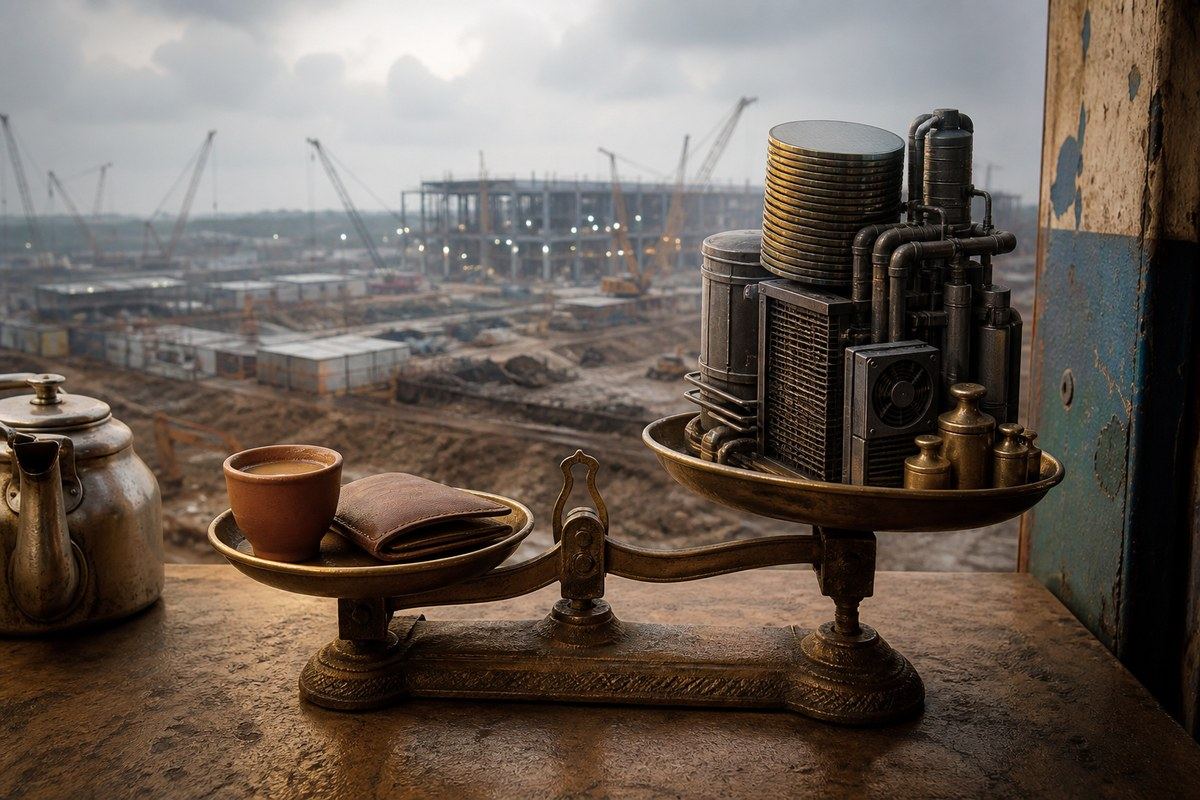
The ceiling fan in my study turns with a faint, rhythmic wobble that I have learned to stop noticing, much as one stops noticing the particular pitch of a neighbor’s generator or the perpetual hum of the city beyond the window, which is to say that I notice it precisely when it stops, which happened this morning at six-fifteen, when the power flickered and died for eleven minutes, and in that sudden, humid silence I became aware of how much machinery I had invited into my life to make existence tolerable, and how each machine had brought with it its own small demands, its own particular fragility, its own scheduled obsolescence, and how the aggregate of these machines—the air conditioner, the water purifier, the refrigerator with its ice maker that jams every third week, the router that requires biweekly resuscitation, the phone that updates itself in the middle of the night and emerges with new buttons in new places and new permissions I never granted—constitutes a kind of second body, an external nervous system that I must maintain and troubleshoot and eventually replace, cell by cell, while my original body, the one I was born with, proceeds on its own schedule of entropy, largely ignored until it protests too loudly to be dismissed.
I live in Calcutta, a city that has been renamed Kolkata by official decree but persists in the mouths of its residents and in the architecture of its colonial bones as something older, more complicated, less willing to be tidied up, and this morning, while the fan was still and the sweat began to gather at the back of my neck, I stood at the window and watched the street below perform its usual choreography of contradiction: a man in a pressed white shirt and frayed trousers unlocking a shuttered shop while talking into two phones simultaneously, a cow chewing methodically through a pile of vegetable scraps that someone had dumped there overnight, a municipal sweeper pushing a broom that was more handle than bristles, a young woman in a hijab and sneakers power-walking past a temple where a priest was already ringing the morning bell, the sound of which carried up to my window and mixed, improbably, with the bass from a car stereo three streets away, playing something I did not recognize but could feel in my sternum, and all of this happening under a sky that was the color of a dirty dishcloth, promising rain that would probably come too late or too much or in some other way that would inconvenience everyone and satisfy no one.
This is the complexity I want to think about, not the grand complexity of systems theory or chaos mathematics, though those are real and I have read about them with genuine interest, but the smaller, daily complexity of living in a body, in a city, in a time when the number of things demanding attention has multiplied beyond any reasonable capacity to attend to them, and when the tools designed to manage this multiplication have themselves become sources of multiplication, each app a portal to a hundred other apps, each notification a tiny fracture in the attention I am trying to direct toward something that actually matters, if I could only determine what matters, which is itself a question that the tools claim to answer but in fact only defer, offering me metrics and rankings and trending topics that shift by the hour, leaving me with the persistent sense that I am always slightly behind, slightly out of step, slightly too slow to catch the thing that everyone else has apparently already caught and moved on from.
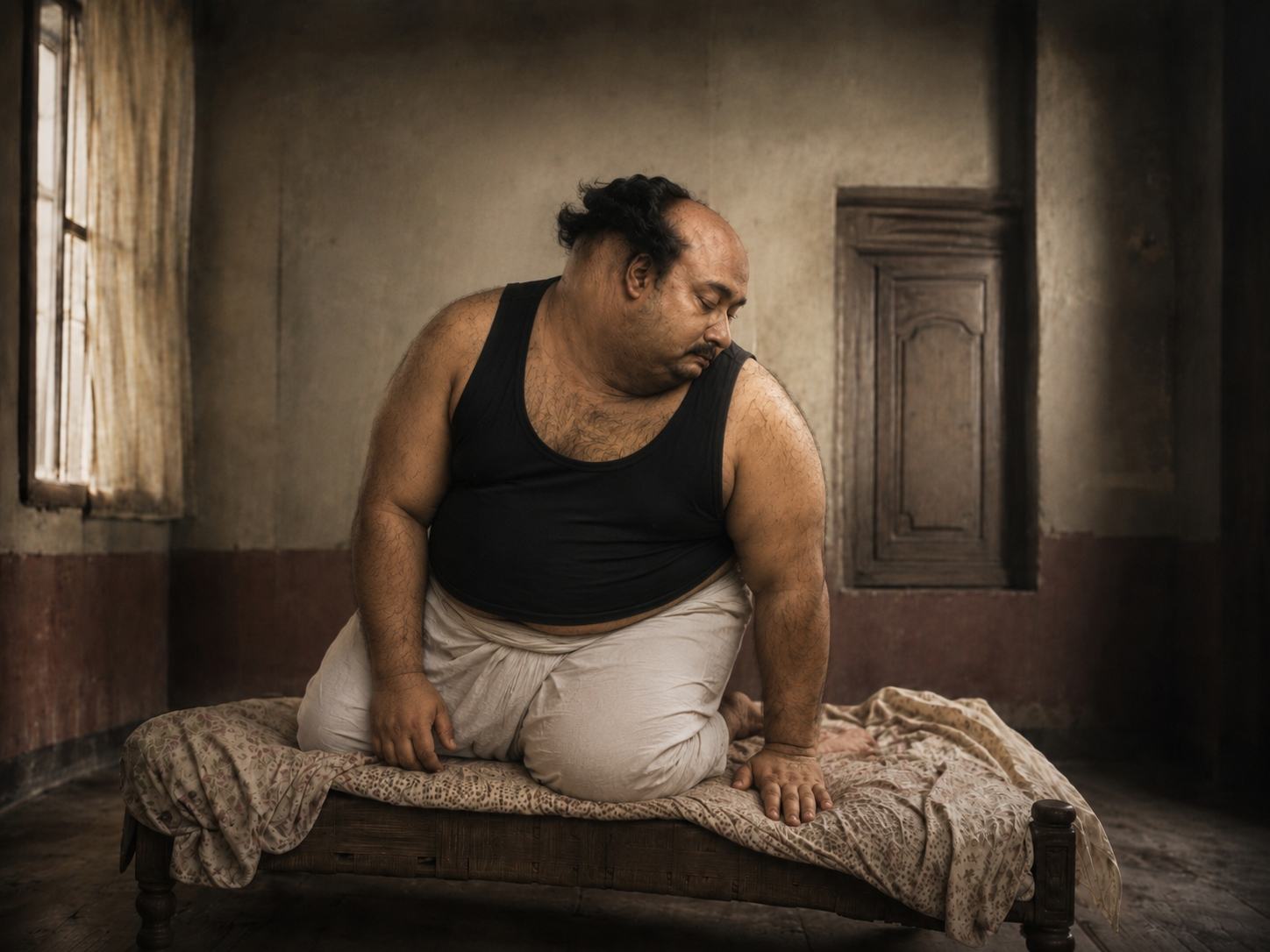
I am not a young man, and I am not an old man, and I occupy that middle stretch where the body begins to send its first honest signals of limitation while the mind, still agile, still hungry, still capable of genuine curiosity, must negotiate with a world that seems increasingly designed for minds that are younger, faster, more comfortable with the perpetual partial attention that the digital environment demands, and I find myself, more and more, in the position of a student who has arrived at the lecture hall to find that the language of instruction has changed while he was in the corridor, and everyone else is already taking notes in a script he cannot read, and the professor is speaking too quickly, and the slides are advancing before he can finish reading them, and the whole enterprise feels less like education than like a test of stamina, a test he is not sure he wants to pass.
The news this morning, when the power returned and I opened my laptop to a screen full of red notification badges, included the Calcutta High Court rejecting yet another petition from a politician seeking to travel abroad, which is the kind of story that would have been shocking once, or at least noteworthy, but which now registers as background noise, another data point in the endless stream of administrative conflict that constitutes public life, and I found myself wondering, not for the first time, whether my capacity for genuine moral outrage has been eroded by repetition, whether the sheer volume of information has produced a kind of ethical fatigue, a numbness that masquerades as wisdom, and whether this numbness is a personal failing or a reasonable adaptation to a world that presents too many outrages for any single person to process with the gravity they deserve.
I think about the students who took the NEET examination last year, this year, every year, the ones whose futures were, are, and shall be compromised by paper leaks and bribery and the general incompetence of the systems designed to protect them, and I think about how those students must feel, studying for years, sacrificing sleep and social life and the ordinary pleasures of youth, only to discover that the game was rigged before they ever sat down to play, and then I think about how quickly these stories moved from the front pages to the back pages to the archives, replaced by newer outrages, newer scandals, newer administrative failures, and I wonder what it does to a person, to a society, to live in a continuous present where the past is always being overwritten, where memory itself becomes a kind of resistance, an act of deliberate, almost political, stubbornness.
The philosopher Bernard Williams wrote about moral luck, the idea that much of what determines the shape of a life is outside our control, and I think about this often, not in the grand way of tragic choices and catastrophic accidents, but in the small way of being born in this city at this time, with this particular temperament, this particular capacity for attention, this particular susceptibility to the anxieties of the age, and how these factors, none of them chosen, none of them deserved, combine to produce a life that feels, on good days, like a more or less successful navigation of complexity, and on bad days like a drowning in it, a slow suffocation by the sheer weight of things that need to be understood, decisions that need to be made, information that needs to be processed, relationships that need to be maintained, bodies that need to be cared for, all of it happening simultaneously, all of it demanding a presence that I cannot always summon, a clarity that I cannot always achieve.
I went to the market this afternoon, because the refrigerator was empty and because I needed to move my body through space in a way that did not involve a screen, and the market was its usual glorious, exhausting, overwhelming self: piles of vegetables that I could name but not always identify with confidence, fish still smelling of the river, vendors calling out prices that fluctuated based on some algorithm of relationship and desperation that I could never fully decode, the physical negotiation of narrow lanes and competing bodies, the heat rising from the pavement in visible waves, the knowledge that I was being watched, assessed, categorized, the simultaneous performance of being a customer and a citizen and a body moving through a crowd, and I found myself, as I often do, in a state of something like wonder at how much intelligence is required simply to exist in this city, how much tacit knowledge, how much improvisational skill, how much tolerance for ambiguity and contradiction and the general failure of things to be what they claim to be.
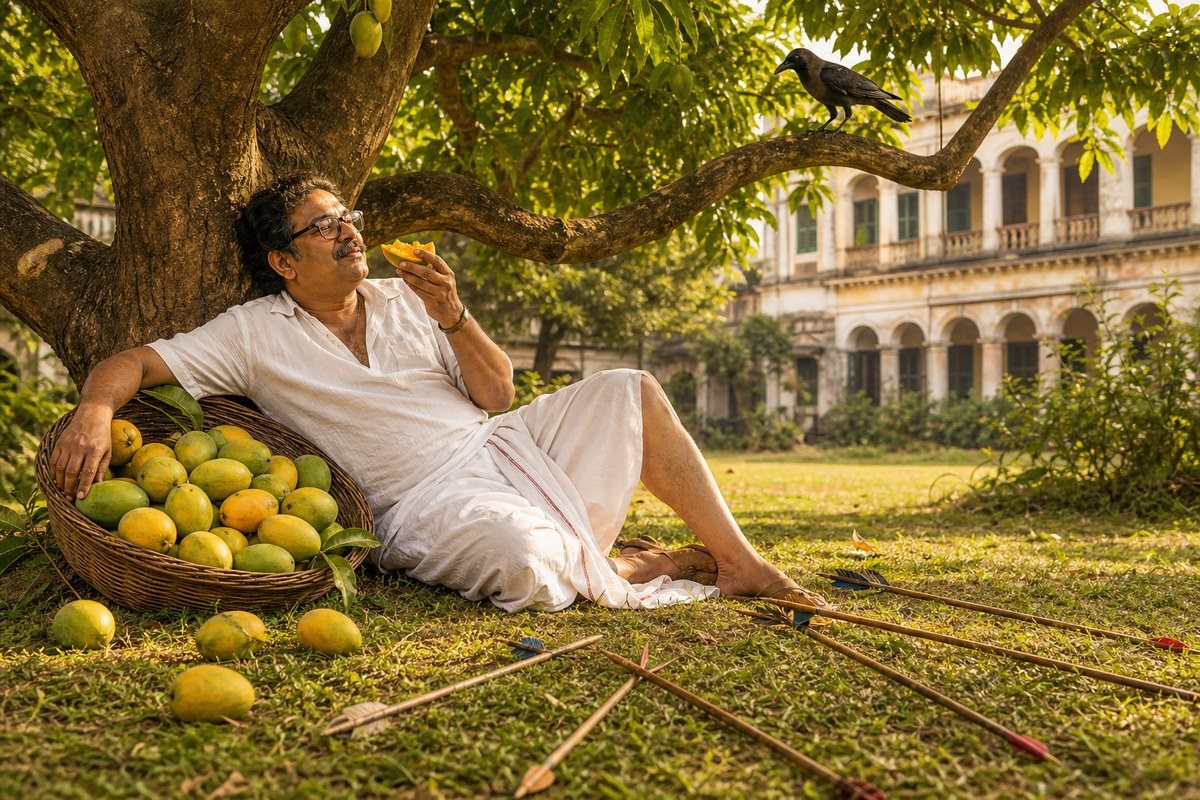
I bought a mango, because it was mango season and because the vendor, a woman whose face I recognized but whose name I had never learned, held one up and said something in Bengali that I understood to mean “this one, sweet, good,” and I trusted her, not because I had any empirical basis for this trust, but because trust itself is a necessary simplification in a world of overwhelming complexity, a heuristic that allows us to move forward without verifying every claim, testing every proposition, and I paid her in cash, because she preferred cash, because the digital payment systems that were supposed to simplify everything had introduced their own complications, their own failures, their own exclusions, and I walked home with the mango in a plastic bag, thinking about how every solution generates its own problems, how every simplification conceals a new complexity, how the dream of a frictionless life is itself a kind of friction, a constant grinding against the reality that life is, was, and presumably always will be, difficult.
The mango was, in fact, sweet. I ate it on the balcony, watching the light change over the city, the particular quality of late afternoon in Calcutta when the sun is low and the dust in the air turns everything golden and slightly unreal, and I thought about the research I had read recently, the studies about decision fatigue and cognitive overload and the measurable deterioration of reasoning capacity that occurs when people are asked to make too many choices in too short a time, and I thought about how this research, conducted in laboratories with clean variables and controlled conditions, might apply to a life like mine, a life lived in the uncontrolled experiment of a city that never stops demanding choices, where every intersection is a negotiation, every transaction a calculation, every social encounter a performance requiring real-time adjustments to an ever-shifting script.
I do not want to sound like I am complaining. I am not. Or rather, I am, but I recognize that my complaints are themselves a kind of luxury, a sign that my basic needs are met, that I have the leisure to worry about the quality of my attention rather than the quantity of my food, and I am aware, constantly, almost oppressively aware, of the gap between my anxieties and the anxieties of most of the people I pass on the street, the ones for whom complexity is not an abstract problem but a concrete, daily, often brutal reality of survival, and I wonder what it means to write about complexity from a position of relative comfort, whether this is an act of genuine reflection or a kind of aestheticization of privilege, a way of turning the manageable difficulties of a fortunate life into something that looks like profundity.
But I also think that complexity is not zero-sum, that the anxieties of the privileged and the anxieties of the poor are not the same but are perhaps related, different manifestations of a system that produces overwhelm at every level, that distributes its burdens unevenly but universally, and that the person struggling to pay for a child’s school fees and the person struggling to maintain focus in a meeting full of digital distractions are both experiencing, in their different ways, the same fundamental problem: a world that has become too much, too fast, too layered, too interconnected, too full of demands that cannot be refused without consequence and cannot be met without exhaustion.
The fan started again, eventually, as fans do, and the air began to move, and I finished the mango and washed my hands and sat down to write this, not because I have anything to say that has not been said before, but because the act of saying it, of arranging words in a sequence that feels honest and precise, is one of the few responses to complexity that I have found genuinely satisfying, a way of slowing the world down to the speed of a sentence, of forcing the chaos into a shape that can be held in the mind long enough to be examined, and even if the examination reveals no solution, even if the shape dissolves as soon as it is completed, there is something in the attempt itself that feels like a small, personal victory, a refusal to surrender entirely to the fragmentation, the speed, the perpetual distraction.
I do not know what I will do tomorrow. I will wake up, probably, at approximately the same time, to approximately the same sounds, and I will perform approximately the same rituals, and I will face approximately the same choices, and I will make them with approximately the same mixture of confidence and doubt, and the day will proceed in its approximately predictable way, with its small surprises and its small disappointments, and I will navigate it as best I can, with the tools I have, with the body I have, with the mind I have, in the city I have chosen, or that has chosen me, or that we have chosen each other, this arrangement of brick and concrete and human need that continues, against all odds, to function, to persist, to generate meaning in the midst of its own chaos.
The mango seed is on the table beside me. I should throw it away. I will, eventually. For now, I am looking at it, this smooth, oblong thing, the remnant of something sweet, and I am thinking about how much complexity is contained in something so simple, how many processes of growth and decay and transformation are encoded in its shape, how many generations of farmers and traders and eaters have handled objects like this, how many stories it could tell if seeds could tell stories, and I am thinking that this, perhaps, is the only honest response to complexity: not to solve it, not to simplify it, not to transcend it, but to sit with it, to look at it, to let it be what it is, and to continue, in spite of it, because of it, in the ordinary, daily, unheroic business of being alive.
I am on the terrace. The light is fading now. The street below is filling with the evening crowd, the commuters and the vendors and the dogs and the children and the cars and the bicycles and the general, glorious, exhausting mess of a city that refuses to be anything other than what it is, and I am going to close this document and go downstairs and make myself some tea, and the tea will be too hot at first, and then it will be just right for a few minutes, and then it will be too cold, and I will drink it anyway, because that is what one does, and because the small pleasures, the ones that do not last, are perhaps the only pleasures that are genuinely available, and because the complexity does not end, and cannot be ended, and the only wisdom, if there is any wisdom, is to know this and to continue anyway, to make the tea, to drink the tea, to wash the cup, to go to bed, to wake up, to begin again, not because it is simple, but because it is not, and because the complexity itself, endured, attended to, refused and returned to, is the only form of meaning we have.
Word Cloud
Related reading
Selected by shared topics and section, with closer publication dates breaking ties.