Aimless With Mangoes
Uses the speech voice supplied by your browser or device.

Acronyms used:
DMN — Default Mode Network, the brain system often active when the mind wanders into self-talk, memory, worry, and autobiography.
SIM — Subscriber Identity Module, the small card or embedded phone identity that lets a mobile network recognize a user.
The mango had gone soft near the stem, which is how many things in Bengal announce decline: not by collapsing dramatically, but by developing a small brown truth in one corner.
I stood beside the table with the knife in my hand, bare-chested, mildly sweating, looking at this fruit as if it were a relative who had returned from America and now refused to discuss what had happened there. Outside, a pump was coughing water upward through the building. Somewhere a pressure cooker screamed. A child in the lane was being told to study as if the future were hiding inside page 43 of a guidebook.
I pressed the mango gently.
It gave in.
At that exact moment, with no orchestra, no dark curtain, no tragic Bengali lighting, I thought: my life now has no aim.
Not no desire.
Desire is still alive. Unfortunately. It moves under the furniture like a cockroach with a long-term survival plan. I still want good food, women, books, silence, money that does not arrive like a shy goat, and enough stability to answer the phone without feeling that a magistrate is calling from inside it. Sometimes after tea, for about four minutes, I even want a second act, a ridiculous late flowering, the world suddenly discovering its clerical mistake and sending me dignity by registered post.
But aim is different.
Aim is the arrow.
Desire is the stomach looking at the mango and making policy.
Aim requires a target, a road, stamina, and the private superstition that the future is not merely a drain with a calendar pasted over it. At fifty-one, in the warm damp edge of Calcutta where walls grow freckles and towels never truly dry, aim does not feel noble. It feels like those plastic toy guns sold near fairs, bright orange, incapable of hurting anyone, but still making a hopeful clicking noise.
Click.
Click.
Nothing leaves the barrel.
This is not despair speaking in a shawl. Despair has style when you are twenty-two, thin, and smoking on a balcony with revolutionary cheekbones. In middle age, despair becomes accounting. It comes with columns. Tooth pain. Rent. Loose fan regulator. Yellowing collar. Mother aging. Body unpredictable. Income irregular. Old friends absorbed into flats, mutual funds, school fees, cholesterol medicine, and the strange private republic of family life. The country outside shouting about progress while the local drain outside your house behaves like an ancient enemy.
That is where aim goes.
Not in one grand explosion. Not like cinema.
It leaks.
People think failure is a single event. Divorce. Bankruptcy. Job loss. Diagnosis. Return from abroad. Career collapse. But much of middle-aged failure is not an event. It is a recipe. A little unpaid work, a little anxiety, a little tooth decay, a little shame, a little insomnia, a little “I will do it tomorrow,” a little rain entering the window, a little phone call avoided, a little confidence lost.
Mix well.
Cover and keep in humidity.
After some years you open the lid and find not a problem but a full ecosystem.
That is the nasty genius of it. Small things breed. A missed appointment becomes shame. Shame becomes staying indoors. Staying indoors becomes fewer chances. Fewer chances become less money. Less money becomes more delay. Delay becomes disgust. Disgust becomes sleep. Sleep becomes waking at 11:20 with a mouth tasting of old metal and a mind already standing over you with a clipboard.
There are mathematicians who study the explosion of possibilities when many little variables interact. They call it combinatorics, which sounds clean because mathematicians generally do not include damp underwear, loan reminders, and South Calcutta mobile shops in their examples. A life with too many small difficulties becomes too large to solve by ordinary search. There are too many branches. Too many “if this, then that.” Too many ways for Tuesday to become unusable before lunch.
In youth, a failure is a stone on the road.
At fifty-one, it is a trapdoor.
You lose direction at twenty-five and people say, “You will recover.” You lose direction at fifty-one and people become gentle in that frightening way. They no longer give advice. They say, “Take care.” This is not cruel. It is worse. It is accurate. They can smell the calendar. They know the market is not exactly waiting with garlands for a middle-aged man with gaps, mood disorder, old American experience, and a consulting income that behaves like Calcutta rain: absent for weeks, then suddenly too much in the wrong place.
And yet.
Here is the mango again.
Its skin looks ordinary from the outside, but when the knife enters, there is that impossible yellow. Almost vulgar. Fruit has no modesty. Mango especially has the confidence of a man who knows the entire summer is named after him. It does not care about my failed arc, my LinkedIn, my missing future, my biography lying in fragments like old bus tickets. It simply sits there, fragrant and sticky, making the room briefly less philosophical.
This is where aimlessness becomes complicated.
Because aimlessness is not always emptiness.
Sometimes it is relief.
The productivity people will not tell you this. The microphone monks, the online clarity vendors, the men with veins in their forearms explaining discipline under blue lighting, the cheerful corporate saints selling morning routines as if waking at 5 a.m. can repair a damaged civilization. They speak of purpose as if it were a kitchen appliance. Buy it, plug it in, make smoothies of destiny.
But purpose can also become a landlord.
It knocks every morning.
What have you done?
Where are you going?
Why are you behind?
Why are you not more?
Why are others ahead?
Why is your old classmate in Singapore smiling beside a glass building while you are negotiating with a soft mango and an unpaid invoice?
Aimlessness, after the first terror passes, sometimes tells this landlord to come later.
That is not liberation exactly. More like the electricity returning after two hours and only the fan working, not the fridge. Still, the fan works. You take what you get.
A crow has no five-year plan.
A stray dog does not wonder whether it should have monetized its personal brand.
The cat on the boundary wall does not suffer because it has failed to become a thought leader in the emerging economy. It is already something. Hungry. Suspicious. Elastic. Entirely without a webinar.
Humans are the poor fools who were handed arrows before we understood distance. In India, this begins early. Become doctor. Become engineer. Become officer. Become respectable. Become married. Become owner of flat. Become father. Become the person relatives can mention without lowering their voice. The child is still learning fractions, and already half the neighborhood has enrolled him in a national anxiety program.
Then if the arrow bends, breaks, or falls into the drain, society looks surprised.
As if it did not run the archery camp.
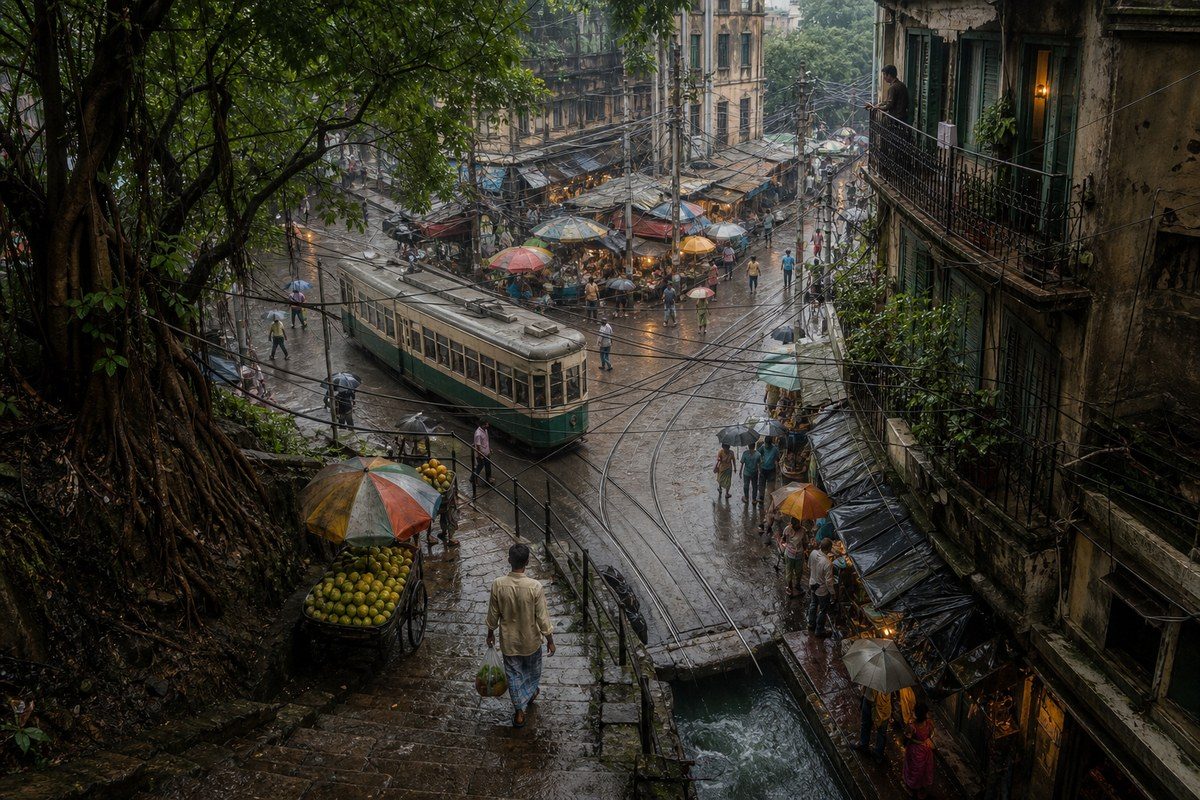
Calcutta has a gift for showing you what continues after importance has left. Old houses continue after families scatter. Trams continue in memory long after speed has become a civic religion. Tea shops continue after revolutions shrink into wall paint and old men arguing over newspapers. Photocopy shops continue near coaching centers, reproducing hope at two rupees a page. Roads are dug, filled, dug again, as if the municipality is searching for a lost earring under civilization.
The city does not teach triumph.
It teaches continuation.
Continuation is not pretty. It has sweat under the arms. It has gastric trouble. It smells of old rice, damp cloth, and the neighbor’s fish being fried at the exact moment you are trying to think noble thoughts. But it is not nothing. A man continues. A room continues. A blog continues. A mango ripens past its ideal point and must still be eaten.
This is not a motivational message.
Motivation is often just panic wearing running shoes.
I am talking about something smaller. The right to stand still without converting stillness into failure every minute. The right to notice the day without asking whether the day can be leveraged. The right to look at ordinary things before the mind drags them into court.
The lizard near the tube light.
The blue plastic bucket.
A woman’s sandal slapping the lane.
A delivery boy calling someone “dada” with professional exhaustion.
A news anchor shouting from a television in another room about crisis, growth, nation, insult, market, border, weather, cricket, artificial intelligence, and three other items that will be forgotten by dinner.
The smell of frying onion entering my room from a kitchen that is not mine, which is one of the more precise forms of social insult known to man.
These fragments do not save me.
Good.
I distrust salvation. It usually arrives with fees.
But fragments interrupt the machinery. And the machinery matters.
The brain is not a temple. It is more like a cheap but astonishingly complicated local office where every file has tea stains and still somehow the pension gets processed. It predicts, worries, compares, remembers, exaggerates, edits, accuses, and repeats. When life becomes uncertain, the brain tries to reduce uncertainty by rehearsing disaster. It simulates humiliation while you brush your teeth. It opens old cases while you urinate. It compares your life with people you barely liked in the first place and calls this analysis.
Attention is the little guard at the gate.
Where it looks, the mind begins to build.
When attention stays trapped inside the autobiography, the autobiography becomes a mosquito net full of mosquitoes. You can see the outside world, but everything inside is whining. The DMN starts its old cinema: childhood brightness, American years, return to India, stalled work, shrinking chance, aging body, mother’s frailty, what might have been, what probably will not be.
Then a mango interrupts.
Or a crow.
Or the ridiculous seriousness of a pigeon walking along a parapet as if inspecting public works.
For a few seconds, attention shifts outward. Not enlightenment. Not peace. Just a lowering of volume. The inner committee stops shouting because a fruit has become interesting. This is why small observations matter. They are not decoration. They are emergency exits.
Reading can do this too, when it is written like a human being and not like a committee report produced by three assistant managers and a dying printer. A good sentence catches attention the way a fish hook catches a shirt. You stop. You look. You think, wait, what is this fellow doing? Then another sentence opens a small door. Then a joke arrives before the lecture becomes unbearable. Then the serious thing enters quietly, without wearing a badge.
That is what I want from writing now.
Not fame.
Fame is a noisy neighbor.
Not immortality.
Immortality is just poor project planning.
I want the sentence to hold one honest second still. I want to say, here, this was the texture of it: the wet room, the doubtful mango, the old fan, the man of fifty-one standing between appetite and accounting, no longer young enough to believe every delay is temporary, not dead enough to stop noticing.
There is authority in this, though not the kind sold at conferences. I spent years studying and working in America. Hospitals, data, systems, research, people who spoke in acronyms as if ordinary language had been outlawed. I know what competence feels like. I also know what it feels like to return and find life reduced to bargaining with the day. That contrast does not make me grand. It makes me inconvenient. A man who has seen large systems fail is not easily impressed by slogans, including the slogans inside his own head.
So when I say I have no aim, I am not asking for a rescue team.
I am describing weather.
Aims require roads. Roads require openings. Openings require timing, health, money, contacts, courage, luck, and a society not entirely designed like a queue where the clerk has gone for lunch. Some people call this negativity. They are welcome to call it that. People who have not counted coins for a dental decision often possess a charming faith in attitude.
Still, the mango is on the plate.
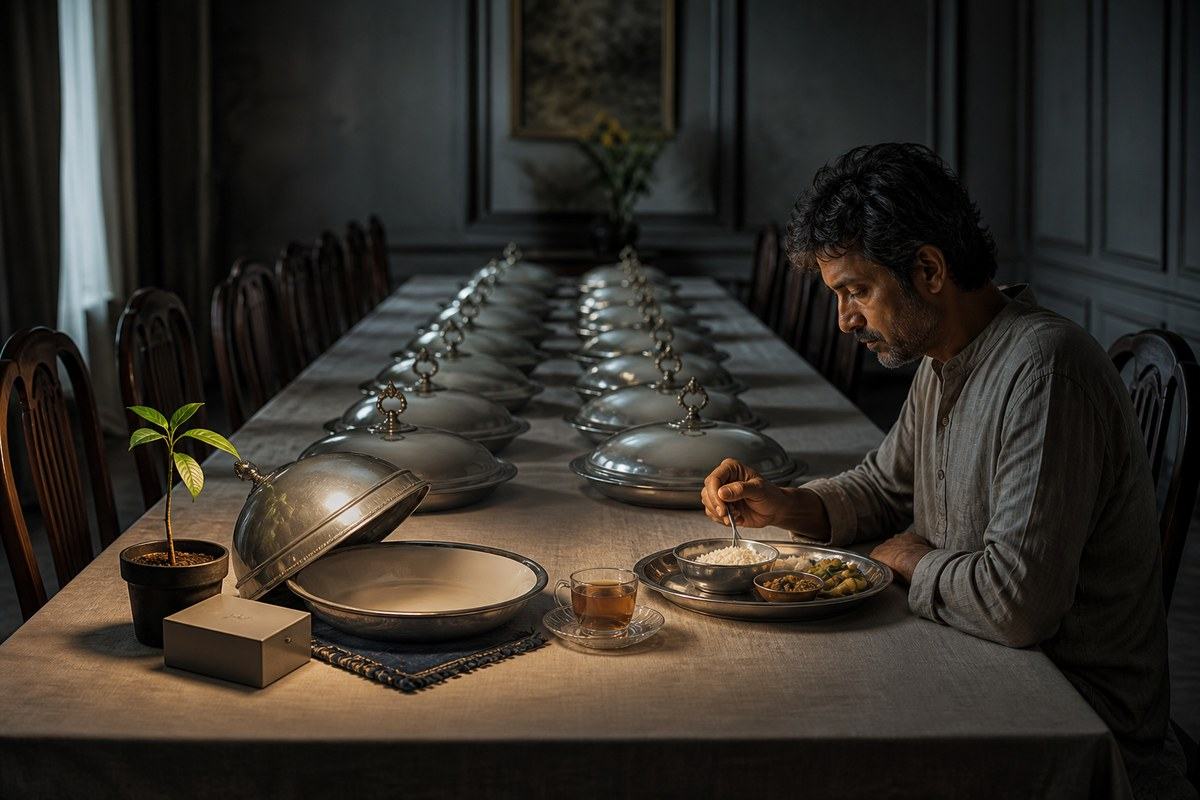
This is the small comedy. Life does not become profound just because you are damaged. It becomes more practical. Cut the fruit. Pay the bill if possible. Avoid the phone if necessary. Write the paragraph. Wash the cup before ants discover civilization. Check on Ma. Cook rice. Lie down. Get up. Complain. Notice. Repeat.
Aimless does not mean empty.
It means no arrow.
And without the arrow, there is at least one mercy: you do not have to pretend that the target was yours.
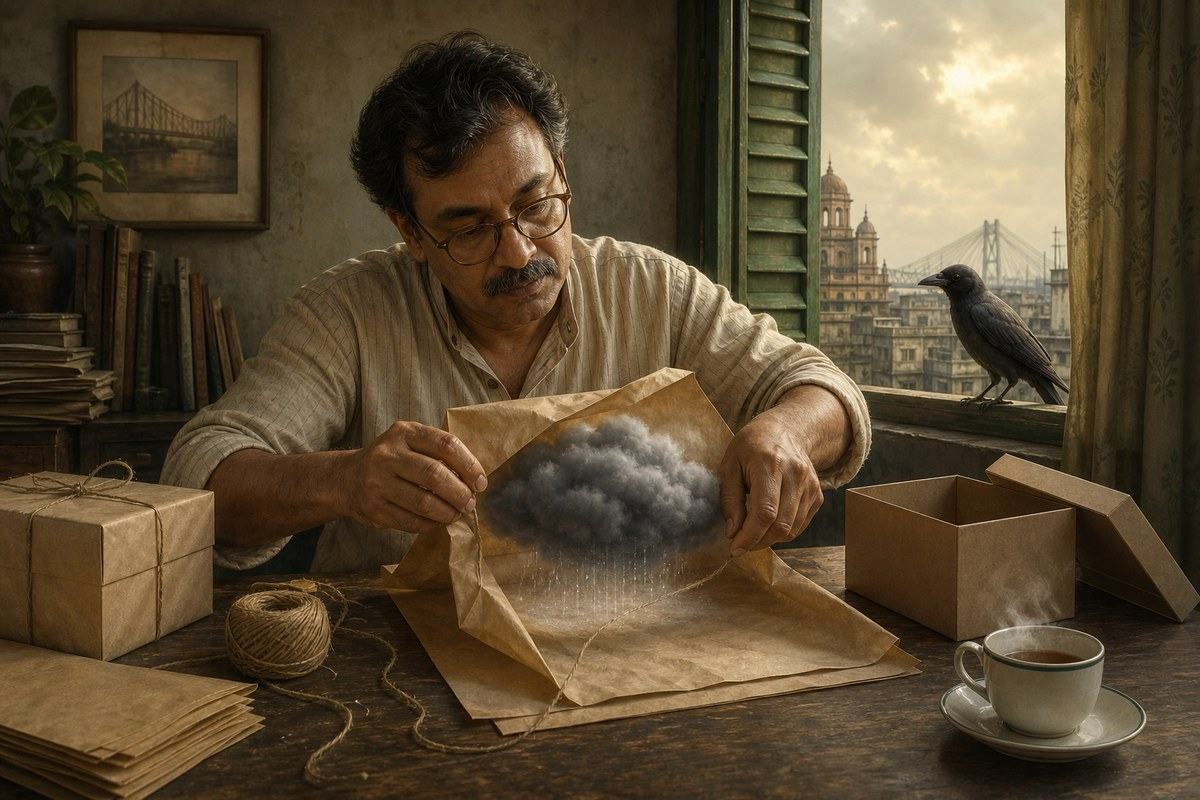
The mango is too ripe now, but still sweet. I eat it over the sink because plates create additional bureaucracy. Juice runs down my wrist. Outside, the pump stops coughing. A crow lands on the opposite parapet carrying something unidentifiable and possibly illegal. It looks pleased with itself.
For a moment I envy the crow.
Then my stomach makes a small administrative announcement, and nature, practical as ever, provides the day’s only honest appointment.
Word Cloud
Related reading
Selected by shared topics and section, with closer publication dates breaking ties.