The Horoscope That Fits Everybody
Uses the speech voice supplied by your browser or device.

Acronyms and shorthand: P. T. Barnum means Phineas Taylor Barnum, the nineteenth-century American showman whose name became attached to crowd-pleasing spectacle and mass gullibility. EMI means equated monthly installment, the fixed monthly loan payment that keeps many Indian households spiritually alert. TED means Technology, Entertainment, Design, the conference brand whose lighting has made many ordinary statements look newly ironed.
A good horoscope is not a prediction. It is a mosquito net thrown over all human suffering, after which the astrologer points to one trapped insect and says, “See?”
You know the room. Even if you have never entered it, India has supplied the furniture in your imagination. A small table. A plastic chair with one leg slightly philosophical. Incense. Old calendars. A brass object whose job is mainly to look ancient. A god laminated so many times he could survive the monsoon. A mobile phone with a cracked screen. Maybe a bottle of sanitizer, because fraud also has to modernize. The astrologer looks at you as if the planets have briefed him personally during lunch.
Then comes the sentence.
“You have great potential, but obstacles have delayed your progress.”
Wonderful.
Also useless.
A man in Behala, a woman in Barasat, a clerk in Siliguri, a failed poet in Dum Dum, a software engineer in Salt Lake, a fish seller near Gariahat, a retired uncle with acidity, and one depressed middle-aged fellow boiling tea in the southern edges of Calcutta can all hear that sentence and feel vaguely stabbed by destiny. That is the magic. It fits everybody, so everybody thinks it fits only them.
This is the Barnum statement.
It is language cut like cheap readymade clothing. Not tailored, but forgiving. “You are kind, but sometimes people take advantage of you.” “You like company, but you also need solitude.” “You are practical, but you have a spiritual side.” “You have been misunderstood.” “You carry pain you do not show.” “You are loyal until betrayed.” These are not insights. These are blankets in a railway waiting room. Anybody can pull one over himself and say, yes, exactly, how did you know?
The phrase comes from P. T. Barnum, the American showman of the nineteenth century, circus man, museum man, advertising wizard, and professional supplier of astonishment to the paying public. The famous line about a sucker being born every minute is often pinned to him, though history, like a para gossip committee, is not always careful about evidence. But the spirit fits. Barnum understood something darker and more useful than “people are stupid.” He understood that people want wonder, and if you wrap a mirror in enough velvet, they will pay to see themselves in it.
The laboratory story arrived later, in 1949, when psychologist Bertram R. Forer gave students a personality test and then returned what they believed were personal assessments. The trick was that every student received the same assessment. It was made from vague, flattering, astrology-like statements. The students still rated it highly accurate. Forer called this the fallacy of personal validation. A fine academic name. It wears a tie. “Barnum effect” is better. It has peanuts on the floor and a ticket counter.
Why does it work?
Because the human mind is not a judge sitting calmly with spectacles and a fountain pen. It is more like a harried Bengali mother packing school tiffin during load-shedding. It grabs what is available, fills gaps, makes do, and shouts at anyone asking too many questions.
First, the statement is broad.
Second, it is mildly flattering.
Third, it includes a small flaw to look honest. “You are generous, but sometimes impatient.” Ah. Balance. Now it has the flavor of truth. Like adding one green chili to watery dal and calling it character.
Fourth, your memory does the tailoring. The astrologer says, “There has been disappointment connected to money,” and your mind immediately opens the cupboard. Out falls the unpaid invoice, the lost job, the failed interview, the relative who borrowed and vanished, the consultancy payment that will arrive “next week” until civilization ends. The astrologer has not found your truth. You have supplied it, like a fool bringing his own fish to a restaurant.
Fifth, authority adds polish. Robe. Sanskrit. Beard. English. Charts. Gemstones. A serious pause. A microphone. A party flag. A spiritual logo designed by someone’s nephew in Photoshop. These things do not improve accuracy, but they improve obedience.
Finally, confirmation bias comes with a broom. The misses are swept under the cot. The one sentence that half-fits is placed on the shelf and garlanded.
The thing travels beautifully because it does not need a passport. In America it lives in newspaper horoscopes, personality quizzes, psychics, self-help seminars, corporate assessment nonsense, and those cheerful workshops where people discover their inner eagle for $299. In Europe it has sat comfortably inside palmistry, graphology, spiritualism, salon mysticism, and personality typing. In East Asia it mixes with blood-type personality beliefs, zodiac systems, fortune sticks, and the many local ways humanity has invented to avoid saying, “I do not know.”
In the digital age it has become an app. Enter your birth time, place, relationship status, anxiety level, and payment method. Out comes the same old fog, now with push notifications.
But India did not merely receive Barnum statements.
India put them on a scooter, gave them a garland, made them sit on a stage, and asked the local councillor to inaugurate the event.
Here the Barnum sentence has ideal weather. We are a country where “adjust” is policy, “manage” is infrastructure, “sentiment” is evidence, and “auspicious timing” can delay a wedding, a surgery, a business opening, a house entry, and occasionally common sense itself. We already live inside ambiguity. The Barnum statement does not have to break in. The door is open. Tea is served.
“There is some blockage in your path.”
Which path? Career? Marriage? Kidney stone? Income tax? The lane outside after rain? The family pension paperwork? The blocked drain near the tea stall? Yes. All paths. Welcome to India.
Astrology runs on this fuel. “Today you may face challenges at work, but patience will help.” When is this false? Even a goat tied beside a tea shop faces challenges at work if its job is not becoming lunch. “Someone close may disappoint you.” In Bengal that is not prediction. That is the afternoon schedule. “Money matters require caution.” Money always requires caution unless you are a builder, a politician, or a spiritual entrepreneur with excellent cash flow and no visible product.
Palmistry is the same theatre with different props. Your hand becomes a railway map for emotional fog. This line is strong, but broken. That mound is developed, but troubled. You are sensitive, but practical. You want love, but fear betrayal. Early life had struggle. Later life improves. Wear this stone. Avoid blue on Tuesday. Bring your mother’s date of birth next time. Cash is better.
Notice the grammar of the fraud. Strong, but broken. Sensitive, but practical. Delayed, but not denied. Troubled, but blessed. These little “buts” are the hinges. They let the sentence swing both ways. Whatever happens later can be made to fit.
If success comes, the astrologer was right.
If failure continues, the remedy was incomplete.
If nothing happens, the obstruction is deep.
This is not a belief system. This is a refund-proof business model.
Babadom uses the same technique at industrial scale. The baba does not need supernatural knowledge. He needs common human pain. Health anxiety. Marriage pressure. Career fear. Sexual frustration. Family resentment. Money panic. Guilt. Loneliness. Shame. Envy. And that great Indian national hobby: what will people say?
These are not predictions. These are raw materials.
A baba says, “Someone close to you is jealous.”
Of course. Someone close to you is always jealous, loving, irritated, dependent, bored, loyal, resentful, and worried about gas prices. Human relationships are mixed metal. They do not come in pure gold. If they did, families would not need so many plastic chairs and long silences.
He says, “Your mind is restless.”
In this heat? With EMIs? With political shouting entering through the wall like damp? With a pressure cooker whistling in one flat, a devotional loudspeaker in another, and someone drilling tiles at 8:17 in the morning because civilization has no sense of timing? Restless mind is not revelation. It is the weather report.
Pseudoscience only changes the packaging. The alternative healer says your body has imbalance. Which body does not? The detox seller says toxins have accumulated. Which toxins? Where? Measured how? At this point the conversation usually becomes cloudy, because detail is where the ghost loses its bedsheet.
Quantum spirituality is the funniest of the lot. It steals words from physics, dresses them in incense, and announces that your energy is vibrating at a low frequency. In real physics, frequency means something. In this sentence it means you are sad, tired, broke, confused, unlucky, aging, or all of the above, but now with imported terminology.
That is the genius of Barnum language. It turns ordinary human mess into secret design.
This is also why it is comforting.
Science is not naturally polite. Science says, “Your claim is vague. Your memory is biased. Your sample is too small. Your prediction cannot fail because it says nothing definite. Your evidence is behaving like a wet biscuit.” Barnum language says, “You suffer because your soul is unusually deep.” Naturally the second sentence sells better. Even a rationalist may enjoy it for seven seconds. Then the inner sweeper arrives with phenyl.
And then there is politics.
Political rhetoric is Barnum language with a flag. It has to make millions of people feel personally addressed while saying very little that can be nailed to a table and examined.
“You are the hardworking people of this great nation.”
Who will object? Even the lazy man supports hard work as a principle, provided it does not become too personal.
“We will restore dignity.”
Whose dignity? Farmer? Student? unemployed graduate? small trader? religious majority? religious minority? angry youth? retired uncle? government employee? migrant worker? Everyone hears his own missing piece. Dignity is the political version of hidden potential. Large, warm, difficult to measure, excellent for speeches.
“The system has ignored you.”
Correct. The system has ignored nearly everyone except itself.
The sharper version is more dangerous: “Real citizens know the truth.”
Now the Barnum statement has grown teeth. It does not merely flatter you. It recruits you. You are not just a voter. You are awake. Pure. Original. Betrayed. Chosen. Your anger is not anger; it is evidence. Your suspicion is not suspicion; it is wisdom. Your leader understands you without needing details. Experts are corrupt. Opponents are enemies. Doubt is weakness. Complexity is treason wearing spectacles.
This is how crowd horoscopes are written.
A difficult period will end. Hidden enemies will be defeated. A strong guide will emerge. The nation will regain its lost glory. Wear saffron, red, green, blue, or whatever color the party shop has printed in bulk.
Even technocratic language does this, only with cleaner shoes. “Inclusive growth.” “Development for all.” “People-centric governance.” “Transformational reform.” “Empowerment.” “Justice.” “Security.” “Freedom.” None of these phrases is automatically false. That is precisely the problem. They are containers. Everyone pours private desire into them. The businessman hears deregulation. The poor man hears subsidy. The young man hears jobs. The old man hears order. The party hears votes. The slogan smiles and digests everything.
That is why Barnum statements are hard to kill. A pure lie can be caught. A precise prediction can fail. A vague half-truth slips away like mustard oil on the kitchen floor. You do not defeat it by shouting. You defeat it by asking small, ugly questions.
What exactly is being claimed?
Could this apply to almost anyone?
What would prove it wrong?
Was it said before the event or after?
How many wrong statements are being ignored?
Is there a measurable mechanism?
Am I being understood, or merely pleased?
Who profits if I believe this?
That last question is the important one. Behind most Barnum statements there is a shop. Horoscope app. Gemstone dealer. Baba ashram. Vastu consultant. Personality test vendor. Motivational coach. Management consultant. Miracle healer. Political party. Television astrologer. YouTube guru. Or some cousin’s recommended expert who looks at your rented flat and says the toilet is blocking prosperity, which is brave, because poverty had already done that without plumbing assistance.
The point is not that Indians are foolish. That is the cheap insult, and usually said by people selling their own imported nonsense. India has intelligence in abundance. We have exam-crackers, engineers, doctors, accountants, coders, poets, mechanics, shopkeepers, grandmothers who can detect fever by looking at your eyelids, and bus conductors who can do mental arithmetic in a moving vehicle while abusing three people at once.
What we lack is public respect for disciplined doubt.
We respect marks, degrees, rank, ritual, seniority, English pronunciation, beard density, and the ability to speak confidently while knowing very little. But “show me evidence” still sounds rude in many rooms. It sounds Western, arrogant, anti-culture, disrespectful, joyless, personally hurtful. As if truth must remove its slippers before entering the house of nonsense.
So the Barnum statement survives.
It sits in the horoscope column.
It sits in the baba’s blessing.
It sits in the motivational video.
It sits in the family WhatsApp forward.
It sits in the political slogan.
It sits in the matrimonial horoscope where two anxious families outsource human compatibility to planets doing paperwork.
And, inconveniently, it sits in me too.
Because some evenings even a tired atheist wants his suffering to have architecture. Not just bad luck, bad decisions, bad timing, chemistry, poverty, aging, and the slow clerical cruelty of existence. Something grander would be nice. A pattern. A ledger. A cosmic reimbursement form moving through the invisible office.
Then the kettle whistles.
The tea rises too high.
The gas lighter refuses to spark.
An ant appears near the sugar jar with the confidence of a land developer.
And from some phone, some baba, some app, some leader, some horoscope, some smiling vendor of fog, the old sentence crawls out again:
Your difficult time will soon pass.
Yes, yes.
Terms and conditions apply.
P.S. References: Bertram R. Forer’s 1949 work on the fallacy of personal validation is the classic psychological source for what later became known as the Barnum effect. Paul Meehl helped popularize the Barnum label in criticism of vague personality assessment. The common quotation about “a sucker born every minute” is often attributed to P. T. Barnum, but the attribution remains historically disputed.
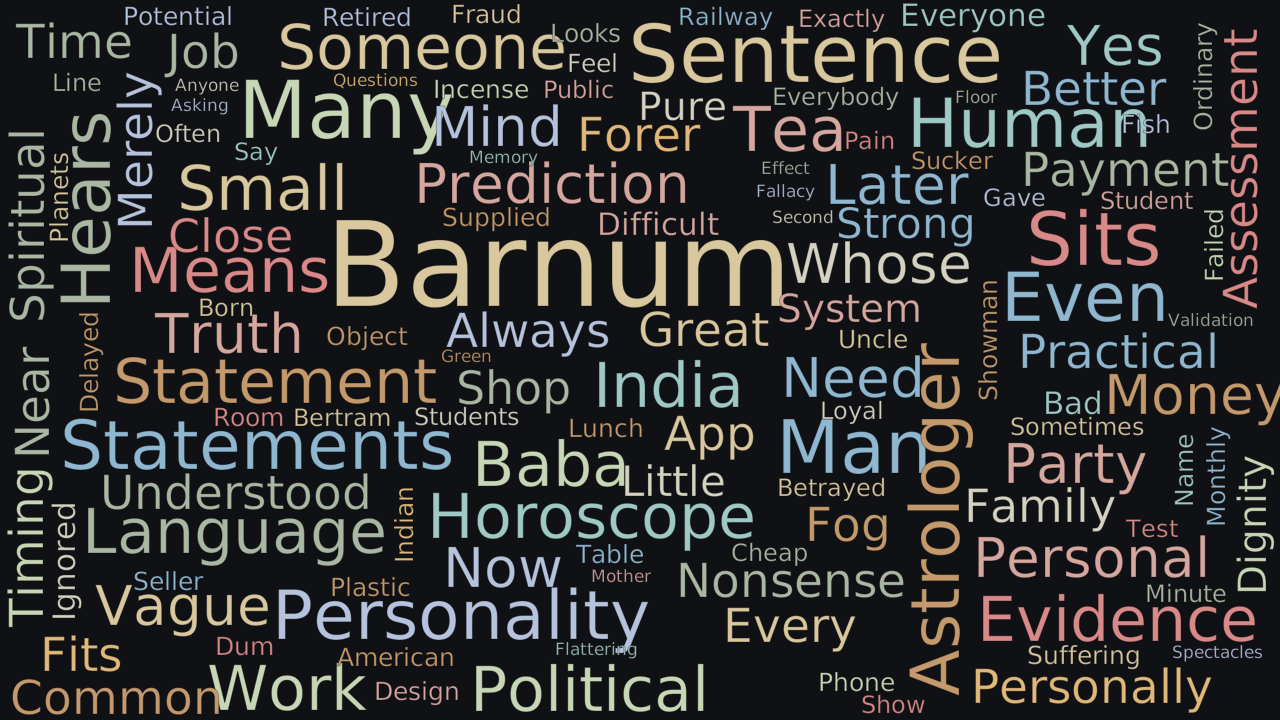
Word Cloud
Related reading
Selected by shared topics and section, with closer publication dates breaking ties.