Artisanal Darkness in a Kolkata Room
Uses the speech voice supplied by your browser or device.

I am not a mystic. Let us clear that small fog first. I am not a saint, monk, guru, healer, dawn-walker, lemon-water drinker, or one of those laminated human beings who wake at 5:15 in the morning, do breathing exercises, check mutual funds, forgive enemies, and enter the day with the moral shine of a stainless steel tiffin carrier.
I wake like a Kolkata drain after three days of rain.
Slowly.
Darkly.
With bubbles.
There is acid in the stomach, shame in the mouth, gas in the pipes, old rice in memory, stale tea in the soul, and somewhere nearby a crow of philosophy is pecking at the last edible scrap of dignity. Not a grand crow. Not a mythological crow. A local crow. The kind that has seen everything, judged everything, and still looks disappointed.
Then society appears at the window and says, “Perform.”
Smile.
Comb your hair.
Answer the phone.
Sound employable.
Be pleasant.
Be grateful.
Be clean, but not merely clean. That is no longer enough. A man must be market-clean. He must not only bathe. He must look as if he has never known sweat trapped in a cheap shirt, fungus in the corner of the bathroom, rent anxiety, unpaid consulting invoices, failed romance, weak teeth, old socks, or the special Bengali middle-class insult in which your education sits in one room and your bank balance in another, and the two refuse to speak.
This is the new hygiene. Not soap. Optics.
A man may be broken, but he must not appear poorly packaged.
My body, meanwhile, has become a general election in which every constituency votes against me. Face: against. Belly: against. Teeth: rebellion. Hair: low turnout. Skin: old government paper. Sleep: coalition failure. Libido: present but unemployed, sitting outside the office with a file and a fading hope of regularization.
Even my organs seem to have formed a residents’ welfare association whose only agenda is non-cooperation.
And still the world expects cheerfulness.
Why?
This is a real question, not a decorative one. Why is cheerfulness demanded most aggressively from people who are being slowly peeled like old paint?
Go to any tea stall, pharmacy queue, local train platform, bank branch, or family WhatsApp group, and you will find the same national miracle: men who know everything. Not something. Everything. Geopolitics, masculinity, vaccines, women, civilization, cricket selection, Chinese strategy, the American economy, the correct way to raise children, the correct way to treat depression, and the precise reason the country is collapsing, which always turns out to be somebody else’s fault.
The same man may not know where his towel is.
No matter.
He speaks as if volume were a university degree.
This is one of the great tricks of public life. Noise has disguised itself as knowledge. Confidence has stolen the chair of competence. A man who has read three headlines and half a caption now clears his throat like a cabinet secretary and begins explaining the world to people who made the mistake of standing within earshot.
And I, poor fellow, am considered unstable because my despair is less professionally wrapped.
That is the neat little fraud. If you lie smoothly, society calls it adjustment. If you suffer visibly, society calls it disorder. If you sell fantasy with clean branding, you are an entrepreneur. If you describe reality as a badly lit drain with municipal ambitions, people say you are negative.
But reality is not negative.
Reality is just poorly lit.
I did not invent this economy of polished nonsense. I merely live downstream from it, where all the big slogans arrive after travelling through enough pipes to become something else entirely. Success, nationalism, spirituality, productivity, positivity, hustle, purity, wellness—by the time these noble words reach a lower-middle-class man in the shanty boondocks of Calcutta, they resemble floating debris with incense sticks attached.
Very holy.
Very fragrant.
Still debris.
Of course I am not innocent. Let us not make a statue of me yet. The municipality has enough problems.
I have vanity. I want to be seen. Not merely noticed, but seen properly. I want the same society that passes me like a stain on a wall to suddenly pause and say, “Wait. This man is not only failing. He is failing with texture.”
What a ridiculous desire.
Also what a human one.
I want the wound to mean something. I want the garbage to glitter. I want unpaid pain to raise an invoice. I want someone to look at this cluttered room, this anxious mind, this aging body, this record of lost chances and stubborn sentences, and say, “There is voltage here.”
Not success. Not glamour. Voltage.
This is why obscenity tempts the wounded mind. Not because crudity is clever. It usually isn’t. Most crudity is just boredom wearing muddy shoes. But sometimes polite language is too small a spoon for the soup. Sometimes the mind is not producing an essay. It is producing steam from a pressure cooker whose whistle has been held down by three generations of shame.
People think vulgarity is the collapse of thought.
Not quite.
Sometimes vulgarity is thought without its shirt. Sweaty, embarrassed, still breathing. It is language refusing to wear a tie while drowning.
But let us keep the room clean enough for visitors. The point is not profanity. The point is pressure.
And pressure has a way of becoming comedy if it cannot become money.
That may be the only alchemy I understand. Not mystic alchemy, with lamps and diagrams and men in robes. Ordinary alchemy. The kind that happens in small rooms when there is too much humiliation and not enough furniture. You take one part shame, two parts gas, half a cup of insomnia, a pinch of old ambition, and stir until it begins to smell like literature.
Literature, of course, does not pay rent.
That is one of its defects.
AI is taking jobs, the city is breaking roads, prices move upward like spiritual insects, and every second person online is telling you to build a personal brand. A personal brand. What a phrase. Once upon a time a brand was what they burned into cattle. Now we do it voluntarily and call it growth.
The modern world has discovered that anything can be packaged.
Loneliness can be packaged.
Anger can be packaged.
Failure can be packaged.
A man sitting in a small room with a headache, bad sleep, and a bank account that looks like a moral accusation can also be packaged, provided he chooses the correct thumbnail.
That is the joke.
The world does not ask, “Is this true?”
It asks, “Can this be sold safely?”
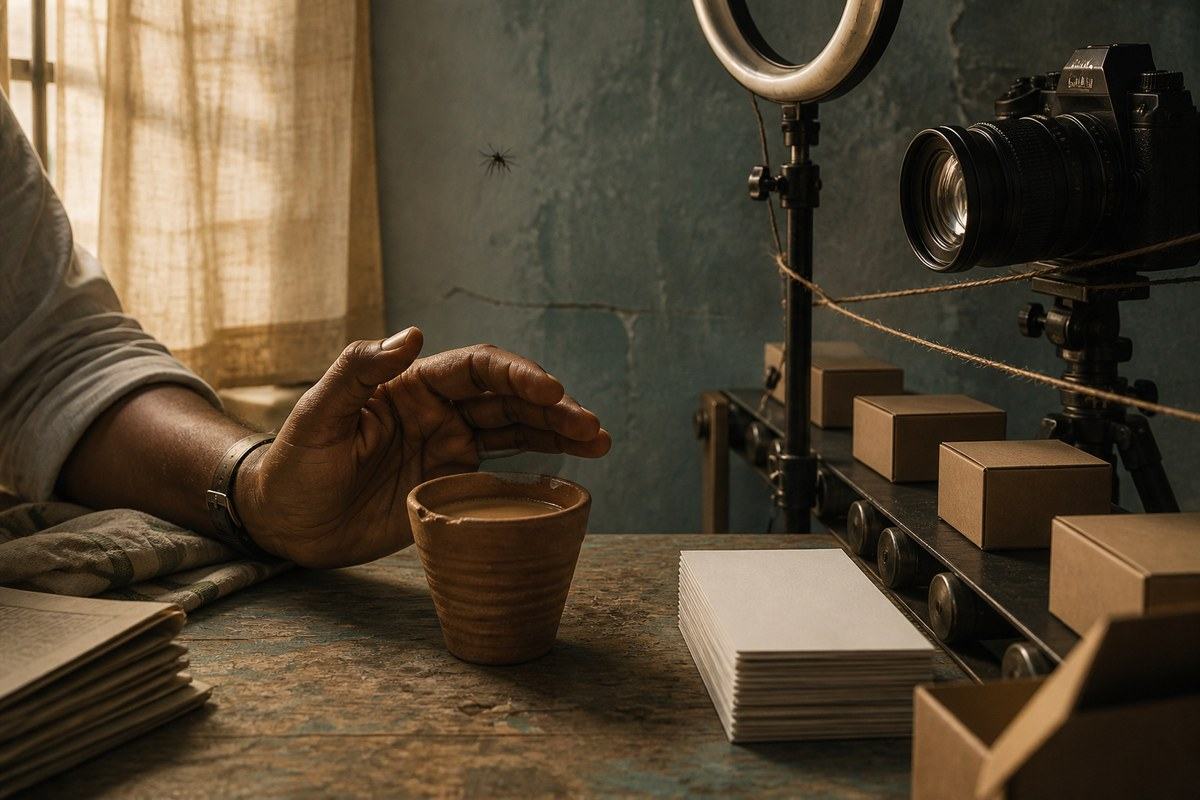
A guru sells emptiness with good lighting. A politician sells hunger as destiny. An influencer sells loneliness through a ring light. A company sells poison with a wellness font. A motivational speaker with soft hands tells people whose rent is due that success begins in the mind.
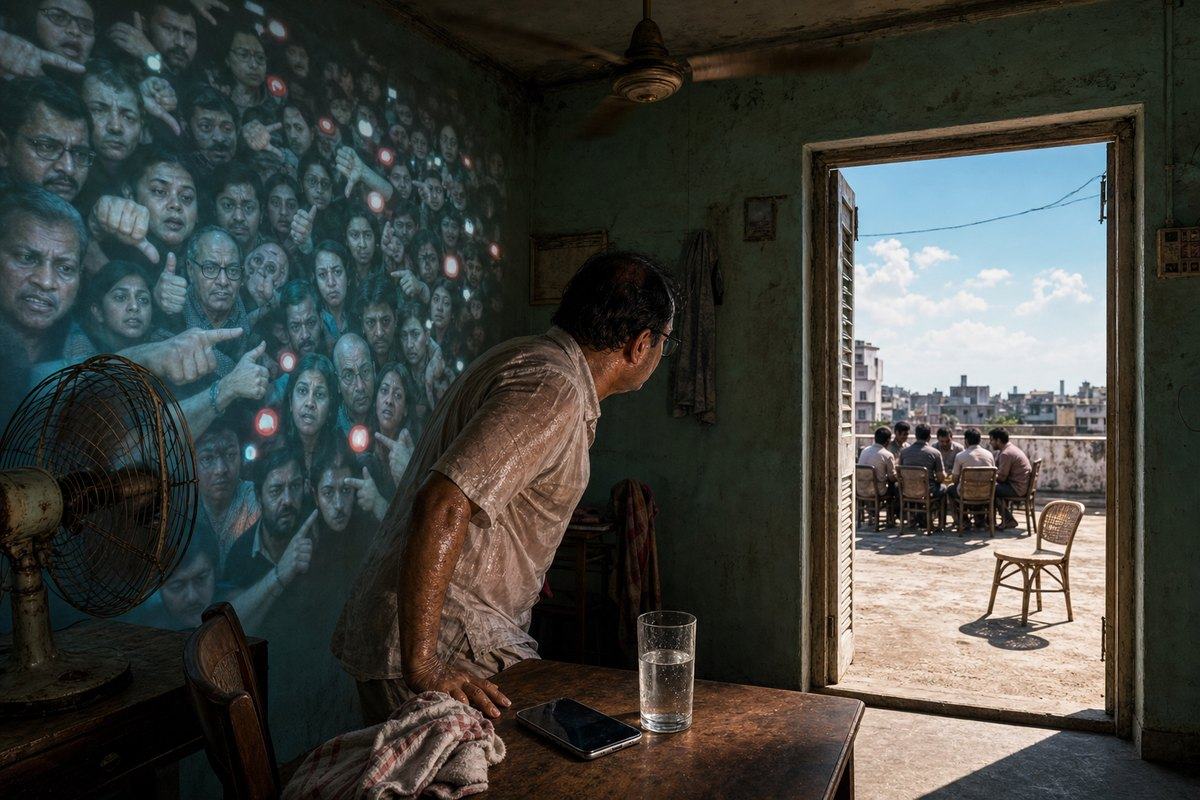
The mind, poor thing, is sitting under a fan wondering about the electricity bill.
So I ask a modest question.
If everyone is selling nonsense, why am I the only fool ashamed of my inventory?
Why should my despair not be packaged? Why should my ruined mornings not be optimized, recommended, subscribed to, and praised by people who also wake with shame in their mouth but have better curtains?
I will not call it depression.
I will call it artisanal darkness.
I will not call it failure.
I will call it post-capitalist domestic realism.
I will not call myself lonely.
I will call myself limited edition.
This is how rebranding works. A thing that would disgust people in a drain becomes lifestyle when placed in a box with soft colors. Add a slogan. Add testimonials. Add a short video of someone looking thoughtful near a window. Suddenly decay has become a premium experience.
Calcutta understands this better than many cities. We live among old walls, old names, old claims, old drains, old pride, old electrical wires hanging like tired snakes, and new cafés where people photograph coffee with the seriousness once reserved for freedom movements.
The city is always rebranding collapse as character.
Perhaps I am also trying the same trick.
The ceiling has a stain. Call it history.
The fan makes a noise. Call it texture.
The invoice is unpaid. Call it suspense.
The man is alone. Call him difficult, deep, independent, eccentric, intense, authentic, problematic, raw, complex, or whatever word keeps him from looking merely abandoned.
Language is the cheapest interior decoration.
But cheap things matter. Ask any lower-middle-class household. A plastic chair, a steel plate, a bucket, a cracked mug, a curtain bought years ago from Gariahat, a pressure cooker that whistles like a railway guard with sinus trouble—these are not objects. They are civilization on a budget.
My room has its own parliament. The bed speaks for inertia. The chair speaks for work not done. The table speaks for bills. The mirror speaks only when bribed. The bathroom is the opposition, constantly raising uncomfortable questions.
“Will you bathe today?”
“Will you shave?”
“Will you look like a citizen or a recently discovered artifact?”
Some days I win. Some days the bathroom wins.
People who have never negotiated with their own body may not understand this. They think bathing is a simple event. Open tap, apply soap, done. Very efficient. Very innocent. Like explaining the Indian railways by saying trains move on tracks.
But a depressed body is not a machine that obeys instruction. It is a reluctant old employee who has not been paid properly in years. You ask it to get up, and it asks for documentation. You ask it to move, and it forms a committee. You ask it to live, and it says, “Let us discuss this after tea.”
So I drink tea.
Not artisanal tea. Not silver-tipped Himalayan mist kissed by monks and packed in a box by people who say “curated” too often. Plain tea. Local tea. The democratic brown liquid of our civilization. The tea that has heard every complaint and solved none of them, but has at least attended the meeting.
For ten minutes, life becomes slightly less absurd.
Then the phone pings.
Someone has an opinion. Someone has posted outrage. Someone has discovered a conspiracy. Someone has become rich in a reel. Someone has found the one secret habit that changes everything. Someone is smiling beside a rented car. Someone is explaining discipline. Someone is selling a course.
And there I am, sitting with my tea, feeling like a cracked cup in a showroom of thermos flasks.
But I still speak.
That is my revenge.
Not success. Not salvation. Speech.
I take the humiliation that society wants hidden under the bed and drag it into the middle of the room. I point to it. I name it. I say, yes, this is mine, but do not behave as if your own life is made of sandalwood and bank approval. Your lives leak too. You have only hired better decorators.
I am bitter because sweetness is demanded most from people being quietly chewed.
I am ridiculous because dignity, in my price range, comes irregularly and usually without warranty.
I am vulgar in mood because refinement has too often been used as a police baton. The refined man may insult you with policy, salary, silence, grammar, invitation lists, and the shape of a dining table. But if you shout, you become the problem. Very convenient. The house is burning, but please use indoor voice.
No.
I will use the voice that remains.
Some days it is comic. Some days it is sour. Some days it limps. Some days it arrives wearing mismatched slippers and carrying a plastic bag full of metaphors nobody asked for.
But it arrives.
That matters.
Because when a man stops speaking, the room grows teeth.
And I know that room. I know how it behaves in the afternoon, when the city outside is too hot, the ceiling fan is doing its best, the body is tired, the mind is chewing old insults, and the future sits in the corner like a debt collector pretending to read the newspaper.
That is when darkness becomes clever. It does not kick the door. It enters like a relative.
“Just one thought,” it says.
Then another.
Then another.
Soon the room is full.
So I write, partly to think, partly to breathe, partly to keep the darkness from becoming the only educated person present.
Writing does not cure me. Let us not manufacture a TED Talk out of a leaking bucket. But writing gives the leak a shape. It turns fog into sentences. It makes pain stand in line. Not politely, but enough.
And sometimes, in the middle of all this, there is a laugh.
Not a happy laugh. Nothing so cinematic. More like a ceiling fan laughing before it falls. A dry little sound from the back of the throat. The laugh of a man who has seen the trick and cannot unsee it.
The trick is this: civilization first calls you filth, then discovers your market segment.
First it avoids your smell.
Then it frames you.
Then it sells tickets.
If one day the same people who avoided my sadness begin praising my “raw authenticity,” I will not be surprised. That is how the market launders discomfort. Yesterday’s embarrassment becomes tomorrow’s niche content. The stain becomes design. The wound becomes merchandise. The failed man becomes a mood.
Until then I remain here.
Single. Middle-aged. Bengali. Lower-middle-class. Atheist. Anxious. Often depressed. Not entirely wrong. Living in my small kingdom of unpaid thought, where the day begins with acid and tea, the afternoon smells of heat and old walls, and evening comes like a tired clerk locking up a government office.
Outside, Calcutta continues its ancient circus. Autos cough. Dogs debate. Crows supervise. Political posters fade into one another like old threats. Someone fries telebhaja in oil that has seen too much. Someone argues about the nation. Someone buys coriander. Someone blocks traffic with moral confidence.
The clouds pass over the city like exhausted buffalo.
Thunder gathers.
For a moment I expect revelation.
Then my stomach answers first.
Word Cloud
Related reading
Selected by shared topics and section, with closer publication dates breaking ties.