The Public Mouth
Uses the speech voice supplied by your browser or device.

THIS IS A WORK OF FICTION
When the man with the giant molars came to Calcutta, he first asked for the newspaper.
Not the newest one. Not the most respectable one. Not the paper whose masthead still looked as if the British had left it behind by accident along with a few clubs, statues, and digestive disorders. He asked for any newspaper, with the impatience of a man asking for water after walking through a desert made entirely of opinions.
It was a wet Tuesday near College Street, that grand old bazaar of books, umbrellas, failed revolutions, cheap spectacles, exam guides, damp philosophy, and tea thick enough to qualify as masonry. Rainwater trembled in potholes. Tram wires crossed the sky like the city’s unfinished handwriting. Hawkers had covered their books with blue plastic sheets and were shouting the names of dead European thinkers at boys who only wanted help passing multiple choice questions.
I was standing outside the office of The Calcutta Sentinel, holding a bundle of corrected proofs under my arm and wondering whether two months of unpaid salary still counted as employment or had become a devotional practice.
My name is Prabir Chatterjee. I was a proofreader.
This is not a profession now so much as a small, courteous funeral. Once, a proofreader sat between error and public life like a customs officer at the border of nonsense. Now mistakes were allowed in with garlands. Facts arrived late, adjectives arrived drunk, headlines shouted before learning to walk, and nobody wished to pay a man for noticing that a minister had inaugurated the same bridge three times in six months.
Still, I went every morning.
Habit is the pension of the defeated.
The stranger stood beneath the awning of Gupta Tea Cabin, smiling at the newspaper vendor.
“Paper,” he said.
His voice was soft. Almost elegant.
The vendor, old Haradhan, held up three newspapers.
“Bengali, English, Hindi?”
“All,” the stranger said.
“Big man,” Haradhan muttered. “Wants to be misinformed in three languages.”
The stranger laughed, and then I saw his molars.
They were enormous.
I do not mean merely big teeth, the sort a dentist admires in the privacy of his greed. These were great rear stones packed into his mouth, square and flat and faintly ridged, like grinding slabs from some ancient kitchen where lentils, bones, and proclamations had been crushed into paste. His front teeth were big too. But the back of his mouth was an architectural event.
Haradhan stared.
The stranger unfolded the papers, one by one, but did not read them. He listened to them.
This is difficult to explain without sounding feverish, and Calcutta has enough fever already. He held the newspaper close to his ear. He listened to the print. Then he sighed with such satisfaction that Haradhan, foolish old man, said, “What did you hear?”
The stranger smiled wider.
“Nothing,” he said. “That is why it is perfect.”
Haradhan began talking at once.
Not speaking. Not chatting. Not doing that Bengali thing where a man buying one cigarette pauses to explain the history of the Soviet Union. Talking. As if a municipal tap had been opened inside his throat after ten years of drought.
He began with newspapers. Their old smell. Their new cowardice. The advertisements disguised as public feeling. The public feeling disguised as advertisements. The editorials written like school essays by men afraid of their own commas. Then he moved to his father, his piles, his oldest son in Pune who sent money but not respect, his suspicion that every famous person on television looked recently polished by lies.
Customers gathered. They laughed. Then they answered. Then they interrupted.
The stranger stood among them, listening.
His molars moved slightly.
I should have walked away. A wise man in Calcutta survives by refusing participation in sudden public scenes. But I had spent thirty years correcting other people’s sentences. Bad speech attracts me as drains attract rain.
“Haradhan-da,” I said, “drink water.”
He did not hear me.
By noon, College Street was speaking in layers.
Bookshop owners announced which editions were pirated. Students confessed they had bought Marx only for the cover photograph. A man selling test papers declared that education in our time had become a ladder painted on a wall: very inspiring from a distance, useless to climb. Tea boys recited the secrets of professors. Professors, infected within minutes, retaliated with the secrets of tea boys, which were fewer but better structured.
The stranger moved slowly through the crowd.
He did not speak unless spoken to. He merely listened. He listened with alarming sincerity, that rare and dangerous quality which makes people hand over their souls like loose change.
At the Sentinel office, our editor, Mr. Bhaduri, was dictating an editorial through a mouth full of muri.
“The paper must remain balanced,” he said, which in his usage meant we would print the truth in such a posture that nobody powerful would recognize it and take offense.
He was a small man with a large forehead and the permanently exhausted air of a school principal managing a staff of goats. For thirty years he had believed in journalism. For the last ten he had believed in survival and called it nuance.
I told him about the stranger.
“Molars?” he said.
“Very large.”
“Then dentistry is now our crime beat?”
Before I could answer, our junior reporter, Riju, burst in.
Riju was twenty-six, thin, hopeful, badly dressed in the way of young men who believe ideas will iron their shirts. He had joined the paper because he wanted to speak truth to power. Power had not replied. It rarely does; it has people for that.
“Sir, there is something happening outside,” he said. “Everyone is talking.”
“That is not news,” Bhaduri said. “That is Bengal.”
“No, sir. Talking without stopping. Confessing things.”
Bhaduri stood. “Confessing?”
One could almost see the old editor waking behind his tired eyes, like a tramcar receiving current after years of ceremonial rust.
We went to the window.
College Street below had become a fairground of tongues. Men stood on stools, boxes, steps, scooter seats, anything that raised the mouth above its competitors. Everyone had adopted the posture of public importance. Chins lifted. Fingers pointed. Brows arranged themselves into concern. A fruit seller was delivering a lecture on monetary policy with two papayas as visual aids. A student had climbed a lamppost and was explaining love as a colonial conspiracy. Three retired men had formed a panel and were disagreeing with themselves.
“This is magnificent,” Riju whispered.
“This is catastrophe wearing a kurta,” Bhaduri said.
Then the stranger entered our office.
He had somehow climbed the stairs without sound. Rain darkened his shoulders. Ink from one of the newspapers had smudged his fingers.
“Editor?” he asked.
Bhaduri straightened. Even ruins remember dignity when inspected.
“I am Bhaduri.”
The stranger bowed slightly. “A great honor. I have heard your paper.”
Bhaduri frowned. “Read.”
“Heard.”
Riju grinned. “Sir, perhaps he means voice of the people.”
The stranger turned to him with warmth.
“Ah. The people. Such a large mouth for such an empty stomach.”
Riju laughed.
It was a good line. That was the trap. Wickedness with style is always allowed one step closer.
The stranger sat in the broken visitor’s chair.
“Tell me,” he said to Bhaduri, “what is news?”
Bhaduri opened his mouth.
Then he closed it.
This was unusual. Editors rarely close their mouths voluntarily.
At last he said, “News is what someone does not want printed.”
“Beautiful,” said the stranger. “And what do you print?”
Bhaduri began to tremble.
Riju looked delighted. I felt a coldness pass through the room, though the ceiling fan was only stirring warm air like a lazy spoon in dal.
“We print,” Bhaduri said, “what can be survived.”
The stranger leaned forward.
His molars shone.
That was all.
Bhaduri began talking.
He spoke of owners. Advertisers. Calls from offices whose names never appeared in print. He spoke of photographs held back, stories softened, numbers trimmed, questions postponed until they rotted. He spoke of the old days with such tenderness that even Riju stopped smiling. He spoke of a reporter beaten in Howrah whose story became “minor scuffle.” He spoke of a land grab described as “development.” He spoke of the dead, the evicted, the poisoned, the cheated, all compressed into respectable columns beside advertisements for luxury flats no reader could afford.
Then he began to cry and went on speaking through the tears.
The stranger listened as if receiving music.
Riju took out his notebook.
The stranger looked at him.
“And you,” he said, “what do you want?”
Riju’s eyes brightened.
“To tell the truth,” he said.
“No,” said the stranger kindly. “What do you want?”
Riju swallowed. “To be heard.”
And then he too began.
He spoke of truth, yes, but also of bylines, invitations, panels, awards, small fame, the warm narcotic of being quoted, the private itch to become a face people recognized before he had become a mind worth recognizing. He spoke faster and faster, ashamed but unable to stop. He admitted he had once hoped a flood would worsen because he had already reached the site and needed a stronger story. At this, Bhaduri groaned like a man hearing his own youth return in cheaper shoes.
I backed toward the door.
The stranger turned to me.
“Proofreader,” he said.
I had not told him.
His smile widened until the molars seemed to fill the room.
“You listen to errors.”
“I correct spelling.”
“Same priesthood. Smaller temple.”
He rose.
I am not a brave man. I have never pretended otherwise. Brave men enter burning buildings, marry into argumentative families, start magazines, and answer unknown numbers. I ran.
Down the staircase, through the press room, past the old machines whose metal ribs smelled of oil and defeat.
Behind me, the office became sound.
By evening, the infection had spread beyond College Street.
At first the city treated it as entertainment. Calcutta has a great appetite for other people’s collapse, provided tea is available. Crowds gathered wherever somebody had begun speaking uncontrollably. They laughed, clapped, corrected dates, supplied missing context. Then the listeners became speakers. Then the speakers attracted more listeners. By nightfall, the city had converted itself into a republic of compulsory expression.
At Shyambazar, fish sellers offered not hilsa but analysis. At Sealdah, commuters missed trains because each platform had produced six reformers and twelve witnesses. In Burrabazar, traders revealed real prices and were nearly lynched by their own families. Outside a coaching center, students delivered public addresses on failure while their parents stood weeping and calculating fees.
By ten, even the silent had begun carrying placards.
NOT SPEAKING IS ALSO A STATEMENT, one said.
Naturally, this caused arguments.
The great disease of the age had found its perfect climate. Once we feared being voiceless. Now everyone possessed a voice, amplified by vanity, grievance, loneliness, and that cheap new confidence by which every half-formed thought declares itself a national emergency. In our fathers’ time, one had to capture a newspaper to mislead a city. Now a tea stall and a raised eyebrow were sufficient.
I went home to my room above a shuttered watch repair shop near Amherst Street.
My sister, Mita, called from Barasat on the landline. She disliked my keeping a landline, as if I were preserving tuberculosis for heritage purposes.
“Dada,” she said, “Ma is talking continuously.”
My stomach dropped.
Our mother had not spoken much in two years. A stroke had taken from her the swift, cutting speech with which she once managed children, prices, servants, relatives, and God. She had been a history teacher before retirement, and in our house even the pressure cooker whistled in correct sequence.
“What is she saying?”
“Everything. Childhood things. Your father. Me. You. She says she hid something from you.”
“What?”
“She won’t stop long enough.”
A crackle on the line. Then my mother’s voice, thin and urgent.
“Prabir, are you there? Your father did not die when I told you he died.”
I sat down.
My father had been a reporter for The Calcutta Sentinel before the paper became cautious and then ornamental. He died when I was sixteen, officially of heart failure, privately of unemployment, though in our family we did not say such things. We called despair “pressure.”
My mother spoke over the line, words tumbling.
“He was beaten after that mills story. Not by police. Not exactly. Men came. Men who knew which lane we lived in. He came home bleeding. He said nothing. Next week the paper printed apology. Your father did not write it. Bhaduri knew. I told him not to fight. I told him we had children. I told him truth does not buy rice. He looked at me as if I had sold him. Maybe I had. Maybe all wives sell some part of their husbands to keep the ceiling fan turning.”
The line filled with her breathing.
“Mita,” I said. “Put cotton in her ears. Yours too. Don’t listen to anyone outside.”
“You sound like a madman.”
“That may finally be useful.”
I hung up.
Then I went back to the Sentinel.
The streets were nearly impassable.
The whole city had become a speaking engagement.
People stood beneath streetlights addressing invisible audiences. They used phrases never heard in ordinary hunger: “structural issue,” “larger question,” “with due respect,” “my lived reality,” “civilizational crisis.” A beggar near the tramline had become a keynote speaker on inequality. A sweet old auntie in a white sari was explaining, with terrifying clarity, which nephews had visited for affection and which for property. A taxi driver delivered a twenty-seven-minute address on urban planning while blocking traffic in three directions, thereby demonstrating his thesis.
The horror was not that people lied.
The horror was that much of it was true.
Truth, released without form, had become sewage after rain: everywhere, undeniable, and carrying things best treated before public circulation.
Inside the Sentinel, Bhaduri and Riju were still talking.
The press room had filled with infected citizens. They had arranged themselves around desks like panelists. Somebody had placed name cards before them, though nobody had names short enough to fit. The stranger stood near the old rotary press, listening.
The machine had not run properly in months. Parts were too expensive. Ink suppliers demanded payment. The owner preferred the paper’s online future, by which he meant fewer salaries and more slogans. But the old press still stood there, massive and black, a tired elephant of iron.
The stranger stroked its side.
“You built this,” he said to me, without turning, “to make a few mouths large.”
“No,” I said. “To make some words accountable.”
He laughed.
The molars shifted.
For the first time I saw them clearly. Each great tooth had a tiny face pressed into its surface. Not carved. Trapped. Editors, reporters, anchors, experts, panelists, spiritual explainers, retired officials, professional patriots, professional skeptics, emergency historians, weather prophets, market gurus, poets of taxation, all flattened into enamel, all whispering at once from the back of his mouth.
Among them I saw my father.
You know a dead parent instantly, even when reduced to a stain in a monster’s tooth. He looked younger than I remembered. Angry. Exhausted. Unheard.
The stranger opened his mouth wider.
“Every age produces the organ it deserves,” he said. “Once the press. Then the platform. Then the panel. Then the public mouth. Now every man is a masthead. Every grievance a bulletin. Every ignorance a freedom. I merely remove the final inconvenience.”
“What inconvenience?”
“Listening.”
The room roared with talk.
Bhaduri was now confessing the apology printed after my father’s beating.
“I was young,” he said. “I had a wife pregnant, a mother dependent, a landlord with lawyer friends. I told myself one correction could save the paper. One silence could preserve future truth. This is how cowardice dresses for office: one practical decision at a time.”
Riju shouted over him, “But people must speak!”
The stranger beamed. “Yes. Endlessly. Without burden. Without consequence. Without memory. Speech is democracy with the work removed.”
I looked at the old press.
On the composing table lay trays of metal type, kept by Bhaduri out of sentiment and the hoarding instinct common to editors and rats. Individual letters, cold and small. Once, every public sentence had to be assembled by hand, locked into place, inked, printed, corrected, paid for. Speech had weight then. Not virtue, necessarily. But weight.
I picked up a metal letter.
A Bengali ক.
My father had taught me as a boy that print was speech forced to stand still and accept inspection.
The stranger noticed.
“Careful,” he said. “Letters are dead teeth.”
“Then they know you.”
I hurled the metal type at his mouth.
It struck one molar with a tiny, ridiculous click.
Nothing happened.
The stranger smiled sadly. “Proofreader.”
I ran to the press controls.
The old machine should not have worked. It had no reason to. But machines, like old clerks, sometimes respond to insult better than maintenance. I pulled the lever. The press shuddered. Belts trembled. Somewhere inside, a motor coughed like a smoker waking from litigation.
The infected crowd did not notice. Their own voices held them captive.
I grabbed galley trays at random and fed them into the press bed. Old headlines. Rejected stories. Death notices. Corrections. Advertisements. A recipe column. My hands moved without plan, then with one.
I found the locked chase from that morning’s abandoned front page.
CITY LISTENS, CITY SPEAKS.
A headline Riju had made before infection took him fully.
Too neat. Too proud.
I pulled the letters apart.
My fingers shook as I reset them.
CITY, LISTEN.
That was all.
Absurd, yes. Tiny, yes. A spoon against a flood. But a sentence gains strength not from size but from direction.
Bhaduri saw what I was doing.
Still talking, he staggered toward me. He took a composing stick and helped lock the line. His hands remembered what his courage had not.
Riju came next, crying and speaking at once. He placed blank paper in the feed.
The stranger rushed forward.
“No,” he said.
His voice had changed. It no longer charmed. It scraped.
“You cannot print silence.”
Bhaduri looked at him with red eyes.
“We printed fear for twenty years,” he said. “Silence will be an improvement.”
We started the press.
The first sheet came out crooked and wet.
CITY, LISTEN.
Then another.
CITY, LISTEN.
Then another.
The words slapped paper with the brutal simplicity of a school punishment.
The crowd nearest the machine faltered.
One man stopped mid-sentence and stared.
A woman covered her mouth.
Leena from accounts, who had been explaining provident fund fraud to a chair, picked up a sheet and began weeping quietly.
The stranger screamed.
All the tiny faces in his molars opened their mouths. The sound that came out was not a scream but a news cycle: outrage, denial, debate, clarification, counterpoint, exclusive, breaking, developing, sources say, nation wants to know, citizens respond, experts believe, questions remain, more after the break. The room filled with the hot stale air of a thousand studios where nothing had ever been discovered except the value of interruption.
The press kept printing.
CITY, LISTEN.
I do not claim the sentence saved Calcutta. Calcutta is not saved by sentences. It is not even reliably improved by drainage. But the sheets moved from hand to hand. People read them. Reading is listening with the mouth closed. That ancient miracle returned one person at a time.
The stranger staggered.
His molars cracked.
From one tooth my father’s face looked at me.
His lips moved.
I could not hear him over the press.
For once, this was mercy.
The stranger fell against the machine. His mouth opened too wide. The press caught the edge of his jaw, and the great molars struck the rollers. They did not break like teeth. They burst like overripe fruit, spilling not blood but packed little words, gray and wet, thousands of them, wriggling on the floor.
Headlines without facts.
Opinions without cost.
Questions asked only to prevent answers.
Voices trained to sound wounded on command.
They dried quickly in the ink smell and became dust.
By dawn, College Street was quiet in the way a battlefield is quiet after everyone remembers breakfast.
The official explanation arrived before the tea: gas leak, mass anxiety, seasonal neurological disturbance, rumor spread by irresponsible elements, matter under investigation. Each newspaper printed a version suitable to its debts. The Sentinel printed, beneath the masthead and above the fold, only two words.
CITY, LISTEN.
We sold out by eight.
By noon, three larger papers had stolen the phrase.
By evening, men were invited to discuss it.
By night, four public meetings were announced on the urgent need for listening. Speakers were listed. Chief guests confirmed. Microphones booked. Tea sponsored.
So the city recovered.
That is to say, it resumed.
Bhaduri resigned the next week, then returned as consulting editor because resignation is noble but rent is monthly. Riju became quieter for some time and then, being young, healed dangerously. My mother stopped talking and would not repeat what she had said. Mita claimed not to remember. Families are private governments; they classify documents faster than any ministry.
As for me, I kept one cracked piece of the stranger’s molar in my desk drawer.
Some evenings, after the edition closes and the unpaid salaries arrange themselves in my mind like mourners with no bus fare, I take it out. It is smooth, yellow, and faintly warm. If held near the ear, it whispers.
Not loudly.
Never loudly.
It says: Speak.
It says: Explain.
It says: React.
It says: The public is waiting.
On such evenings, I put it back in the drawer, lock it, and sit by the old press until the urge passes.
Outside, Calcutta talks. Naturally it talks. It has always talked. It talks through drains, tea stalls, bookshops, tram bells, marriage negotiations, fish prices, political walls, unpaid bills, mothers, editors, beggars, and boys with degrees that shine less brightly than their hunger.
But sometimes, after rain, the whole city seems to pause between one sentence and the next.
In that pause I hear my father.
Or perhaps only the press cooling.
It makes the same small sound either way.
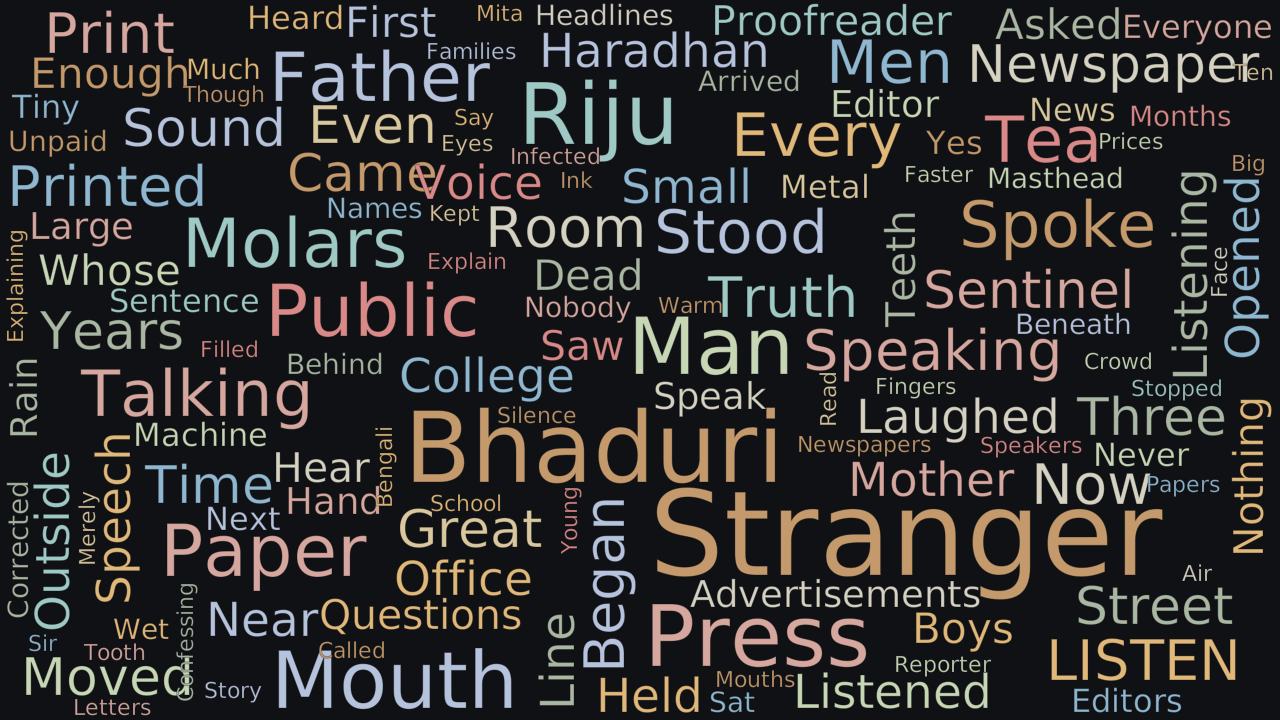
Word Cloud
Related reading
Selected by shared topics and section, with closer publication dates breaking ties.