The Ledger of Soft Parts
Uses the speech voice supplied by your browser or device.

THIS IS A WORK OF FICTION
By half past six the tea stall beside the broken drain had already become a parliament of men who owed money to one another.
Rainwater stood in the potholes of the narrow road like old tea. A milk van leaned at the corner with one wheel in the gutter. Above it, three separate posters of three separate leaders smiled with the same dental brightness, as if politics had been outsourced to one ambitious dentist. Autos coughed black smoke. A woman in a faded nightie argued with the fish seller over the freshness of pabda. From a balcony, somebody shook yesterday’s washing and sent a small shower of water onto a passing schoolboy, who looked up with the settled contempt of youth for all civilization.
Anirban stood under the torn blue tarpaulin of Buro’s stall and held his bhaar of tea with both hands.
He had returned from America twelve years earlier with two suitcases, a folder of certificates, and the touching belief that a man who spoke plainly would be respected for it. Calcutta had corrected this misconception with the patience of a street dentist.
“Dada, sugar less?” Buro asked.
“Sugar normal.”
“Sugar normal means mood improving.”
“Tea cannot perform that miracle.”
Buro laughed. He had few teeth but great confidence in them.
Anirban drank. The tea was too sweet, too hot, and made from milk that had already seen much of life. He liked it. It belonged honestly to the morning. Nothing about it pretended to be scalable.
Across the road, a new diagnostic center had opened on the ground floor of what used to be the Banerjees’ house. The old green shutters were gone. A glass door now announced WELLSPRING ADVANCED CARE in blue letters. Inside, a young receptionist sat beneath an air conditioner, her face arranged into the expression of someone paid to deny discounts.
Anirban looked away.
Once, he had wanted to build something like that, though better, cleaner, less greedy. A network of small clinics, proper records, honest billing, medicines tracked, doctors paid on time, patients not sent from counter to counter like luggage. He had seen hospitals in Texas where systems spoke to one another in clean columns and codes. He came home thinking India needed such discipline.
India, meanwhile, needed his signature, his rented office, his foreign return, his polite English, and his inability to suspect that a smiling man with sandalwood paste on his forehead could be preparing to skin him with a spoon.
First came the cousin of a school friend who knew “investors.” Then a local businessman who offered “market access.” Then an accounts man who said taxes in India were a river and one must hire a boatman. Then a doctor who wanted shares for lending his name. Then two brothers who supplied equipment at prices so swollen they needed diuretics. Then the landlord who increased rent after seeing foreigners visit. Then the lawyer who explained betrayal in Latin and billed by the syllable.
By the end Anirban had lost the company, the office, the equipment, his savings, his mother’s bangles, and the last square inch of foolish pride. What remained was a rented room near the southern edge of the city, where Calcutta thinned into ponds, construction dust, cheap tiles, and half-built dreams with bamboo scaffolding.
He now survived by doing small consulting assignments for people who paid late, partly, or in compliments. His room contained a mattress, two bookshelves, a rice cooker, three shirts, unpaid bills, and a brown ledger he had never thrown away.
The ledger was from the startup days. Thick, cloth-bound, ruled in red and blue. He had bought it from College Street because the first accountant said, “Digital is good, sir, but India respects paper.” In it were signatures, advances, supplies, loans, promises, visiting cards pasted with glue, and a page at the back titled, in his own careful handwriting: People To Be Paid When Cash Flow Improves.
He had opened it the previous night during a power cut.
Not from nostalgia. From heat.
The fan stopped at 1:12 a.m. and the room became a box in which a damp animal had died politely. He sat in his vest by the window, sweating, and pulled old papers from under the bed to make space for air that was not coming. The ledger appeared beneath a stack of proposals, its cover furred with grey mildew.
When he opened it, the smell rose.
Not ordinary damp. Not paper.
Something sweeter. Overripe guava, antiseptic, and meat kept too long in a closed tiffin carrier.
He had nearly thrown it away. Then a page fell open.
ARINDAM LAHIRI — INTRODUCTORY CONSULTING FEE — 2,75,000
Beside it, Arindam’s signature, large and theatrical. Below, in Anirban’s smaller handwriting: never delivered investor meeting.
He had stared at the name until the letters seemed to loosen.
Now, at the tea stall, Buro said, “You heard?”
“Heard what?”
“That Lahiri fellow. Used to come in big car to your office, no? Always sunglasses.”
Anirban lowered the bhaar.
“What about him?”
“Hospital. Some disease. Skin coming off, they are saying. Like old jackfruit. Don’t make that face. I am only repeating. His driver’s nephew told our para electrician.”
In Calcutta, news travels through channels more complex than any nervous system. By breakfast, a man’s private liver may be public property.
Anirban said, “Which hospital?”
“Private. Naturally. These people will not rot in government queue with us. Their rotting also must have package.”
“Don’t joke.”
“I am not joking. Painful, they are saying. Very painful.”
Anirban paid for tea and left without finishing it.
That evening he told himself illness was common. Men like Arindam drank, ate rich food, collected enemies, and shook hands with bacteria. Skin diseases happened. Hospitals had names for everything. Autoimmune. Necrotizing. Idiopathic, which meant the doctors had put on a necktie and admitted defeat in Greek.
At night, the ledger waited on the floor.
He had wrapped it in newspaper and pushed it under the bed again. But the room smelled of it. Sweet, medicinal, rotten.
The next call came two days later from Nandini.
She had been his operations manager in the old company, twenty-three then, sharp as a blade and twice as thin. She had left before the collapse, which he had once considered betrayal and later recognized as intelligence. She now ran admissions for a nursing home near Jadavpur and had the careful voice of someone who handled panicking relatives for a living.
“Dada, did you hear about Dr. Bhaduri?”
Anirban was washing rice in a steel bowl. The water clouded around his fingers.
“No.”
“He died this morning.”
The rice slipped through his hand.
Dr. Prabal Bhaduri. Gastroenterologist. Public intellectual. Television panelist. First medical advisor to Anirban’s company. Had taken ten percent equity for “credibility,” then demanded monthly retainers, then sent his own patients through their system while billing separately, then withdrawn his name publicly when payments slowed.
“How?” Anirban asked.
There was a pause.
“Some infection. But not infection. Nobody is saying clearly. His tissues were… breaking.”
“Breaking?”
“His wife is telling people it was a rare immune disorder. The nurses are saying he smelled before he died.”
He sat down on the low stool.
“Nandini, why are you telling me?”
Another pause. In the background he heard a hospital announcement, blurred and metallic.
“Because before he died he kept saying your name.”
“My name?”
“He was saying, ‘Call Anirban, he has the file.’ Which file, dada?”
“I don’t know.”
“You don’t?”
“No.”
“Think.”
The line went quiet except for her breathing.
Then she said, softer, “Do you still have that old ledger?”
He looked at the bed.
“Why?”
“You used to make everyone sign in it. Even for cash. You remember? We laughed at you.”
“You said I was behaving like a school monitor.”
“You were. But now I am asking.”
“Why?”
“Because Dr. Bhaduri’s right hand went first.”
Anirban closed his eyes.
“So?”
“The hand he signed with.”
The room seemed to shrink, though the walls had no distance left to surrender.
After she disconnected, he pulled out the ledger.
The cloth cover had darkened. The mildew was not grey now but green-black, arranged in little islands. He opened to Bhaduri’s page.
DR. PRABAL BHADURI — MEDICAL ADVISORY RETAINER — 6,00,000
Equity allocation pending final compliance review.
His signature cut across the line like a man slashing a throat.
The ink looked wet.
Anirban touched it before he could stop himself. His fingertip came away warm and dark.
He smelled his finger.
Not ink.
Blood has a smell people pretend not to know. Iron, coin, and kitchen knife.
He washed his hands with Lifebuoy until the skin tightened. Then he sat on the mattress and watched the ledger.
Nothing moved.
From outside came the evening orchestra of the locality: pressure cookers, a bicycle bell, a child reciting multiplication tables, a drunk man insulting his own destiny, the temple loudspeaker trying to improve God’s hearing.
At midnight, the ledger opened by itself.
Not dramatically. No wind. No thunder. It simply lifted its cover with the modesty of an old clerk beginning work.
Pages turned.
Names passed.
Arindam Lahiri. Prabal Bhaduri. S. K. Agarwal & Sons Medical Suppliers. Nirmal Dutta, Chartered Accountant. Rakesh Jalan, Strategic Partner. Mrinal Senapati, Legal Counsel.
The pages stopped at a blank one near the back.
Words appeared slowly, pressed upward from beneath the paper.
DUE.
Anirban did not scream. Screaming would have required a certain innocence.
He picked up the ledger with both hands, carried it to the kitchen corner, and held it over the gas flame.
The cover smoked but did not catch.
The smell filled the room so violently that he gagged: iodine, wet cloth, spoiled fruit, and something alive under plaster. He dropped the book. On the floor, where the flame had touched it, a blister formed on the cloth cover and burst.
A small drop of dark fluid slid out.
The next morning Nandini came.
She wore a blue cotton sari and no jewellery except a thin chain. Her face had filled out since the old days, but tiredness had made its home under her eyes. She stood in the doorway and looked past him at the room, the books, the rice cooker, the damp wall, the ledger wrapped in plastic on the table.
“You should have told me you were living like this,” she said.
“I was planning to send engraved cards.”
“Still making jokes. Good. Not fully dead.”
“Tea?”
“No. Show me.”
He unwrapped the ledger.
She did not touch it. Sensible woman.
He told her about the page, the blood, the flame. She listened without interrupting, which frightened him more than disbelief would have.
Finally she said, “Agarwal is admitted.”
Anirban’s stomach tightened.
The supplier.
S. K. Agarwal & Sons had sold them refurbished machines as new. When Anirban objected, Agarwal laughed and said, “Sir, in India even new is old after invoice.” Then he threatened to file a case for unpaid dues.
“What happened?”
“Same. Fingers black. Skin separating. Pain so bad sedation is not working.”
Anirban looked at the ledger.
Nandini said, “This is not random.”
“I know.”
“Who else is in there?”
He did not answer.
She took a breath. “Am I?”
“No.”
“You checked?”
“You were staff.”
“Staff can harm also.”
“You left because I could not pay salary.”
“I left because your company was sinking and you kept thanking the sea.”
That hurt because it was accurate.
He opened the ledger and turned pages. The old names lay there like insects pinned for study. Each signature had begun to shine faintly, as if lit from behind by a fever.
Nandini leaned closer.
“This one,” she said.
Her finger hovered over a page.
RAKESH JALAN — STRATEGIC PARTNERSHIP ADVANCE — 12,00,000
Jalan had been the worst. Soft voice, white kurta, expensive watch, always “my dear Ani.” He had introduced the investors who never invested, arranged meetings in hotel lobbies where Anirban paid the bills, persuaded him to hire people they did not need, and quietly registered a similar business under his wife’s name. When creditors arrived, Jalan vanished into that large Indian country called Not Reachable.
“What about him?” Anirban asked.
“He is well. Saw him last week at a conference. Giving lecture on ethical healthcare entrepreneurship.”
Anirban laughed once. It came out like a cough.
Nandini’s face hardened.
“Maybe this thing has taste.”
“Don’t.”
“What? You are feeling bad for them?”
“I am not a judge.”
“No. You were the goat tied before Eid and everyone brought their own knife. But yes, now become Mahatma.”
“It is not about them.”
“Then what?”
He looked at the ledger.
“It is about what happens to me if I enjoy it.”
That silenced her.
Outside, a vegetable seller dragged out the word lau until it became a lamentation.
Nandini sat on the chair. “My father died last year,” she said.
“I didn’t know.”
“Nobody knew. He had borrowed from relatives for my brother’s coaching. Engineering. What else? In Bengal now every family produces either one engineer, one poet, or one uncle who says both are useless. My brother failed, father got a stroke, relatives stopped answering calls. Respectability is our cheapest and most expensive addiction.”
“I’m sorry.”
She shrugged. “When Bhaduri died, I thought good. Then I saw his wife outside ICU holding his slippers. Very ordinary slippers. Brown. Cracked. Suddenly I felt ashamed. Then I remembered he had not felt ashamed of us.”
Anirban said, “What do you want me to do?”
“Find out if it can be stopped.”
“How?”
She looked at the ledger. “You started it.”
“I didn’t.”
“Maybe not knowingly.”
That night they examined every page.
The first three dead or dying names had one thing in common: beside each, Anirban had written a note in red ink. Not accounting notes. Personal notes, made in those last months when sleep had thinned and humiliation had become a second bloodstream.
Arindam — liar.
Bhaduri — parasite.
Agarwal — thief.
Nandini found the red pen clipped inside the back cover, dry and cracked.
“Did you write more?” she asked.
He knew before turning the pages.
Nirmal Dutta — coward.
Rakesh Jalan — butcher.
Mrinal Senapati — vulture.
And below them, on the final page, a line he did not remember writing:
ANIRBAN MUKHERJEE — FOOL.
Nandini read it and said nothing.
He remembered the night of collapse, after the landlord locked the office with their chairs inside, after his mother cried not for the bangles but because he had stopped eating, after creditors called him cheat though he had cheated no one. He had sat alone at the office desk by emergency light and written in red. Not curses exactly. Diagnoses.
Words were the only weapons left to a man who could not throw a punch without apologizing to the air.
“What did you use?” Nandini asked.
“Use?”
“This red ink.”
“Pen.”
She held it up. “This pen?”
He looked.
It was not his.
The barrel was transparent, stained brown inside. On it, in faded letters, was printed the name of a pharmaceutical conference in Siliguri, years ago. Bhaduri had given it to him, joking, “Use this to sign your billion-dollar papers.”
Anirban took it from her.
The pen was warm.
Its tip glistened.
He wrapped it in newspaper and put it in a steel tiffin box. Then he put the box under an upturned bucket, which was absurd, but civilization itself is largely upturned buckets placed over what we fear.
At 3:17 a.m. the phone rang.
Unknown number.
He answered.
For a long time there was only breathing. Wet, shallow, threaded with pain.
Then a voice said, “Ani?”
He knew it.
Rakesh Jalan.
Anirban sat upright.
“Ani, my hands…”
Nandini woke on the chair.
Jalan sobbed. Not elegantly. Not strategically. Like a child whose body had betrayed all negotiations.
“Which file, Ani? Bhaduri said you have file. What file? Please. I have family.”
Anirban closed his eyes.
“You remembered my number.”
“I always had affection for you.”
Even now.
Even with his flesh calling him to account, the man reached for charm like a drowning man for driftwood.
“Tell me what you did,” Anirban said.
“What?”
“With my company.”
“Ani, business failed. Don’t open old matters.”
“Tell me, or I disconnect.”
A cry came through the line. Something struck metal at the other end. A nurse shouted.
Jalan spoke quickly then, words tumbling over pain.
He had taken their model. Yes. Registered through his wife. Used Anirban’s proposals. Yes. Told investors Anirban was unstable. Yes. Delayed payments so he could acquire assets cheaply. Yes. Suggested to the landlord that locking the office would force settlement. Yes. Paid Senapati to draft notices. Yes. Bhaduri knew. Agarwal knew. Dutta adjusted accounts. Everyone knew.
“Why?” Anirban whispered.
“Because you would have failed anyway,” Jalan said, and then screamed.
The line went dead.
Nandini was standing now.
“You recorded?”
“No.”
“Of course not. Honest people never record. They preserve evidence in their own bleeding heart and then wonder why court does not accept it.”
Anirban did not reply.
The ledger on the table had opened.
Beside Rakesh Jalan’s name, the red word butcher had begun to fade.
In its place new words surfaced, black and neat.
CONFESSED.
Nandini said, “So that is the file.”
The disease did not kill Jalan that night.
By morning, news had already run ahead: rare condition, sudden deterioration, multiple organ involvement. By afternoon, a doctor at Nandini’s nursing home had heard from a colleague that Jalan was asking for Anirban Mukherjee and refusing morphine until he came.
“You don’t have to go,” Nandini said.
“Yes.”
“Why?”
“Because if this thing wants confession, I need to know what comes after.”
The hospital was in Salt Lake, all glass, chrome, and anxious money. Families sat under bright lights with the stunned look of people discovering that premium billing does not make death more courteous. At reception, Anirban gave his name. Nobody stopped him. This was the first privilege Jalan had ever given him free.
Jalan lay in a private room behind two doors.
He had shrunk. Pain had removed the businessman and left an old animal. His fingers were bandaged. Dark stains showed through. His face looked waxy except around the mouth, where the skin had cracked.
“Ani,” he whispered.
Anirban stood by the bed.
Jalan’s wife sat in the corner, eyes swollen, holding a handbag in both hands as if it contained instructions.
“I told,” Jalan said. “I told everything.”
“Yes.”
“Why not stopping?”
“I don’t know how.”
“You have book.”
Anirban said nothing.
Jalan’s eyes rolled toward him. “Forgive.”
There it was. The most expensive word in Bengal, usually demanded wholesale by people who had never paid retail.
Anirban looked at the man who had ruined him. He waited for hatred to rise pure and useful. Instead came memory: Jalan laughing over prawn cutlets, Jalan touching his shoulder, Jalan saying, “My dear Ani, you are too sincere for India,” and everyone laughing, including Anirban, who had mistaken insult for affection because it arrived buttered.
“Why should I?” Anirban asked.
Jalan wept soundlessly.
His wife looked up. “Please,” she said. “Whatever happened in business, don’t curse him now.”
“I didn’t curse him.”
But the room smelled of the ledger.
Sweet. Medicinal. Rotten.
Anirban leaned close.
“I wanted all of you to suffer,” he said. “I won’t lie. Some nights that wish was the only thing in the room keeping me company. But I did not want this.”
Jalan’s eyes fixed on him.
“I forgive the debt,” Anirban said slowly. “Not the deed. The debt.”
Jalan gasped.
For a moment nothing happened.
Then the monitor steadied. Not healed. Not saved. Only eased.
A little color returned to his face. The terrible smell lessened.
Jalan slept.
His wife began to cry into the handbag.
At home, the ledger had changed.
Rakesh Jalan’s page was blank except for the signature. The red note was gone. The black CONFESSED was gone. The amount was gone.
Nandini touched the edge of the page with the back of a spoon.
“So forgiveness works.”
“Not forgiveness,” Anirban said. “Release.”
“Then release all.”
He turned pages.
Nirmal Dutta. Mrinal Senapati.
Then the last page.
ANIRBAN MUKHERJEE — FOOL.
His own name had darkened.
Under it, in red, new words appeared while they watched.
WANTED THEM DEAD.
Nandini stepped back.
“That is not the same.”
“No.”
“You were angry.”
“Yes.”
“Anyone would be.”
“Yes.”
The ledger waited.
Anirban understood then why the book had not burned. It was not punishing the guilty on his behalf. It was collecting. From them, confession. From him, truth.
All those years he had told himself his ruin came only from innocence. Naivete. Honesty. Bad luck. Predators. All true, as far as truth goes. But below it sat another truth, small and ugly as a rat behind a cupboard.
After the collapse, when he heard one exploiter had prospered, another bought a flat, another gave lectures, another sent his children abroad, he had fed himself on fantasies of their destruction. He had not acted. He had not harmed. He had only imagined. But imagination, in a lonely room, repeated nightly with devotion, becomes a kind of worship.
The red pen had merely taken dictation.
“Write,” Nandini said quietly.
“What?”
“Your confession.”
He sat at the table. His hand trembled.
The pen lay before him, though neither of them had removed it from the tiffin box.
He picked it up.
Warm.
Alive.
On the blank space beneath his name, he wrote:
I wanted justice without responsibility. I wanted pain to prove I had been wronged. I wanted their bodies to speak because my voice had failed.
The room exhaled.
From the wall came a damp cracking sound. A black patch near the ceiling, one he had ignored for months, split open like a mouth. Behind the plaster, something pulsed. Not a creature exactly. More like wet paper breathing.
The ledger pages fluttered.
Names appeared in the air around him, not written but remembered: creditors, landlords, friends who stopped calling, relatives who advised humility from safe sofas, men who said “adjust” when they meant “submit.” Then other names too: his mother, whose bangles he had taken with promises; Nandini, whose salary he had delayed while thanking her for loyalty; a junior technician who had waited three months for payment and then stopped coming.
“No,” Anirban said.
Nandini’s face changed.
“What?”
“I harmed people also.”
“You didn’t cheat them.”
“I still harmed them.”
“That is different.”
“Different is not nothing.”
The thing in the wall made a soft sound, almost approving.
He turned to the page titled People To Be Paid When Cash Flow Improves.
The ink there had not shone before. Now it glowed faintly, patiently.
He read the names.
Some he had forgotten.
Some he had tried to forget.
At the bottom was Nandini.
Her amount was modest. That made it worse.
“I told you I don’t want it,” she said.
“I know.”
He tore the page out.
The ledger screamed.
Not loudly. Paper cannot be loud. It screamed inside the teeth.
The wall-mouth opened wider. Damp plaster rained onto the floor. From within came the smell of offices after rain, hospital corridors, currency notes handled by feverish hands, and old resentment kept warm too long.
Anirban held the page over the gas flame.
This time it burned.
As it burned, his phone began to ring. One call after another. Unknown numbers. Known numbers. Nandini’s phone too. Somewhere, perhaps in private rooms and nursing homes and expensive flats with imported tiles, pain was changing shape.
The ledger thrashed on the table.
Anirban fed the flame page after page. Not the names of those who had wronged him first. The names of those he owed.
The fire took them eagerly.
Smoke filled the room. Nandini coughed, cursed him, opened the window, then helped. Together they burned the unpaid list, the old promises, the polite lies of future cash flow. The room darkened though morning had come. Outside, the tea stall radio played a cheerful song about love, because Calcutta has no shame about accompaniment.
When the last owed name burned, the thing in the wall sagged.
The ledger lay still.
Only his final page remained.
ANIRBAN MUKHERJEE — FOOL.
Below it, his confession.
Below that, a new line appeared.
AMOUNT DUE: BALANCE UNKNOWN.
Nandini looked at him.
“What does that mean?”
Anirban knew.
The men who had used him might live or die according to what truth they could bear. That was no longer his work. His work was smaller and more terrible. He would have to pay what he could. Apologize where he must. Stop polishing ruin into nobility. Stop calling helplessness purity. Stop feeding the damp thing with nightly prayers for other men’s decay.
He took the ledger in both hands.
It was light now.
By evening, they walked to the tea stall. The rain had stopped. The road steamed. Buro served tea and announced, with professional satisfaction, that three big men in three big hospitals had suddenly improved, though one lawyer was still “melting like cheap ice cream.”
“God is great,” Buro said.
“God is busy,” Nandini replied. “This is accounts.”
Anirban almost laughed.
Across the road, the glass diagnostic center glowed in the wet evening. A man in a white shirt argued at the billing counter while his old mother sat behind him, small and silent, clutching a packet of reports.
Anirban watched them for a moment.
Then he opened the ledger.
The pages were blank now except for one line on the first page.
WRITE ONLY WHAT YOU WILL PAY.
He borrowed Buro’s pen, an ordinary blue one with tooth marks on the cap, and wrote Nandini’s name.
The amount looked embarrassingly small. It was not small.
Above him, tram wires that no tram had used in years cut the sky into old, patient lines. The city smelled of wet dust, frying oil, drains, incense, and second chances, which are never clean things. They come sticky. They come late. They come carrying bills.
When he closed the ledger, somewhere far away a man began to scream.
Anirban did not smile.
He counted the money in his pocket, paid for two teas, and kept the receipt.
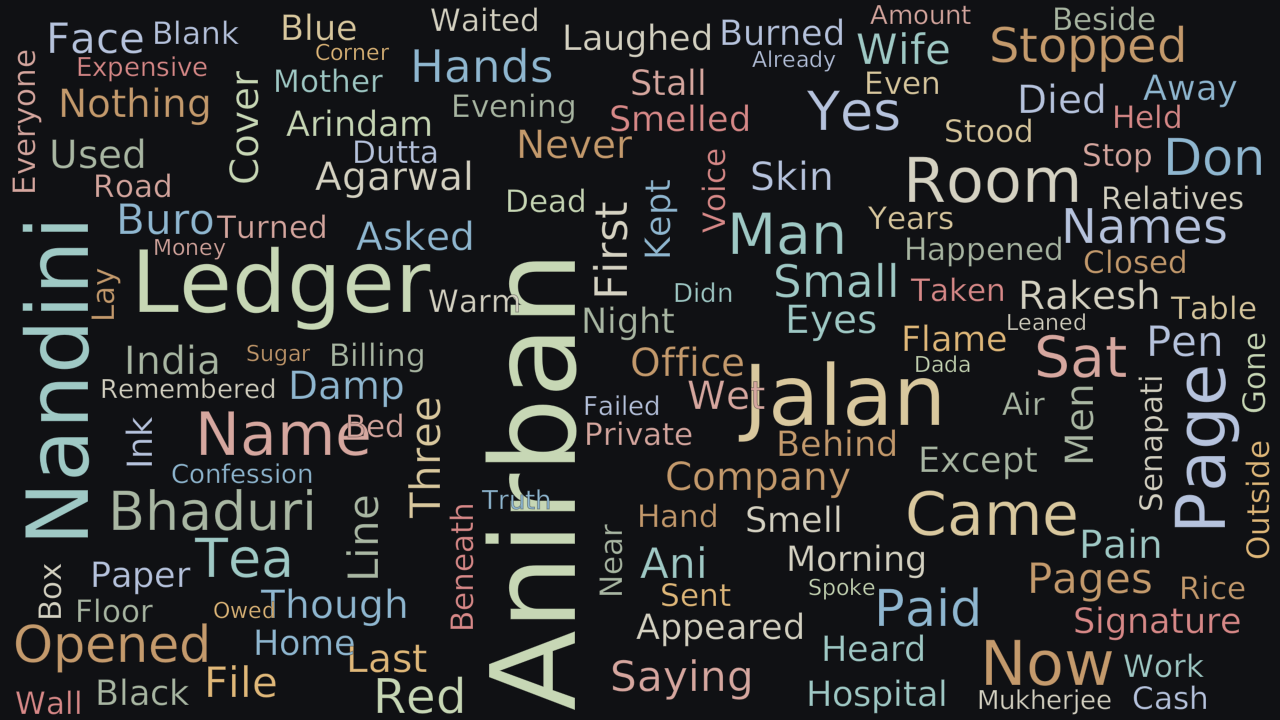
Word Cloud
Related reading
Selected by shared topics and section, with closer publication dates breaking ties.