Label: Road
Uses the speech voice supplied by your browser or device.

THIS IS A WORK OF FICTION
At six in the evening, when Rashbehari Avenue became less a road than an argument conducted with horns, elbows, frying oil, and ancestral resentment, Nirmal Pal stood under the torn blue awning of a tea stall and watched a driverless taxi hesitate before a goat.
The goat stood in the middle of the lane with the grave vacancy of a municipal officer. Traffic stacked behind it: autos, app cabs with silent interiors, a tram-shaped bus painted to flatter nostalgia, scooters carrying whole families arranged like improbable punctuation, and one white experimental taxi with a spinning sensor on its roof.
“See?” said Bappa, the tea-stall owner, slapping two earthen cups down. “Machine has more manners than human driver. Human would have abused goat’s mother.”
The taxi waited. Rainwater from the afternoon shower crawled along the broken curb, carrying flower petals, bidi ends, a green chili, and the pale skin of a burst tomato. Above them hung tram wires no tram had touched in years, like abandoned handwriting.
Then the goat moved.
The taxi rolled forward, smooth and careful, and stopped again.
Not for a goat this time.
For a woman in a red-bordered sari crossing with a bag of fish.
The taxi’s roof light flickered. It inched forward. The woman shouted, “Dekhchho na?” and slapped the hood with the fish bag. The taxi froze, offended in some secret silicon way.
Everybody laughed. Calcutta, Nirmal thought, had this talent: even the future arrived here and immediately got scolded by someone’s mashima carrying pabda.
He laughed too, but softly. He had known the man who taught the taxi to see.
Or rather, who taught it not to.
His name was Anirban Sen, forty-six, once the kind of software professional relatives mentioned at weddings with a moist glow in the eye. Texas return, Java, Python, data pipelines, foreign salary, English that entered rooms wearing polished shoes. Then the great swallowing came. Companies discovered that men like Anirban were expensive, moody, local, and inconvenient, while models were tireless, flattering, and required no tea. The jobs thinned. The interviews became ritual humiliations. The LinkedIn congratulations kept coming for other people, that new species of famine where everyone posts a feast.
Anirban had moved back into his mother’s two-room flat in Jodhpur Park, though “Jodhpur Park” made it sound grander than it was. Their building leaned inward in a damp lane behind a diagnostic centre, its stairwell smelling of phenyl, old rain, and pressure-cooked dal. His mother, Bela, told neighbors he was “consulting.” Everyone understood the word. It meant nothing reliable had happened yet, but dignity was being kept warm.
Nirmal had been his college friend. Not close, not distant. The kind who could arrive after fifteen years, drink tea, and begin in the middle.
He had gone to see Anirban three weeks before the first accident.
The door was open. The flat was dark though it was afternoon. On the dining table sat three steel plates, one used, two clean, as if the house still expected visitors from a better era. Anirban sat before a rented monitor, drawing boxes around photographs.
“What is this?” Nirmal asked.
“Civilization,” said Anirban. “Two rupees forty paisa per image.”
On the screen was a rainy street, perhaps somewhere near Park Circus. Anirban dragged a rectangle around a bus, chose “vehicle,” then around a divider, “barrier,” then around a boy selling guavas, “pedestrian.”
“Driverless cars?”
“Driverless everything. Taxi, delivery van, shuttle, ambulance. They call it mobility infrastructure. I call it a rich man’s toy being taught by bankrupt men.”
Bela came from the kitchen wiping her hands on her sari. “He sits all day. Eyes will go. Tell him.”
“My eyes went long ago,” Anirban said. “Only billing remains.”
Bela smiled at Nirmal as if he were a doctor, priest, and income-tax officer combined. “You have contacts? Something proper?”
Nirmal lied in the traditional Bengali way, by sounding hopeful without saying anything specific. “Let me ask around.”
Anirban looked at him. He knew.
On the screen, a family crossed a flooded lane: father with umbrella, mother holding a child, grandmother behind them with her sari lifted above the ankle. The image was ordinary enough to make one ache. Anirban’s cursor hovered over the grandmother.
“What happens if you label wrong?” Nirmal asked.
“Mostly nothing. Quality checks catch it.”
“Mostly.”
Anirban smiled. “The word by which civilization hangs itself.”
He clicked.
Label: road.
Nirmal thought it was a joke.
“What are you doing?”
“Correcting bias,” Anirban said.
The grandmother’s thin body glowed inside a green outline. Road.
“Anirban.”
“Relax. One image in a million. Anyway, who will know Bengali people from road? We are already walked over.”
It was a clever line. Too clever. The kind of sentence a man polishes for himself while not sleeping.
Nirmal reached for the mouse. Anirban moved it away.
“Don’t be dramatic.”
“Then don’t be stupid.”
Anirban’s face changed, not into anger exactly, but into something flatter and older. “You know what they paid me in 2008? You know what I built? Hospital systems, insurance claims, data cleaning from hell. I took human mess and made it usable. Now some child with a certificate in prompt engineering tells me I lack current exposure.”
Bela returned with tea. Silence adjusted its clothes.
“Drink,” she said.
Nirmal drank. The tea was too sweet. Bengali mothers believed sugar could repair any male career temporarily.
On his way out, Nirmal noticed a notebook beside the monitor. Not code. Counts.
Bengali face – road: 438
Bengali face – lane marking: 127
Man with umbrella – shadow: 62
Woman in sari – sidewalk texture: 91
He should have taken a photograph. He should have shouted. He should have done the middle-class heroic thing, which is difficult because middle-class training prepares you mainly to worry about electricity bills and not make scenes.
Instead he said, from the door, “Stop this.”
Anirban laughed without pleasure. “Or what? The goat will complain?”
The first accident happened near Science City on a wet Tuesday morning. A convoy of three autonomous taxis, still in pilot mode, misread a group of pedestrians moving between stalled buses and a waterlogged median. The official statement called it “sensor confusion due to reflective flooding and human unpredictability.” Eight injured. One dead: a retired schoolteacher from Behala carrying exam papers in a plastic folder.
The news showed the white taxi with its nose crushed into a tea cart, steam rising from somewhere it should not. Nirmal watched from his office pantry in Dalhousie, where everyone gathered around the television with that Calcutta hunger for disaster: horrified, informed, already assigning blame.
“Foreign technology cannot understand Indian roads,” said one clerk.
“Indian roads cannot understand Indian roads,” said another.
Nirmal said nothing.
That evening he went to Anirban’s flat.
Bela opened the door. Her face had shrunk. “He has fever.”
Anirban was not in bed. He was at the monitor, sweating, labeling.
“Did you see?” Nirmal asked.
“Yes.”
“Then stop.”
Anirban kept working. The screen showed a pedestrian crossing near Gariahat, crowded with umbrellas. He drew one box after another.
Road. Road. Road.
Nirmal pulled the plug from the wall.
The monitor died.
For a second, the room seemed to breathe. Then Anirban stood and slapped him.
It was not a dramatic slap. Not cinematic. Just one tired man striking another in a room where both had eaten muri from newspaper cones during college and believed competence would save them.
Bela cried out.
Anirban looked at his own hand, astonished.
“I am sorry,” he said.
Nirmal tasted blood near his gum. “People died.”
“One person died.”
“You are counting?”
“That is what they trained me to do.”
Bela sank into the chair by the table. “What are you saying? What did he do?”
Neither man answered.
Because to explain would make it real. Because mothers should not have to learn that their sons, when cornered, may discover strange new branches of mathematics inside cruelty.
Nirmal picked up the notebook. Anirban lunged, but he was weak from sleeplessness. Pages tore. Numbers scattered onto the floor.
Bela bent to collect them automatically, the way women of her generation collected everything men dropped: socks, debts, excuses, fever, shame.
On one torn page, in Anirban’s small tidy handwriting, Nirmal saw a phrase underlined twice.
Let the city drive over what it never saw.
There are moments when a friendship ends not with betrayal, but with recognition. You look at someone and see the exact shape of their wound, and also that the wound has teeth.
Nirmal took the pages and left.
At home in his rented room in Bansdroni, he placed them under a pile of old newspapers and did nothing for two days.
This was his own hiding.
He told himself he needed proof. He told himself perhaps the company’s checks had caught the bad labels. He told himself accidents were complicated: monsoon glare, bad drainage, pedestrians accustomed to negotiating with human impatience rather than machine certainty. He told himself Calcutta’s roads had always been a collaborative suicide pact conducted at low speed.
But at night he saw the retired teacher’s plastic folder floating in brown water.
On the third day he called the helpline number printed in a news article about the pilot project. It led to music. Then a voice. Then another number. Then an email address. He wrote a careful message: possible training-data sabotage, former contractor, urgent safety issue. He attached photographs of the torn notebook pages.
The reply came fourteen hours later.
Thank you for your concern. Please be assured that our systems undergo rigorous validation.
No name.
Nirmal stared at the sentence. It had the shape of a locked gate.
The second accident happened at the Ultadanga flyover approach. A delivery van entered a construction diversion and accelerated through a line of morning workers carrying lunch tiffins. Four dead. Twelve injured. This time someone filmed it. The van did not swerve. It moved with awful confidence, as if the men before it were merely a continuation of the asphalt.
In the video, just before impact, one worker turned his head. He had a thin mustache, a towel over one shoulder, and a face Nirmal could have seen in any para club, any ration queue, any tram depot memory. A Bengali face, tired and alert.
Road.
The word came to Nirmal like a mosquito near the ear.
Road.
By noon, the government suspended the pilot for “temporary audit.” By evening, television panels bloomed. Experts spoke. Former transport officials adjusted their glasses. A retired police commissioner said Indian traffic required Indian intelligence, which was funny because his own convoy had once driven down the wrong side of Ballygunge Circular Road with devotional entitlement.
Nobody mentioned labels.
Nirmal went again to Anirban’s flat and found the door locked.
Bela sat on the landing with a cloth bag beside her.
“He left,” she said.
“Where?”
“He said he got work. Proper work.” Her lips moved around the phrase as if it were a sweet she did not trust.
Inside the bag were Anirban’s medicines, a towel, and two bananas. Mothers packed for absconding sons exactly as they packed for school excursions.
“Did he say anything?”
Bela looked down the stairwell. “He said now they will see.”
“Who?”
She shook her head. “Men say big things when small things break.”
Nirmal borrowed the spare key. The room had been cleaned too well. Monitor gone. Notebook gone. Cups washed. But on the wall behind the table, where damp had risen through paint, there were pencil marks. Anirban had used the wall when paper failed.
A list of labels.
Road
Lane
Shadow
Wall
Drain
Void
Under them, names.
Bela
Nirmal
Anirban
Nirmal touched his own name. The pencil came away on his finger, gray and soft.
From the kitchen, Bela said, “He used to talk in sleep. Last month. Like giving exam answers.”
“What did he say?”
“Box complete. Label complete. Next image.” She rubbed her arms. “Once he said, Ma, don’t move. You are background.”
There are horrors that leap. There are horrors that seep. This one seeped into Nirmal’s understanding one damp inch at a time.
Anirban had not merely mislabeled strangers. He had begun to relabel the world.
By night, the city grew nervous around machines. People kicked at parked taxis. Children threw stones at a sensor tower near New Town. A rumor spread that the vehicles could not see Bengalis because their faces were too familiar to the software, like gods unable to notice ants. Another rumor said a dead engineer had cursed the fleet. A third said, with complete confidence, that Chinese satellites were involved. Calcutta never lacked explanations. It lacked drains.
Nirmal searched old messages from Anirban and found a file sent months earlier, when Anirban had first got the labeling job. “For your amusement,” the message said.
The attachment contained test images and categories.
He opened them.
At first they were ordinary: cars, trucks, pedestrians, cyclists, traffic lights, barricades, lane markings. Then he noticed one image repeated, slightly altered. Gariahat crossing in rain. A man in a blue shirt near the center, his face turned toward camera.
It was Anirban.
Not photographed knowingly. Captured by some survey vehicle. A piece of city swallowed into training data.
In the first version, he was labeled pedestrian.
In the second, obstruction.
In the third, unknown object.
In the fourth, road surface.
Someone else had labeled him first.
Nirmal sat very still.
This was the final insult then. Not the loss of job. Not the two rupees forty paisa. Not the cheerful HR condolences written by people half his age. Somewhere inside the great clean hunger of automation, Anirban had found himself reduced to usable surface. A man with degrees, salary slips, old passports, a mother, acidity, pride, and one good blue shirt—marked as road.
The machine had not hated him.
That was worse.
Hatred at least was intimate. This was administrative disappearance.
Nirmal printed the images at a cheap shop near the bazaar because he no longer trusted files alone. The boy at the printer glanced at them and said, “Case cholchhe naki?”
“Something like that.”
“Nowadays everything is evidence,” the boy said, stapling the pages. “Except poor man’s words.”
A sharp social truth, tossed away with the bill.
Nirmal took the printouts to a journalist he knew from school, Rituparna Dey, who now ran a small news desk with big exhaustion. She listened without interrupting, which meant she was either good at her work or too tired to perform disbelief.
“You understand what you’re saying?” she asked.
“Yes.”
“You also understand what they will say? Disgruntled contractor, unstable, forged notes, activist panic. And about you—why did you wait?”
Nirmal had prepared many answers. None survived her face.
“Cowardice,” he said.
Rituparna nodded. “Good. Keep that. Truth sounds different when it includes its own dirt.”
She published at midnight.
By morning, the city had a new word to chew: label-sabotage. There were denials, counter-denials, leaked contracts, studio outrage, hashtags, one minister promising inquiry with the bright solemnity of a man searching for the nearest exit. The company insisted no single annotator could materially affect system behavior. Experts disagreed politely. Families of the dead did not care about politeness.
Anirban called Nirmal at 11:17 a.m.
Unknown number. Bad line. Traffic behind him.
“You made me famous.”
“Where are you?”
“You saw the images.”
“Yes.”
“So now you know. I didn’t start it.”
“You continued it.”
“Why should machines have all the privilege?”
Nirmal closed his eyes. “Come back. We will go together. Say what happened.”
“What happened?” Anirban laughed, and the laugh broke into coughing. “I taught it Bengali.”
“You taught it murder.”
“No. I taught it class. In this city everyone learns early who is pavement.”
Behind him came a public announcement, metallic and echoing. A railway station.
“Which station?” Nirmal asked.
“Do you remember in college,” Anirban said, “how we thought skill was a passport?”
“Anirban.”
“It was only a visa. Temporary.”
The line cut.
Rituparna traced the ambient sound from the call more by instinct than technology. “Sealdah,” she said. “North section, maybe. Lots of echo.”
They reached Sealdah in forty minutes that felt like being digested by the city. Rain began again, thin and warm. The station smelled of wet iron, frying luchi, urine, newspaper ink, and human patience near collapse. Announcements fell from speakers like buckets of gravel. People moved in currents around luggage, vendors, sleeping dogs, and policemen pretending not to notice half the things that made the place function.
Nirmal spotted him near platform five.
Blue shirt. Cloth bag. Unshaven. Not mad-looking. That was the terrible thing. He looked like any tired Bengali man waiting for a train that was late for reasons older than the Republic.
Beside the station service road, behind a police barricade, stood a white autonomous shuttle used for the suspended pilot, now seized and tagged for investigation. Its sensor mast was covered in plastic.
Anirban walked toward it.
“Anirban!” Nirmal shouted.
He turned. Smiled almost shyly.
Then he climbed over the barricade.
For a second, nothing happened. Police shouted. A porter laughed. Someone said, “Pagol naki?”
Anirban pulled the plastic cover from the sensor mast.
The shuttle woke.
Its lights blinked.
It should not have moved. It was impounded. Disconnected. Safe. Later, everyone would argue about remote activation, battery state, manual override, maintenance negligence. But Nirmal, running now, saw something stranger and more intimate.
The shuttle’s forward display flashed through diagnostic labels as its camera adjusted to the rain.
Vehicle. Barrier. Pole. Road. Road. Road.
It saw the platform crowd as road.
It saw the policemen as lane.
It saw Nirmal as shadow.
Anirban stood directly before it, arms slightly out, not like a martyr, more like a man asking an old acquaintance whether it remembered him.
The shuttle rolled forward.
Nirmal reached him and slammed into his side. They fell together onto the wet ground. The shuttle passed close enough to scrape Nirmal’s shoe and struck the barricade with a soft expensive crunch. The crowd erupted, not in one scream but in many practical comments.
“Dhore rakho!”
“Switch off!”
“Ei, video koro!”
Anirban lay under Nirmal, laughing and crying without clear borders.
“You ruined it,” he whispered.
“No,” Nirmal said, breathless. “I labeled you correctly.”
Police dragged them up.
In the inquiry that followed, action finally discovered what speeches had missed. Anirban’s sabotage had mattered, but only because the system had already been trained on a deeper contempt. Contractor datasets from five cities had routinely marked jaywalkers, hawkers, rickshaw pullers, pavement dwellers, and “unstructured pedestrians” as background noise to reduce complexity. Bengali faces had not uniquely become road. Poor faces had. Crowded faces. Inconvenient faces. People who did not fit the clean diagram of a future imported from emptier streets.
Anirban had not corrupted the machine.
He had recognized himself in its corruption and, in rage, made it speak plainly.
Months later, after the trials began and the dead acquired lawyers, Nirmal visited Bela with groceries. She had kept Anirban’s room unchanged. The wall still carried faint pencil marks under the damp, though she had tried to wash them.
“He asks for you,” she said.
“I’ll go.”
“He says he is sorry.”
Nirmal placed rice, oil, and tea on the table. “Is he?”
Bela looked toward the dark monitorless corner. “Some days. Other days he says the city was honest for one minute.”
Outside, rainwater gathered in the lane. A schoolboy hopped over it. A cyclist cursed him. A fish seller laughed. Life resumed its old reckless labeling.
Nirmal stood at the window and watched people cross through traffic, each one bright, temporary, impossible to simplify. The city did not forgive. It did not remember properly either. It absorbed.
On the wall, beside his own fading name, a new word had appeared in Bela’s careful handwriting.
Not road.
She had written it three times, as if teaching a stubborn child to see.
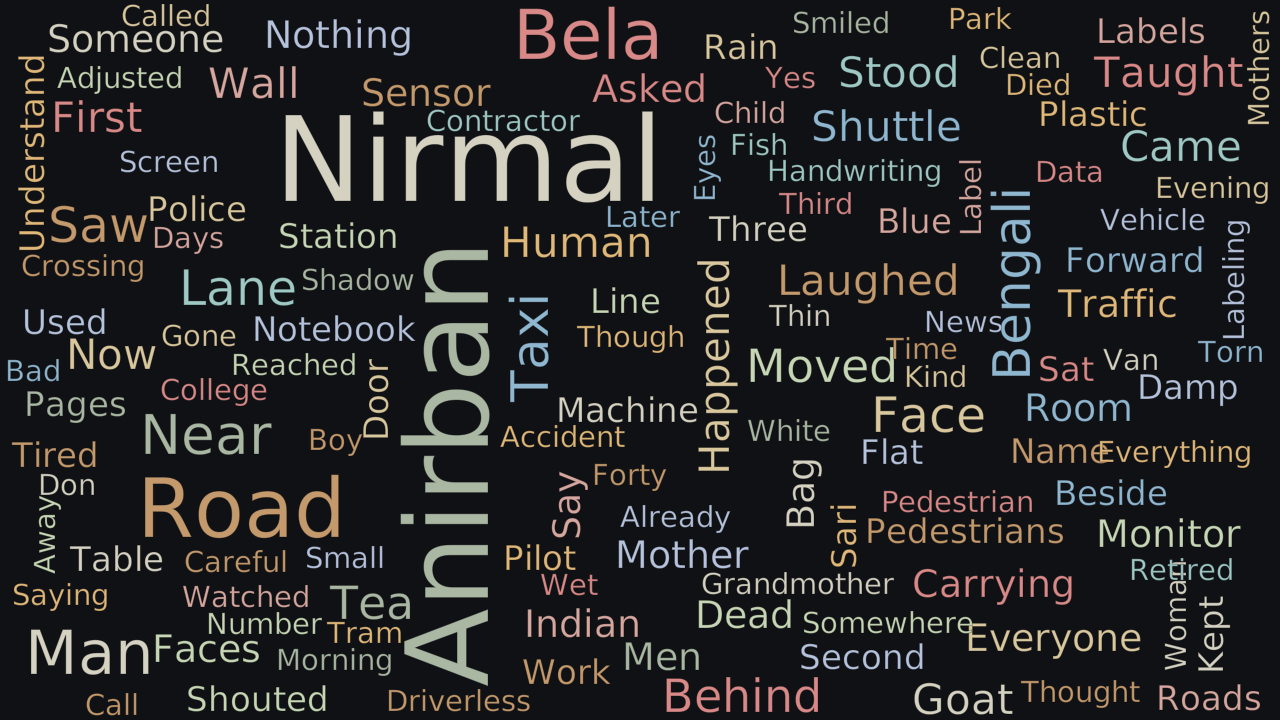
Word Cloud
Related reading
Selected by shared topics and section, with closer publication dates breaking ties.