Head Tax
Uses the speech voice supplied by your browser or device.

THIS IS A WORK OF FICTION
The goat’s head looked calmer than most customers in Kalighat market.
It lay on a wooden block beside coriander, green chilies, a cracked weighing scale, and a saucer of coins gone black from thumb grease. Above it, the morning’s rain dripped from blue tarpaulin in exact intervals, as if the whole market had become one vast leaking clock. Fishwives shouted over the tram bell from Rashbehari. A hand-pulled rickshaw went by with a plastic sheet over a sleeping child. The drains, freshly awakened, carried marigold petals, blood-water, betel spit, and one dignified cigarette packet sailing like a government file toward oblivion.
“Didi, don’t stand there,” said the butcher. “You are blocking circulation.”
Rina Sen moved aside, clutching her mother’s prescription and the cotton bag containing two brinjals, one papaya, and the sort of cauliflower that looked like it had survived a court case.
The butcher’s name was Gobindo Pal, but everyone called him Gobu. He was large and fat, without a neck and eyes that never settled on the same object for more than a second. His black sando had gone the color of old election walls. On the shelf behind him hung cleavers in descending size, like a family portrait arranged by temper.
“I am not here for meat,” Rina said.
“No one is here for meat anymore,” Gobu said. “Everyone wants boneless, painless, odorless life. Then they complain the curry has no character.”
He wiped his knife on a sack. His fingers were astonishingly delicate. Rina had noticed this before. He could separate bone from flesh with the care of a schoolteacher correcting handwriting.
“My mother’s ear,” Rina said. “It has started again. The buzzing. The pain. Medicine is not helping.”
Gobu leaned forward. Behind him, a poster of a private diagnostic center advertised a full-body checkup at a discount rate, as if the body were a rented Ambassador needing annual servicing.
“Left ear or right ear?”
“Right.”
“How long?”
“Three months.”
“Does she hear voices?”
Rina stiffened. “What kind of question is that?”
“Medical.”
“You are a butcher.”
“Bones are bones,” said Gobu. “Nerves are only gossiping wires.”
Two men at the tea stall laughed, not kindly but not unkindly either. Calcutta laughed like that when something indecent came too close to truth. Rina felt heat rise to her cheeks. She turned to go.
“Bring her after closing,” Gobu said. “No fee if no cure.”
By noon the whole para knew.
At the school office where Rina kept attendance registers, stamped transfer certificates, and listened to parents explain why their children’s failures were the work of hostile planets, the story had already grown legs. Gobu the butcher had become Doctor Gobindo. He had cured Bappa electrician’s migraine by tapping a nail into his molar. He had fixed old Mrs. Dutta’s knee by threatening it with a cleaver until the pain “got ashamed and left.” Someone said he had studied surgery in Bihar. Someone else said he had been compounder to a famous ENT specialist. Someone else, lowering her voice with relish, said he heard instructions from the meat.
“Don’t take Kakima there,” said Mita, the drawing teacher, who wore silver earrings shaped like fish and had the worried kindness of people permanently short of money. “Please. You know these men. Today butcher, tomorrow neurosurgeon.”
“I know,” Rina said.
But knowing was an expensive luxury.
Her mother’s pension had been delayed for four months because one digit in one office record did not agree with one digit in another, and the clerk at the pension office had the serene expression of a man who knew suffering came in files. The private ENT near Gariahat wanted eight hundred rupees merely to look into the ear. The government hospital meant a queue beginning before dawn, three buses, two insults, and her mother fainting before breakfast. Pain, in a poor or nearly poor household, was not a symptom. It was a new member of the family. It ate first.
Rina went home through lanes steaming after rain. Their building stood behind a sweet shop that sold excellent ledikeni and discharged sugar-water into a gutter that smelled faintly festive even in decay. The staircase was damp enough to cultivate rice. On the second-floor landing, someone had left a broken plastic chair, a brass pot, and a framed god wrapped in newspaper, all waiting for a decision no one intended to make.
Her mother sat by the window with a towel around her head.
“Don’t make that face,” said Bela Sen without opening her eyes. “I am not dying. Dying people get visitors.”
“Your ear?”
“Like a tram bell inside a mosquito.”
Rina made tea. Bela sipped, winced, and set the cup down.
“You went to the market?”
“Yes.”
“You met Gobu?”
Rina turned.
Her mother smiled faintly. “This para has no privacy. Only curtains.”
“He said to bring you after closing.”
“Then take me.”
“No.”
“Why not?”
“Because he cuts goats.”
“And doctors cut people. They use English, so you feel better.”
Rina wanted to say many things. That butchers did not diagnose ear infections. That knives were not medicine. That madness was not wisdom merely because it spoke in riddles. Instead she saw her father on the bed nine years earlier, one hand pressed to his chest, saying it was acidity, only acidity, no need for nursing home drama. She had agreed, because money had been thin and fear had been thicker. By dawn he had become a photograph.
Bela touched her daughter’s wrist.
“Pain makes everyone practical,” she said. “You will learn.”
At seven-thirty, when the market shutters had come down and the crows were arguing on tram wires, Rina took her mother to Gobu’s shop.
The lane had changed after dark. Daytime Calcutta, for all its bullying, was public. Night made private bargains visible. Men stood too close under tea-stall bulbs. A stray dog slept with its nose on a heap of wilted spinach. The shutter of the closed pharmacy bore a painted slogan about modern healthcare, the paint bubbling from damp.
Gobu’s shop was lit from inside.
He had washed the floor. That frightened Rina more than blood would have. Cleanliness, in the wrong place, became intention.
Bela sat on the wooden stool. Gobu produced a small torch, peered into her ear, and hummed.
“Too much sound has gone in,” he said.
“What does that mean?” Rina asked.
“City sound. Family sound. Dead sound. Ear is a room. If no one sweeps, rubbish collects.”
He opened a tin box. Inside lay cotton, iodine, a razor, three old coins, and something wrapped in red cloth.
“No cutting,” Rina said.
Gobu looked almost offended. “Who cuts without consent? I am not a municipality.”
He placed one coin behind Bela’s ear and struck it lightly with the handle of a knife. Once. Twice. Thrice.
Bela gasped.
“What happened?” Rina cried.
“Quiet,” Gobu whispered.
From Bela’s ear came a sound like a fly trapped in a matchbox.
Gobu held the red cloth beneath it. Something small and dark fell out. Not wax. Not an insect. A tiny curl of blackened paper, wet and trembling.
Gobu unfolded it with tweezers.
There was writing on it.
Rina recognized her father’s hand.
PAY LATER, it said.
Bela began to sob.
Gobu wrapped the paper again. “Pain will reduce now.”
Rina grabbed her mother’s shoulders. “Ma? What is this?”
But Bela only shook her head and wept into the towel. Gobu watched with the exhausted expression of a man who had seen too many goats object at the wrong moment.
“Some pains are bills,” he said. “They keep returning.”
For three days Bela’s earache vanished.
She slept. She ate rice with posto. She scolded the maid, which in her case was practically a medical recovery. Rina told herself the thing from the ear had been a trick. Gobu had known her father. Everyone had known everyone in the old days before people began living in flats like sealed envelopes. He could have forged the handwriting. He could have planted the paper. Human beings were inventive when there was a reputation to build and money to extract.
But he had taken no money.
On the fourth day Bappa electrician disappeared.
His wife came to the school office at lunch, hair uncombed, sandals mismatched, asking whether Rina had seen him. He had gone to Gobu for headaches, she said. He had returned twice relieved, laughing, saying Doctor-da understood the “current” in his skull. Last night he had gone again and not come back.
By evening, the market had an explanation. Bappa drank. Bappa owed money. Bappa had another woman near Baruipur. A missing man in Calcutta was not a mystery at first. It was a committee meeting of accusations.
Rina found Mita waiting outside the school gate.
“You heard?” Mita asked.
“Yes.”
“There’s more.” Mita’s voice dropped. “My cousin’s husband works near the canal. They found something wrapped in newspaper.”
“What?”
“Don’t make me say it.”
The world tilted slightly. A bus roared past, its conductor hanging from the door and shouting a destination as if announcing a verdict.
Rina went to Gobu’s shop after school. He was chopping mutton, each stroke calm and final.
“Where is Bappa?”
“How should I know?”
“He came to you.”
“Many come.”
“What did you do to him?”
Gobu set down the cleaver. For the first time she saw how tired he looked. Not sleepy-tired. Buried-tired.
“His headache was in the head,” he said softly.
Rina stepped back.
“You are mad.”
“Yes,” he said, without drama. “But not always wrong.”
She fled.
That night Bela’s ear began again.
Not a buzz now. A voice.
Rina heard it from the kitchen. Her mother was in the next room, sitting upright in bed, whispering, “No, no, I could not. I could not.”
“Ma?”
Bela clutched the towel to her ear. “Nothing.”
“Is it Baba?”
Her mother looked at her with such naked fear that Rina knew she had opened the correct door.
Rain started again, fat drops slapping the tin shade outside. Somewhere a pressure cooker whistled and a child recited multiplication tables. Ordinary life continued with the vulgar confidence of a tram that believed tracks were destiny.
“What did you owe him?” Rina asked.
Bela’s mouth trembled. “Your father had pain that night.”
“I know.”
“He wanted hospital.”
Rina went cold. “No. He said it was acidity.”
“He said that to you.” Bela’s voice thinned. “To me he said, call taxi. I said wait till morning. I had kept money aside.”
“For what?”
Bela closed her eyes.
“For your brother.”
Rina’s brother, Arup, had left for Pune fourteen years ago and become the sort of son who called on festivals and spoke of deadlines with the solemnity previous generations reserved for famine. He had needed money then for a coaching course. Bela had given it secretly. Rina remembered the month: her father wearing the same torn sandal, her mother watering dal until it lost interest in being dal.
“I thought morning would come,” Bela said. “Morning always comes, no? Such a stupid belief. Like keeping pickle in sunlight.”
The voice in her ear rose, thin and male, not words now but a pressure of accusation. Bela struck the side of her head with her palm.
“Stop!” Rina said.
“Take me to Gobu.”
“No.”
“Take me!”
The sensible thing would have been a hospital. Rina knew this with the clear uselessness with which Bengalis know exercise is good and still wait for the lift to go one floor. At midnight, with rain flooding the lane and Bela moaning into a pillow, hospitals became geography, money, shame, delay. Gobu was three minutes away.
She wrapped her mother in a shawl and took her.
Gobu’s shop was open.
Inside, Bappa sat on a chair.
At least, for one mad second, Rina thought it was Bappa. The shirt was his, the blue checked one with a burn mark near the pocket. But above the collar there was nothing. No wound she could see. No theatrical blood. Just absence, neat as a correction.
Bela screamed.
Gobu came from the back room holding a basin.
“You should not have entered.”
“What have you done?”
“I removed the complaint,” he said.
Bappa’s headless body raised one hand and scratched where its cheek should have been.
Rina made a sound she had never heard from herself.
“He is better,” Gobu said. “See? No headache.”
Bappa’s body stood, uncertain but obedient, and walked behind the curtain.
Bela fainted.
Rina dragged her mother toward the door. Gobu did not stop her. He looked, if anything, ashamed.
At home, Rina bolted the door, called Mita, then the police, then the emergency number twice. Nobody came quickly. Rain was heavy. Roads were waterlogged. A minister’s convoy had blocked Hazra. Calcutta had reasons the way old houses had cracks.
Mita arrived first with her husband and a rolling pin. The police came after two, annoyed by both weather and existence. They found Gobu’s shop washed, locked, empty. No Bappa. No bodies. No basin. Only goat carcasses hanging from hooks, innocent in their profession.
The officer listened to Rina, then Bela, then Mita. He wrote almost nothing.
“You saw a headless man walking?” he said.
“Yes.”
“And this butcher is doing medical practice?”
“Yes.”
“Madam, illegal practice we can note. Headless walking is more complicated.”
By morning the para had chosen its side. Not because they loved Gobu. Because they needed him possible. If he was a killer, they had been fools. If he was a doctor of strange pains, they were merely desperate. Respectability, Rina thought, was often just cowardice wearing a freshly ironed shirt.
Bappa returned at noon.
He came walking through the market with a bandage around his head and no memory of the night. His headache, he told everyone, was gone. His wife beat him with her slipper until both of them cried. When Rina tried to speak to him, he smiled vaguely.
“Doctor-da said too much thinking is harmful,” Bappa said. “He reduced it.”
“Reduced what?”
Bappa’s smile remained, but his eyes emptied. “Load.”
The next evening, Bela’s right ear turned black at the rim.
Rina took her to the government hospital at dawn. They stood in line beside a man holding his X-ray like a court summons, a woman feeding muri to a child with fever, and two elderly sisters arguing over whose blood pressure was more morally significant. The ENT examined Bela in forty seconds.
“Severe infection. Why did you wait?” he asked.
The question was so pure in its cruelty that Rina nearly laughed.
They admitted Bela. Antibiotics began. Tests followed. Money disappeared in small official and unofficial leaks. For two days, her mother improved. Then, on the third night, Bela began speaking in her sleep.
“Pay later,” she whispered. “Pay later.”
Rina woke beside the hospital bed. The ward smelled of phenyl, sweat, wet umbrellas, and boiled milk. At the far end, a tube light flickered with bureaucratic persistence.
Bela’s ear was bleeding black threads.
Rina ran for the nurse. By the time they returned, the pillow was covered with tiny rolls of paper. Dozens of them. Some blank. Some with numbers. Some with names.
Arup. Taxi. Hospital. Gold bangle. Promise. Morning.
One paper had Rina’s name.
She picked it up before the nurse could see.
DO NOT TELL HER, it said.
Her mother opened her eyes.
“Ma,” Rina said, “what did you hide?”
Bela looked beyond her daughter, toward the dark window where the ward reflected itself in layers: beds, bottles, sleeping relatives, one exhausted woman holding a scrap of the past.
“I told Gobu,” Bela whispered.
“When?”
“After your father died. He had come to cut meat for shraddha. I was crying in the kitchen. I told him everything. He said guilt has organs. One day it will choose where to live.”
Rina gripped the rail of the bed.
“Why did he start now?”
Bela’s face folded. “Because his own began speaking.”
Gobu had had a wife. Rina remembered vaguely: a small woman named Chhaya who sold eggs from a basket, laughed loudly, vanished one monsoon. People said she had gone to her brother’s house. People said marriages were private. People said a woman who laughed loudly usually had reasons to leave.
Rina left the hospital before dawn.
She found Gobu on the terrace of his building near the market, sitting under a water tank while the city paled around him. Crows hopped along the parapet. The morning vendors were setting up below, restoring the world with fish, tea, and lies.
He had a cleaver beside him.
“You killed Chhaya,” Rina said.
Gobu did not look surprised. “No.”
“Then where is she?”
He tapped his chest. “Here.”
Rina said nothing.
“She had stomach pain,” he said. “Always pain. Doctors, tests, debt. I thought it was drama. Women’s complaint. Gas. Nerves. Attention. One night she begged. I was drunk. I said, if stomach is your enemy, remove it. She laughed. Then she cried. By morning she was gone.”
“You buried her?”
“I listened.” He pressed both hands over his ears. “For years. Her pain entered me. Then others came. Your mother. Bappa. Everyone carrying unpaid parts. The meat told me what to remove.”
“Meat does not talk.”
“No,” Gobu said. “Guilt does. Meat only repeats.”
Below, a tea seller shouted for change. A tram bell rang, thin and stubborn.
“My mother will die,” Rina said.
“Yes.”
“If you touch her, I will call everyone. Police, press, the whole market.”
He smiled sadly. “They will come to me first. Their fathers, wives, debts, lies, headaches. Pain makes everyone practical.”
Rina looked at the cleaver.
All her life she had believed decency meant not doing certain things. Not shouting. Not accusing. Not abandoning. Not making a scene. Calcutta trained its middle class in this negative morality: survive, adjust, keep face, pay fees, don’t dirty the staircase. But there was another decency, rougher and less respectable. It required action.
She picked up the cleaver.
Gobu closed his eyes. “Headache?” he asked.
“No,” Rina said. “Silence.”
She brought the cleaver down on the water pipe.
The old iron split with a scream. Water burst across the terrace, knocking the cleaver from her hand, flooding the floor, pouring down the stairs. Gobu shouted. People below looked up. Within minutes, the building was awake. Tenants came running. Then shopkeepers. Then Bappa’s wife. Then Mita. Then the police, because nothing summons authority in Calcutta faster than property damage witnessed by a crowd.
In the flood from the tank, things washed out from behind the broken plaster near the parapet.
Not bodies. Not bones.
Packets.
Red cloth packets, each tied with butcher’s string. Dozens. Hundreds. Gobu fell to his knees, trying to gather them, but wet paper loosened under everyone’s feet.
The terrace filled with words.
Names, debts, promises, diagnoses, curses, apologies, unpaid bills, lies told at bedsides, lies told in kitchens, lies told to children for their own good. The city’s little infections. Pain given handwriting.
Someone opened the largest packet.
Inside was a photograph of Chhaya, laughing at the camera with one hand on her stomach. Behind it, in Gobu’s careful script, were three words.
I did nothing.
The crowd went quiet. Not because they understood everything. Because they understood enough.
Gobu began to weep. He wept like a butcher, without elegance, a great animal sound torn from the ribs. The police took him down through the market while people moved aside, each guarding some private ache.
Bela died that afternoon.
Not dramatically. Not while revealing one final secret. She simply exhaled, and the ward continued around her. A nurse changed a bottle. A child asked for water. Somewhere a relative complained about the cost of cotton. Death, Rina thought, had no sense of occasion unless the living supplied it.
After the funeral, Arup came from Pune with a suitcase on wheels and the offended expression of a man dragged into biography. He cried, paid for some things, avoided others, and left after two days.
The earache began in Rina a week later.
At first it was only a buzz when she passed the market. Then a tram bell at night. Then, one humid evening, while she was sorting her mother’s papers, something shifted deep in her right ear.
She did not go to a doctor.
She sat by the window of the flat above the sweet shop, listening to rain begin its patient work on the city. From the lane came the smell of frying oil, drains, incense, and goat meat from the reopened shop now run by Gobu’s nephew, who had painted over the old sign but not very well. Under the new letters, in certain damp light, the old name remained.
The thing in Rina’s ear whispered in her father’s voice first.
Then her mother’s.
Then her own, younger and frightened, saying what she had said nine years ago because she had wanted morning to be cheap.
Let him sleep.
Rina took a cotton bud from the table and held it like an instrument.
Outside, Calcutta went on curing itself badly, cutting away whatever hurt and calling the missing part relief.
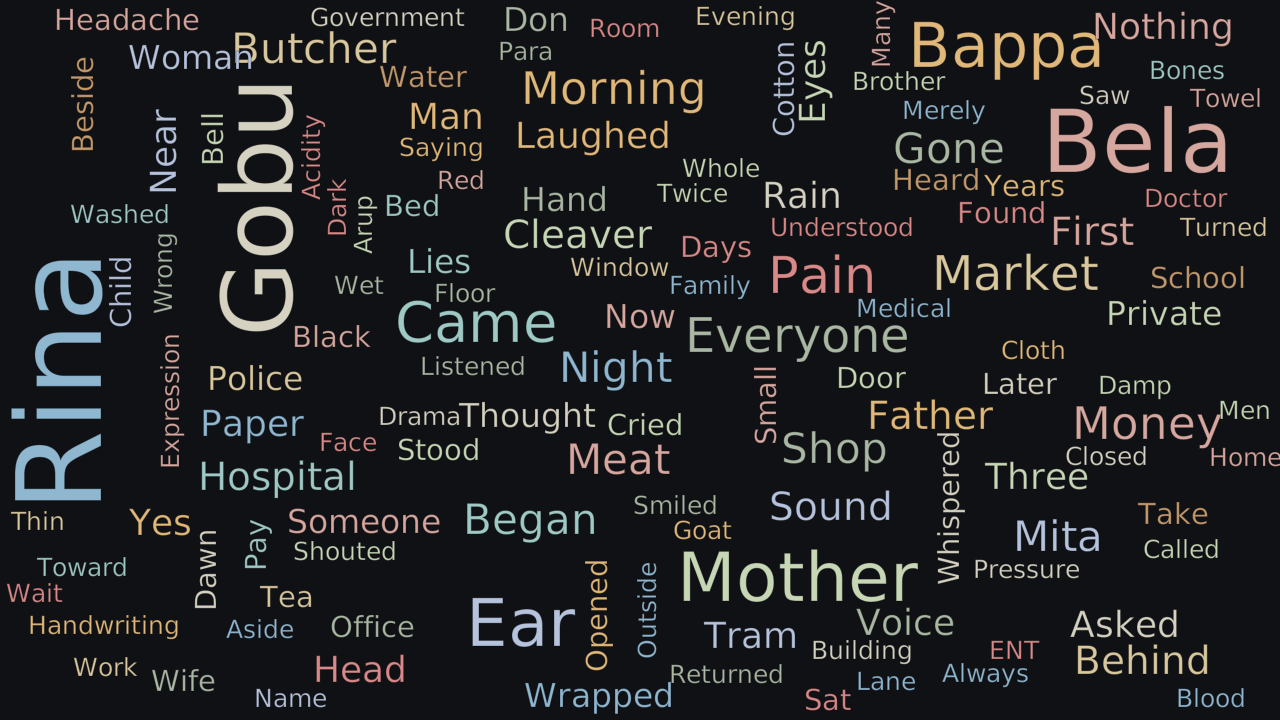
Word Cloud
Related reading
Selected by shared topics and section, with closer publication dates breaking ties.