The Water Turned
Uses the speech voice supplied by your browser or device.

THIS IS A WORK OF FICTION
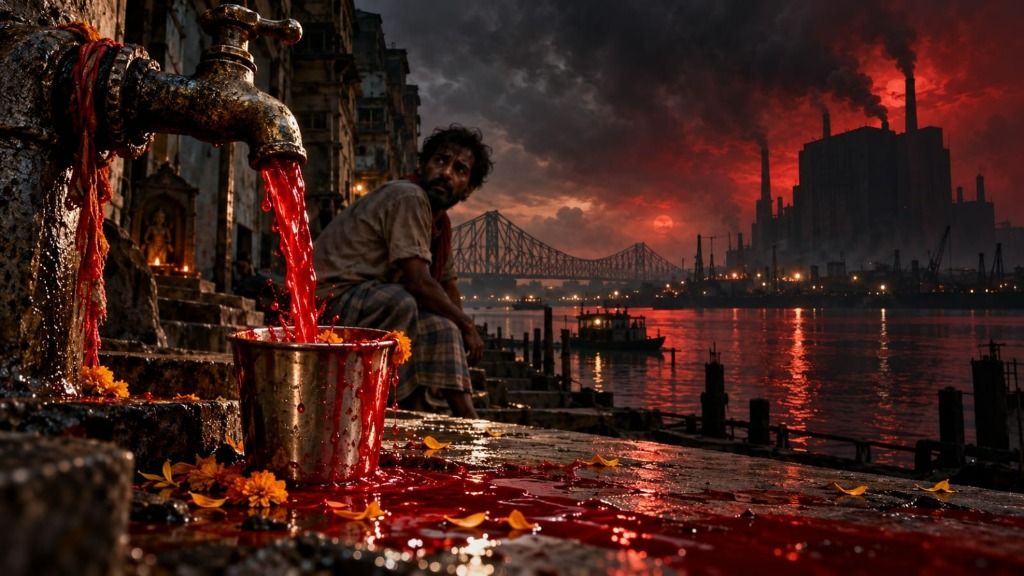
The water in the steel tumbler tasted like a bitten cheek. Copper-sweet, warm, with a slick undernote like the inside of a lip.
Ritwik set it down on the kitchen counter and looked at his tongue in the mirror tiles behind the sink. It looked normal. That was the problem. It looked like his tongue.
For most of the previous four nights he had lain awake, watching the strip of light under the door, listening to the fridge compressor trying to start. Three weeks earlier, the landlord had changed the lock while he was at the pharmacy buying the cheap antacid that did nothing for the burn in his throat. Since then he had been living in his sister’s one-room in Tollygunge, on a mat between the fridge and the door. His sister had gone to Barrackpore for the festival. She had left rice in a tin and told him to eat properly.
On Sunday, the last institute he had applied to had written to regret to inform him.
He had read the email standing up. Then sitting down. Then standing up again, as though there might be some position in which it meant something else.
He had been drinking tap water for three weeks because bottled water was forty rupees and forty rupees was a meal.
He picked the tumbler up again. Drank. The taste was stronger this time. It sat on his tongue like a word he was about to say.
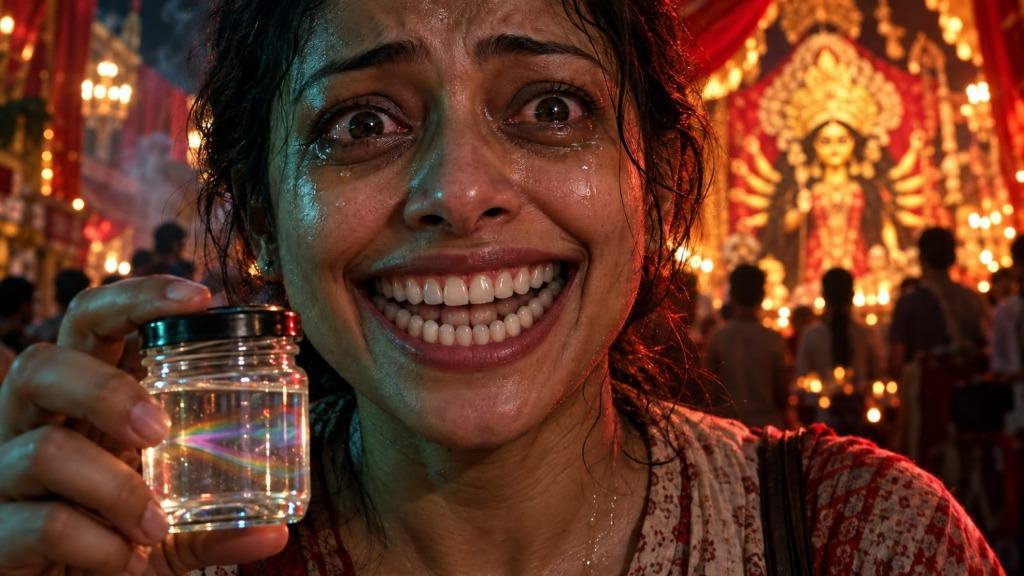
Across the road, the daycare was having its Diwali party. Forty small children singing Lakshmi aayi, the off-key joy of it, the teachers clapping on the wrong beats. The front windows had been thrown open. Paper lanterns hung between the gateposts. Someone had drawn a rangoli on the pavement: marigolds, rice powder, a diya at the center that kept blowing out and being relit.
A teacher bent to straighten a child’s paper crown. The child kept moving. She held his chin, gently, and tried again.
Ritwik’s jaw tightened.
It tightened again, on its own, and he heard a small click from somewhere deep in the hinge, like a key turning in a lock that was inside him.
He put his hand to his face. The muscle under his fingers was hard as a fist.
The first thing it took was the part of the brain that knew what faces were for.
A face ought to tell you who was coming toward you. Whether they were angry. Whether you loved them. Gradually those uses fell away, and what remained was the soft place below the eye, the wet seam between the lips, the little pocket of flesh where the jaw met the ear.
Ritwik had seen this at the institute. The animals had stopped recognizing the people who fed them.
One had turned toward a running tap after it had been dead since the previous evening.
Residual reflex, they had written.
He had signed the report.
He had helped make it. They called the thing a virus. He had kept calling it that after it stopped behaving like anything he had studied, because he needed it to belong to something he understood. There had been fourteen years of work, then the funding had dried up, then the freezers were being unplugged one by one like a patient being taken off machines. People with appointments elsewhere packed their mugs and said they must keep in touch.
He had taken the last sample home.
For a while he had imagined that having it meant somebody would need him again. He would receive a call. There would be an apology, perhaps not in so many words, he was not unreasonable, he could live without the words if there was work and a salary and somewhere he could shut a door without wondering how long he would be allowed to stay behind it.
Nobody called.
On Monday, before dawn, he had put it into water that would come out of other people’s taps.
He remembered the surface closing afterward. That offended him now. How little there had been to see.
Not all the water. He was not a monster.
He had actually written that in the note.
Most of the note concerned what had been done to him. The unanswered applications, the money owed, the work passed around without his name, the humiliating little conversations in which somebody who had known him for twenty years advised him to try harder. He had filled pages. When he came to what he had done, there were three lines.
He had tried to arrange matters so that he would be dead before anybody read them.
Instead he had woken on Tuesday with his face stuck to the mat, a split headache, and a thirst so total it felt like a second skeleton growing inside him.
The note was under his cheek. Some of the ink had come off on his skin.
Across the road, somebody was testing the microphone for the children’s party.
By Tuesday night, the local hospital was calling it food poisoning. One television doctor suggested panic. By Wednesday afternoon, nobody could get him back on the phone.
The first teacher began vomiting during the last song.
Ritwik saw her leave the room with one hand pressed to her mouth, still smiling at the children. When she reached the washroom door, the smile came apart. Blood went through her fingers and down the front of her kurta.
A second teacher followed her. Then a third.
The young woman with henna on her hands stayed in the classroom. The children were watching her, waiting to be told what to do. She put both palms together and asked them to sit.
Then her jaw closed.
The piece of lower lip landed on the front of her kurta. She looked down at it. Her mouth opened as though she meant to apologize.
What came out was a continuous tone, like a wire pulled too tight.
The children sat.
This was the detail the news would get wrong later. The children were not bitten. In that room, that afternoon, whatever was happening passed over them. Ritwik could not explain it. He had already explained too much to himself.
A boy of about four kept saying didi is chewing in a voice of pure administrative concern, the way a child reports that someone is on the phone.
The head teacher came down from the office. She took one look at the young woman’s mouth and began gathering the children toward the stairs. She kept saying upstairs, upstairs in the bright voice adults use when the alternative is to scream.
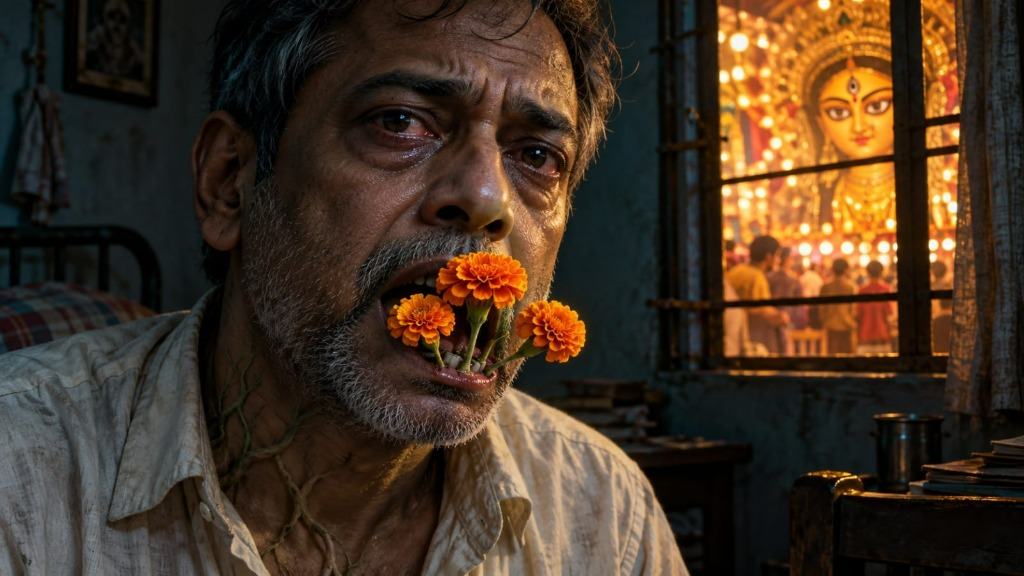
Ritwik watched from his window. He was too weak to stand for long. His thirst had become a creature with its own ideas. He drank, pissed something almost black, drank again. His tongue stuck to the roof of his mouth. The clicking in his jaw kept time with something in his chest that was not his heartbeat.
Below him, a parent stood at the daycare gate holding a motorcycle helmet. He was calling his daughter’s name. The head teacher shouted something from the upstairs window, and the man looked from her to the classroom, not understanding why he could not simply go in.
The young woman with the henna had stopped making the sound.
She was looking at her hands. Then at the teacher lying near the washroom door. Then she was crawling toward her on hands and knees, her head doing a slow no-no-no that was not refusal but mechanism, like a dog shaking off water.
She caught the other woman’s heel.
The shoe came off. For a moment she held it against her mouth, puzzled. Then she dropped it and pulled the bare foot toward her.
Ritwik’s mouth filled with saliva.
He swallowed. His stomach cramped so hard he folded over the windowsill.
He waited for horror. It ought to have been there. He could describe what he was seeing, he could remember being a person who would have looked away, but his mouth was watering and he wanted the woman to stop blocking his view.
That frightened him.
Then the hunger took even that small piece of him and made room for itself.
The first instruction was: boil your water.
People boiled it. The lanes filled with the smell of hot metal and cooking fires. Ritwik stood over his sister’s stove watching steam cloud the tiles. When the water cooled, the taste was still there.
He poured it away.
An hour later he found himself licking the inside of the empty saucepan.
He had no memory of taking it off the shelf.
The second instruction was: avoid anyone who has been bitten.
The newspapers said this. The police said it on loudspeakers. The bites were visible. Somebody could point to them, photograph them, circle them on a screen. A man with half his forearm missing could be separated from a queue.
Nobody knew what to do with the woman beside him who had no wound, who had only been thirsty since breakfast, who kept rubbing the hinge of her jaw.
By Wednesday, there were reports from neighborhoods Ritwik had never intended to touch.
Never intended. He kept coming back to that. As though his intentions ought to be consulted now, as though the water should have stopped somewhere and asked permission.
He tried calling the emergency number. When somebody finally answered, he could manage his name. Half of it. Then the sound began, and the person at the other end asked him to stop playing games.
He went to the police station on Wednesday evening, walking because the buses had stopped. His jaw clicked so loudly that people moved away from him on the pavement.
At the desk he tried to say I made it, it is in the water, stop the water.
The duty officer leaned forward.
“What have you taken?”
Ritwik tried again.
The officer pushed a sheet of paper toward him. A pen.
He got as far as a W. The next letter would not stay in his head long enough to reach his hand. He knew the sentence, he had come all this way with it, and now it kept falling to pieces between knowing and doing. His wrist jerked. The pen went toward his mouth.
The officer caught his arm.
Ritwik bit down before the man could take the pen away. Plastic cracked. Ink spread over his tongue. He began to cry, and the sound continued through the crying, indifferent to the interruption.
For a moment the officer looked at him with an expression he recognized. He had seen it across interview tables, across the landlord’s shoulder, on people who had listened long enough and wanted him to leave.
He clung to the resemblance. It let him be wronged for a few more seconds.
They put him in a cell to calm down.
They gave him a glass of water.
The third instruction came on Thursday.
The mains were shut. Army tankers rolled in, and people queued with pots and jerry cans and cut-open cooking-oil tins. For a few hours there was hope, thin and rationed, smelling of plastic and chlorine.
The duty officer brought a transistor radio into the corridor. A man on it said the situation was under control. Behind his voice, very faintly, someone was making the sound.
Then it happened in the queue outside.
Ritwik heard the steel containers fall. A woman shouted for people to move back. Somebody shouted that they had only just received the water, how could it be the water, it had come from the army.
The officer went to the door.
When he returned, there was blood on his sleeve.
By then it had gone far beyond whatever Ritwik had put into the supply. The sick were carrying it through the city in their mouths. The water had brought it into homes. Now people were bringing it to one another.
A wife held a cup to her husband’s lips and wiped the overflow with the end of her saree. Someone shared a beedi. Someone tried to breathe into a person who had stopped breathing.
The officer had shown him a clip on his phone. A woman on a pavement, cradling a man’s head, bending over his ruined mouth again and again. Each time she came up she called his name, furious with him for not answering.
He had recognized the street. He had bought tea there.
The officer opened the cell to collect the glasses. Somewhere outside, a woman began screaming his name. He went toward the sound and left the door against the wall. Ritwik waited for him to come back.
After a while he walked out.
Calcutta was having its teeth pulled by invisible pliers.
The daycare gate was open.
One lantern had caught fire and burned through its string. Its wire frame lay on the pavement. The rangoli was scuffed to nothing. In the middle of it, the diya held a blackened wick bent over a little skin of oil.
The children were gone.
He had heard, in the lockup, that vans were collecting children from schools and daycare centers. He wanted to believe somebody had come here. Upstairs, a line of small handprints ran along the wall at the height of his thigh. Someone had left a water bottle shaped like a rabbit.
He did not touch it.
The young woman with the henna was sitting against the classroom wall.
Her hands lay in her lap. Part of one forearm was open to the bone, and something white and frayed hung between her fingers. Her throat had been torn open. The pale rings of her windpipe showed through the dark flesh.
It was still moving.
That slow mechanical no-no-no. Left, right, left. A fly settled on the wet edge of her neck and stayed there. Her chest did not rise. The henna had darkened beautifully.
He remembered the animal turning toward the tap.
Residual reflex.
She had a name. He found himself looking at the wall for a staff photograph, a timetable, anything that might give it to him. He wanted to be able to say her name. He could not have said it if he had found it.
His jaw clicked.
Her head stopped.
For the first time since he had entered the room, her eyes moved.
Ritwik backed into the doorframe. His mouth was watering so badly that he had to hold his lips closed with his hand.
He bit through his cheek to punish it.
The blood filled his mouth like a meal.
He did not eat her.
He wants that understood, even now, even here, with the city behind him and what he is about to do.
He walked away.
At the ghats, people were still setting lamps on the Hooghly. Little clay bowls of oil and wick, carrying prayers into the black water. There were fewer people than there should have been, and they kept looking toward the lanes, where the screaming would stop for long enough to let them hope it had stopped.
A man held a match to a wick. His hand shook. He tried shielding it with his body.
Ritwik knelt and put his face into the river.
The water was cool. It tasted of ash, sewage, dead fish, everything the city had put into it and expected it to carry away.
Underneath, the bitten cheek.
He drank until his stomach hurt. Water came back through his nose. His knees slid on the slime and he caught the step with both hands, tearing a nail loose. He did not lift his face.
The people nearest him moved away.
His thirst had stopped. He realized that before he stopped drinking.
He tried to close his mouth. His jaw opened wider. He could feel the small, steady movements of his throat, doing their work without him, and for a few seconds he was back at his sister’s door, standing outside with his key, hearing somebody inside and knowing that his key no longer mattered.
He dragged himself up by the edge of the step.
A woman stood above him. Middle-aged, saree the color of the lamps, a small clay diya in her hands.
“Beta,” she said. “Are you all right?”
He tried to answer.
The sound came out. Water ran from his mouth onto her feet.
She looked down at it.
For a moment he thought she would touch his forehead. He wanted her to. He wanted it with such suddenness that he began to lean toward her, and she saw something in his face and stepped back.
She set the diya on the stone beside him. Then she went up the steps without turning around.
He watched until he could no longer distinguish her from the other people leaving.
The lamp burned beside his hand.
He is sitting on the ghat now.
It is night. Most of the lamps have gone out or drifted away. Behind him, the city is making the sound. It comes from the lanes, from the bridge, from somewhere across the river. Thousands of voices on that same wire-tight note. Sometimes one stops. He listens for the silence it ought to leave, but the others fill it.
His jaw clicks. His head shakes.
He has stopped being able to remember the institute. He knows there was a room he went to every day. He cannot get inside it now.
He cannot remember his sister’s face.
The fridge is there. The mat. The rice tin with its lid that never fitted properly. He remembers being annoyed about that lid. He would have liked to remember her instead. He keeps lifting the lid in his mind, finding the rice, shutting it, trying again.
The email remains almost whole.
So does the landlord’s hand on the new lock.
He returns to them because they are still there, because they let him remember himself as somebody things were done to. Across the road from his sister’s room, a little boy had said didi is chewing. He tries to put that beside the email. It will not stay.
He is relieved when it goes.
Somewhere there will be a cordon. News crews. People arriving in clothes that rustle when they move. Somebody will say the research should never have been abandoned. Somebody will promise funding.
He tries to feel vindicated. He has wanted it for so long that he makes the effort even now.
The lamp beside him gutters.
There is a little oil left. He watches the flame lean toward it, shrink, recover. He wants to put his hand around it the way the man had done with the match. He cannot remember why.
It goes out.
He picks up the diya. The clay is warm against his palm.
He had wanted the world to feel what he felt. He can still reach that much. He had wanted somebody else to be thirsty, to stand outside a locked door, to wait for an answer that would not come. He had wanted to stop being the only person in the room who could not bear another day.
The clay touches his lower lip.
There is something else he meant to think. It concerns the children, or his sister, or the woman who called him beta. He holds still, trying to let it come.
His jaw closes.
The rim breaks between his teeth. A sharp piece goes into the soft place under his tongue. He feels it enter. He feels his tongue begin pushing the pieces toward the back of his mouth.
He is trying to spit them out.
His jaw opens again.
He hears the chewing before he understands it is his.
Word Cloud
Related reading
Selected by shared topics and section, with closer publication dates breaking ties.