Hot Wind
Uses the speech voice supplied by your browser or device.

THIS IS A WORK OF FICTION
The transformer behind Muktaram Babu Street was sweating ghee.
Naren Bose stood in the alley at 3 a.m., watching pale fat bead on the ceramic insulators and drip down the rusted housing to pool in the dust. It smelled like his grandmother’s kitchen during Lakshmi Puja — hot ghee, scorched marigold, the sweet rot of straw. But there was no temple here. Only the junction box, the humming transformer, and the new emergency cables the municipality had run through the lanes in September, black and thick as pythons, stapled to every wall in the district.
October had forgotten how to be October. The heat pressed down like a hand on the back of the neck, dry as paper, and the wind never stopped. It came off the Maidan in hot gusts that lifted tarpaulins, scattered puja-brochure leaflets, and drove the dust into stinging spirals. El Niño, the newspapers said. A bad year. Fire weather.
Naren’s phone buzzed. Control room. He looked at the sweating transformer, then at the cable stapled to the wall of the building beside him — a crumbling mansion divided into eleven households, all of them running fans against the heat, all of them drawing power through hastily rigged lines approved in a week for work that should have taken months.
He did not answer the phone. He was looking at the staples.
Brass staples. No proper saddles, no protection at the bends. In places the metal had bitten into the sheath. He had written “approved clips” on the inspection form. But the staples were not holding the cable flat. They held it raised, a half-inch off the wall, all the way down the lane, so that it hung in the hot wind like a clothesline. He reached out. The cable was warm. Not electrical warm. Body warm.
He remembered an unconnected length lying on the pavement in September, warm through his glove. He had blamed the pavement.
“Naren-da?” It was Pintu, his apprentice, seventeen, holding a torch and a coil of wire. “You see it too?”
“See what?”
“The cable. It’s breathing.”
It was. A slow expansion and contraction, a rhythm just slower than a sleeping man’s breath. Naren touched it again. Through the rubber came something quite separate from the transformer’s familiar vibration. A pulse. It was slow. It was patient.
His phone buzzed again. This time he answered. “Bose.”
“Where are you? We’ve got reports from three pandals. Cossipore, Shyambazar, and one on Muktaram Babu Street itself. The ghee lamps. They’re—” The supervisor’s voice cracked. “The flames are going sideways. The wind is blowing them horizontal and they’re not going out. They’re stretching. Like they’re reaching for the wires.”
Naren looked down the lane. The cable had begun to sweat ghee too.
He had been there when they rushed the hookups. Everyone in the department had. September, the hottest September in forty years, the puja committees applying for sanction in the hundreds, the Chief Minister’s office calling the Commissioner, the Commissioner calling the Chief Engineer, the Chief Engineer calling Naren’s supervisor at midnight and saying, “I don’t care how. I don’t care what it costs. I want power in every pandal by Mahalaya. If a single committee complains that their lights didn’t work, I will hang you from the Howrah Bridge.”
So they had done it the fast way. Overhead lines strung from balconies, cables stapled to walls, junction boxes screwed into doorframes, loads three times what the cables could safely carry, fuses too large to protect them. Naren had signed off on eleven installations on Muktaram Babu Street alone. He had left a signed copy of each certificate folded inside its junction box. That was the inspection done. He had told himself it was temporary. He had told himself the festival would end, the pandals would come down, the cables would be removed.
He had not told himself what he told the committees, which was: “This is safe. This is proper work.”
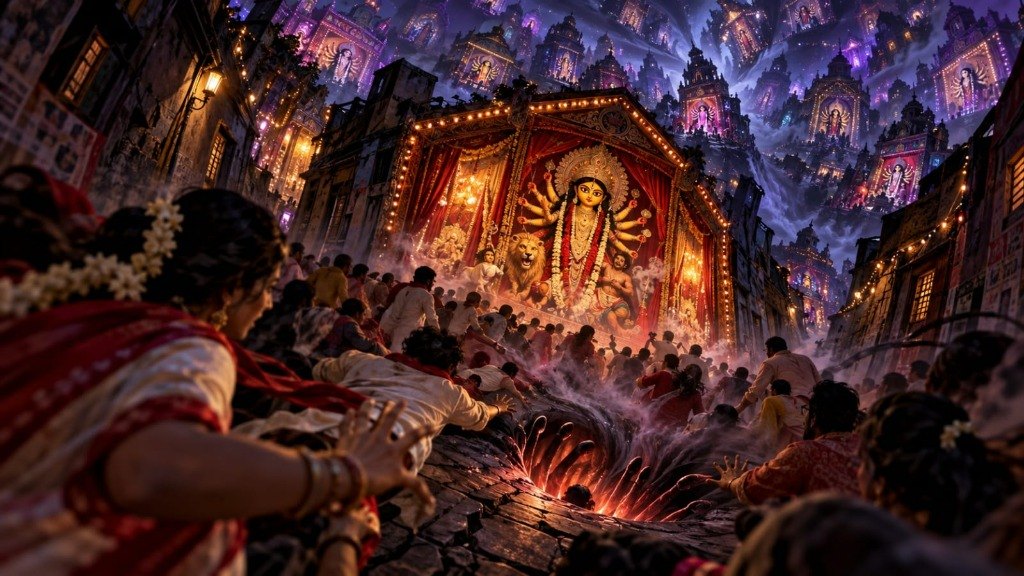
Now the wind carried a sound from the end of the lane — a low, continuous roar, like the sea, except the sea had no business in this lane and this sound was made of people. Thousands of people. The Durga pandal on Muktaram Babu Street was still packed at this hour, the crowd thick as rice in a sack, and the lane was blocked at both ends by bamboo scaffolding and a generator truck that had stalled at the corner of Rabindra Sarani.
“Naren-da.” Pintu’s torch was shaking. “The cable. It’s growing.”
The black rubber sheath had split in four places along the wall. Not from heat. From inside. Something pale was pushing through the splits — fibrous, pale-yellow, like straw. Like the dry straw the decorators had spread beneath the canopy and stacked in bales behind the idol. Beyond the scaffolding, a ghee-lamp flame stretched across the brass lip of its bowl and fastened itself to the nearest bale. The wind found it waiting.
The fire did not spread the way fire spreads. It chose.
It ran along the straw bales in a straight line, leapt the gap to the canopy, and then — Naren saw this, and would spend the rest of his life wishing he had not — the flames leaned into the wind, stretched horizontally, and touched the sweating cable where it hung a half-inch off the wall.
The cable drank.
He heard it. A sound like a man who has been walking in the desert for three days and is finally given water — a deep, grateful, obscene swallowing. The flames vanished into the sheath. The sheath glowed dull red, then faded. And then the cable, every cable in the lane, every cable in the district that they had stapled up in September, began to hum in a key Naren had never heard from electricity.
It was the hum of a crowd. A million voices, distant, satisfied.
He called control. “Cut the emergency feeders. All of them. And get the generators stopped.”
“Bose, there are people—”
“Cut them.”
A minute later, the decorative lights went out. The fans in the mansion’s open windows coasted to a stop. Down the lane, someone killed a generator; its cough broke off in the middle.
The cable kept swallowing.
Naren shouted for the exits to be cleared. His voice went into the roar of the crowd and did not come out the other side.
The first stampede started at 4:12 a.m. at the Cossipore pandal, where the fire had found the generator’s fuel and then the LPG cylinders of the food stalls. The second started at 4:19 at Shyambazar, where the crowd panicked not at the fire but at the cables — the cables that had split open and were breathing out hot dust, the dust settling on skin like ash from a crematorium, and where it settled, people began to run, and where they ran, they fell, and where they fell, the others ran over them.
The wind never stopped. That was the thing Naren would testify to, later, before the commission, before the journalists, before the widows. The wind was hot and it was dry and it blew from the southwest, off the Maidan, and it did not stop for three days, and every fire it touched it fed, and every cable it touched it woke.
By dawn, central Calcutta was a lattice of burning. The pandals — there were fourteen within a square mile — burned one after another, not by accident but by connection, fire passing along the rushed lines from pandal to pandal like a message being passed hand to hand. A cable would swallow flame in one lane and breathe it out in the next. The fire brigade could not reach the lanes. The lanes were blocked by the crowds, and the crowds were blocked by the scaffolding, and the scaffolding was held together by the same jute rope and bamboo and faith that held everything else together in that part of the city.
It had gone beyond the pandals now. Up stairwells, across rooftops, along the temporary branches they had run into houses whenever somebody with a letterhead asked. The regular supply had been cut to whole neighborhoods. The houses burned anyway.
Naren ran. He ran with Pintu through lanes he had known for twenty years, and the lanes were wrong. The cables hung from every wall now, split open, the pale fibrous stuff — straw, he understood finally, it was straw, it had always been straw, the city had been thatching itself for a month and calling it infrastructure — waving in the hot wind like the hair of drowning women.
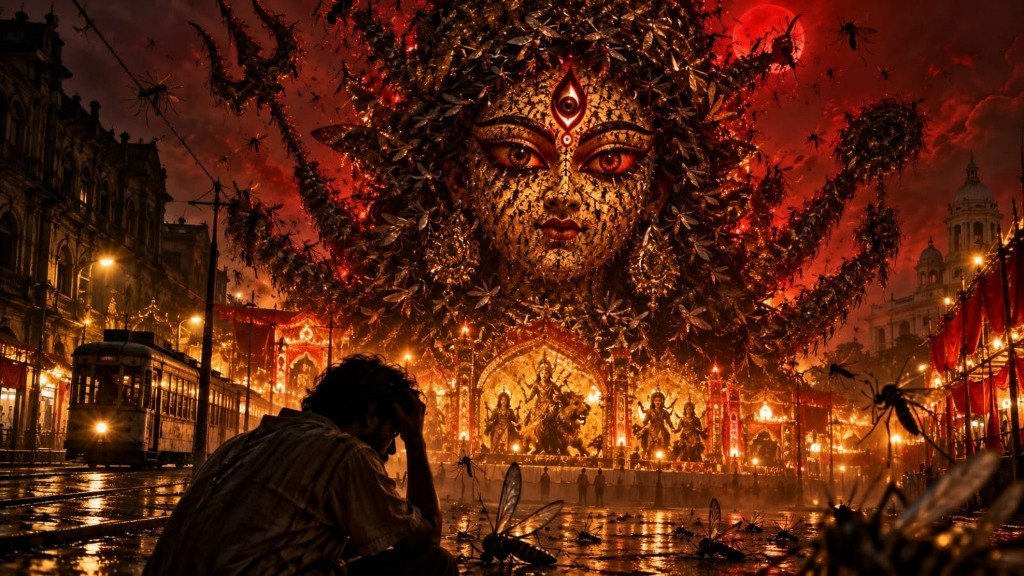
At Rabindra Sarani they found the generator truck abandoned, its driver hanging from the cab window, not dead but laughing, laughing and pointing at the sky. Naren looked up. The cables had left the walls. They hung between the buildings now, spanning the street, a black and burning web, and in the center of the web, where the lines crossed and crossed again, something was gathering itself out of heat and ghee-fat and straw and the breath of the crowd — something that had the shape of a man if a man were made of festival, of hunger, of the wish to be fed.
Pintu said, very quietly, “Naren-da. What did we plug in?”
Naren did not answer. He was doing arithmetic. Eleven installations on Muktaram Babu Street. Fourteen pandals in a square mile. Hundreds across the district. Thousands across the city. Each one a mouth. Each one fed.
He had wanted one ordinary thing that night. He had wanted to go home. He had wanted to sleep.
The thing in the web turned its head, and every cable in Calcutta tightened, and the wind blew harder, and the city began to burn in earnest.
Naren caught Pintu by the wrist and pulled him toward a side lane. The crowd struck them from behind. One moment he had the boy’s wrist. The next he had an empty hand.
He turned once. The crowd had closed.
He went on running.
They would call them the El Niño fires in the reports. Climate anomaly, extreme weather event, infrastructure failure exacerbated by overcrowding. They would count the dead in the hundreds of thousands and revise upward for years. They would blame the rushed hookups, and they would be right, and they would be wrong, because a hookup is only a door, and a door is only a door if something is waiting on the other side to be let in.
Naren survived. He survived because he ran, and he ran because he was guilty, and he was guilty because he had known. Not about the thing in the web. He had not known about that. But he had known the fasteners were cutting into the sheath. He had known the loads were wrong. He had signed anyway. He had signed because the Commissioner had called, because the festival had to be lit, because a city that prays in the dark is a city that remembers it is afraid.
On the third night, the wind stopped. The fires went out. The cables cooled and hung slack, black and dead, and the thing in the web was gone, or was everywhere, which amounted to the same thing.
Naren walked through the burned district at dawn. He had not found Pintu. He called the boy’s name at the mouths of lanes until his throat would no longer do it. The pandals were charcoal. The straw was ash. The cables lay on the ground like shed skin. At the corner of Muktaram Babu Street, he found the junction box he had installed in September, and he opened it, because he had to know, because the not-knowing was worse than any answer.
Inside, fused to the terminals, was a handful of grain. Rice, uncooked, dry, impossibly preserved. And beneath the rice, a scrap of paper, browned but unburned — the certificate he had folded into the box in September. His handwriting. His signature. The date wrong, the load rating wrong, everything wrong.
He had signed it. He had signed all of them.
The wind began to rise again, hot and dry, off the Maidan.
Naren stood very still, holding the paper, and listened to the cables begin to hum.
Word Cloud
Related reading
Selected by shared topics and section, with closer publication dates breaking ties.