The Last Dashami
Uses the speech voice supplied by your browser or device.

THIS IS A WORK OF FICTION
The hole smelled like the inside of a mouth.
Ritwik noticed it at six in the morning on Saptami, down on his knees with a bucket of marigold petals. The pandal had been built over the old marble courtyard of a community hall in Bowbazar, and the floor was supposed to be spotless before the first devotees arrived, and there it was: a circle no wider than a one-rupee coin, so perfectly round it looked drawn, set into the white marble like a pupil.
He touched the edge. The marble was warm. The slabs around it were cool against his knees, but the little circle was warm like something behind a wall of flesh.
He put his finger in.
The hole was smooth as a throat. His finger went in past the first knuckle, the second, and touched nothing. He pulled back fast, and his fingertip came out wet. He wiped it on his kurta and told himself it was condensation, and then he made the mistake of sniffing it.
It smelled like the inside of a mouth. Not bad breath. Worse. The warm, coppery, faintly sweet smell of a mouth that had been closed for a very long time and had just opened.
“Did you drop something?”
Mr. Chatterjee, the pandal secretary, was standing over him with his hands behind his back, watching with the expression of a man who had not slept in three days and blamed Ritwik for it.
“There’s a hole,” Ritwik said.
“It’s a crack. Marble cracks.”
“It’s round.”
Mr. Chatterjee crouched, groaning, one hand on his knee, and peered at it. Then he went to find a flashlight. When he came back, he lay flat on the marble and shone the beam into the opening.
The light caught the smooth sides for an inch or two. Below that, nothing reflected it. He changed the angle, pressed his cheek against the floor, moved the light closer. The blackness remained black.
Mr. Chatterjee made a small sound in his throat and dropped a one-rupee coin in, edge first.
They waited. Ritwik counted to sixty. He counted to one hundred and twenty.
No clink, no tick, no distant ping of metal on stone. The coin fell and said nothing about it.
“Acoustics,” Mr. Chatterjee said, in the voice of a man who did not believe it. “The hole must curve. Or the bottom is soft.”
But he had stopped looking into it. He was listening. His lips moved twice, counting something Ritwik could not hear.
“What is it?” Ritwik asked.
Mr. Chatterjee stood up, brushed off his trousers, and told him to get back to work. But he did not let go of the flashlight, and at seven-fifteen, when the dhaak players arrived, he made them set up on the far side of the pandal, as far from the hole as the structure allowed.
By nine, the pandal was full. By ten, the line for prasad stretched around the block. Nobody else saw the hole. The floor was a chaos of feet and petals and dropped laddus, and the dhaak was pounding, and the idol, ten feet of clay and paint and gold, Durga with her ten arms and her calm, sideways smile, looked down at all of it with her usual expression of mild, infinite patience.
Ritwik kept working. He told himself it was a hole. Holes had bottoms. Every hole had a bottom. That was what the word meant.
At noon, during another round of pushpanjali, with the whole pandal chanting and the priest’s voice rising and the dhaaks at full thunder, Ritwik stood at the back with his bucket and felt, through the soles of his feet, through the marble, through the bones of his feet:
A pulse.
One. Slow. Enormous.
Like something far below had shifted its weight.
He looked at the idol. Durga smiled sideways at him, and for half a second her smile seemed to be held in place by an effort he could almost feel in his own jaw.
Then the chant ended, and the crowd surged forward for prasad, and Ritwik’s ordinary want asserted itself, the way it did every day of his twenty-six years: he wanted to go home, eat his mother’s cooking, and sleep. That was all. That was the whole of his ambition on Saptami afternoon.
On Ashtami morning, the hole was the size of a dinner plate.
Ritwik knew something had happened before he saw it. Police tape ran across the courtyard, a municipal engineer was standing beside it, and the dhaak players, who had played until two in the morning and come back at five, were standing in a silent cluster at the far edge of the lot. Nobody was tuning a drum. Nobody was talking.
The hole was nearly a foot across. The marble around it had cracked in long, radiating lines, and the cracks were warm.
The engineer had a flashlight, a tape measure, and a clipboard. Beside him lay the empty spool from a builder’s plumb line. He had already dropped a washer, a bolt, a steel water bottle, a brick, and a coconut into the opening. None had made a sound.
He had then lowered a weight on thirty meters of line. When he pulled it back, the weight was gone. So were the last six meters of line.
The remaining end was wet. It had not frayed. It had been flattened.
“Localized subsidence,” he said to the gathering crowd. “An old drain, perhaps. A void beneath the courtyard. We need to examine the plans.”
“Thirty meters of drain?” someone asked.
“The line could have snagged.”
“On what?”
The engineer opened his mouth and closed it.
Because now there was a sound.
Ritwik tried turning his head to locate it and found he could not. It came up through the soles of his feet and resonated in his chest. Slow, and slow, and then two close together. A pause. Again. The loose buckle on a policeman’s belt tapped against the metal of his baton in time with it.
Hari, the oldest dhaak player, walked to the tape and crouched. He had played at this pandal for forty years. He stayed there so long that someone asked whether he was feeling faint.
“That’s our beat,” he said.
“Water can make a rhythmic sound,” the engineer began. “Pressure in a damaged pipe can—”
Hari held up his hand.
The sound repeated. Three slow beats. Two close together. A pause.
“That’s the mistake Bappa made yesterday,” he said.
The youngest drummer looked at him.
“During the second anjali. You lost your place. I brought you back in.”
They waited. Under their feet, the mistake happened again.
By afternoon, the hole was two feet across, and the police had cleared the pandal, and the committee had made a decision that seemed, for a few hours, like doing something: they moved the idol.
Not far. To a temporary platform thirty feet from the opening, at the eastern edge of the lot, where the ground had been inspected and pronounced solid. It took forty men, a rented crane, and four hours of shouted instructions and terror. Hari insisted that the dhaaks keep playing. He could not explain why. He simply refused to let them stop.
Ritwik stood at the rope line and watched the goddess sway past on her wooden base, her ten arms outstretched, her smile calm, her eyes painted wide and black and seeing nothing, and he could not shake the feeling that she was being evacuated like a child from a burning building.
That evening, the hole swallowed the pandal.
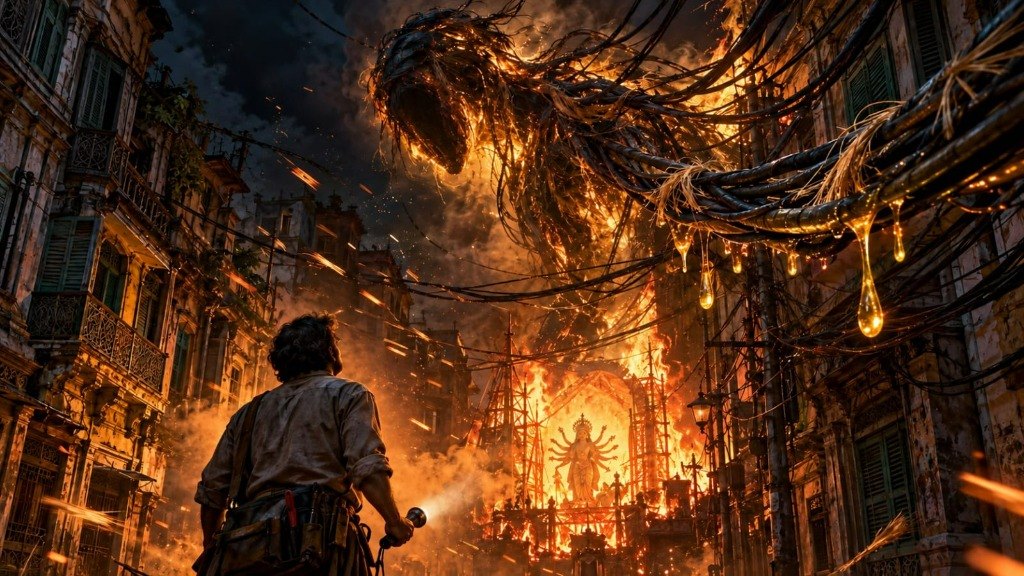
The marble floor went first, folding downward in one smooth motion. Then the bamboo scaffolding, then the fabric walls, then the rented chairs and the generator. The police barricades slid toward the opening so fast that the constables chasing them had to turn and run. A jeep went in with its lights still flashing.
The brown stray that slept beneath the prasad table woke to find the world tilting. It ran toward the men on the pavement. The table slid past it, struck its hind legs, and carried it backward. Ritwik saw it scrabbling at the marble with both front paws. He heard the nails.
He did not hear it land.
The collapse reached the eastern platform. For a moment the idol stood above the opening, still upright, the base supported by nothing Ritwik could see. Then one end dropped. Durga tipped backward, her painted face turning toward the people who had spent four hours rescuing her. Her crown caught the edge and came off.
Everything else went down.
The hole was now eighty feet across, perfectly round, and warm around the edges like a fresh wound.
From it came the dhaak.
Three slow beats. Two close together. A pause.
Then it corrected itself.
When Sandhi Puja came, at the junction of Ashtami and Navami, the surviving priests performed it on a rooftop beyond the cordon. Someone brought a small household image of Durga. Someone salvaged the lotuses and the trays of lamps from the community hall. They counted out 108 of each because counting was still a thing they knew how to do.
Ritwik watched the live video on his phone from the roof of his family’s building on College Street. Beside him, his mother kept asking whether those people understood that rooftops stood on buildings, and buildings stood on the ground.
The priest’s hands shook so badly that oil spilled down the front of his dhoti. A lamp tipped. Another went out. From below came a slow, approving roll of drums.
Nobody in the video was playing.
By dawn on Navami, the streets were lower than they had been the night before.
Ritwik could see it from the roof. Doorsteps stood clear of the pavement. Drains had pulled away from walls. A delivery bicycle lay on its side with its front wheel wedged beneath a manhole cover that now stood six inches above the road. Downstairs, the bathroom door would no longer close, and the water in the toilet sat level against a bowl that had begun to lean.
His mother was packing. She packed food first, rice, dal, potatoes, the Ashtami laddus she had saved, then water, then her wedding sari. At the last moment she took the small brass Kali from the household shrine and wrapped it in her own sari blouse.
“We are going to your uncle’s in Barrackpore.”
“How?”
“With our feet, if necessary.”
He looked at the bag. She took out the rice and the potatoes. Then the sari. Her face did not change while she did it.
They left at seven with two bottles of water, the laddus, her medicines, and Kali.
By ten, they were back.
The northbound road had split across both lanes. On the other side of the break, people were trying to climb out of a bus that had sunk to the bottoms of its windows. The eastern route was blocked by vehicles, their drivers absent, their horns sounding continuously where the descending metal had pinned hands or chests against the steering wheels. Police turned the pedestrians back while an army engineering team tried to open a passage.
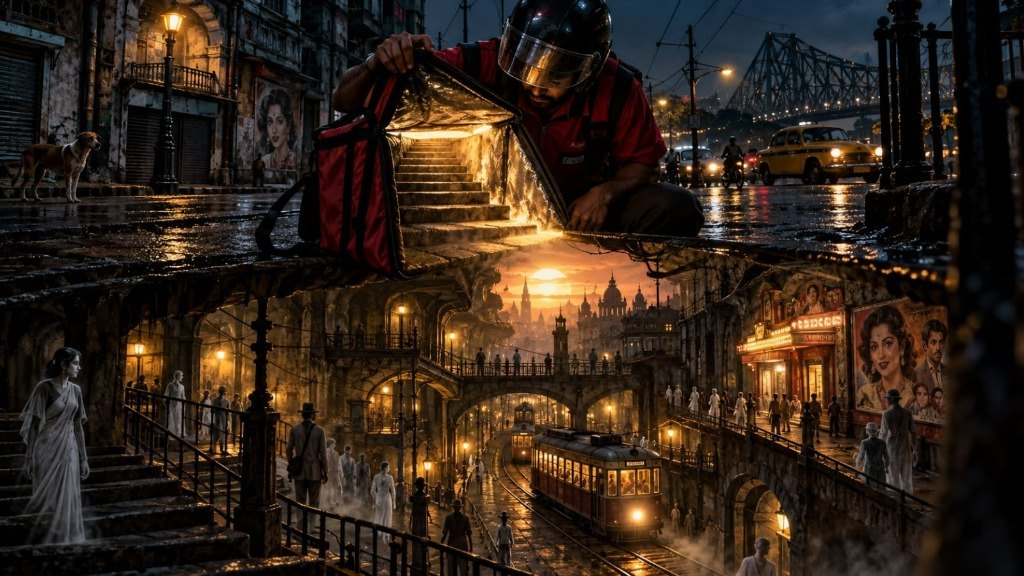
The trains had stopped. The Metro had stopped. On a maintenance worker’s video, a tunnel under central Calcutta ended in a surface that looked black and soft and slightly inflated. The rails continued into it. While the worker filmed, six inches of rail slid out of sight.
Somebody behind him said, “Don’t touch it.”
Then the camera dropped.
At the relief point beside College Square, Ritwik wrote down their names. Transport would come at noon, a volunteer told him. Stay nearby. Keep the elderly upstairs. Do not enter the streets unless instructed.
At noon, the transport was coming at two.
At two, the man with the list was gone.
Ritwik carried boxes because there were boxes to carry, and helped move an old woman because there was an old woman who could not move herself, and tried calling his uncle until the calls stopped connecting. His mother waited on their roof with the neighbors. Every time he looked up, she was at the parapet, checking that he was still there.
The stories reached the relief point before the people who had lived through them.
A woman in Bowbazar had woken because someone was calling from the bathroom drain. Her mother had been dead for nine years. The voice had her mother’s warm, scolding cadence. It asked why she was still wasting electricity by leaving the bathroom light on. Then it described how the woman would die. It gave a time. It named the people who would be standing beside her.
At a school in Shyambazar being used as an emergency shelter, the children waiting in the playground had stopped talking almost together. One by one, they turned toward a manhole cover. A girl of seven said, very clearly, “That’s me. That’s me down there. She’s telling me how I get buried.”
The adults dragged them inside. When someone looked out again, the cover was gone.
There were photographs of the Hooghly, flat and glassy while the boats strained sideways against their moorings. There was a video of Howrah Bridge with its traffic stopped and its steelwork giving out a low, continuous note. Men in helmets walked along the empty roadway, looking up. Ritwik watched one of them put both hands over his ears and keep walking.
The seismologist on the news had taken off his tie by the time Ritwik saw him. He sat beside a map on which the red area kept being enlarged.
“We are receiving signals from at least ten kilometers below street level,” he said. “That does not establish a bottom. We have not established a bottom.”
Someone off camera asked about evacuation distances.
The man looked toward them.
“The boundary we gave you an hour ago is no longer safe.”
“And the movement you mentioned?”
He took off his glasses.
“Something below the city is moving upward. The surface is moving down. They are approaching each other. Please stop telling people this is localized.”
By midafternoon, the opening at the pandal site was three hundred meters across. By evening, that measurement was something people repeated because they had not been given another one.
Buildings at the rim leaned inward without falling. Their foundations came out of the soil in long, pale lengths. Brickwork stretched into curves. Windows narrowed. Through a pair of binoculars borrowed from Mr. Ghosh on the third floor, Ritwik watched a row of balconies bend downward together. The people on them clung to the railings. Washing slid along clotheslines toward the building’s center.
He lowered the binoculars. The view did not become easier to understand with the naked eye.
The relief point had been abandoned. The loudspeaker now told everyone to get above street level and wait for the teams approaching from the east. Ritwik went upstairs. His mother was sitting on a plastic chair with the bag between her feet.
Beyond the neighboring roofs, there were lights in the hole.
Small lights. Thousands of them, much farther down than any cellar or station or buried pipe. People on the roof began naming constellations. Orion. The Pleiades. Someone pointed out a shape that almost made sense until another light appeared inside it.
His mother stood and gripped his arm hard enough to bruise.
“Those aren’t stars.”
“Maa—”
“Look at how they blink.”
He looked.
A band of darkness passed over the points of light. They went out in order, from one side of the opening to the other, then returned in the same order. The sequence repeated. There was no cloud. Nothing passed between the lights and the people watching them.
Mr. Ghosh began to weep.
He was a retired schoolteacher, a man who corrected arithmetic on shop receipts, who had once spent an entire residents’ meeting explaining why the new water pump could not possibly do what the installer said it did. Now he stood with his binoculars hanging against his stomach and tears running into his mouth.
“Every year,” he said. “We take her down every year.”
Nobody asked what he meant.
“We make her. We dress her. We feed her. Then we carry her to the river and put her under, and all the time we’re telling our children that we love her.”
He looked around at them.
“What if something has been listening? All these years. What if it learned what we do with the ones we love?”
“Please stop,” someone said.
“What if it wants to do it for us?”
From the hole came the drums.
Not one dhaak. Thousands.
The full immersion rhythm, the beat that accompanied the goddess to the river, that sent her into the water with joy and grief and trumpets and weeping. It came up through their feet and filled their chests and rang in their teeth. The timing was right now. It had learned the pauses. It had learned when to hurry and when to let the sound hang.
Then Ritwik heard his father.
His father had been dead for four years. He knew the voice the way he knew his own pulse: the slight rasp, the little clearing of the throat, the way he lengthened the second syllable of Ritwik’s name when he wanted him to listen.
“Ritwik. Come down before the water.”
His mother heard it too. Her grip stopped tightening and began to shake.
“Dilip?”
A young voice. A wife’s voice. Ritwik had not heard it from her in four years.
“It’s warm,” his father said. “Everyone is here. Bring your mother. She shouldn’t have to do the stairs alone.”
His mother took a step.
Ritwik wrapped both arms around her and held her against his chest. He put his mouth against her hair.
“That’s not him. Maa. That’s the thing that’s been listening.”
The voice described the house where Ritwik had grown up. It described the scar on his knee. It repeated what his father had said during their last conversation, including a small, stupid joke that Ritwik had never told anyone because it had not seemed worth remembering until remembering was all he had left.
His mother tried to pull away.
“He’s waiting.”
“I know what it sounds like.”
“He’s been waiting so long.”
Then the voice explained, in his father’s warm and reasonable tone, what would happen to Ritwik’s body when the ground took him. Which joint would give first. Why holding on to something would make it worse. How long he would remain conscious.
It gave the time.
“Tomorrow. Six forty-three. You’ll still be holding her hand.”
Ritwik pressed his face into his mother’s hair. He could hear it just as clearly.
“Come down,” it said.
The rasp disappeared. Something much larger finished the sentence.
“Or we will come up.”
His mother went very still. When she spoke, she used her ordinary voice, the voice she used to ask about groceries.
“Ritwik. Your father says the water is coming.”
He heard it under the drums. A continuous roar, getting louder. Somewhere west of them, the opening had reached the riverbank.
The Hooghly had moved.
On the next roof, a man was shouting through a battery-powered megaphone. A rescue team had reached the adjoining buildings. They were laying an aluminum ladder across the alley, flat between two parapets. Beyond that roof was a stairway to a lane the army was still holding open.
“One at a time. On your hands and knees. Leave the bags.”
Ritwik took the bag from his mother. She would not let go of it until he unzipped it, found the little wrapped Kali, and put it in the pocket of her blouse.
She crawled first.
The ladder rattled under her knees. Halfway across, she stopped and looked down. Ritwik said her name. He said it again. On the other roof, a firefighter lay on his stomach and reached both arms toward her.
“Keep your eyes on him, Maa. Keep going.”
She went.
Behind Ritwik, Mr. Ghosh was saying, “I’m coming. Yes. Just a minute.”
He was facing the wrong parapet.
Ritwik caught his sleeve. The old man pulled free with an irritated little jerk, the gesture of someone being interrupted in the middle of an important conversation.
Across the street, a woman stepped off a balcony. She had taken off her slippers first. A man on the floor above leaned over the railing and called after her, then climbed over it himself.
Ritwik understood what they were hearing. That was the part he could not bear. He knew what it cost to resist that voice. He had wanted, for one filthy second, to ask his father whether dying had hurt, and whether he had been angry with him, and whether four years was too late to say he was sorry.
The building shifted.
Mr. Ghosh disappeared below the parapet with his arms held out. Ritwik was knocked onto his hands. From somewhere inside the building came the crash of furniture moving through walls.
“Now!” the firefighter shouted.
Ritwik crawled onto the ladder. The gap beneath him widened. He watched the rungs move away from the far parapet, an inch, another inch, and tried to crawl faster without standing, without looking into the alley where all the drain covers had begun to turn.
His mother caught his wrist.
The firefighter caught his other arm. The ladder dropped. For a moment his legs hung above the alley and something warm blew up under his shirt, carrying the smell of his father’s hair oil.
Then they had him on the roof.
They went down the stairs with the others. A plaster crack widened beside them from the ceiling to the floor. Through it, Ritwik saw the apartment next door, a dining table laid for a meal, three steel plates, a bowl of dal vibrating toward the edge. He remembered that he was hungry. The thought disgusted him and remained.
At the bottom, a soldier pointed them toward a truck.
They climbed in. His mother sat on the floor between his feet. Neither of them let go of the other’s hand.
Through the last working phones, the people in the truck watched the city go down behind them.
The dome of the Victoria Memorial descended between its surrounding trees, whole and white, until the trees descended too. A hospital ward tilted on a security camera. Beds began to move. A nurse braced herself against a doorframe and held a bedrail until the frame bent and the picture failed.
Howrah Bridge appeared in a live broadcast from the western bank. Its great steel span buckled as the ground at the eastern end was drawn inward. The camera operator ran, still filming. For several seconds there was only pavement and the sound of his breathing. When he turned back, the lit roadway was entering the earth at an angle no road should have.
Then the river came over it.
Water poured across the torn bank, carrying boats, mooring posts, sections of steps, the little stalls where people bought flowers for the dead. It fell into the opening in a broad white sheet. Farther upstream, another stretch of bank broke. Another waterfall formed. The blackness took all of it. Its level did not rise.
Someone in the truck said the water might drown whatever was down there.
Nobody answered. The drums had become louder.
They moved east through Navami night. Twice the truck turned back from roads that had ceased to join the roads beyond them. Once everyone climbed down and walked past a culvert while the driver crossed it alone. Ritwik’s mother was shaking too badly to step over the gap, so he went backward, holding both her hands, telling her where to put each foot.
Behind them, the city was being emptied by love.
The voices came through drains and abandoned telephones and the open mouths of water pipes. Dead mothers. Lost children. Husbands who had left for work and never come home. Voices that knew the private names, the unfinished quarrels, the things nobody had confessed aloud. People broke from the walking columns and headed toward them. The soldiers caught some. There were too many people, too many directions, too many names.
Ritwik heard his father from beneath a roadside hand pump.
“You’re hurting her feet.”
He kept walking.
On Dashami morning, beyond the eastern edge of the city, they reached a school where buses were supposed to collect them. The buses did come. By then the school playground had begun to sag.
They left again.
At the next assembly point, the water tank leaned. At the next, cracks opened beneath the parked ambulances. Maps were unfolded and discarded. A man in uniform drew a line across a map with his finger, listened to his radio, and moved the finger farther east.
The roads filled. The fields filled. People carried saline bags above relatives lying on doors. Men pushed wheelchairs until the wheels sank into the soft ground, then lifted them, then put them down and stood bent over the handles, unable to lift them again.
All afternoon the darkness followed.
By sunset on Dashami, the Calcutta Ritwik knew was gone.
There was no skyline. No dome, no water tower, no last familiar building by which to measure where home had been. There was an opening so wide that dust and river spray hid its far side, and at least ten kilometers of depth beneath it, if the last instruments had meant anything at all.
The Hooghly was still pouring in. They could hear it from the broken road where the final convoy had stopped.
The ground ahead had split too.
A soldier went down the line of vehicles telling people to stay together. Someone asked where they were supposed to go. He continued down the line without answering.
Ritwik and his mother stood with the others on a strip of ground that had been a roadside field that morning. The near edge had fallen away a hundred yards behind them. Now it was fifty. Nobody could see the moment it moved. They looked away and looked back and found there was less earth.
His mother had not spoken for hours. Her blouse was torn at the shoulder. One foot was bleeding inside her sandal. The little brass idol made a hard lump against her ribs.
“Maa,” he said. “Don’t listen.”
“I’m not listening.”
She looked past him.
“Look at the edge.”
He turned.
The exposed rim was ridged and pale beneath the topsoil. Moisture ran along it without dripping. The ridges tightened, relaxed, tightened again, each contraction moving a few feet of road toward the opening.
Someone crouched and put a hand on the ground. He snatched it back and wiped his palm on his trousers, exactly as Ritwik had wiped his finger on Saptami morning.
Behind the stranded vehicles, a crack widened in the field.
Something white rose through it.
At first Ritwik thought it was a buried concrete wall being forced upward. Then more of it appeared, a curved surface without seams, narrowing as it rose. Soil slid down it in sheets. It stood higher than the buses. Along the crack, farther away, another white shape emerged. Then another.
The people nearest them began running toward the hole because that was the only open ground left.
The concentric fractures on the emergency maps had not marked the outer limit of the collapse. They marked where the teeth were coming through.
The warm rim beneath Ritwik’s feet flexed again.
They had escaped the throat.
They were still inside the mouth.
He thought of Mr. Ghosh on the roof, trying to make a rule out of what was happening. A yearly feeding. A ritual learned by something buried beneath the river. Perhaps. Or perhaps the drums were only a noise that made people come closer, and the dead were only voices that worked, and whatever held them had no more understanding of love than a hook had of hunger.
It knew what brought them to the edge.
It knew what made them let go.
Farther south, the same pale curves were rising through embankments and mangrove mud. The fractures continued toward the Sundarbans and beyond the limits of the maps still being broadcast. Calcutta had vanished, and the opening was still widening to accommodate something that had not finished moving.
Ritwik’s mother took his left hand in both of hers.
His phone had enough battery to show him the time.
6:42.
Below them, the little lights went out in sequence. The drums stopped. For the first time since Saptami, he heard the sound beneath them without anything laid over it: wet surfaces pulling apart, slowly, against an immense weight.
His mother’s hand was warm.
A voice that was almost his father’s and almost hers and almost his own said his name, once, with love, and asked if he was ready.
He was not ready. He pulled his mother closer. There was nowhere left to put his feet that did not move when the thing beneath them moved.
At 6:42 p.m. on Dashami, a satellite image of Calcutta showed nothing but darkness.
At 6:43, the darkness opened its eyes.
Word Cloud
Related reading
Selected by shared topics and section, with closer publication dates breaking ties.