The Five Days of Rot
Uses the speech voice supplied by your browser or device.

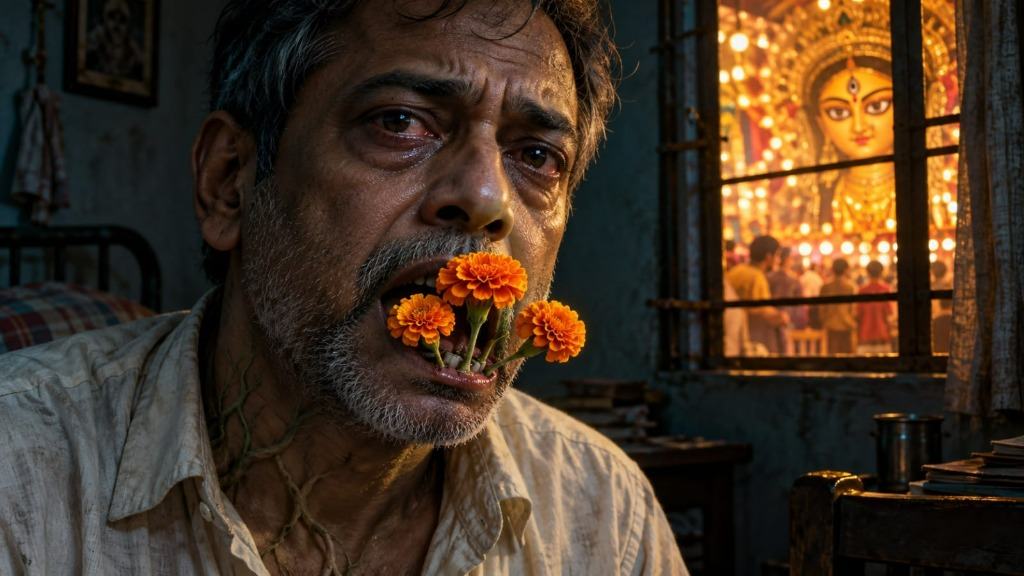
The meat was breathing.
Not the swelling you sometimes saw when spoiled meat filled its packaging with gas. That stayed swollen. This parcel rose and fell. The plastic tightened against the goat shank, relaxed, tightened again.
Arif Hossain stood in the cold room at 3:14 a.m. with his torch in one hand and his phone in the other, and he watched it happen six times.
Three nights before Maha Shashthi. The city outside was stringing lights. Inside the warehouse, forty tonnes of chicken and goat waited beneath a sign that said QUALITY IS OUR FIRST COMMITMENT.
He had been hired at midnight. Cash. He had worked dispatch jobs before, so they put him on labels and paperwork while six other men handled the loading. The supervisor, a man with a gold chain thick as a finger, wanted the stock relabeled and the trucks gone before sunrise.
No questions. Double pay.
The new label read: FRESH — GRADE A — BANERJEE COLD STORAGE PVT. LTD.
The old label, lifting at one corner, had a red stamp.
SEIZED — NOT FOR SALE.
Arif had seen the restaurant raid on his phone. Golden Crown Hospitality. Dirty kitchens, spoiled meat, a manager holding his palm over the camera. A municipal officer had promised that the seized stock would be destroyed.
That officer had been very clear about the destruction.
Arif photographed the stamp. Then he photographed the crate number. He wasn’t collecting evidence for anyone. His initials would be on the dispatch sheets. If something went wrong, he wanted proof that the label had been there before he arrived.
He had a wife who was eight months pregnant and a landlord who did not accept explanations.
He picked up the label gun.
Then the parcel moved.
He told himself it was gas. He told himself it was the compressor cycling. He told himself he had been awake too long.
From the doorway, the gold chain said, “What’s the problem?”
Arif pressed the fresh label over the red stamp.
“Nothing.”
The supervisor watched until he handed the crate to the next man.
At the end of the shift, Arif was told to burn the duplicate dispatch sheets. He put them in his backpack instead. They recorded the hours, the loads, the name of the company that owed him money.
He collected his cash.
In five days, Calcutta would be counting its dead. Tonight, it was still counting its profits.
DAY ONE — MAHA SHASHTHI
Dr. Priya Sen had been awake for thirty-one hours when the first one came in.
She was thirty-four, an emergency medicine resident at NRS Medical College, and she had volunteered for the Puja shift because somebody had to. Usually it meant road accidents, drunken fights, falls from things people should not have climbed.
The boy on the stretcher was nineteen. His friends said he had eaten a chicken roll near Gariahat that afternoon. He was sweating through his shirt. His pulse was 140. His abdomen was distended like a drum.
“Food poisoning,” the nurse said.
“Probably.”
Priya examined him, started treatment, and asked the nurse to keep checking his blood pressure.
By 6 p.m., there were four more. By 10 p.m., eleven. By midnight, twenty-six patients had arrived with the same combination of violent vomiting, abdominal distension, a racing pulse, and fever.
The emergency department had run out of trolleys.
Priya stood at the nurses’ station and looked at the addresses.
Gariahat. Shyambazar. Park Circus. Behala. Sealdah.
Different foods. Rolls, biryani, kebabs, dhaba thalis. Different vendors. But the patients kept describing the same sequence: a meal, a few hours without trouble, then a cramp so sharp that several had thought they were being stabbed.
“We need their suppliers,” she told the senior resident.
“It’s Puja. Half the city is eating off the street.”
“At different stalls. In different neighborhoods. Something is reaching all of them.”
She called the hospital’s infection-control team and the duty administrator. Samples were collected. Someone began a list.
A nurse put a roll beside her paperwork.
“Eat.”
Priya took three bites before an ambulance arrived. When she came back, the paper had soaked through and a fly was standing on the filling.
She threw it away.
Outside, the dhak drums thundered. The pandals blazed. People argued cheerfully about where to eat next.
Inside, the man in Bed 14 began screaming.
Priya went to him. His name was Anil Kumar. Forty-two. Taxi driver. He had eaten biryani between fares.
“Something’s moving.”
She put her stethoscope against his abdomen.
At first she heard the usual wet, irregular sounds.
Then a dry scrape.
She lifted the stethoscope and checked that the tubing wasn’t rubbing against the bedrail. She placed it somewhere else.
The scrape came again.
Three short strokes. A pause. Three more.
Anil watched her face.
“You heard it.”
She did not answer quickly enough.
DAY TWO — MAHA SAPTAMI
Bimal Das sold egg chicken rolls from a cart on Camac Street. He had been there for eleven years. He knew his customers by name. He knew how they liked their onions, how much green chili they could handle, whether they wanted the paratha crisp or soft.
On Saptami morning, a man in a white van offered him chicken at forty percent below his usual supplier’s price.
Surplus stock. Hotel order canceled. Take it now.
The invoice had a company name, a tax number, a stamp. Bimal looked at those things. He did not telephone the company.
He bought forty kilos.
The first bag smelled wrong when he opened it. Not violently wrong. Enough to make him stop with the knife in his hand.
The delivery man was already gone.
Bimal stood there thinking about the money he had paid, the queue he would have by evening, and the regular supplier who would want cash up front.
He used it.
By evening, the cart was doing its best business of the year.
A college student returned with a half-eaten roll and said the chicken tasted sour.
Bimal gave him his money back. He blamed the sauce.
Then he served the next customer.
At nine, he packed three rolls to take home. He scraped the last of the chicken from the pan. Nothing wasted.
In the one-room flat in Entally, Lata counted the money while their daughter ate sitting cross-legged on the bed.
Rani was seven. She asked why the chicken was so soft.
“Because I cooked it properly,” Bimal said.
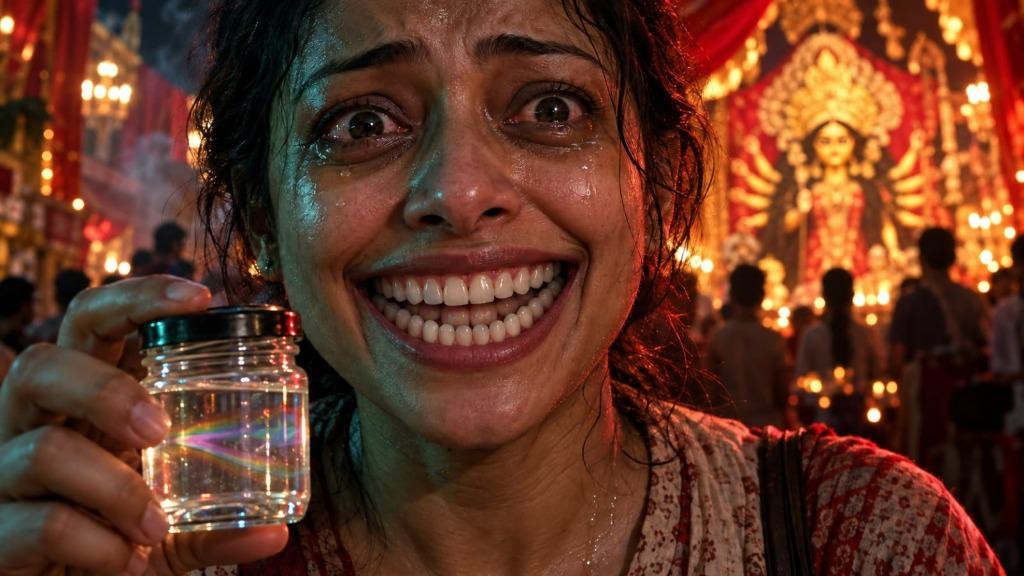
She pulled a pale strand from between her teeth.
It stretched before it broke.
Bimal took it from her fingers and dropped it into the discarded wrapping.
“Eat the egg if you don’t like it.”
She ate the egg and most of the paratha. Lata finished what she left.
Bimal gave his wife extra money for Puja shopping. He kissed his daughter’s forehead. For perhaps twenty minutes, with the plates cleared and the fan running, he felt he had done well.
At 11:40 p.m., Rani sat up and vomited onto the sheet.
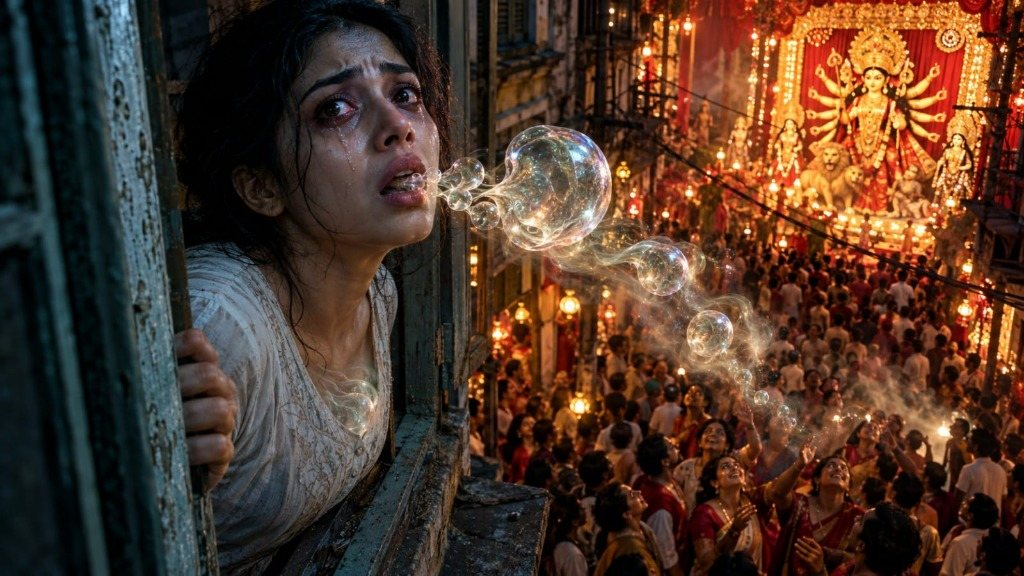
Bimal carried her to the bathroom. She was burning. She clutched his shirt and said something was crawling in her tummy.
He held her hair back.
“It’s a bad stomach. It’ll pass.”
She vomited again. There was almost nothing left, but her body kept trying.
Outside their window, someone tested a microphone.
One, two. One, two.
DAY THREE — MAHA ASHTAMI
Lata started just after midnight.
Bimal felt the first cramp an hour later.
By dawn, they had been turned away from one nursing home and told at another that there were no beds. An autorickshaw took them to NRS. Bimal held Rani upright while Lata leaned over the side.
At the hospital, a nurse checked the child and began treating her dehydration. There was nowhere to put her. Bimal sat on the floor beside a trolley with Rani against his chest and held her drip bag above his head.
Lata crouched beside him.
Every few minutes, she asked whether he could still see their daughter’s chest moving.
When Priya reached them, she asked what they had eaten.
“Chicken rolls,” Bimal said.
“From where?”
“My cart.”
“Where did you buy the chicken?”
He said his regular supplier. He said New Market.
Priya asked for the invoice.
He said he had thrown it away.
She looked at him for a moment. Then Rani retched, and the questions stopped.
An hour later, Priya returned with a man carrying a cheap plastic folder.
No white coat. No badge.
“Your cart is on his delivery list,” she said.
The man opened the folder. Bimal saw the company name from the invoice.
“Arif Hossain,” he said. “I loaded the vans.”
He had come to the hospital that morning with his dispatch sheets and the photographs on his phone. He had spent two days telling himself that whatever he had seen in the cold room had an ordinary explanation.
Then he saw the hospital footage on television.
“Was it a white van?” Arif asked.
Bimal nodded.
Arif showed him a registration number.
He nodded again.
“I need the invoice.”
“Will it help her?”
Arif looked at the child. At the bag her father was holding up because there was no stand.
“I don’t know.”
Bimal began to cry.
The invoice was still in his shirt pocket.
At 10:17 a.m., the lights went out.
Emergency lamps came on along the corridor. Somewhere outside, a diesel generator started. The sockets beside several beds stayed dead.
Staff shouted for portable equipment. Someone ran past carrying a bag of fluids. From the critical-care area came a voice counting compressions, stopping, starting again.
Forty minutes later, the mains supply returned.
Three patients had died during the outage.
The festival loudspeakers outside had their own power.
They had not stopped once.
By afternoon, patients occupied the corridors, the entrance, a patch of shade beside the parking area. Other patients, people with strokes and chest pain and injuries that had nothing to do with chicken rolls, waited among them.
Priya had slept for four hours that morning before being called back. She could still feel the edge of the bench against her cheek.
Anil Kumar was worse.
The surgeons had already been called. He needed further investigation. He needed a monitored bed. He needed several things that people were trying to obtain for thirty other patients.
Priya pulled back his sheet.
His abdomen was moving.
Not with his breathing. Not with any movement she could connect to the rest of him.
A ridge traveled beneath the skin, stopped near his navel, and flattened.
She put on gloves.
When she pressed gently against the swelling, something pressed back.
She withdrew her hand.
The pressure remained. A small mound held its shape beneath the skin for another second, then sank.
Anil was looking directly at her.
“It’s eating me.”
“Tell me where the pain is.”
“Everywhere it goes.”
She called the surgical resident again.
Anil caught her wrist. His fingers were cold.
“Don’t put your hand there again. It comes to your hand.”
She stayed beside him until the porter arrived.
They had just begun to move him when his heart stopped.
They tried to bring him back.
Priya remembered the compressions. The drugs. The porter pressed against the wall because he couldn’t get out of the way. She remembered looking up at the clock and having to look twice because the hands would not make sense.
Afterward, the nurse drew the sheet over Anil’s legs.
His abdomen had collapsed.
Minutes earlier it had been stretched tight. Now loose skin lay in folds between the jutting edges of his ribs and pelvis.
There had been no operation. No wound. Nothing beneath the trolley except a dropped glove.
The nurse stared.
“Where did it go?”
Priya put her hand above the hollow without touching it.
She could not answer.
She asked that the body be kept for examination. She wrote the request herself. There were already bodies waiting in places that were supposed to hold living patients.
Then she remembered the roll.
Three bites. Shashthi evening. Bought from somewhere outside the hospital.
She went to the bathroom and vomited.
When she could stand upright, she lifted her shirt.
Her abdomen looked ordinary.
She pressed two fingers against it.
Nothing pushed back.
Someone banged on the door.
“Doctor.”
She lowered her shirt and went out.
DAY FOUR — MAHA NAVAMI
Arif did not uncover a secret empire by working through company registrations. He had no access to any of that. He had a prepaid phone, a backpack, and paperwork the supervisor had been too careless to destroy himself.
It was enough to begin.
Golden Crown’s name appeared on the original transfer slips. Banerjee Cold Storage appeared on the replacement invoices. The crate numbers matched.
Most of the stock had been moved out before the raid, into a warehouse operating under the second company’s name. The stock actually seized during the raid had followed it later.
Those crates were accompanied by a disposal authorization.
According to the attached certificate, they had already been destroyed.
Arif recognized the signature at the bottom. The officer from the news footage. The one who had promised that none of the seized meat would reach the public.
Bimal’s invoice completed one small part of the journey.
A crate in a warehouse. A van. A cart. A child on the floor.
Arif took the folder to the municipal office.
The officer looked at the photographs. He looked at the dispatch sheets. He spent longer on the destruction certificate.
Then he closed the folder.
“Leave the originals.”
“Will you give me a receipt?”
“Don’t make this difficult.”
Arif kept his hand on the folder.
“People are dying.”
“We are aware.”
“That meat was supposed to be destroyed.”
“The matter is under investigation.”
“Your signature is on it.”
The officer stopped looking tired.
For a while, neither man spoke.
Then the officer leaned back.
“You put the new labels on.”
Arif said nothing.
“You signed the loads out. You took the money.”
“Yes.”
“Then think carefully about what you’re bringing me.”
There was no speech about the system. There didn’t need to be. The man behind the desk had a stamped certificate proving the meat no longer existed. Arif had signed proof that he had shipped it.
“Go home,” the officer said. “You have a family.”
Arif took the folder.
At home, his wife was cooking lentils. The smell of frying onions filled the flat. She asked whether he had been paid.
He showed her the money.
She smiled. Then the baby kicked, and she took his hand and put it against her belly.
Strong. Alive.
He pulled his hand away too quickly.
“What?”
“Nothing.”
She looked at him.
He washed his hands. He washed them again. He sat down and ate what she had made.
At eleven, his phone rang.
“Mr. Hossain.”
A polite voice. No hurry.
“You’ve been causing confusion.”
Arif said nothing.
“Your wife has a hospital appointment on Tuesday. Isn’t that right?”
He stood up.
“Listen to me—”
“We’d prefer you to concentrate on your family.”
The line went dead.
His wife was watching him from the doorway.
This time, when she asked, he told her about the meat, the papers, the officer. He told her about the phone call.
He did not tell her what he had seen beneath the plastic.
She took the money from the shelf. She put her medical papers in a bag.
“Who else has copies?”
“No one.”
“Then send them.”
He photographed every page and sent the files to three reporters whose numbers he found on their newspapers’ websites. One called back.
By midnight, Arif and his wife were sitting in a newspaper office. A reporter was copying the documents. Another was trying to reach the hospital.
Arif gave them his statement.
He did not leave out the labels. He did not leave out the cash.
DAY FIVE — VIJAYA DASHAMI
The story broke at dawn.
By noon, the photographs were everywhere. The fresh labels. The red stamps underneath. The destruction certificate. The delivery sheets.
Golden Crown’s owners could not be reached. Their office was locked. Staff at the family residence said they had gone abroad.
Ministers expressed shock. Inquiries were announced. A photograph circulated of one of those ministers inaugurating a Golden Crown outlet, cutting a ribbon while the owner held the loose end.
The official death toll stood at 347.
At the newspaper office, reporters were trying to reconcile that number with calls from hospitals, nursing homes, and families whose relatives had died before anyone registered them. Their running list had passed six hundred. Several hundred more reports remained unconfirmed.
Nobody had a complete count.
The hospitals were still receiving patients.
So were the mortuaries, whether they had space or not.
At one cremation ground, the queue of vehicles extended into the road. At the hospital, a man kept telephoning his dead wife’s number because her phone was somewhere with her and no one could tell him where that was.
Some pandals closed. Others kept their lights on and lowered the volume. At one entrance, volunteers handed out bottled water beneath a banner thanking the festival’s food sponsor.
Bimal sat between his wife and daughter.
Rani was awake. Her fever had fallen. She had stopped vomiting. She asked whether they could go home.
Lata had stopped answering him during the night.
Her abdomen rose and fell.
Sometimes with her breathing.
Sometimes between breaths.
Bimal watched both movements until he could no longer tell which one he was waiting for.
A doctor came and checked Lata’s pupils. Another adjusted her treatment. Nobody told him she would be fine.
Rani asked for her mother.
“She’s sleeping.”
“Why are you holding her eyes open?”
He had no answer for that.
He held his daughter’s hand. He watched his wife’s belly.
The first bag had smelled wrong.
That was the part he kept returning to. Not the invoice. Not the discount. Not the man in the van.
He had opened the bag and stopped.
There had been a moment when he could have thrown it away.
Then he had picked up the knife.
Across the room, Priya compared the charts.
Some of the patients who had eaten the most were dead. Several who had eaten only a little were improving. It might have meant something. It might have meant nothing. The records were incomplete, the portions uncertain, the food itself different from one stall to another.
She wanted it to mean something.
She had taken three bites.
At the start, she had expected an identifiable cause. A common source, a toxin, an infection. Something that could be tested for and named.
The early results had not explained what they were seeing.
None of them explained Anil Kumar.
She had written down what happened. So had the nurse. Neither account made the other any easier to believe.
Anil’s body had been taken away before the requested examination. There was a transfer entry, an illegible signature, and no destination.
Priya had telephoned three times.
On the fourth call, someone asked her to stop calling.
She stood at the nurses’ station with the receiver in her hand.
Then she put it down and went to the bathroom.
She lifted her shirt.
Flat. Quiet.
She pressed her fingers against her abdomen.
Nothing.
She stayed there a little longer.
Still nothing.
From outside came the scrape of a trolley wheel. Someone was calling for a doctor.
She lowered her shirt.
Before opening the door, she looked back at the mirror.
She could not have said what she expected to see.
Arif crossed Howrah Bridge with his wife at sunset.
They were going to her sister’s home. He carried the backpack. She carried the medical papers because she would not let him put them in with the other things.
Below them, the Hooghly was crowded near the immersion ghats. Some processions had been canceled. Others had come anyway. Idols waited beside the water while men argued about the queue.
The drums were still beating.
He had given the press everything.
The last pages in the folder had been advance orders. More stock. Other warehouses. Deliveries for Diwali, Christmas, the next Eid. Different dates, different company names, some of the same telephone numbers.
The reporter had copied those too.
By afternoon, one warehouse had been sealed.
There had been no announcement about the others.
Arif stopped at the railing to shift the backpack from one shoulder to the other.
His wife stopped beside him.
“Are you all right?”
“Yes.”
She took his hand.
For a moment, he thought she was going to put it against her belly again. He hated himself for the relief he felt when she only held it.
Down by the ghat, men tipped an idol toward the water. The face struck first. The painted eyes disappeared.
Arif watched the water close.
He thought about the cold room. The rise and fall beneath the plastic. The pressure that had tightened the wrapping and then let it go.
The meat had been dead.
Whatever moved inside it had not needed the animal alive.
Nobody at the hospital had been able to tell him what happened to it when a patient died.
He squeezed his wife’s hand.
“Let’s go.”
A little way from the ghat, a floating mass of straw and broken clay stopped drifting.
Other debris moved past it.
Then it began to move back toward the steps.
Arif kept walking.
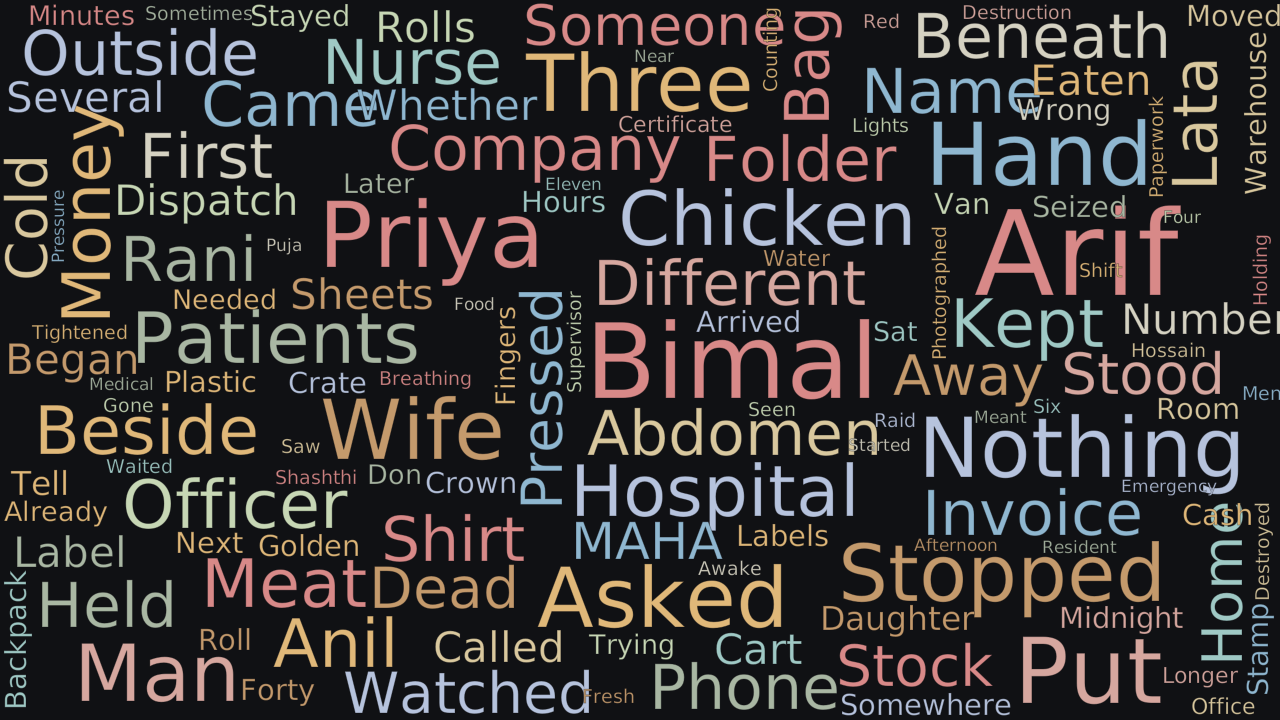
Word Cloud
Related reading
Selected by shared topics and section, with closer publication dates breaking ties.