The Corridor of Wind
Uses the speech voice supplied by your browser or device.

THIS IS A WORK OF FICTION
At seven in the evening, College Street still believed in ordinary disasters.
Rainwater stood ankle-deep beside the bookstalls, shining with oil, spit, crushed betel leaf, and the blue glow of phone screens. A boy in a soaked Messi jersey was holding a tarpaulin down with both hands while his father rescued second-hand engineering guides from a rising gutter. The tram wires trembled overhead with that tired, metallic patience Calcutta gives to things that should have died long ago but have instead been asked to continue.
Niloy Sen stood under the low tin roof of a tea stall near the Medical College gate and watched a delivery rider argue with a traffic sergeant.
“Sir, how can I fly?” the rider said, helmet visor lifted, rain dripping from his nose. “Customer is calling me as if I personally invited the cloud.”
The sergeant, magnificent in wet khaki, said, “You people have apps. Ask app to stop rain.”
Everyone laughed. Not because it was funny, exactly, but because in Calcutta laughter often arrives as a small public receipt: yes, we have all noticed the absurdity; yes, none of us can pay for its repair.
Niloy took his tea in a small glass. The tea was too sweet, with that coppery taste old kettles gave to everything. On the wall behind the stall, above a curling poster for a coaching center promising government jobs in impossible font sizes, someone had pasted a political slogan over an older political slogan, both peeling in the damp. A newspaper headline mentioned an unusual low-pressure system over the Bay. The word “cyclonic” had been used, carelessly, as if Calcutta had not grown up with such words and learned their relatives, cousins, frauds, and ghosts.
His phone buzzed.
MILI: Where are you?
He did not answer. His younger sister had been on duty at the hospital for fourteen hours and still found time to be angry with him, which he considered unfair and also one of the few proofs that she loved him.
Another message appeared.
MILI: Baba’s oxygen concentrator stopped again. Power cut. Come home or at least call.
Niloy typed: In rain. Coming.
Then, before he could send it, another notification slid down from the top of the screen.
KOLKATA CIVIC WEATHER ALERT
SEVERE ROTATIONAL SIGNATURE DETECTED
SEEK SHELTER BELOW GROUND
CORRIDOR: SOUTHWEST TO NORTHEAST
ESTIMATED IMPACT: 19:34
For two seconds, the tea stall became soundless in his head.
Then the city came back: buses snorting, tram bells, horns, rain, the fryer hissing as oil met wet batter, a man beside him shouting into his phone, “No, no, I am telling you, buy the Hilsa now, tomorrow price will become murder.”
Niloy stared at the alert.
It was nonsense.
Calcutta got cyclones, depressions, thunderstorms, nor’westers like sudden bad moods. It did not get wedge tornadoes crossing twenty kilometers of dense city like an American apocalypse bored with Kansas and looking for literature.
The delivery rider, having lost his argument, rolled his bike toward the stall. He glanced at Niloy’s screen.
“You also got this?” he asked.
Niloy looked up. The rider was young, perhaps twenty-two, with tired eyes and a packet of biryani tied in orange plastic behind him.
“Yes,” Niloy said.
“What does it mean, rotational?”
“It means somebody’s model has drunk phenyl.”
The rider grinned, relieved. “I thought so. App people send anything.”
But more phones were buzzing now. A woman buying exercise books frowned at hers. The tea seller held his phone away from his face, as if it smelled bad.
“Basement shelter?” he read aloud. “Where basement, dada? Under pothole?”
Niloy refreshed the radar page out of old habit, the habit of a man who had once been paid to look at weather until weather began looking back.
Three years earlier, he had worked for a private disaster analytics firm in Sector V, producing flood-risk models for insurers, municipal consultants, and real estate developers who wanted to know which parts of the city were unsafe without being required to say so publicly. His last project had been an early-warning model for severe storms. The prototype had performed well on test data, which was to say it had predicted yesterday with priestly confidence. He had warned his boss about gaps in the local sensor network. His boss had warned him about EMIs.
Then came the pre-monsoon squall that tore scaffolding from a luxury tower near Ruby and dropped it onto a line of pavement dwellers sheltering below. Nine died. Niloy’s model had marked the corridor low-risk. Not because the sky had lied, but because the data had. He had smoothed out an ugly spike to meet a deadline. He told himself everyone did such things. The dead, with admirable restraint, had not argued.
After that, he left the company. More accurately, he stopped going. His father’s stroke gave him a respectable reason to become unemployed. Mili paid the bills without mentioning it except in the thousand tiny ways a household mentions what it has swallowed.
Now the radar loaded.
A hook echo had formed west of the city.
Niloy felt the tea glass warm against his fingers. He zoomed in. The green, yellow, and red bands rotated with a terrible elegance over Howrah, a comma of violence tightening its tail.
His phone rang. Mili.
“Did you see the alert?” she said.
“Yes.”
“Is it real?”
He stepped away from the stall into the rain. “Where are you?”
“Emergency. Medical College. We are already getting people from Howrah. Some market roof collapsed.”
“Mili, listen carefully. Go to the lowest floor. Away from windows.”
She was silent for one second too long. “You think it’s real.”
“I don’t know.”
“You always know.”
That was cruel, because once he had pretended to.
The first sign was not wind.
It was paper.
A thousand pages lifted from College Street all at once. Not blown sideways, not scattered by a gust, but raised vertically into the air with a whispering rush, as if an invisible librarian had decided the city was overdue for sorting. Pages from medical textbooks, cheap romances, exam guides, Marxist pamphlets, old magazines, school notebooks, devotional calendars: they rose above the tram wires, fluttered in the rain, and began circling.
People looked up.
Someone laughed again. This time the laugh did not travel.
The sky to the west had turned the color of old iron. A long darkness hung beneath it, not quite a cloud, not yet a shape. The tram wires started singing.
Then all the pigeons under the eaves of the Sanskrit College burst out at once and flew east, low and frantic, like thrown ash.
The delivery rider whispered, “Ma go.”
The tornado entered the city through Howrah with the appetite of a god nobody had worshipped properly.
Later, if there had been a later in which numbers retained meaning, they would call it an EF5. They would say winds exceeded three hundred miles per hour, as though wind at that speed remained wind and did not become a new law of matter. They would trace its path from the industrial sheds near Shibpur across the river, through the old arteries of the city, Sealdah, Entally, Park Circus, Ballygunge, Gariahat, Jadavpur, and beyond, a corridor of subtraction. They would speak of millions dead and injured across the metropolitan sprawl, though millions is a word the mind refuses to hold. It drops the faces. It keeps only the zeroes.
But Niloy saw first a bus rise.
It was a blue-and-white private bus, packed, leaning at the curb with men hanging from the door. It lifted gently, almost politely, as if reconsidering its profession. Then it turned sideways in the air and vanished into a cloud of brick dust.
The sound arrived a moment later.
Not a roar. Roar is too animal, too honest. This was the continuous tearing of the world’s largest cloth, stitched through with metal, glass, wire, bone, and prayer.
Niloy ran.
The tea stall roof peeled away behind him. Glass burst from the hospital windows in silver sheets. A tram buckled on its tracks like a toy pressed underfoot. The delivery rider crashed beside him, bike skidding, biryani packet spinning into the water. Niloy grabbed him by the collar and dragged him toward the Medical College gate.
“Inside!” Niloy shouted.
A scooter flew past them at head height.
The rider stopped arguing with the universe and ran.
They reached the hospital entrance as the air filled with things no air should carry: window grilles, ceiling fans, flowerpots, a framed photograph of a goddess, a handcart wheel, spectacles, a child’s red shoe, an entire balcony railing wrapped in electrical wire. People surged through the doors, not in a crowd but in a liquid panic. Somewhere a man was screaming that his mother was still in the taxi. Somewhere else a nurse was shouting instructions with the crisp rage of someone who had no time for terror.
Inside, the lights went out.
Then the emergency lamps came on, red and weak.
Niloy pushed through the corridor, calling Mili’s name. The building shook. Plaster fell in soft explosions. Patients lay on trolleys, on the floor, on sheets of cardboard. A boy with blood running down one side of his face held a cracked phone and asked everyone whether Baguiati was still there, as if neighborhoods were people who might pick up if called.
The delivery rider stayed near Niloy, perhaps because fear had tied them together.
“My name is Imran,” he said, absurdly.
“Niloy.”
“My customer will complain.”
Despite everything, Niloy almost laughed.
They found Mili in a stairwell, organizing people downward with the authority of a small, furious deity. Her hair had come loose from its clip. Blood marked one cheek, not hers.
When she saw Niloy, relief crossed her face and was immediately replaced by anger, its more durable cousin.
“You came.”
“I was nearby.”
“So heroic. Take that end.”
They carried an old man on a bedsheet down two flights. The stairwell smelled of antiseptic, urine, wet clothes, and fear. Above them the hospital groaned. Below, in a storage basement, dozens of people had gathered among broken chairs, oxygen cylinders, old files, and boxes labeled with departments that had probably ceased existing in 1998 but remained, as all things in government buildings remain, materially undefeated.
For seventeen minutes the tornado passed over them.
Time became muscular. It pressed on the ears. It made breathing a negotiation.
In the dark, people prayed, cursed, vomited, whispered phone numbers, promised gods goats, sweets, sobriety, gold, obedience. A child asked whether Durga Puja was cancelled. His mother said no with such conviction that even Niloy believed her for half a second.
Then, beneath the cosmic tearing, phones began to ring.
Not one. Many.
The sound started as scattered chimes in pockets and handbags, then became a nervous chorus. Screens lit faces from below. People looked down.
Niloy’s phone, though it had shown no network for ten minutes, displayed a new notification.
KOLKATA CIVIC WEATHER ALERT
DO NOT EXIT
SECOND WALL APPROACHING
CONFIRMED FATALITIES: 1,842,109
UNCONFIRMED: 3,006,882
NILOY SEN: ACCOUNTABLE NODE
He stared until the words blurred.
Accountable node.
That phrase belonged to his old project.
He had written it in a technical document nobody had read. Accountable nodes were sensor points whose failure degraded the model. Rain gauges, cell towers, traffic cameras, pressure stations, human reports. He had argued the city needed citizen alerts tied to local observations. His boss had said citizens were unreliable. Niloy had said so was everything else.
Mili leaned over his shoulder.
“What is that?”
“I don’t know.”
“You know that phrase.”
Before he could lie, someone in the basement screamed.
An old woman sitting beside the oxygen cylinders had received an alert with a photograph attached. It showed her standing outside a house in Behala, looking up at something beyond the frame. Her sari was dry. Her eyes were calm. The timestamp was tomorrow.
In another corner, a young man’s phone displayed a list of names under the heading RECOVERED FROM TOLLYGUNGE METRO. His own name was fourth.
Imran’s phone buzzed. He held it out to Niloy with shaking hands.
DELIVERY FAILED
RECIPIENT DECEASED
RIDER DECEASED
ORDER COMPLETED
“What kind of joke is this?” he said.
Nobody answered.
The wind above them moved on at last, dragging the city behind it.
When they climbed out, Calcutta had been opened.
The hospital facade was gone in places. Rain fell through floors. Cars had been packed into corridors. Trees stood stripped of leaves, their branches pointing with accusation. Across College Street, where shops had been, there was a low field of pulp, tin, books, bodies, wires, and water. A tram lay upright against a building, nose down, as if trying to enter the second floor. The air smelled of wet cement, gas, blood, and the strange green odor trees release when torn apart.
There were no proper streets now. Only directions.
Mili wanted to go home to their father.
Niloy wanted this too, or wanted to want it. Their flat was near Ballygunge, in the corridor. The oxygen concentrator would be useless without power. Their father could not walk. The lift would have died. The windows—
He stopped.
Mili saw his face. “Don’t.”
“We don’t know.”
“Then we go.”
Imran came with them because his rented room in Park Circus was also in the path and because no one survives a disaster alone unless he has first been ruined by practice.
They moved south through a city reduced to pieces that still insisted on being recognized. A sweet shop sign lay in a flooded intersection. A torn flex banner advertised luxury apartments with sky decks and Italian marble; behind it, the luxury tower had lost one entire side, exposing bedrooms, prayer shelves, wardrobes, a treadmill hanging by its cord. In a lane near Sealdah, a coaching center had collapsed into the street, its poster still promising railway jobs, bank jobs, police jobs, futures laminated against rain. Parents clawed at the rubble with bare hands.
Here was the social genius of the city laid naked: everything had been too crowded to fall without killing something else.
At Park Circus, the sky cleared briefly. Not with mercy. With indifference.
The tornado was visible to the southeast now, a black revolving pillar lit from within by blue flashes. Around it spun a glittering skin of the city: roofs, buses, idols, hospital beds, scooters, water tanks, satellite dishes, cooking pots, election banners, schoolbags, human shapes too distant to be human until the mind betrayed itself and understood.
Niloy’s phone buzzed again.
KOLKATA CIVIC WEATHER ALERT
ACCOUNTABLE NODE APPROACHING
CONFIRM DATA CORRECTION?
Below it was a file attachment.
He opened it.
It was the old model log from three years ago. The night of the scaffolding collapse. Lines of code. A manual override. His username.
He stopped walking.
Mili turned. “What now?”
The rain had flattened her hair to her skull. She looked young suddenly, then old.
“I changed the risk score,” he said.
“What?”
“For that storm. Ruby. The collapse.”
She stared at him.
“I thought the spike was sensor noise. We needed the report cleared. I adjusted—”
“Nine people died.”
His throat closed. “Yes.”
“You told me the model failed.”
“It did.”
“No,” she said. “You failed.”
The words landed without drama. Drama would have been kinder.
Imran looked away, granting them the small dignity of pretending not to hear. Around them survivors walked through calf-deep water, each carrying something insufficient: a pressure cooker, a framed certificate, a cat, a plastic bag of medicines, a sleeping child who was not sleeping.
Niloy’s phone grew hot in his hand.
CONFIRM DATA CORRECTION? YES / NO
“What does it want?” Mili asked.
“I don’t know.”
But he did.
Not intellectually. Not in any way that belonged to science or software or the neat fenced garden of professional error. He knew the way one knows, after years of not answering a particular memory, that it has never stopped calling.
He pressed YES.
The screen went black.
Then every phone around them lit.
Across the broken intersection, in hundreds of hands, the same message appeared.
CORRECTION ACCEPTED
WARNING ISSUED: 03 YEARS 017 DAYS AGO
STATUS: IGNORED
ACCOUNTABILITY TRANSFER COMPLETE
A sound came from the southeast.
The tornado changed direction.
It bent.
Not like weather. Like attention.
Mili whispered, “Niloy.”
The black column, which had been moving away, curved back toward them. Its lower edge widened, grinding through buildings, gathering new debris. Sirens began from nowhere, though there was no power. Loudspeakers crackled on broken poles. Metro announcements echoed from stations whose roofs were gone.
The next train is approaching. Please stand behind the yellow line.
Imran began to run. Others followed. Panic found fresh legs.
Niloy did not move.
He understood with a coldness almost peaceful that the tornado had not come because of him. Calcutta did not need one man’s guilt to summon catastrophe. Cities are built from millions of small bargains with danger: a bribe paid, a drain not cleared, a warning softened, a balcony extended illegally, a hospital generator unfueled, a worker sent back onto scaffolding because rain delays cost money, a family choosing fees over medicine, a government choosing spectacle over repair, a citizen choosing not to know because knowing ruins dinner.
But the storm had found him because he had given it a name it could use.
Accountable node.
Mili grabbed his arm. “Move!”
He let her pull him into the entrance of a half-collapsed mall. Its glass doors had vanished. Inside, mannequins lay scattered in fashionable attitudes of death. A coffee chain counter had folded. The escalator descended into black water.
They ran down.
Behind them the mall began to come apart.
In the service corridor below, emergency lights flickered. People crouched along the walls. Someone had a transistor radio, impossibly alive, coughing out fragments.
“…unprecedented tornadic event… metropolitan casualties… multiple vortex… no confirmed communication from airport… Salt Lake… Rajarhat… southern districts…”
Then another voice entered beneath the broadcaster.
At first Niloy thought it was interference.
Then he heard names.
Not announced. Recited.
Amit Das, age thirty-seven. Shibpur. Crushed under printing press.
Rehana Bibi, age sixty-two. Kidderpore. Found beside water tank.
Tapan Mondal, age fourteen. Ultadanga. Still holding sister’s hand.
The corridor fell silent.
The radio continued, patient as a clerk.
Names poured out. Thousands. The dead made administrative by being listed.
Then Niloy heard: Prabir Sen, age seventy-eight. Ballygunge. Respiratory failure during power outage. Found beside window.
Mili made a sound like someone struck in the stomach.
Their father.
The tornado passed over the mall.
The ceiling peeled in strips. The air became full of dust and perfume from shattered cosmetic bottles upstairs. The service corridor door tore away, and beyond it Niloy saw the escalator rise out of the dark water, not moving on its machinery but being pulled, step by step, toward the sky.
Mili was slipping.
He caught her wrist.
For one second they were children again in their Sinthee house during a nor’wester, holding the same bedsheet as their mother shouted from the kitchen to close the windows. Mili had always trusted him in storms. That was before adulthood explained the weather.
“Let go,” she shouted. “You’ll fall.”
“No.”
“You already did.”
Her wrist slid in his wet hand.
Imran appeared behind him and wrapped both arms around Niloy’s waist, anchoring him against a pipe. Together they pulled Mili back as the escalator flew upward and took three people with it into the rotating dark.
Then the pressure broke.
The second wall moved on.
By midnight, the city was no longer a city but a rumor told by fires.
They reached Ballygunge at dawn.
Dawn was not pink. It was grey-yellow, bruised by dust. The old apartment building where Niloy and Mili lived had lost its front balconies. Their flat on the third floor was exposed to the sky like a dollhouse opened by a cruel child. The room where their father had slept was visible from the street. His bed was there. The oxygen concentrator lay on its side. The window grille had folded inward.
Their father was not visible.
Mili climbed the rubble without speaking.
Niloy followed.
In the flat, everything had been rearranged by an intelligence without taste. The refrigerator stood in the bathroom. The television was embedded in the wardrobe. Their mother’s framed photograph had landed face up on the dining table, unbroken. Beside it lay their father’s glasses.
Mili found him under the fallen wooden almirah.
He looked smaller than he had in life, which seemed impossible because illness had already spent years reducing him. His mouth was slightly open, as if about to complain about the electricity bill.
Mili knelt beside him and put her hand on his chest.
Niloy waited for grief to arrive as a wave, but it came as bureaucracy. Name. Age. Time. Cause. Certificate. Cremation. Queue. Payment. Signature. The dead must be processed, even when the world processing them has collapsed.
His phone buzzed.
He almost smashed it.
Instead he looked.
KOLKATA CIVIC WEATHER ALERT
FINAL SURVEY REQUIRED
CONFIRM HOUSEHOLD CASUALTY
Below were three names.
PRABIR SEN — DECEASED
MILI SEN — DECEASED
NILOY SEN — DECEASED
Niloy read the list twice.
“Mili,” he said.
She did not turn.
The screen updated.
SURVIVOR COUNT ERROR
PLEASE CORRECT
His sister stood by the broken balcony, looking down at the street. Morning light passed through her in a way he first mistook for dust.
“Mili?”
She turned then.
Her face was calm, terribly kind.
“I told you to go below ground,” he said.
“You did.”
“We pulled you back.”
“No,” she said. “Imran pulled you back.”
From the street below came the thin, persistent bell of a bicycle. Imran was there, alive, pushing through debris with his broken delivery bag still tied behind him.
Niloy looked again at Mili.
Behind her, through the place where the wall had been, the city lay scattered in twisted disrepair from one horizon to the other. Smoke lifted from Gariahat. A metro pillar leaned like a tired finger. Torn saris fluttered from tram wires. Somewhere, astonishingly, a tea seller had begun boiling water on a coal stove, because even apocalypse in Calcutta must eventually ask whether anyone wants cha.
Niloy’s phone buzzed one last time.
CORRECTION COMPLETE
ACCOUNTABLE NODE RECOVERED
WELCOME TO THE WARNING SYSTEM
Mili stepped toward him and took his hand. Her palm was dry.
Below, among the living, Imran looked up at the ruined balcony and called Niloy’s name again and again, growing smaller each time, as if distance were not measured in feet but in worlds.
Niloy wanted to answer. He opened his mouth.
But the only sound that came out was the long, rising siren that would wake the next city before the wind arrived.
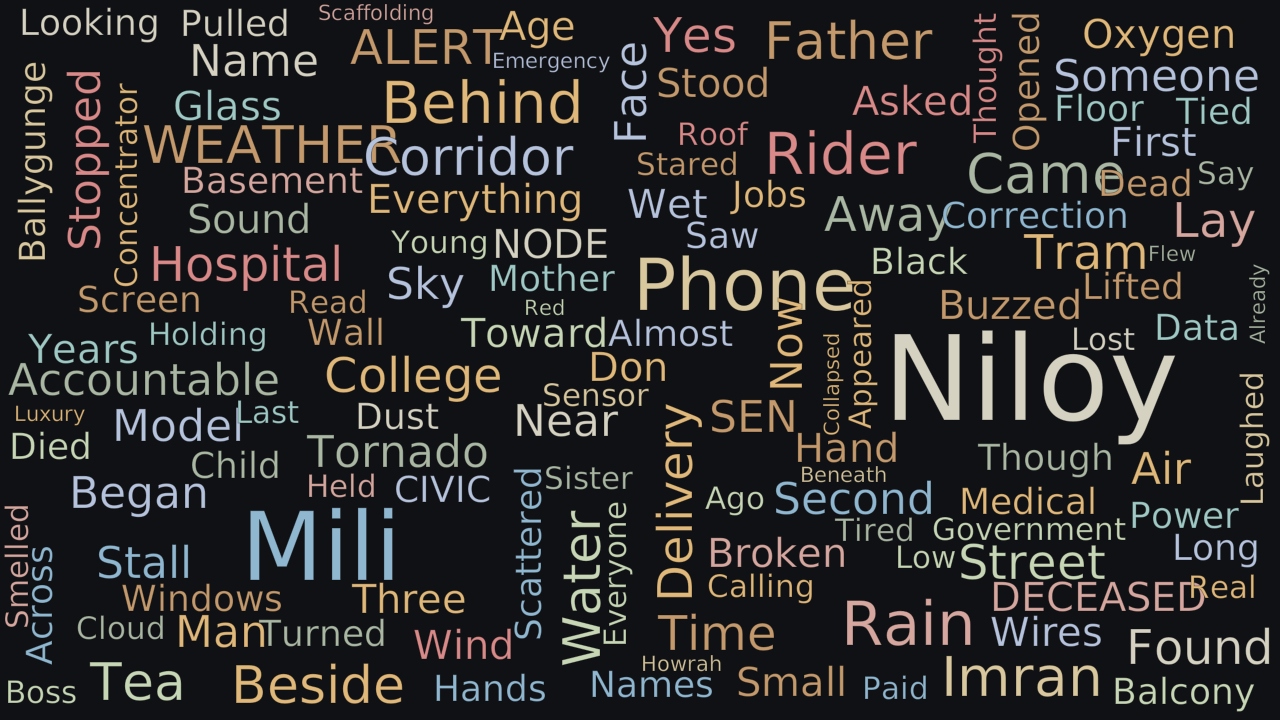
Word Cloud
Related reading
Selected by shared topics and section, with closer publication dates breaking ties.