The Eye-Eater of Hazra
Uses the speech voice supplied by your browser or device.

THIS IS A WORK OF FICTION
By the time the twelfth woman was found in the locked storeroom behind the Hazra stationery shop, people in south Calcutta had stopped looking directly at one another.
It began as a small adjustment, almost polite. In the tea stall outside Kalighat Metro, men spoke into their glasses, not across them. Women in autos lowered their eyes to their handbags. Coaching-center girls walked in pairs with sunglasses on even after sunset, their faces solemn and insect-like. Delivery boys, who had once threaded through traffic with the fearless insolence of minor gods, now kept their helmet visors down.
The city did not go silent. Calcutta never grants fear that much dignity. It discussed, corrected, embroidered, denied, declared.
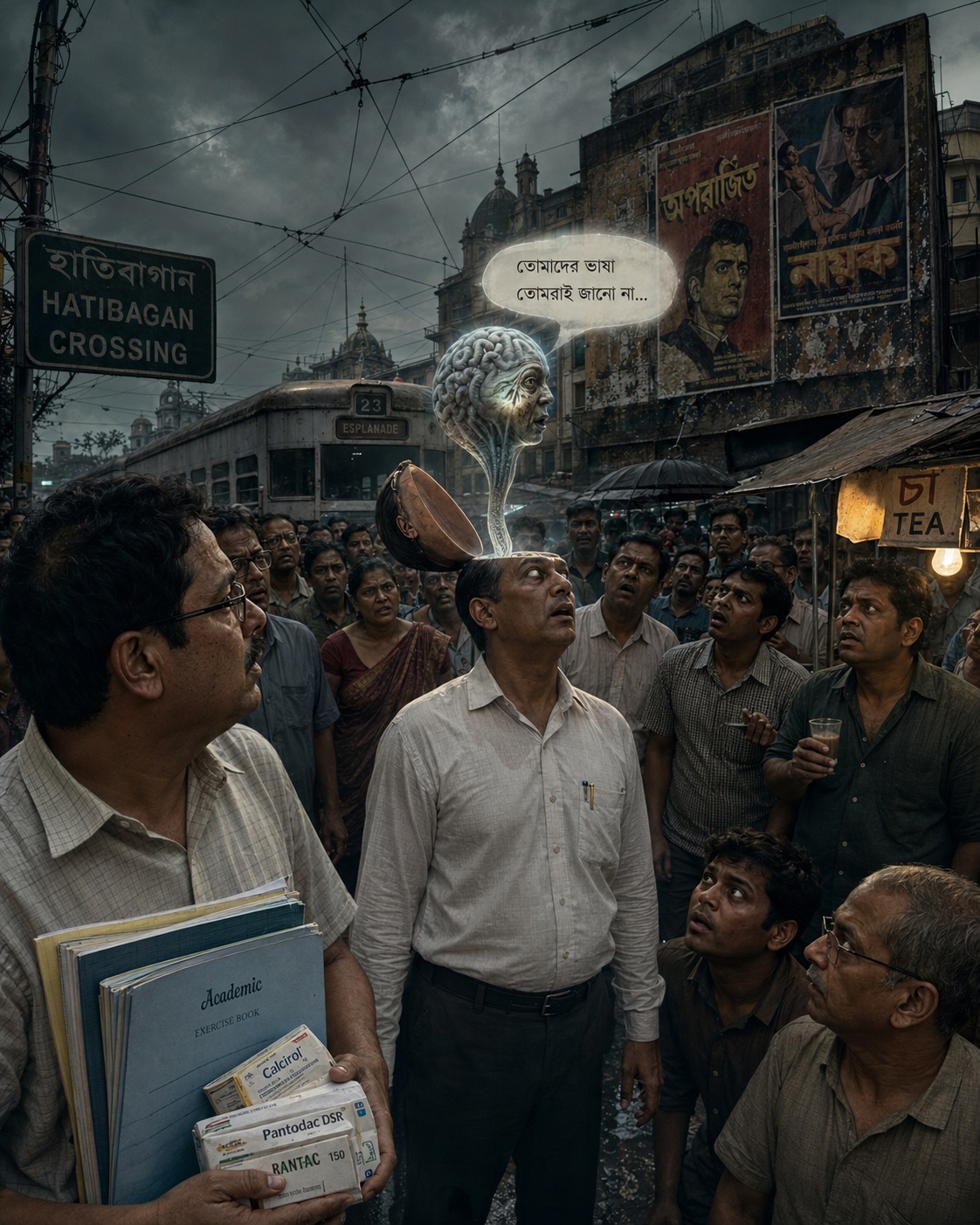
“He takes only beautiful eyes,” said the man at the tea stall, stirring sugar into tea with an old spoon black at the handle.
“Arrey, what beautiful? My cousin’s neighbor’s niece had specs minus six. Like bottle glass.”
“Specs can be removed.”
“Beauty remains.”
There was a pause for this philosophy.
Above them, tram wires crossed the sky like old surgical stitches. Rainwater from the previous night stood in shallow brown pans beside the broken pavement. A political poster had peeled from a wall and curled inward, making a minister smile at his own armpit. Across the road, a girl in a yellow kurti waited for the bus with one hand over her face, not because of dust, but because every staring man now seemed to possess a possible appetite.
Mrinmoy Sen heard all this while drinking his second tea.
He was fifty-two, a schoolteacher by profession and a widower by reputation, though the second fact had eaten more of his life than the first. His wife, Anindita, had died six years earlier on a July afternoon so wet and ordinary that he still considered the weather an accomplice. A taxi had jumped the red light near Rashbehari. There had been witnesses. There had been sympathy. There had been advice. There had been that uniquely Bengali ceremony of suffering in which everyone arrived with fruit, biscuits, and superior knowledge of grief.
Since then Mrinmoy had lived in a two-room flat in an old building near Hindustan Park, where the balcony railing had rusted to the color of dried blood and the lift worked only when it wished to participate in civilization. He taught history at a girls’ school in Ballygunge and corrected answer scripts with the patience of a man who had learned that empires, marriages, and ceiling plaster all fall eventually.
The first victim had been one of his former students.
Her name was Mitali Basu. Twenty-four. Worked in a small design studio near Deshapriya Park. Found at dawn beside the shutter of a closed beauty parlour, alive then, dead by afternoon. The newspapers used the word “mutilated” with that smug little shiver newspapers enjoy. Her eyes had not merely been destroyed. They had been removed.
After the fourth attack, people named him.
Chokh-kheko.
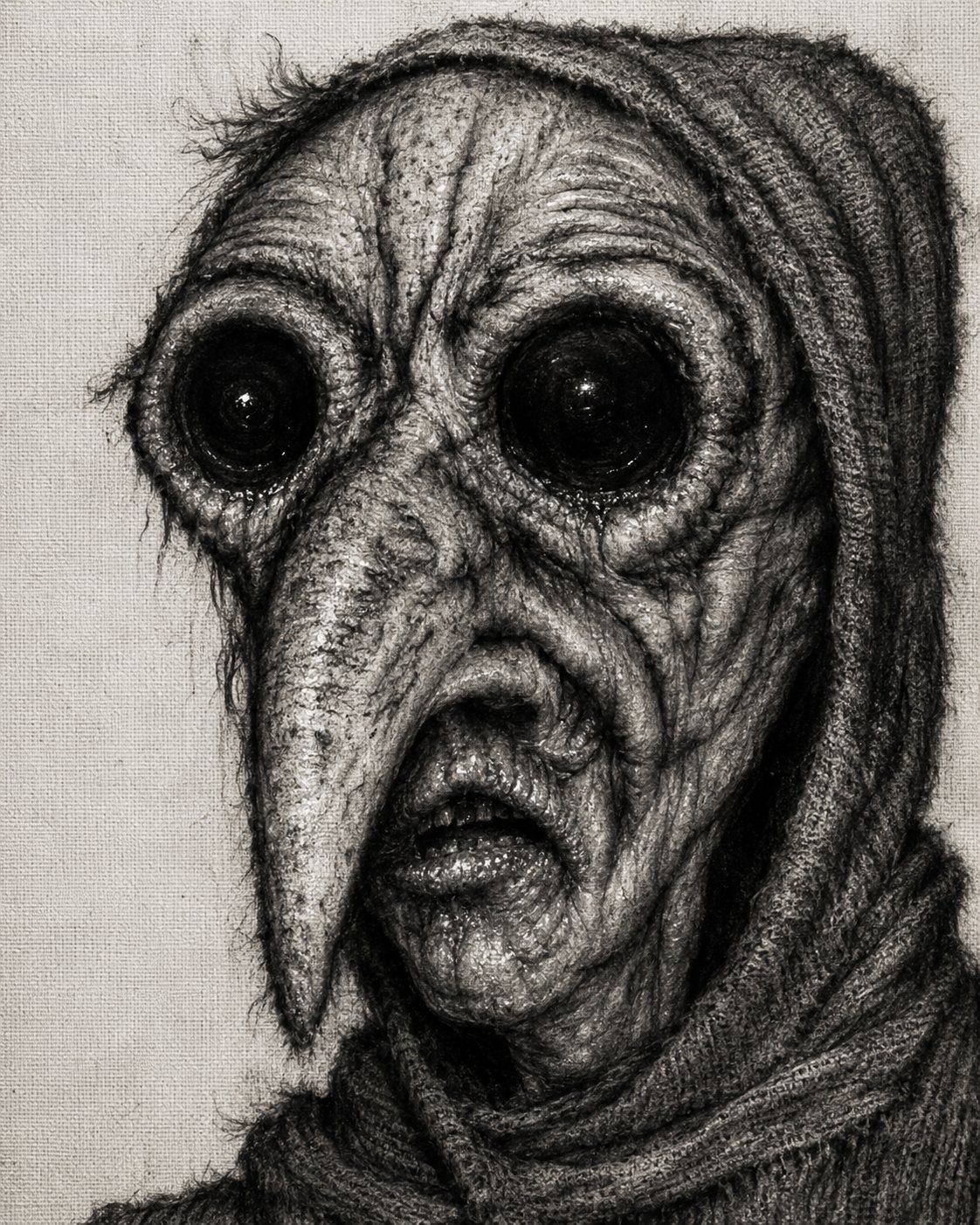
The Eye-Eater.
The police objected, then used it privately.
By the seventh, the city had created him properly. He was a madman with a beard. He was a failed painter. He was a man rejected in love. He was an organ trafficker. He was an occultist from Tarapith. He was a migrant. He was a rich boy from a gated tower. He was a poor man from the canal. He was, inevitably, someone from outside.
Calcutta, which loves its criminals local and its blame imported, clung to this last theory with tender relief.
Mrinmoy did not intend to investigate anything. He had no detective’s vanity. He owned no pipe, no revolver, no tragic sharpness of mind. But after Mitali’s mother came to school with a photograph and stood in the staff room without sitting, something shifted inside him.
“She liked your class, Sir,” Mrs. Basu said.
This was a sentence with no practical use. Yet it entered him like a nail.
That evening, the power went out at eight-fifteen. The whole building sighed. Somewhere a pressure cooker released steam with the hiss of a warning snake. Mrinmoy lit a candle and opened the old attendance register he had brought home from school by mistake. Mitali’s name was there from eleven years ago, neat and dark.
Beside it, in the margin, someone had once drawn an eye.
Not a child’s doodle. Not the lazy almond shape of boredom. It had lashes, a wet pupil, a little white fleck of light.
Mrinmoy stared until the candle bent in the fanless heat.
The next morning, he asked Rupa Dutta about it.
Rupa taught biology, was thirty-five, unmarried, brisk, and dangerous to fools. She had the practical intelligence of someone who had spent years explaining menstruation to adolescents while male committee members discussed “modesty.” Her hair was always tied too tightly. Her sarcasm had tenure.
“Girls draw eyes everywhere,” she said. “In notebooks, on benches, on palms. Eyes, flowers, BTS hearts, existential misery. Why are you asking?”
“Mitali drew well?”
“She was in my class? I don’t remember.”
“You remember everyone.”
“That is my tragedy, not my job description.”
But when she saw the register, her face changed.
“This isn’t Mitali’s,” she said.
“How do you know?”
“Because I’ve seen this before.”
Rupa took him to the old art room, now used for storing broken chairs, discarded charts, and one skeleton with a missing left hand. The room smelled of dust, varnish, and adolescent ambition. On the inside of a cupboard door, hidden behind rolled-up maps, were dozens of eyes.
Large, small, laughing, furious, half-closed, weeping.
All the same hand.
Below them, scratched faintly into the wood, was a name.
Nabaneeta.
Mrinmoy felt the past, that lazy beast, lift its head.
Nabaneeta Lahiri had been a student twelve years earlier. Quiet. Brilliant. Scholarship girl. Lived somewhere near Chetla with a mother who stitched blouses and a father who had evaporated, as fathers sometimes do in lower-middle-class stories, not dramatically, but by degrees—first from the dining mat, then from conversation, finally from responsibility itself.
She had drawn constantly. Eyes especially.
Beautiful eyes, everyone said.
Mrinmoy remembered her now with a teacher’s shame: not fully, but in fragments. A thin girl near the window. Excellent essays. A habit of looking up sharply when praised, as if praise might be a trap.
“What happened to her?” Rupa asked.
“She left before Class Twelve.”
“Why?”
He knew then. Not as fact, but as a door inside him unlocking.
There had been an incident.
A rumor. A complaint. A girl said a tuition teacher near Hazra had touched her. The tuition teacher denied it. Parents whispered. The school advised discretion. The girl stopped coming.
Respectability in Bengal is often a curtain made of other people’s fear. Everyone stands behind it naked and calls it culture.
“Nabaneeta,” Mrinmoy said.
Rupa watched him. “You knew?”
“I knew there was trouble.”
“Same thing, in our noble profession.”
He did not defend himself. Defense requires innocence, or at least stamina.
That night the thirteenth attack almost happened.
A woman named Sohini was followed from Lake Market through the lanes behind Sarat Bose Road. She noticed because the man behind her was humming a Rabindrasangeet incorrectly. She ducked into a pharmacy, screamed before he touched her, and two young men from a momo stall chased him. He ran with surprising speed, one hand pressed to his mouth.
The police released a description the next day. Male. Thin. Early forties. Patchy beard. Dark shirt. Possibly mentally unstable.
Possibly mentally unstable: that official dustbin into which society throws everything it does not want to understand.
But Sohini added one detail.
“He had very beautiful eyes,” she told the reporters. “Like a woman’s.”
By afternoon, three channels had made this sentence famous.
By evening, Mrinmoy and Rupa were in Chetla.
They found Nabaneeta’s old address above a shuttered electrical repair shop, after asking a paan seller, a tailor, two old women on a balcony, and one boy who claimed ignorance until Rupa used her teacher voice on him. The staircase was narrow, damp, and decorated with the long artistic history of leaking pipes. On the second floor, a woman opened the door.
She was small, white-haired, and wore a faded blue nightgown. Her eyes were cloudy with cataracts, but not blind.
“You are from school,” she said before they introduced themselves.
Mrinmoy felt the old machinery of guilt begin its work.
“Yes,” he said. “I taught Nabaneeta.”
“My daughter is dead,” the woman said.
“I am sorry.”
“No, you are not. You are visiting.”
It was not said cruelly. Only accurately.
Her name was Krishna Lahiri. She let them in because the rain had begun and because old manners are harder to kill than old anger. The room was clean, poor, and orderly. A sewing machine stood by the window. Above it hung a framed drawing of two eyes.
They were extraordinary. Not pretty. Not decorative. Alive in a way that made the viewer feel borrowed.
“She drew that?” Rupa asked.
“She drew only eyes after that year,” Krishna said. “Before, she drew houses, dogs, clouds, film actresses, Durga. After, only eyes.”
“What happened to her?” Mrinmoy asked, though he had earned no right to ask.
Krishna looked at him for a long moment.
“She became famous for one night,” she said. “Everyone knew her story. Then everyone forgot. Except her.”
The tuition teacher had been a respected man, a producer of rank-holders, owner of a coaching center with air-conditioning and laminated success. Nabaneeta accused him. He said she was unstable, attention-seeking, vulgar. Other parents panicked, not for her, but for their children’s marks. The school requested quiet. Krishna fought until money ended. Nabaneeta stopped eating. Then speaking. Then drawing anything but eyes.
“She used to say nobody saw,” Krishna said. “So she would make eyes. Enough eyes to shame the city.”
“How did she die?” Rupa asked softly.
“Fever first. Then hospital. Then bill. Then apology. Infection, they said. These days even death needs paperwork.”
Mrinmoy looked at the drawing. “When?”
“Four years ago.”
The attacks had begun three months ago.
Krishna rose slowly and opened a tin trunk. From inside she took a stack of exercise books tied with red thread. Nabaneeta’s sketchbooks. Eyes upon eyes, page after page.
On the last page, there was a man’s face.
Thin. Patchy beard. Mouth slightly open.
Eyes blank.
Under it, Nabaneeta had written: He will carry what they refused to see.
Mrinmoy’s breath tightened.
“Who is he?”
Krishna touched the paper with one finger.
“My son.”
The name was Nirmal Lahiri.
Nabaneeta’s elder brother. He had worked at a printing press near College Street, then as a night guard, then nowhere consistently. After his sister’s death, he had begun sitting for hours before her drawings. He told his mother he could hear them blinking. He said the city was full of stolen sight.
Doctors had used words. Psychosis. Schizophrenia. Medication. Follow-up. All correct, perhaps, in the way a street map is correct about a flooded lane. Useful, insufficient, and dry.
“Where is he now?” Rupa asked.
Krishna smiled with terrible fatigue. “If I knew, would I be sitting here?”
On the way back, the rain had made Chetla shine with a cheap, feverish glamour. Headlights smeared across puddles. Fish scales glittered near the market drain. Somewhere a television argued about national pride. Mrinmoy walked under Rupa’s umbrella and felt himself becoming smaller.
“You couldn’t have saved her,” Rupa said.
He almost laughed. “That is what people say when saving would have been inconvenient.”
She did not answer.
They found Nirmal three nights later because of an eye drawn on a wall.
Not in paint. In soot.
It was on the side of the abandoned Basu mansion near Hazra, a crumbling house trapped between a pharmacy and a new glass-fronted diagnostic center. Once it had balconies, servants, Durga Puja, a courtyard where conch shells blew. Now it had moss, rats, and a sign announcing LUXURY RESIDENCE COMING SOON, as if luxury were a species of termite.
A police constable had noticed the drawing after the fourteenth victim was found nearby, dead behind a stack of plastic chairs rented for a thread ceremony.
Rupa called Mrinmoy at school. “Come now.”
“Why me?”
“Because your guilt has finally become useful.”
Inside the mansion, the air was wet and stale. The police had cordoned off the entrance badly, because in Calcutta even crime scenes must negotiate with pedestrians, goats, and curiosity. An inspector named Arindam Ghosh allowed them in after Rupa lied that they could identify handwriting. Mrinmoy did not correct her.
They moved through a hall where old portraits leaned against walls, their painted eyes silvered by damp. From somewhere upstairs came the drip of water. A cat fled past them like a thrown rag.
In the courtyard, under the remains of a thakur dalan, they found the room.
It had been a shrine once. Now the floor was covered with paper. Newspaper clippings. School notices. Photocopies. Drawings of eyes. At the center sat a brass plate.
On it were twelve small glass marbles.
Not eyes.
Marbles.
Beautiful ones: brown, black, greenish, amber, each with a painted pupil.
Rupa bent down, then recoiled. “What is this?”
Mrinmoy knew before he knew.
“He isn’t keeping their eyes,” he said.
Inspector Ghosh frowned. “What?”
“He takes them, yes. But he replaces them in his mind. With these.”
“Mad fellow logic,” the inspector said.
“No,” said Rupa. “Ritual logic.”
Behind them, someone laughed.
Nirmal stood in the doorway.
He was thinner than the sketch, older than his years, wearing a dark shirt pasted to his body by rain. His beard grew unevenly, as if his face itself had lost interest. But Sohini had been right. His eyes were beautiful.
They were not his.
They were large, luminous, and unmistakably feminine. One had a tiny fleck of gold near the pupil. Mrinmoy had seen that fleck earlier, in a framed drawing above a sewing machine.
“Nabaneeta,” he whispered.
Nirmal smiled with cracked lips.
“She sees now,” he said. “Dada, move aside.”
The inspector raised his gun. “Hands up!”
Nirmal did not look at him. He looked only at Mrinmoy.
“You were there,” he said. “Staff room. White shirt. Red pen. You said, ‘These matters become complicated.’”
The sentence returned whole.
Mrinmoy felt the room tilt.
He had said it. Not to Nabaneeta, perhaps. To the headmistress. To another teacher. In the lazy coward’s grammar of institutions. These matters become complicated.
Nirmal stepped forward.
Rupa moved between them.
“No,” she said.
Nirmal blinked. For a moment the eyes in his face seemed to focus separately, as if one person looked at Rupa and another through her.
“She does not want you,” he said to Rupa. “You saw enough.”
Then he turned again to Mrinmoy.
“She wants the ones who looked away.”
The inspector fired.
The sound in the old mansion was enormous. Birds exploded from the rafters. Nirmal fell backward into rainlight, his head striking the stone with a flat, domestic sound, like a coconut dropped in a market.
For three seconds nobody moved.
Then Rupa ran to him. Inspector Ghosh shouted for an ambulance though everyone knew the bullet had done its bureaucratic work efficiently.
Mrinmoy stood frozen.
Nirmal’s eyes were open.
Their beauty was gone.
They were ordinary male eyes now, brown and frightened, already dulling.
On the wet floor beside his head lay two glass marbles.
One rolled toward Mrinmoy’s shoe and stopped.
Inside it, impossibly, a tiny gold fleck caught the light.
The newspapers called it solved.
Nirmal Lahiri, forty-one, mentally ill, unemployed, resident of Chetla, responsible for the Eye-Eater killings. Police praised. Public relieved. Channels performed their nightly wrestling match with truth. Experts spoke. Neighbors said he had always been quiet. Someone found an old prescription and held it before a camera as if diagnosis were motive, verdict, and obituary.
Krishna Lahiri refused to claim the body.
Or so they said.
Mrinmoy returned to school after three days. Girls filled the corridors again, cautious but alive, their laughter returning in little test flights. Rainwater dripped from umbrellas. The bell rang. History resumed its fraud of sequence and explanation.
In Class Ten, he began the Revolt of 1857 and found he could not continue.
Thirty-seven girls looked at him.
He closed the textbook.
“There are times,” he said, “when people say they did not know. Often they mean they knew only enough to remain comfortable.”
No one wrote this down.
After class, he went to the old art room. The cupboard door had been removed by the police, but one drawing remained on the wall behind a broken chart of the human eye. A tiny sketch, missed by everyone.
A woman’s eye.
Under it, in Nabaneeta’s hand, were four words.
Not twelve. Not enough.
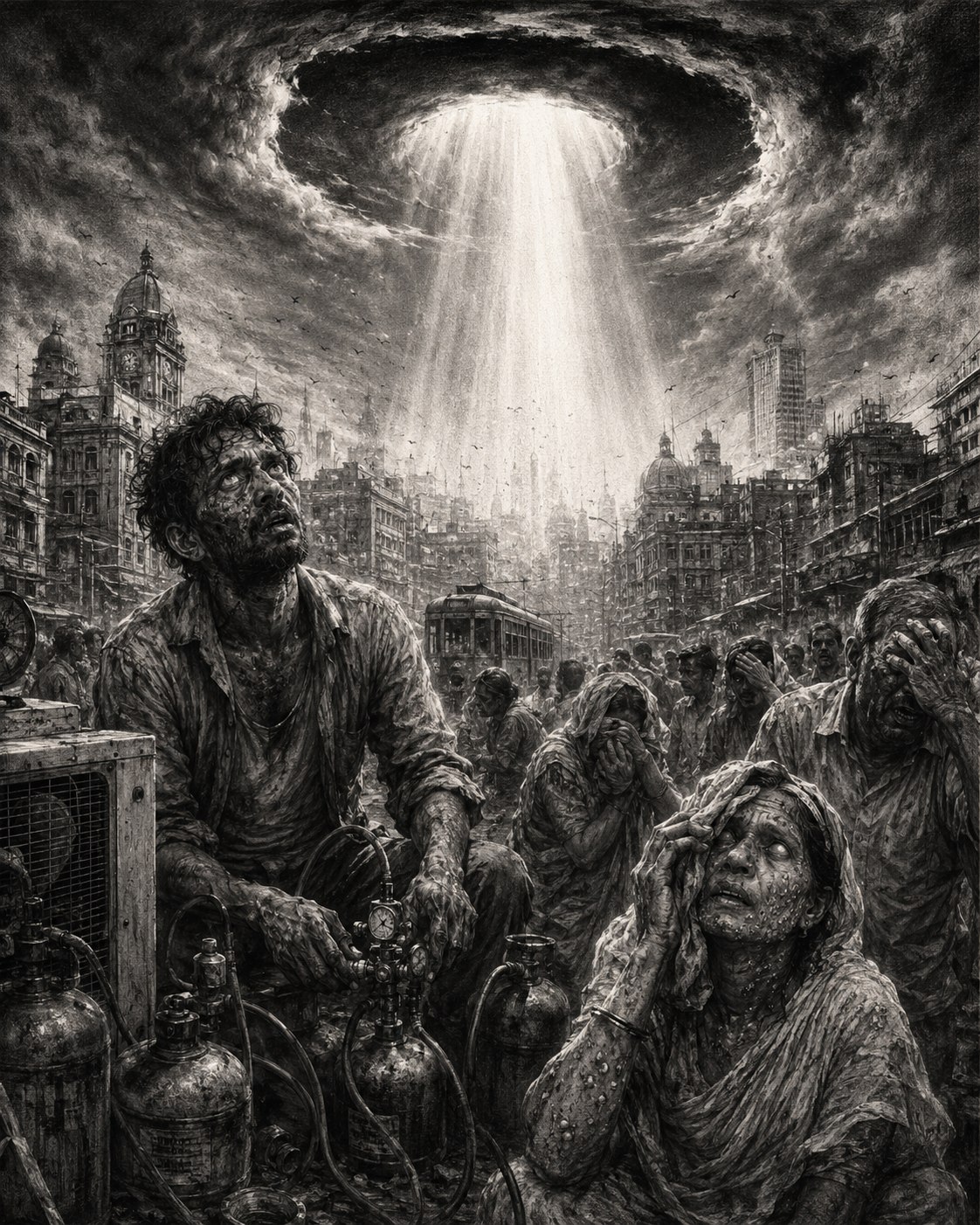
That evening, Mrinmoy walked home past Gariahat, where hawkers had spread plastic sheets over shirts, bras, pirated books, phone covers, puja lights, and imitation sunglasses. Life had already begun to bargain with horror. A man shouted the price of mangoes. A child cried for momo. A bus conductor slapped the side of a bus as if waking a stubborn animal. Above the crossing, the city’s lights trembled in the wet air like eyes that had not yet decided what they had seen.
At home, the power failed again.
Mrinmoy lit a candle.
In the bathroom mirror, his own reflection looked tired, guilty, ordinary.
Then he noticed that his right eye had changed.
Near the pupil, bright as a trapped match flame, was a tiny fleck of gold.
He leaned closer.
From somewhere inside the dark socket of the building, from pipes, walls, old registers, old rooms where teachers had chosen quiet over trouble, a young woman’s voice whispered—not angrily, not even loudly, but with the terrible patience of the unseen.
Now you.
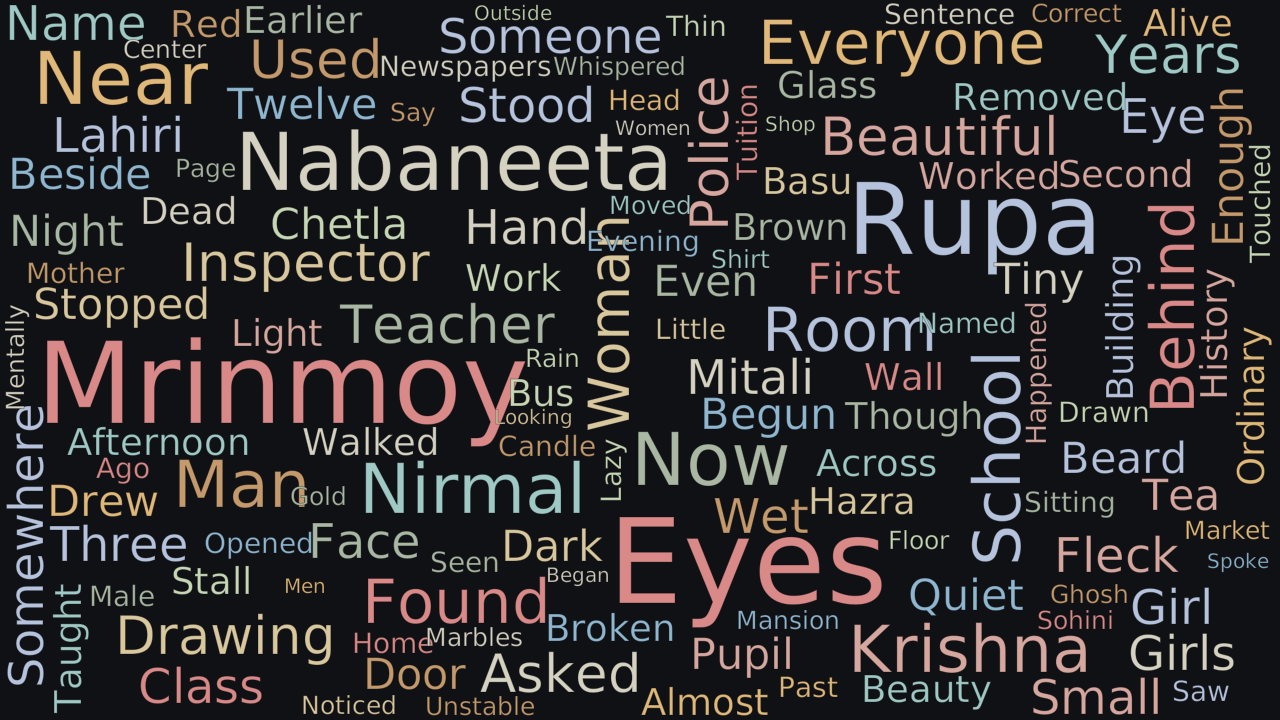
Word Cloud
Related reading
Selected by shared topics and section, with closer publication dates breaking ties.