The Free Prasad Hour
Uses the speech voice supplied by your browser or device.

THIS IS A WORK OF FICTION
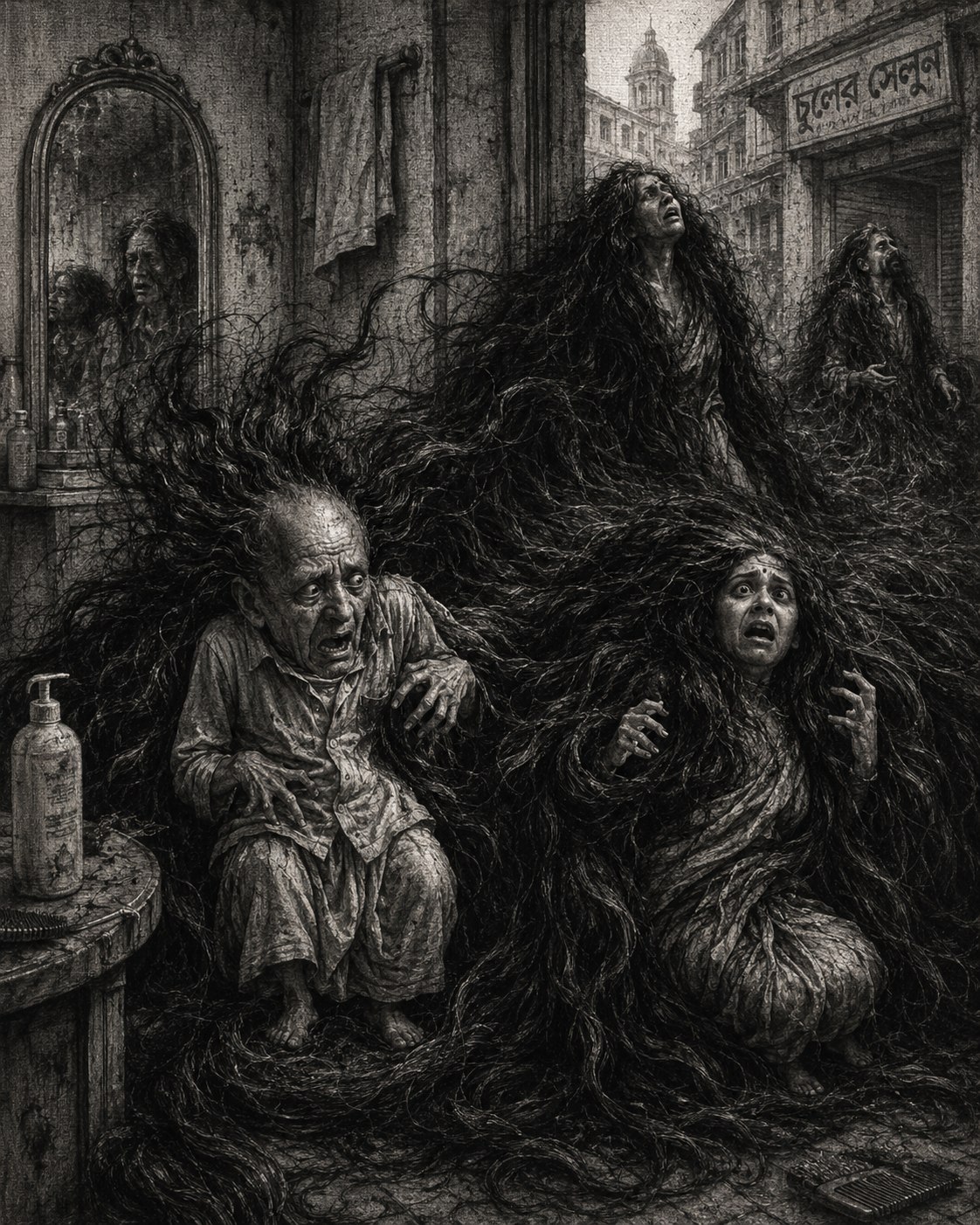
By two in the afternoon, College Street had become a frying pan with tramlines.
The rain had promised itself since morning but refused to arrive, hanging instead in the air as a wet threat. Booksellers sat behind towers of exam guides, their vests darkened at the chest and armpits, fanning themselves with old question papers. A tea stall near Paramount had acquired the authority of a small republic: six men, four stools, one boy pouring tea from a height, and everybody explaining the country to everybody else. Overhead, torn posters flapped on lamp posts—tuition batches, blood tests, political martyrs, a missing parrot, and one enormous smiling face with a halo printed badly enough to resemble a jaundiced umbrella.
BABA BIJOYANANDA RETURNS TO CALCUTTA
MIRACLE DARSHAN
FREE PRASAD, FREE SAREE COUPONS, FREE HEALTH BLESSING
LIVE TELECAST FROM 5 P.M.
Below the Baba’s face, in smaller type, as if embarrassed by its own relevance:
COME EARLY. LIMITED SEATING. CAMERA ZONE NEAR MAIN GATE.
Nandita stopped under the poster not because she believed in men who could bless blood sugar, exam results, visa delays, and uterine fibroids with the same two fingers, but because the printing was familiar. The yellow border. The red burst around the word FREE. The careless spelling of “spiritual” as “spirtul” in the lower corner. She had corrected that spelling in another life and been told by Rishav that the masses did not require spelling, only color.
A bus coughed black smoke at her elbow. Somebody behind her said, “Didi, move na, full road is not your father’s property,” with the weary intimacy of Calcutta, where strangers insulted you as if they had known your family for three generations.
She moved.
Her phone buzzed. A message from an unknown number.
You should not come today.
No name. No punctuation. But she knew the shape of the threat. Rishav had always typed like a man granting parole.
For a moment the street loosened around her. She saw not College Street but his old office in Tollygunge, four floors above a diagnostic center, the room cold with air-conditioning and ambition. Rishav Basu, hair too carefully careless, shirt sleeves rolled, saying, “Nandu, emotion is not lying. It is editing reality until reality becomes useful.”
He had called himself a media man. Not journalist, not producer, not fixer, though he had been all three according to need. A media man, as if he belonged to the age itself.
Nandita put the phone in her bag and walked toward the crossing. She taught spoken English now to boys who wanted call-center jobs and girls who wanted enough fluency to stop being corrected by future in-laws. It was honest work, though honest work in Calcutta had the glamour of a wet umbrella. Every month, rent ate first, medicine ate second, and dignity licked the plate.
She had not seen Rishav in three years.
That was not true. She had seen him everywhere. On banners. On news panels. Behind godmen. Beside politicians. In the sudden camera angle that made a crowd look like a nation.
The rally was at the old tram depot ground near Esplanade, a wounded rectangle of city that had survived empires, unions, rallies, pujas, cinema hoardings, and the municipal genius for turning everything into a queue. By four, Nandita had reached the area. The sky had gone the color of tin. Police barricades leaned like bored schoolboys. Vendors sold water pouches, plastic garlands, incense sticks, paper masks of Baba Bijoyananda’s face, and cheap biscuits in packets swollen with heat.
At the main gate, volunteers in saffron scarves shouted instructions nobody could hear.
“Ladies this side!”
“Senior citizen front!”
“Coupon line separate!”
“Darshan line not coupon line!”
“Media entry! Media entry! Don’t push!”
That last phrase had the effect of making everyone push.
Nandita stood across the road beside a peanut seller and watched.
People had come in thousands. Housewives from Behala with shopping bags folded under their arms. Clerks still wearing office shoes powdered with dust. Elderly men in white vests beneath translucent shirts. Children dragged by wrists. Young men taking photos of themselves against the stage. Women from the suburbs who had risen before dawn to cook, travel, stand, wait, and believe just enough to make the day worth the pain in their knees.
Belief, Nandita thought, was not always stupidity. Sometimes it was hunger wearing a clean shirt.
The TV vans stood along the eastern edge, dishes pointed upward like metal lotuses. On the bamboo stage, a giant cutout of Baba smiled over the ground. Beneath him, a smaller banner announced: CALCUTTA RECEIVES GRACE. Below that: Powered by RB MediaWorks.
Rishav’s company.
She saw him near the camera platform, speaking into two phones at once. He had filled out slightly. Success had thickened him in the neck. He wore a pale linen kurta, dark glasses, and that expression of noble fatigue men acquire when other people’s exhaustion makes them money.
Beside him stood Baba Bijoyananda.
Without the poster’s kindness, the godman looked smaller. A plump man in his sixties with a beard like overboiled milk, eyes restless beneath sandalwood paste, fingers heavy with rings. He was sweating through his silk. Every few seconds he glanced toward the crowd as if it were not a congregation but a sea with teeth.
Nandita was still watching when Pulak-da found her.
“Ei, Nandu?”
She turned. Pulak Sanyal, once the best cameraman at Rishav’s office, now freelance, stood with a cracked shoulder rig and a face like an old file cover.
“You came?” he said.
“You messaged me?”
“I am not so dramatic. I would write full sentence.” He wiped his forehead with a gamchha. “Why are you here?”
“Curiosity.”
“At our age curiosity is acidity. Go home.”
“What is happening?”
Pulak looked at the ground, then at the crowd, then at Rishav. “Same as always. Faith, free things, camera. Add heat. Stir.”
“Pulak-da.”
He sighed. “He has opened only two gates. See? Entry from north and west. Exit also west. Coupon counter inside near the narrow lane. Water tanker at the far side, but barricade blocking direct path. When Baba throws blessing flowers, people will run forward. When coupon announcement comes, people will run back. Camera gets emotion. Channel gets numbers.”
“That’s dangerous.”
He gave her a dry look. “You have become innocent after leaving media?”
The first chant rose from the ground, loose at first, then caught by speakers and returned enlarged.
Baba! Baba! Baba!
A woman near the gate lifted her child above the crush so he could breathe. A volunteer laughed and told her not to create drama. Behind them, three teenage boys waved at a camera and shouted their neighborhood name. One of them had written “TV” on his forehead with sandal paste.
Nandita felt a small coldness move under her skin.
“What time does it start?” she asked.
“Five.”
“It’s already five-ten.”
“Delay builds devotion.”
“Why did someone tell me not to come?”
Pulak’s mouth tightened. “You got message?”
“Yes.”
“From him?”
“I don’t know.”
Pulak shifted the camera bag on his shoulder. “Then go.”
That was when Rishav saw her.
Across the boiling stretch of road, across barricades and cables and men yelling for bottled water, his face changed only slightly. A narrowing of the eyes. A little private smile, as if she had arrived exactly on cue and was being unprofessional by not knowing it.
He raised one hand.
Not greeting. Marking.
A volunteer with a saffron scarf immediately looked toward her.
Nandita stepped back.
Pulak caught her wrist. “Come.”
He pulled her behind the OB van, through a lane of coiled wires and sweating technicians. The city noise dropped into a mechanical hum: generator, fan, distant chant, someone cursing into a headset.
“You have to leave,” Pulak said.
“Why?”
“Because he asked about you last week.”
“Me?”
“Said old associate may come to create nuisance. Said if she comes, keep her inside VIP enclosure for safety.”
The coldness in Nandita became shape.
“Inside?”
Pulak did not answer.
Memory arrived with disgusting punctuality. Three years ago, after she left Rishav, he had come to her paying-guest room in Lake Gardens with flowers and a promise to change. When she refused, he did not shout. Rishav rarely shouted. He stood in the corridor while other doors listened and said softly, “You think leaving a story removes you from it.”
After that came the small violences. A rumor she had stolen client data. A landlord suddenly unwilling to renew. Two job interviews that evaporated after “background feedback.” Nothing provable. Rishav understood that reputations in middle-class Bengal were like glass tumblers on a steel tray; no need to break them, just make them rattle.
Pulak opened the rear door of the van. “Stay here for ten minutes. I’ll get you out from the back.”
Inside, two monitors showed the crowd from different angles. One wide shot made the ground appear grand, almost sacred. One close shot found faces shining with sweat and hope. An old woman pressed her palms together; a boy grinned into the lens; a man held up a coupon booklet as if it were a passport.
On the production table lay a printed running order.
5:22 — Baba arrival shot
5:27 — Miracle child package
5:31 — Flower blessing
5:34 — FREE SAREE COUPON ANNOUNCEMENT
5:35 — Camera 3 crowd surge
5:36 — Baba exits east
5:37 — N gate hold
5:39 — Sponsor prayer
Nandita read the line again.
Camera 3 crowd surge.
Not crowd reaction. Not crowd emotion.
Surge.
Outside, the chanting sharpened. The monitors flashed to Baba rising from a white car. The camera found him low-angle, so he seemed enormous, a mountain of silk and rings. The crowd convulsed forward.
Pulak swore.
A young production assistant climbed into the van, saw Nandita, and froze. He wore a headset and the over-bright expression of a man too junior to have ethics yet.
“Didi, you can’t—”
“Who wrote this?” Nandita held up the running order.
He looked at it as if it had grown a knife. “Normal rundown.”
“Who wrote it?”
“Rishav-da.”
On the monitor, Baba lifted both hands. Flower petals burst from machines hidden near the stage, a pretty orange rain. People screamed with delight. Those at the back pushed to enter the blessing. Those at the front bent to collect petals. The middle lost permission to stand upright.
Then the announcement came.
“MA-BONERA, PLEASE COLLECT FREE SAREE COUPON FROM WEST COUNTER! LIMITED! ONLY FIRST TWO THOUSAND!”
The speakers cracked. The words dissolved and re-formed as panic.
FREE. COUPON. FIRST.
The crowd changed nature.
A crowd is not many people. That is the mistake. Many people still have names, knees, tempers, mothers, dinner plans. A crowd is a weather event made of bodies. It has currents. It has pressure. It can be engineered by anybody sufficiently patient and insufficiently human.
On the screen, the forward push met the backward turn. The bamboo barricade at the west counter bowed, sprang, vanished. People fell not dramatically but with a horrible modesty, as if kneeling to pick something up. Others stepped because there was no alternative to stepping. The chant became one long animal vowel.
“Open the north gate!” Pulak shouted into his phone.
The assistant was crying. “They told police N gate for VIP exit only.”
“Open it!”
Nandita ran.
Outside the van, the heat struck like a hand. Men were shouting now without words. A camera operator remained on the platform, filming. Another had lowered his camera and was vomiting beside the generator.
At the north gate, three volunteers held the barricade closed while people behind it clawed and pleaded. One volunteer kept shouting, “Order! Order!” as if order were hiding nearby and could be summoned by repetition.
Nandita seized the bamboo pole. “Open it!”
“VIP only!”
“People are dying!”
“Madam, instruction—”
She hit him.
It was not noble. It was not cinematic. She struck him with her handbag, which contained a steel water bottle and two grammar workbooks, and he went down with an expression of wounded bureaucracy. Pulak arrived from behind and kicked the latch loose. The barricade tilted. The first people burst through, stumbling, weeping, furious to be alive.
For the next minutes, Nandita did not think. She pulled children. She slapped faces. She screamed at people to move sideways, sideways, don’t stop, don’t pick up slippers, leave the bag, leave it, leave it. A woman with blood on her forehead clung to Nandita’s kurta and asked whether her mother had come out. A man carrying a limp boy shouted for water. Someone was still chanting Baba’s name, but now it sounded like accusation.
On the stage, Baba Bijoyananda had disappeared.
Rishav had not.
He stood on the camera platform, headset on, one hand pressed to his ear, face pale but composed. He saw Nandita near the opened gate. For the first time that day, he looked surprised.
Not afraid.
Surprised.
She understood then with a clarity so clean it felt almost merciful. He had expected her inside the VIP enclosure, near the west counter, where the first crush had folded. The warning message had not been from him. It had been from someone who knew enough but not how to stop it.
Pulak.
By sunset, the ground was a field of abandoned slippers.
The official number began at seventeen. It rose politely, as official numbers do, stopping for tea at each stage of embarrassment. By midnight it was eighty-nine. By morning it crossed two hundred. By the third day, when the newspapers had found the correct tragic font, it was three hundred and twelve, not counting those who died later in hospitals where corridors held more relatives than beds.
The city performed its rituals.
Ministers arrived. Compensation was announced. Opposition leaders demanded resignation. Channels played loops of the surge with red circles around falling bodies. Experts explained crowd management. Priests explained faith. Rationalists explained superstition. Middle-class uncles explained poor people. Poor people stood in hospital queues holding photographs and death certificates, discovering once again that grief in India requires photocopies.
Rishav was arrested on the second evening.
Not for murder. That would have suggested imagination in the police. He was charged with negligence, unlawful assembly violations, permissions irregularities, safety non-compliance, words that walked around the dead like careful relatives around a sleeping baby.
Nandita gave her statement. So did Pulak. The production assistant leaked the running order, then denied leaking it, then became a hero for two days and unemployed on the third.
Baba Bijoyananda issued a video from an undisclosed location. He wept. He said his heart was broken. He said divine energy had been mismanaged by worldly agents. Behind him, visible for half a second in a mirror, was a hotel towel.
On the fourth day, Pulak came to Nandita’s coaching room.
It was above a sweet shop in Gariahat, up a staircase smelling of syrup, damp socks, and ambition. The students had gone. Rain finally fell outside, flattening the city’s dust into black paste.
Pulak looked older than he had at the rally. He placed a pen drive on her desk.
“What is this?”
“Raw footage. Camera 3. Before uplink.”
“You should give police.”
“I gave one copy.”
“And?”
“And copies disappear. Like witnesses. Like common sense.” He rubbed his eyes. “You keep.”
Nandita did not touch it. “Why did you warn me?”
Pulak looked toward the window. Rainwater ran down the glass in nervous lines.
“I heard him,” he said. “Two days before. He told security, if Nandita comes, put her near west VIP rail. He said you are emotional, may create scene, keep you contained.”
“That doesn’t mean—”
“He also changed coupon announcement time. Earlier after Baba exit. He moved it before exit.”
“Why didn’t you tell police?”
“I did.”
“Tell them again.”
Pulak smiled without humor. “You still believe repetition improves institutions. Very sweet.”
She sat down.
Pulak said, “There is more.”
Of course there was. In Calcutta there is always more; even the ghosts have annexures.
He nodded at the pen drive. “Watch the last file.”
After he left, Nandita waited until the rain grew loud enough to hide her breathing. Then she borrowed the old laptop from the office cupboard and opened the footage.
The video was shaky, time-stamped 17:18. It showed the side of the stage before Baba’s entrance. Rishav stood with Baba near the steps, half hidden by a banner. The microphone had caught them badly, but enough.
Baba: “Too many people. Open more gate.”
Rishav: “Baba, please. Visual will dilute.”
Baba: “I am telling you, I don’t like.”
Rishav laughed softly. “You liked advance payment.”
Baba turned away, wiping sweat from his neck. The camera shifted. For three seconds, it caught Rishav’s face unguarded.
Nandita leaned closer.
He was not looking at the crowd.
He was looking toward the VIP enclosure.
Toward the place where she was supposed to be.
Then he said something to a security man. The sound broke. The man nodded.
The clip ended.
Nandita played it again. Again.
On the fourth viewing, she noticed a woman near the west barricade, partly hidden by a pillar. Blue sari. Hair tied low. A cloth bag against her chest. For one wild second Nandita thought it was herself, some ghost version who had obeyed the trap and gone inside.
Then the woman turned.
It was Ma.
Not her mother, who had died six years ago after three strokes and one final complaint about hospital fish curry. Ma as Rishav used to call his own mother, the widow from Shyambazar who sent mango pickle to the office and once told Nandita, “My son is difficult, but heart is good. You manage him.”
Nandita froze the frame.
Rishav’s mother stood in the coupon line, small and hopeful, wearing the blue sari Nandita remembered from Saraswati Puja at the office. She was holding a paper coupon booklet. She was smiling faintly, not at Baba, not at the stage, but toward the camera, as if she wanted someone at home to see that she too had been present in the city’s bright hour.
Nandita sat there while the rain drummed on the tin shade outside.
The final news came two days later, in a short item below an advertisement for luxury flats in New Town.
Among the unidentified bodies at Medical College, one had been claimed by relatives of arrested media consultant Rishav Basu. His mother, Madhumita Basu, sixty-eight, had died in the stampede.
The channels did not dwell on it. The story had moved on to outrage over compensation distribution, then to a film star’s divorce, then to rainwater entering the airport. Calcutta, that ancient stomach, had begun digesting the dead.
Nandita visited Rishav in jail because she wanted to see whether knowledge had entered him.
He sat behind the mesh in a white shirt gone gray at the collar. Without product in his hair, he looked younger and ruined, like a schoolboy after cheating badly in an exam.
“You came,” he said.
“Yes.”
His eyes searched her face. “I didn’t know Ma was there.”
Nandita believed him.
That was the worst of it.
“I arranged car for her,” he whispered. “She said crowds give her headache. She was supposed to watch on TV.”
“Everyone wants to be on TV,” Nandita said.
He flinched as if she had struck him with something heavier than a handbag.
For a while they listened to the jail sounds: keys, coughs, sandals slapping stone, a man laughing too loudly at nothing funny.
Rishav leaned toward the mesh. “I only needed one death,” he said, in a voice full of wonder, as if arithmetic had betrayed him. “One clean accident inside a crowd. Who can prove? But then they ran. Why did they run like that?”
Nandita looked at him. Beyond the small barred window, rainwater dripped from a pipe into a broken bucket with patient, official rhythm.
“Because you told them there was not enough for everyone,” she said.
He opened his mouth, perhaps to deny it, perhaps to explain the difference between intention and outcome, murder and marketing, sin and strategy, all the delicate vocabulary by which clever men build footbridges over pits.
But no words came.
When Nandita stood to leave, he said, almost tenderly, “You got the warning?”
“Yes.”
“I sent it.”
She turned back.
His face had changed. Not softened. Emptied.
“I sent it from another number,” he said. “I wanted you to come frightened. Frightened people make mistakes. You always hated being managed.”
Nandita held the mesh because the room had tilted slightly.
“So I came because you warned me.”
“Yes.”
“And because I came, Pulak hid me in the van.”
“Yes.”
“And because I was in the van, I saw the running order.”
His eyes moved away.
“And because I saw it, the north gate opened.”
Outside, the bucket filled drop by drop.
Rishav began to cry then, silently, with the offended helplessness of a man who had discovered that even his cruelty could not obey him. He had tried to place her in death’s path. Instead, he had placed her beside the latch.
Nandita left without another word.
That evening, as she crossed College Street in the rain, the posters of Baba Bijoyananda hung in strips from the walls. The halo had melted. The smiling face had peeled open at the mouth. Underneath, from some older campaign, another printed sentence showed through in red letters:
COME EARLY. LIMITED SEATS.
A tram bell rang somewhere ahead, patient and mournful, and the city moved around her with its bags, umbrellas, hunger, faith, suspicion, and foolish little hopes, each person trying to get home before the next announcement.
Word Cloud
Related reading
Selected by shared topics and section, with closer publication dates breaking ties.