Wait Until She Finishes
Uses the speech voice supplied by your browser or device.

THIS IS A WORK OF FICTION
A denture scraped the back of my tongue while all my own teeth were still in place.
I stopped chewing.
Across the table, Ma was separating a piece of potato from her khichuri. Her upper denture clicked. The thing in my throat clicked with it.
I put a finger into my mouth. Something behind my tongue bit it.
Not hard. Enough to hold me there.
“Take that out,” Ma said. “People are eating.”
I pulled my finger free. Two shallow crescents had broken the skin.
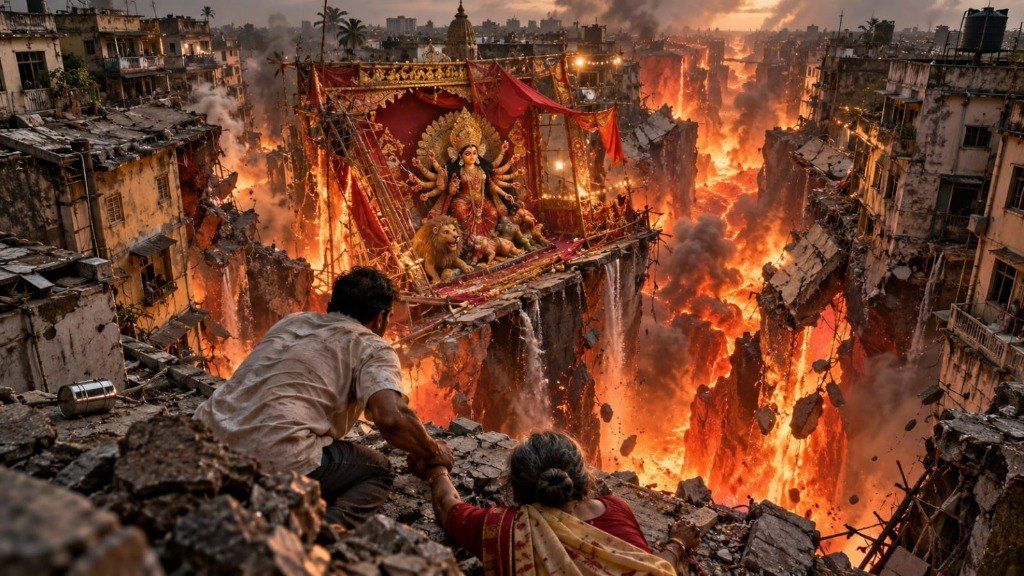
We were in the bhog tent behind our old apartment building in north Calcutta. It was Ashtami, 2026. I had promised Ma lunch and needed to return a rented delivery van by two. Thirty minutes. Eat, drop her home, avoid the argument about how rarely I visited.
She was wearing the sari I had bought her three years earlier. She always mentioned that when she wore it.
“You got a bone?”
“No.”
“In khichuri?”
“I said no.”
She looked down.
Good. I had made her feel stupid. At least she wasn’t looking into my mouth.
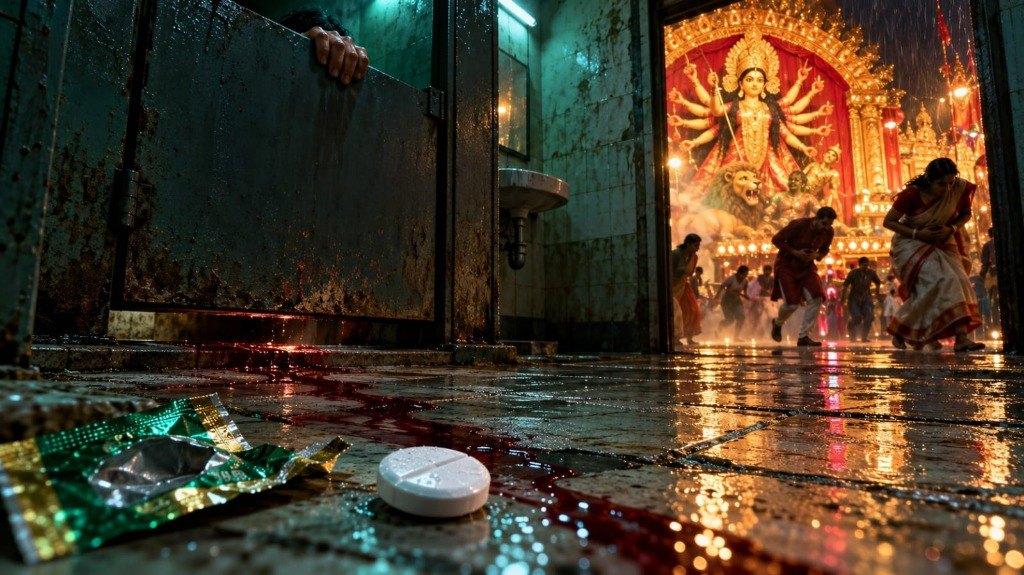
I went to the bathroom behind the kitchen. It had a broken latch and a floor wet with water that smelled of chopped onions.
In the phone light, my throat looked wrong. The little hanging piece at the back had been pushed aside. Below it was a curved strip of pink plastic.
A denture.
Then a small brush came out from underneath it.
The bristles worked along the plastic. I felt them against flesh much deeper than the back of my mouth. Something was pulling my tongue downward, gently, testing how much would come.
I gagged into the sink. Rice came out through my nose.
The brush stopped.
A woman’s voice said, very quietly, “There is a contraction.”
It came out of my mouth. My tongue hadn’t moved.
I stood there with both hands over my lips.
Someone knocked.
“You’ll have to wait,” I said.
The woman inside my mouth said, “Again.”
I didn’t answer.
“Can you repeat that?”
I flushed the toilet so whoever was outside wouldn’t hear.
For perhaps five seconds I felt relieved. I had managed to make this sound like a normal man having a normal shit.
Then my lower left molar rose in its socket.
There was a tight squeak. The tooth tilted inward. I could feel each root pulling free separately. I tried to push it back with my thumb.
“Stop,” the woman said.
I thought she meant me.
The tooth came out with a piece of jaw attached. It slid behind my tongue and disappeared. Blood filled the sink. I grabbed a fistful of toilet paper, packed the hole, and held my face until the first spasm passed.
When I returned, Ma was sitting very straight.
“Mine’s doing something too,” she said.
She lifted her spoon. Her wrist bent backward. She watched it go, her expression getting annoyed before it got frightened.
“Help me put this down.”
I took the spoon.
Her wrist stayed bent.
I pulled her sleeve over it.
I did that before I tried anything else. There were neighbors two tables away. I covered her wrist.
A man near the serving counter made a wet snorting sound. His glasses had slid down because the bridge of his nose was flattening. His wife pushed them back up.
Nobody wanted to be the first person to make a scene.
My left eye went dark.
Something pressed on the lid from a direction I couldn’t identify. The lid lifted.
Through my right eye I could see Ma, the folding tables, a boy carrying a bucket of dal.
Through my left I saw a white ceiling and a woman bent over me. She wore transparent gloves. A light was fixed to her forehead.
I closed my right eye.
The woman jerked back.
“The eye is tracking.”
“Where are you?”
Her lips moved. A fraction later, her words came through my throat in flat, careful Bengali.
“You’re receiving a translation. Please keep talking.”
“Get your hands out of me.”
She looked toward someone I couldn’t see.
“What year is it where you are?”
I told her.
She shut her eyes.
I told her again, louder, because I wanted her to understand that she had frightened somebody who still had errands to do.
She turned a screen toward my open left eye.
ASHTAMI RESTORATION. REFERENCE DATE: 2026. PRESENT DATE: 20026.
I counted the zeros.
“That’s eighteen thousand years.”
“Yes.”
“Ma,” I said, “I need you to listen.”
“I am listening.”
“No. There’s someone.”
“I can hear her.”
Ma’s lips were moving with the translated voice.
The woman had two living mouths available and was speaking through both.
She gave me her name. The translation made a short noise I couldn’t repeat. She was a conservator. She kept saying that. She wanted the other person in her room to know she had followed the restoration instructions.
They had recovered an object from beneath what used to be Calcutta.
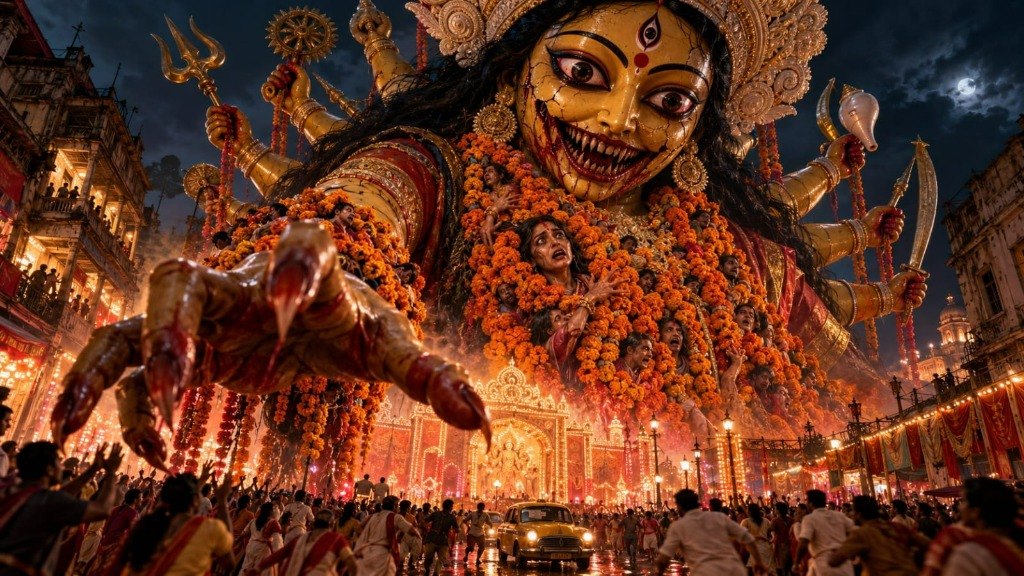
Human bone, mineral deposits, traces of synthetic fabric. Two figures worked into one structure. A man with a woman inside his torso. There were others nearby. Clusters of people, crowded together, their limbs interlocked.
They thought someone had made them after death.
For the Ashtami exhibition in 20026, they had paired their festival day with the Ashtami on which the people had last been alive.
“Quantum entanglement,” she said. “Between the original tissue and the recovered material.”
I told her I drove a van.
“The two dates are sharing a physical state.”
“Tell me how to stop it.”
She didn’t.
They had intended to recover details. Skin texture. Pigment. The arrangement of the faces.
Instead, whatever they touched there was being touched here.
I opened my right eye.
Ma was holding her wrist against her stomach. Her nostrils had started bleeding, two thin lines she kept wiping away with the clean corner of her sari.
“Show me,” I told the woman.
She moved a reflective panel.
In my left eye, I saw the object on her table.
Its mouth was stretched open with a metal brace. My mouth.
The front of its chest had split. A smaller skull sat inside, tilted back beneath the larger one’s jaw. Its teeth were exposed through the crack.
A pink upper denture.
Below that, a pair of knees had been forced up against ribs. One foot protruded under an armpit. Green cloth was trapped around the bones.
Ma’s sari was green.
I opened both eyes.
She had been watching my face.
“What?”
I shook my head.
“Don’t do that. What?”
The conservator said, “We’re stopping the surface work.”
In the tent, the man whose nose had collapsed stood up. One leg stayed under his chair. It separated at the knee without tearing his pants.
He fell onto the table. His wife screamed.
The conservator turned away from me.
“Tell them all to stop.”
She was saying it to her people.
I started saying it to mine.
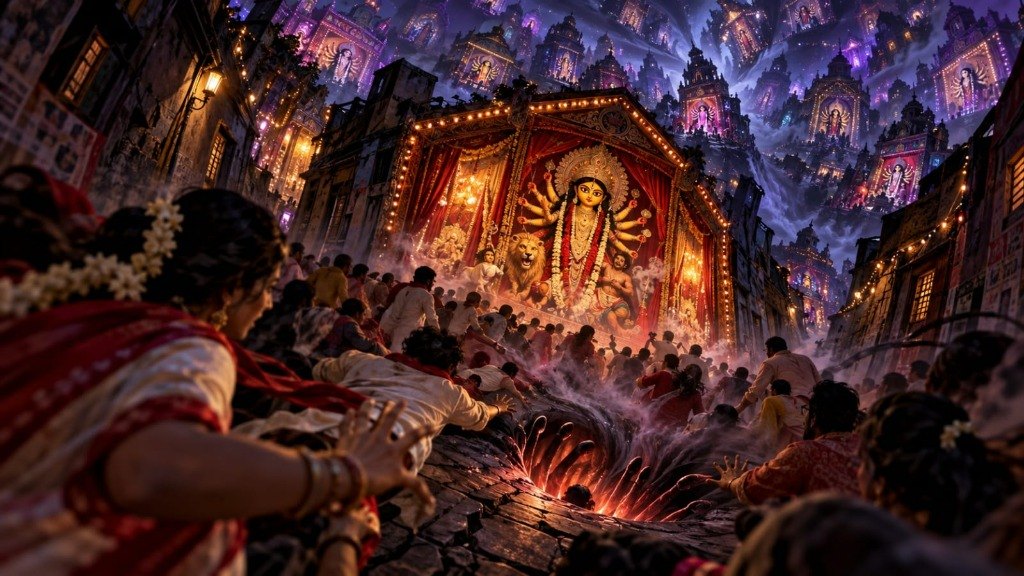
People shoved toward the tent entrance. A woman’s hair caught on nothing and stripped backward off her head. The skin came with it, exposing a white wet patch that began to bleed from dozens of little points.
I grabbed Ma under her arms.
She cried out when I lifted her. Her bent wrist was fixed to her stomach now. The skin had joined.
“Put me down.”
Her fingers were still moving beneath it.
I couldn’t put her down. Something was pulling her toward me.
Her left knee hit my belly. It didn’t stop there.
I felt the hard, blunt kneecap push under my skin.
My shirt stretched. There was no hole in it. Underneath, something tore from my navel toward my groin with a hot, crawling pressure that made me piss down both legs.
Ma grabbed my shoulders with her remaining hand.
“Don’t pull,” she said.
I was pulling.
Her knee was inside me. Her thigh was going in after it. The soles of her feet knocked together under my ribs.
I could hear her bones breaking. She could feel them. Every break made her grip tighten, until her nails came off against my shirt and the bare tips of her fingers kept digging.
“Stop moving the object,” I screamed.
“We aren’t moving it.”
“Then why is she going in?”
The woman didn’t answer immediately.
“The paired state is resolving toward the recovered structure.”
The thing on her table was telling our bodies where to go.
I looked at Ma. Her face was perhaps six inches from mine. Blood had run into the creases beside her mouth.
She said, “Don’t look.”
I looked.
Her chin flattened against my breastbone. Her lower teeth cut through her bottom lip. Her face began to enter my chest, nose first, the skin stretching around it.
I held her head.
For a few seconds I thought I could hold it outside.
Her ears folded forward. One tore loose in my hand. The small gold stud was still in it.
I dropped it because I needed both hands.
Her face went under.
My chest bulged. I could see the shape of her nose beneath the skin.
Then she tried to open her mouth.
Something shoved up behind my tongue.
I fell backward across two chairs. My belly was so large I couldn’t reach the floor. My right arm had been forced outward by a foot wedged underneath it.
Ma coughed.
The cough came up through my throat. It brought blood and a little khichuri from her lunch.
Through my left eye, the conservator was crying.
There were six minutes left in the overlap between the two Ashtamis.
“What happens after?”
“The connection closes.”
“And this?”
No answer.
“Do we go back?”
“No.”
The split in the recovered chest had opened wider. On the table, it was a dark crack between hard brown edges.
Here it ran from my collarbone to my stomach.
I felt air touch something that had never been outside me. Ma’s hand worked out through the opening. Three fingers came through. They felt around until they found my shirt.
She held it.
The conservator called for someone else.
A man arrived, looked through the opening, and told her something that made her stop crying.
“You have connected circulation,” she said to me.
“I don’t care.”
“Trying to separate the smaller individual would be fatal.”
“Her name is Madhabi.”
“I understand.”
“No, you don’t. Say it.”
She said it.
I needed her to have said it. That was the sort of thing I had left to ask for.
They could close the split. They could support the joined tissue while the connection remained. They couldn’t put either of us back.
The man was preparing a thick, clear material.
“We’ll introduce it along the damaged margins.”
I said no.
In my right eye I watched Ma’s three fingers lose their grip on my shirt. Blood was pumping from the split in short bursts. My bursts. Hers. I couldn’t tell anymore.
Inside my mouth, something tapped once against a molar.
Her denture.
I tried to say her name. My tongue touched her gums.
The conservator asked again.
Behind her, the screen showed a rotating scan of the object before they had opened it. A clear seam ran down its chest. An old repair.
The stuff the man was holding.
“That’s yours,” I said.
She looked.
“The repair. You put it there.”
He had stopped with the applicator above me.
They hadn’t found the remains of something people had done to us eighteen thousand years earlier.
They had found their own work.
The count on the screen changed.
Ma’s hand slipped back inside.
“Do it,” I said.
The material went in cold.
It spread between us. I felt it around my heart, under her cheek, between the folded joints of her legs. She tried to move away from it. There was nowhere for her to move.
My chest began to close.
Her hand was in the gap.
I used my good fingers to push it down before the edges met.
I pushed my mother’s hand back inside me.
The conservator asked whether I could breathe.
I could. Not deeply. Each breath lifted something heavy against the bottom of my lungs.
“Can you hear Madhabi?”
I waited.
Nothing.
They adjusted the brace in the recovered mouth. My jaw shifted. A tube was pressed along the side of the smaller skull, making a passage between its lips and the larger throat.
Something hot moved under my tongue.
“Too tight,” Ma said.
I screamed then. I had been making plenty of noise, but that was when I screamed properly, because she could still feel the whole thing.
The conservator loosened the brace.
“Now?”
Ma didn’t answer.
“I think that’s better,” I said.
The white room disappeared.
My left eye stayed blind.
Somebody had thrown a tablecloth over my lower body. I was on the floor. I couldn’t see how much of me was under the cloth.
A young volunteer knelt beside me. She was trying to get through to an ambulance. The calls wouldn’t connect.
“Your mother?” she asked.
I watched her look around. She had served us lunch. She knew there had been two people.
I moved my lips.
Nothing came out.
The girl pressed a folded towel to my chin. My mouth wouldn’t close completely.
“Don’t try talking.”
She reached toward the bulge under my shirt.
I caught her wrist.
She thought it hurt. She apologized.
I could feel Ma breathing. Her upper lip moved against the root of my tongue with each breath. Her denture was loose. Every so often she pushed it into place, and I tasted the adhesive she used because she couldn’t afford a new one.
The girl brought water in a paper cup.
I shook my head.
Behind my teeth, Ma whispered that she hadn’t finished eating.
There was still rice on the table. The girl followed my eyes.
“Food?”
I nodded.
She looked at the towel, the blood, the shape underneath the tablecloth.
Then she picked up a clean spoon.
I let her believe it was me who wanted it. I opened my mouth and accepted a little khichuri.
I waited until I felt my mother finish chewing before I swallowed.
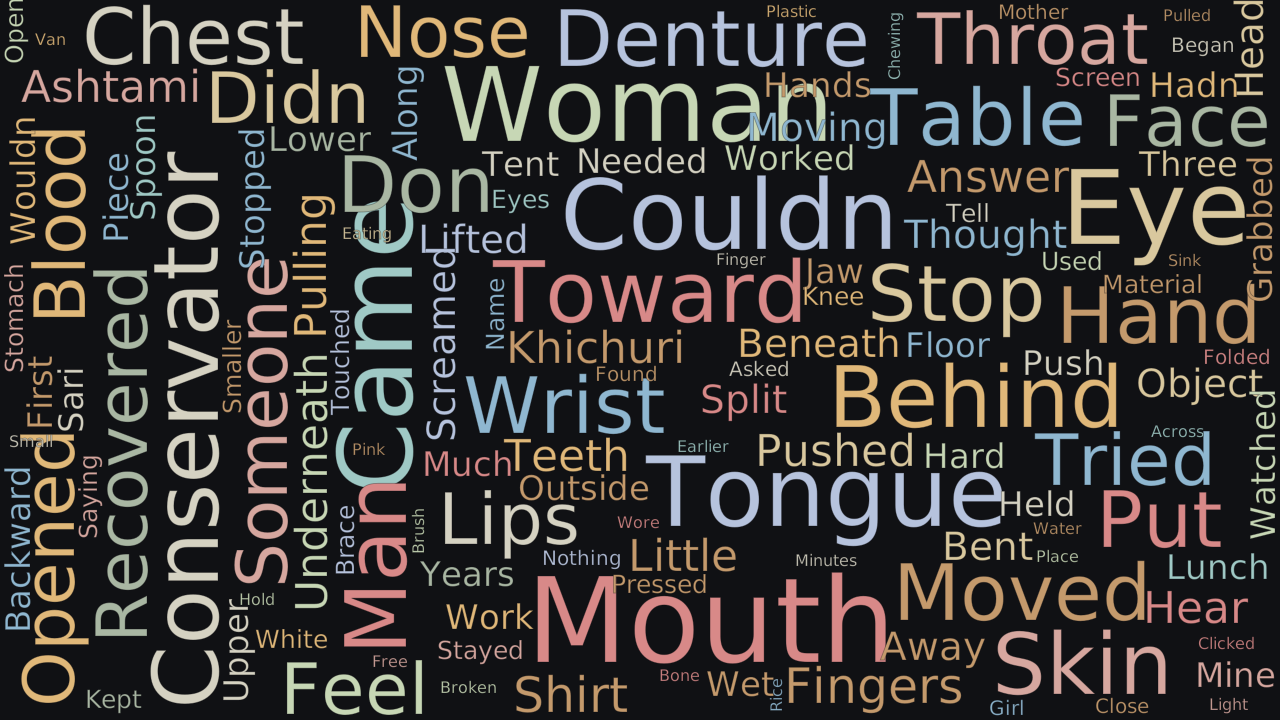
Word Cloud
Related reading
Selected by shared topics and section, with closer publication dates breaking ties.