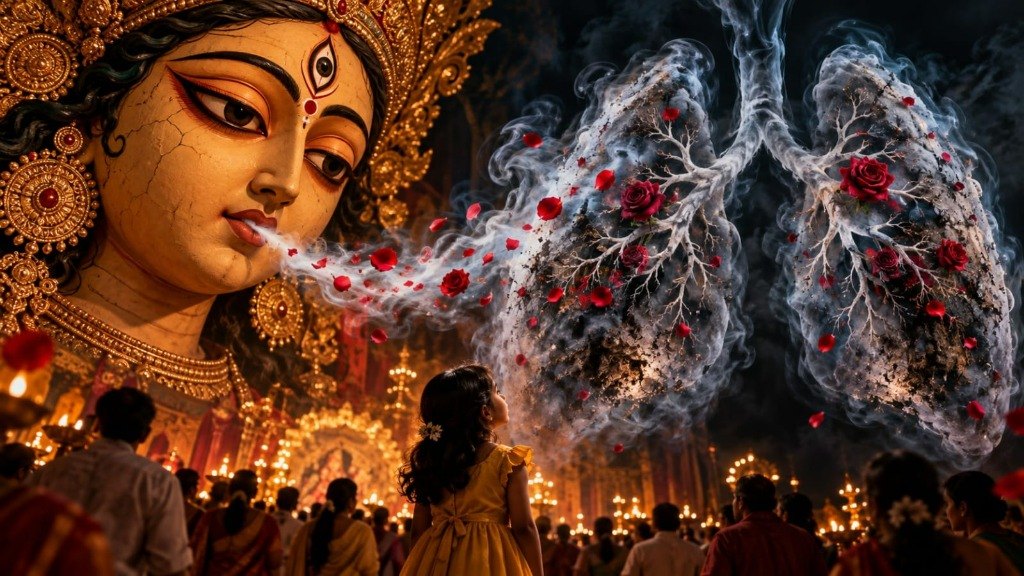
Ashruto (অশ্রুত): The Unheard
On this page
Uses the speech voice supplied by your browser or device.

ASHRUTO (অশ্রুত): THE UNHEARD
A cinematic treatment for a 130-minute Bengali horror feature. The technology, crimes, institutions associated with the experiment, and principal characters are fictional.
ACT I — THE CITY THAT CELEBRATED
At the river, before sunrise, Sabitri Pal finds a man gripping a railing with both hands. The Nabapatrika procession is coming down the steps behind her, the banana plant wrapped in its white sari with a red border, priests calling for room, someone complaining that his new dhoti is already wet. The man has been crying. He is watching the women near the water.
“Didi, amake uthte deben na.” Don’t let me get up.
Sabitri asks where he is hurt.
“Please.”
Behind them, a crew packs away the speakers used for an early sound check. He watches the equipment leave with such relief that she thinks she understands. Some quarrel, some humiliation. Then his right hand releases the railing and begins reaching toward her, while his left hand catches it and holds it down.
She gets a constable.
By seven, she is playing again. She needs the money. She is fifty-five, has been playing the dhaak longer than some committee secretaries have been alive, and still gets asked whether the actual dhaaki is coming. Her nephew Bappa carries the spare straps and argues about their unpaid advance. She tells him to eat before arguing; hungry people accept worse bargains.
Saptami opens around them. Luchi swells in blackened kadais. Boys who have spent the night finishing a pandal eat ghugni from plates balanced on paint tins. Mothers straighten collars their children immediately ruin. Near College Square, reflected lights still tremble on the water after daylight has made the actual lights look cheap.
Mrittika Dutta, thirty-one, arrives to inspect an installation for a fictional consortium supplying festival sound. She has partial hearing loss in her left ear from an old laboratory accident. She adjusts her position when people speak, which they keep interpreting as impatience. Today she is impatient anyway. An unfamiliar contractor has signed off changes to equipment she approved yesterday.
The initials are A.S.
She calls Dr. Arindam Sanyal. He answers warmly, asks whether she has eaten, and says she still suspects every loose connection of being a conspiracy. Forty-eight, recently discharged after psychiatric treatment, he sounds rested. His sister has already told Mrittika that he has stopped taking his medication. Mrittika is worried about him. Then she notices that the contractor authorizations were requested months before his hospitalization. He has been arranging this for longer than either woman knows.
Across Central Avenue, Sub-Inspector Kabir Ali negotiates with a club secretary who has narrowed an exit to accommodate a sponsor’s arch. Kabir gets it widened, photographs it, and turns away. Behind him, men begin shifting the barricade back. His daughter sends him a photograph of herself dressed for Puja. He types that he will see her tomorrow, deletes tomorrow, sends a heart.
Tuli Sen, nineteen, is supposed to meet college friends. Her mother has attached seventeen-year-old Rono to the outing because he has been withdrawn since their father’s death. Tuli resents this until she sees him checking his reflection in a shutter. He wants to look as though someone might be pleased to see him.
A volunteer in a cheap tiger mask helps them through a blocked lane. His badge says RIJU. He has a burn scar beneath his collar and speaks gently to Rono, who cannot decide whether to shake his hand. Tuli ties a loose strap on his mask. “You’ll lose your head in this crowd.”
He holds the repaired knot for a moment after she leaves.
By evening, Mrittika has found the same unauthorized alterations at several sites. A familiar song leaves her with the sudden certainty that someone is standing directly behind her. Nobody is. Habit makes her turn her better ear toward the apparent voice. Across the room, two volunteers turn toward different empty corners. They cannot all be locating the same sound.
She knows this sensation. Eight years ago, in Arindam’s laboratory, subjects described emotions arriving before the memories supposedly causing them.
Arindam called it recognition.
She had written misidentification.
At 8:47 p.m., in the abandoned Chhaya Mahal cinema off Central Avenue, Arindam opens his laptop. Through the broken windows, red and gold lights stretch beyond the dark rooftops.
ANAHATA — MASS TRIAL 07.
POPULATION EXPOSURE: ACTIVE.
For eleven days he has worked as a maintenance contractor across the consortium’s fictional network, from College Square and Mohammad Ali Park to Bowbazar, Sealdah, and adjoining neighborhoods. The elaborate preparation has survived his hospitalization. The decision predates it by years.
He presses ENTER.
A familiar Bengali Puja song begins.
Forty-three seconds pass.
A middle-aged man turns to his wife. “Ami tomake chini na.” I don’t know you.
She laughs. They have been married twenty-six years. Then he asks what she has done with his wife.
A teenage volunteer screams at a queue. An elderly woman begs a child nobody can see to stop calling her. Rono catches Tuli’s sleeve and asks why their father is standing near the barricade.
The first attack near College Square is dismissed as a drunken fight. The second produces phones. Beyond the entrance, people assume the screaming belongs to the pandal’s elaborate theatrical display. They complain that the queue has stopped moving.
Inside, a man keeps apologizing as he strikes a stranger with a broken lighting stand. Another attacker methodically takes shoes off an injured woman’s feet so she cannot run. These people know how bodies work. They know what doors are for.
Kabir’s radio fills with locations. Organizers argue against evacuation because a rush could kill hundreds; meanwhile, frightened volunteers close the very gates people need. Kabir fires once to stop a man attacking a child. The man falls beside a woman who immediately kneels to help him, calling him her husband.
Tuli looks for Rono.
He is beside her, holding her sleeve exactly as before.
“Don’t turn around,” he says. “I’m trying.”
ACT II — THE NIGHT OF A THOUSAND KNIVES
At College Square, the lights keep changing color over the water. Red disguises what the next wash of white reveals. People caught against the waterside railing cannot move back because those behind them are still pushing forward to see what is happening.
Mrittika reaches a sound attendant and gets the local playback stopped. Several people stagger as though waking on a moving bus. Others continue attacking. One woman begs her friend to restrain her before she hurts herself. The apologizing man looks up into the sudden silence, looks down at the person under him, and strikes again.
Sabitri and Bappa begin opening a route through a service enclosure. Kabir removes a barricade despite shouted orders to hold the perimeter. Beyond the railings, spectators are still recording the massacre. One realizes he is watching his own sister and begins screaming her name into a video she will never see.
Rono shoves Tuli away from the route. He believes the men offering help are taking her somewhere. She recognizes the stubbornness in his face, the same miserable certainty with which he used to insist their father would recover.
The tiger-masked volunteer pulls him off her. “Go. I’ll bring him.”
Tuli goes three steps before looking back.
Riju is dragging Rono in the opposite direction.
She follows them into the bamboo passages behind the pandal. Mrittika, Sabitri, Bappa, and a dozen others follow Tuli because the main entrance is disappearing under a crowd.
Inside, unfinished cloth walls brush their faces. The passage branches around the backs of painted buildings. Somewhere inches away, somebody is trying to breathe through a damaged throat. They cannot find the opening to reach him.
Riju begins calling directions in his reassuring volunteer’s voice.
He has learned the structure during its construction. He waits until people commit to a passage, then comes through the adjoining skin of fabric. The first time, a woman thinks someone has stumbled into her. His blade flashes at her neck. Her husband stays kneeling after everyone else runs, pressing his good Puja shirt against the wound, insisting she look at him.
Bappa gets Rono away from Riju and pushes him through a narrow gap. Riju catches Bappa by the dhaak strap. Sabitri sees her nephew dragged backward, his heels cutting two lines through plaster dust. She reaches him in time to hold his hand while the others pull her through. His fingers slip out of hers.
They emerge onto College Street without the spare drum, without Bappa, with Tuli striking Rono across the face because he has tried to bite Mrittika. She stops as abruptly as she began. She has never hit him before.
A bookseller, Haripada Bhowmik, lets them into his shuttered shop. He nearly refuses Kabir, fearing the police will requisition the place and ruin his stock. Then he sees the blood on Sabitri’s hands and lifts the shutter another foot.
Medical guides, engineering entrance manuals, cheap collected poems. People sit among the books trying not to touch each other. Outside, footsteps stop whenever anyone inside speaks.
They devise an ugly little test: say your name, recognize someone, answer a familiar question. Rono passes. A frightened stranger cannot remember his address. Kabir almost sends him outside before Haripada points out that the man has a head wound.
Mrittika admits that recognition proves nothing. An affected person can reason, lie, wait. She is experiencing symptoms herself. For several seconds she sees Kabir’s holstered pistol in his hand and believes he is raising it toward Tuli.
“I need you to stand farther away,” she tells him.
He does. No argument about whether she should know better.
Haripada reveals that a research broker paid him to record interviews when his wife’s treatment bills came due. He has recognized a voice in the music: his own, describing the night he survived the Palbari Puja disaster eight years earlier. Thirty-one people died in that fictional pandal’s enclosed courtyard. Arindam’s wife Madhabi died there. Their teenage son disappeared afterward.
Mrittika had worked on the research commissioned for that event. She helped train a system on intimate recollections, believing it would help people recover memories. When subjects began attributing thoughts to dead relatives, she documented it. Later, she signed a revised report calling the effects temporary confusion.
She needed the job. She says this once and cannot look at anybody.
A scrape comes from above the bookshelves.
Riju has entered through the adjoining storeroom. He has taken off his shoes. Kabir pulls the shelves down between them, burying years of unsold promises of a better life. They escape through Haripada’s rear door while the masked figure begins patiently moving the books aside.
Near Mohammad Ali Park, a first-aid station has spilled into a school courtyard. Dr. Farzana Rahman is marking observation times on paper because phones keep failing. The wounded are mixed with people terrified of what they might do next. An elderly man repeatedly asks permission to hold his granddaughter.
Nobody knows what permission means anymore.
Sabitri recognizes the man from the river. His name is Sudip, a schoolteacher. He remembers everything. He has been lucid for twenty minutes and is helping Farzana sort dressings. Their morning sound check, Mrittika realizes, was a preliminary exposure.
Sudip asks Farzana to keep his hands secured. Another volunteer releases him so he can assist with a badly injured patient. It is an understandable decision. They are running out of hands.
He works carefully. Reassures the patient. Then his expression tightens.
“That’s the man,” he says.
He attacks Haripada, who has been holding a lamp for him. Sabitri and Kabir pull him away, but Haripada is already bleeding heavily from the throat. Mrittika presses a dressing down while he tries to speak. His phone lights up beside him: his daughter asking whether he has eaten.
He dies before anyone answers.
Sudip comes back to himself while Kabir is restraining him. He sees the lamp. He remembers asking to be restrained. His horror is unbearable because it is coherent.
Farzana stops using the word recovered.
Rono asks Tuli to leave him there. She promises to return. Farzana refuses to promise that he will be himself when she does. Tuli writes her name on his observation card so nobody moves him without leaving a record. She touches his forehead and leaves before he can ask again.
Outside, people are walking south in a silent procession.
Some are wounded. Some carry bags and carefully folded shawls. They wait at a crossing for traffic that no longer exists. Asked where they are going, a woman answers, “They’ve opened the door.”
Arindam’s system has planted a shared expectation of refuge at Chhaya Mahal. Mrittika recognizes an experiment she once abandoned: different subjects describing the same nonexistent safe place. Now hundreds are walking toward a building with very few usable exits.
Sabitri hears a real child crying inside the procession. With the small spare instrument borrowed from the first-aid station, she plays a familiar walking cadence and calls for room. Some people look toward her. Others do not. There is no protective rhythm, no counterspell; a living person has given them something else to attend to.
Kabir and local volunteers guide those willing to follow into side streets. They leave space. They repeat names. It is slow, frustrating work, and a man breaks Kabir’s nose because he believes the officer is keeping him from his family.
In the cinema foyer, a makeshift broadcast room contains monitoring screens and old festival files. Upstairs, through the ceiling, they hear someone moving a chair.
Prabir Lahiri, the former Palbari secretary, is locked in a storage cage. Arindam lured him here with a promise to destroy evidence. He admits the committee concealed the old research trial and kept an exit closed for important guests. He insists this was the whole disaster.
Mrittika finds six earlier trial folders. The seventh contains their names, their interviews, predicted responses. Age, emotional history, familiar associations: ANAHATA guesses which intrusive conviction each listener might accept. Its failures are everywhere, filed as exceptions. Arindam deliberately sent Haripada’s voice into his route. He expected Mrittika to come. The deaths are being sorted beside an additional measure: whether survivors will accept an altered account afterward.
Riju appears behind the cage.
Prabir recognizes him before the mask comes off.
“Ritoban?”
Arindam’s son is alive. Twenty-four now, scarred by the original disaster, kept for years as his father’s first experimental subject. The papers that declared him missing spared everyone the inconvenience of explaining where he had gone.
Ritoban kills Prabir through the bars while asking where his mother is. Prabir tries to answer until his mouth fills with blood.
Mrittika sees that Ritoban’s trial record contains repeated attempts to replace one particular memory. His attacks began months before tonight’s transmission. What is pursuing them has already survived long periods of silence.
ACT III — WHEN THE DHAK STOPS
Past midnight, different parts of Kolkata are living through different disasters. Some neighborhoods have shut down their celebrations and opened homes to strangers. Others are still playing music, unable to believe the calls. Ambulances cannot cross streets blocked by people searching for relatives. Rumors give the violence convenient communities to blame.
Kabir finally reaches a senior officer and describes the pattern without pretending to understand it. Sound shutdowns and evacuation must proceed together, with light and room to move. Farzana’s courtyard becomes one receiving point. Runners carry written directions where calls will not connect.
Inside Chhaya Mahal, the old auditorium has been used to store unfinished festival scenery. A huge Durga face hangs above the dead screen. Gold fingers lean against rows of broken seats. The projection booth, containing ANAHATA’s fictional central trial engine, is reached by an iron gallery whose railing moves under Kabir’s hand.
Arindam speaks from behind its locked door. He describes the coming days: Ashtami, Navami, Dashami, each another stage. He wants increasingly precise control over what people do, what they remember doing, and whom they forgive.
He still calls this proof of Kolkata’s violence. Mrittika has seen enough of his records to ask why his measure of success is a confession.
He lets her into the booth.
Years ago, Madhabi discovered that the crowd-calming demonstration was an unauthorized experiment. She went into the courtyard to stop it and bring their son back. When panic began, she reached this booth and begged Arindam to open the door.
He was protecting the equipment and waiting for a useful result. He believed he needed another minute. Then another.
The original recording remains in his archive. Mrittika plays it. The voice they heard buried beneath fragments of tonight’s music is Madhabi’s, outside this very door.
“Kholo. Riju ekhane.” Open it. Riju is here.
Ritoban tried to reach her through the crowd and survived beneath the people who fell. His father later told him that he had caused her death. Every subsequent trial has tried to make that lie settle into memory.
Tonight’s supposed revenge has another purpose. Arindam wants to manufacture witnesses who remember him trying to save his family, including the son who saw him refuse. Making strangers violent gives him new guilt to erase, new memories to replace, measurable evidence that an absolution can be made and made to last. The later festival days are scheduled repetitions until the revised story holds.
Mrittika is his most valuable witness. She knew the original trial. Her compromised report already helped bury it. He wants her to supply the final version willingly, convinced that she remembers.
He asks whether she recalls telling him to keep the experiment running.
For a moment, she does.
The memory has the sickening fullness of something lived. Her own voice. Her own hand on his shoulder. She cannot disprove it by searching inside her head.
So she plays Madhabi’s recording again. She reads her original warning, preserved beneath the revisions. She lets evidence outside herself remain evidence, even when certainty inside her is screaming otherwise.
Below them, Ritoban reaches Tuli and Sabitri. Tuli calls him Riju. He hesitates at the name, then attacks. Sabitri holds the passage long enough for Tuli to reach the gallery stairs. The blade enters beneath her ribs. She sits down hard among the abandoned gold hands.
Her little drum continues for several uneven strokes.
Then it stops.
Outside, the people following its sound hesitate. Volunteers keep guiding them. A woman who has been frightened of touching anyone takes an old stranger’s elbow. The line moves again.
Kabir reaches the booth’s door with Tuli as Arindam begins the next transmission cycle. Mrittika lets them in. There is no time to copy the complete research archive before destroying the trial engine. She saves the ordinary evidence she can, including her own report, and gives Kabir the drive. There will be gaps. There will be people who call those gaps proof of innocence.
They break the apparatus together. No reparative song follows. Across the linked sites, new exposure stops; people already affected still need help.
Ritoban pounds against the outer door. Arindam begs Mrittika to leave it locked. His son will kill them. Surely she can see the necessity now.
Through the glass, Tuli sees Ritoban reach for the knot she tied in his mask, now hanging at his throat. She calls his name. Kabir lowers his weapon and moves behind cover, giving Mrittika room to open the door without standing in his line of fire.
She opens it.
Ritoban enters, shaking. His mother’s recorded plea is still playing on a separate recorder. He recognizes the room. He remembers waiting outside it.
Arindam tells him the recording is fabricated.
Ritoban lifts his blade. Mrittika stays near the open doorway. She cannot promise that his next thought belongs to him. She asks him to put the blade on the floor anyway.
He does. Slowly, furiously, crying with the effort.
Arindam lunges for the evidence drive in Kabir’s hand. Ritoban catches his father on the gallery. Arindam drives him against the loose railing, trying to get past. The whole section tears away.
His fall ends in the stacked steel scenery supports below. One punches through beneath his jaw. His legs kick against a painted palm; blood runs down its gold fingers. He is conscious, trying to form a word with a mouth that can no longer make it.
Ritoban goes down to him. He holds his father’s hand. He does not tell him that anything is forgiven.
Sabitri is still breathing when Tuli finds her. She wants Bappa’s drum brought home. Tuli says she will look for it. Sabitri keeps watching her, making sure she has understood that this is an actual request, that someone must go back and find the thing.
She dies before they reach the courtyard.
By dawn on Maha Ashtami, discarded shoes lie in the gutters with flowers ground into their buckles. Search parties lift torn fabric and discover people sleeping beneath it, or people they wish were sleeping. Most of the idols remain standing. Their lights have gone out.
Kabir records his own account before anyone can improve it for him. Mrittika hands over the drive and names the report she falsified. Ritoban is taken away alive. Nobody agrees on what should happen to him. Farzana insists that disagreement can wait until his injuries are treated.
Tuli finds Rono in the courtyard, awake, watching the gate. She sits close enough for him to move away if he needs to. After a while, he puts his head on her shoulder.
At the small neighboring pandal, people gather for anjali. The priest asks whether they want to wait. A woman holding her missing husband’s photograph says she has nowhere else to stand.
Flowers are passed from hand to hand. Some people pray. Others simply remain there because leaving would mean being alone with what they remember. Tuli holds a few bruised petals. Rono’s hand rests inside hers.
At the back, Mrittika notices him move his thumb against his palm.
Three times. A pause.
She saw Ritoban make that movement before entering the bamboo passage.
Rono turns toward his sister. “Didi, gaan-ta ekhono cholchhe.” The song is still playing.
Around them, several people finish the same small movement. A hand holding flowers. A hand resting on a walking stick. A hand supporting someone too tired to stand.
Tuli feels her brother’s fingers tighten. She keeps holding them.
The camera withdraws through the people offering flowers until the whole gathering is visible beneath Durga’s open hands. Among the bowed heads, a few have begun to turn toward the person nearest them.
The rest are still praying.
Word Cloud
Related reading
Selected by shared topics and section, with closer publication dates breaking ties.