Durga Puja: The Great Hiatus of Larceny
Uses the speech voice supplied by your browser or device.

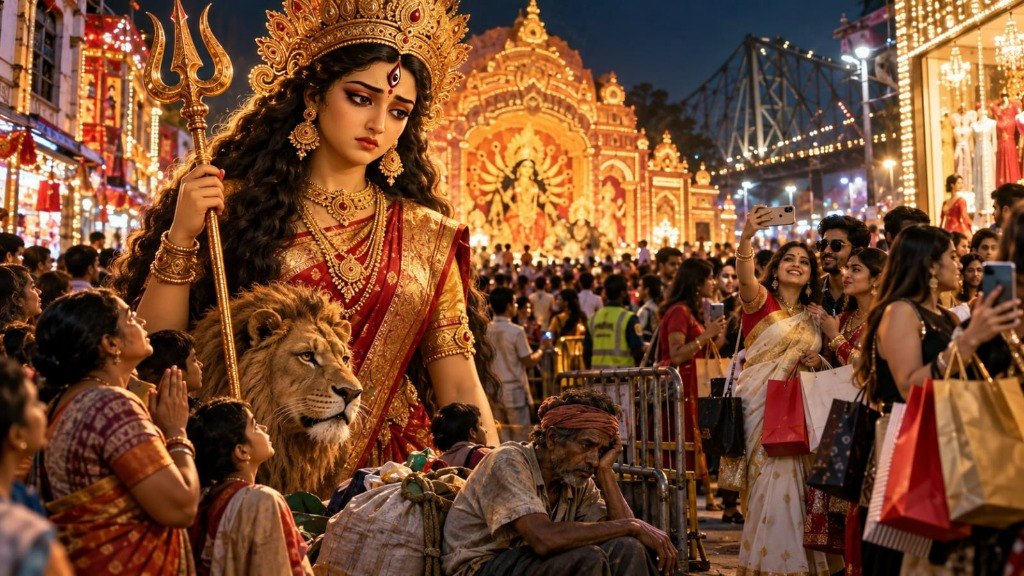
In a way, Durga Puja is a great hiatus for the political and underworld nexus. A holiday from having to explain itself. The business continues, naturally; the collections, the favors, the little arrangements between men whose public designations require considerably more washing than their clothes. But for a few days everything can be conducted beneath the most powerful advertisement available to them. God. Or culture. Or Bengali identity. Whichever name makes you feel most ashamed of asking where the money went.
The goddess arrives with ten arms. The gentlemen managing her earthly affairs do remarkably well with two.
I have watched Calcutta dress itself for this annual suspension of uncomfortable questions, and what gets to me is the ease of it. A man can spend the year making other people’s lives difficult and arrive at Puja as their benefactor. There he is, smiling from the banner, wishing everyone happiness. You may have needed his intervention to get something done that should never have required his intervention. Now you must thank him for the lights. He has arranged a very beautiful evening around the fact that he owns a piece of your life.
There is history behind that smile. The lavish household pujas of Bengal’s rajas and zamindars put wealth, rank, and religious authority on public display well before the modern club committee acquired its microphone. Under Company rule, wealthy Bengali intermediaries and merchants made the celebrations occasions for entertaining Europeans and advertising their proximity to power. Devotion had a guest list. The landlord’s magnificence could be admired without spending too much time on the rents that sustained it.
The British did not need to convert to enjoy the hospitality. Nor did the host need to misunderstand who governed him. There was business in knowing whom to seat, whom to flatter, whose presence would make the neighbors swallow their own importance. The goddess occupied the shrine; the useful men occupied the room. A great deal could be achieved between the two.
Puja subsequently moved beyond those elite courtyards through collective celebrations, and it also became a place for nationalist politics. Public worship could gather people around a claim against power. Which makes the present surrender of so much of that public space to patrons, sponsors, and political guardians particularly nauseating. We acquired the right to assemble and somehow ended up with Dada’s face above the entrance.
The local strongman does not have to retire from intimidation to become a cultural figure. A committee designation will do. A donation helps. A photograph beside the deity is excellent. Where coercion pays for public generosity, the people supplying the money can even be assembled to applaud the man spending it. Chanda is a lovely word until the amount is decided for you and refusal becomes a discussion about your attitude toward the neighborhood.
This is ordinary enough for Kolkata Police to issue warnings against forced Puja collections. And yet the word donation continues to sit there in its freshly ironed innocence, as though everyone involved has misunderstood a voluntary transaction. The shopkeeper understands it perfectly. He also has to open his shop the following morning.
What an arrangement. The sponsor buys visibility, the politician buys affection, the local operator buys a little more respectability. Legitimate work and genuine devotion supply the setting in which these transactions become harder to question. An artisan’s skill can make the whole thing so beautiful that asking about the patron begins to sound like an insult to the artisan. The bastard has managed to put somebody else’s honest work between himself and your suspicion.
But this year the anger goes beyond the money. I cannot keep looking at what is happening nationally and then return, obediently delighted, to discussions about which pandal has the cleverest lighting.
On October 10, Abhijeet Dipke, Saurav Das, and Ashutosh Ranka of the Cockroach Janta Party were detained as they arrived in Delhi for the planned protest. On October 13, Ranka and Das were detained again after entering the restricted Jantar Mantar site. They were subsequently sent to judicial custody for five days. On October 16, Dipke was detained again ahead of the Connaught Place gathering.
Read those dates together. There is barely time for the previous detention to become yesterday’s news before the next one arrives.
The authorities cite restrictions, preventive measures, unauthorized entry. I would also like to know why, when citizens want answers from institutions that exercise power over their votes, so much official energy goes into deciding where the citizens may stand. Jantar Mantar was removed from the list of designated protest sites. Alternative venues were announced. Then the park at Connaught Place was closed ahead of the next gathering. The public question keeps acquiring a geographical problem.
The protests concern disputed electoral-roll revisions and demand Chief Election Commissioner Gyanesh Kumar’s resignation. The Election Commission denies partisan favoritism and says eligible voters wrongly removed can re-enroll. That leaves questions worth pursuing: how were the decisions made, how are mistakes established, how easily can an ordinary person obtain a remedy, and how do we independently examine the institution’s assurances? A citizen’s vote should not depend on how much spare time, money, or administrative stamina he has available to recover it.
And here we are, in Bengal, pandal-hopping en masse.
Look at the crowd. Look at the installation. Look at the fucking lighting. Someone has reproduced a palace, someone has suspended a universe from bamboo, someone has arranged a socially conscious theme for us to admire before we proceed to dinner. Meanwhile, people asking questions about the actual country are being picked up again.
I find that juxtaposition unbearable. The news of another detention lands between photographs of pandals, gets its few seconds, and is pushed down the screen. The arrested person remains arrested after we have scrolled past him. His family still has to find out what happens next. His absence continues while our attention has already arrived somewhere more photogenic.
Bengal is very fond of remembering its political courage. We have shelves of it. Songs, anniversaries, portraits, speeches about the Bengali mind and its refusal to kneel. Dead dissenters enjoy excellent cultural recognition here. They can be quoted without interrupting the evening. The living ones have dreadful timing. They insist on needing our attention while something else is on.
This is a moment in our history when people have already done the frightening work of asking uncomfortable questions aloud. There is an opening. We could add our voices, insist on answers, make it more difficult for detention to become a routine response that everyone eventually learns to accommodate. I don’t know how long that opening lasts. I do know that “after Puja” is a very convenient place to put something you would rather not face.
I am angry because we seem capable of finding endless room for the celebration and almost no room inside it for this. Several hours for a queue, elaborate planning for a route, ferocious arguments about the best theme, and then democracy arrives like an irritating relative who should have called before coming. Must we discuss this now? During Puja? Can’t people have a little happiness?
How long must an uncomfortable fact wait before it stops being an interruption and becomes part of the country we are living in?
The same city that puts the destruction of evil at the center of its annual spectacle becomes exquisitely sensitive when evil is discussed without a costume. Give it horns, a buffalo, a rehearsed defeat, and we can bring the children. Give it an office, a party connection, control over public money, or the authority to order a detention, and suddenly we must be careful about spoiling the atmosphere.
Mahishasura has the disadvantage of being identifiable. Nobody needs to check who sponsored him.
And this is where the old arrangements around money meet the newer business of managing attention. A festival offers the well-connected a vast audience and a ready-made vocabulary of generosity. A political crisis needs sustained attention, memory, the refusal to let one incident disappear beneath the next. Put them beside each other and look at which one has the lights, the sponsors, the uninterrupted microphones. Look at which one has to negotiate for somewhere to stand.
There need not be a meeting at which somebody orders Bengal to enjoy itself while dissenters are detained. A pickpocket need not organize the procession. He needs to know where everyone is looking.
Nor does a crowd have to be stupid to be useful. It can be educated, articulate, proud of its sophistication, perfectly capable of explaining the symbolism of the installation it has come to see. The convenience lies in keeping all that intelligence occupied with something that requires nothing of the people currently exercising power. We can discuss tyranny in mythology until the loudspeakers burn out. The living official would prefer a written application.
I am tired of being expected to treat this as an unfortunate clash of moods. As though the detentions are my private gloom intruding on a public happiness that has already been certified. These things are happening together. The calendar has not suspended the country. The police have not postponed their work out of respect for our enjoyment. Why should our questions be the only things obliged to take leave?
The money deserves scrutiny too. The collections, the contracts, the patronage, the permissions, the public funds, the relationship between a donation and the favor that follows it. But the loss I keep thinking about now is the chance to object while an objection can still gather other people around it. Let each arrest become familiar enough and eventually the remarkable thing will be that anyone bothered to protest at all.
After Puja, we say. Let these few days pass.
A few days are quite a long time when somebody else is spending them in custody.
The goddess looks out through painted eyes. Beneath her, the men on the banners continue wishing us happiness, and the crowds move on toward the next beautifully illuminated victory over evil.
No one has to know. Better still, everyone can know and be too busy.
Tee hee. Haa haa.
Word Cloud
Related reading
Selected by shared topics and section, with closer publication dates breaking ties.