The Three Ts and the Three Fs in Modi's India
Uses the speech voice supplied by your browser or device.

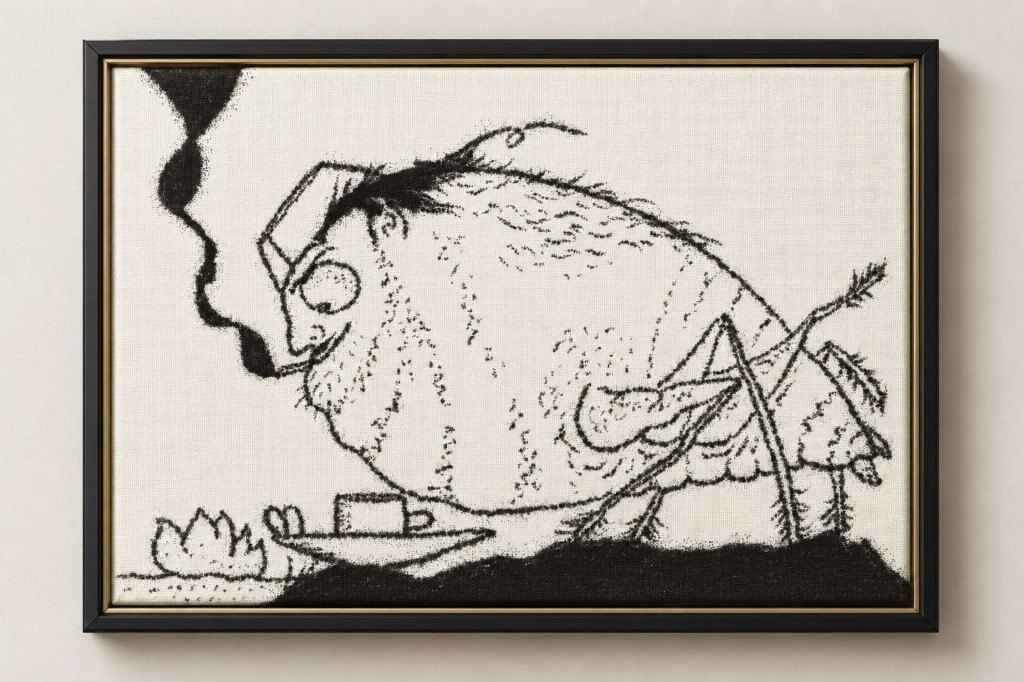
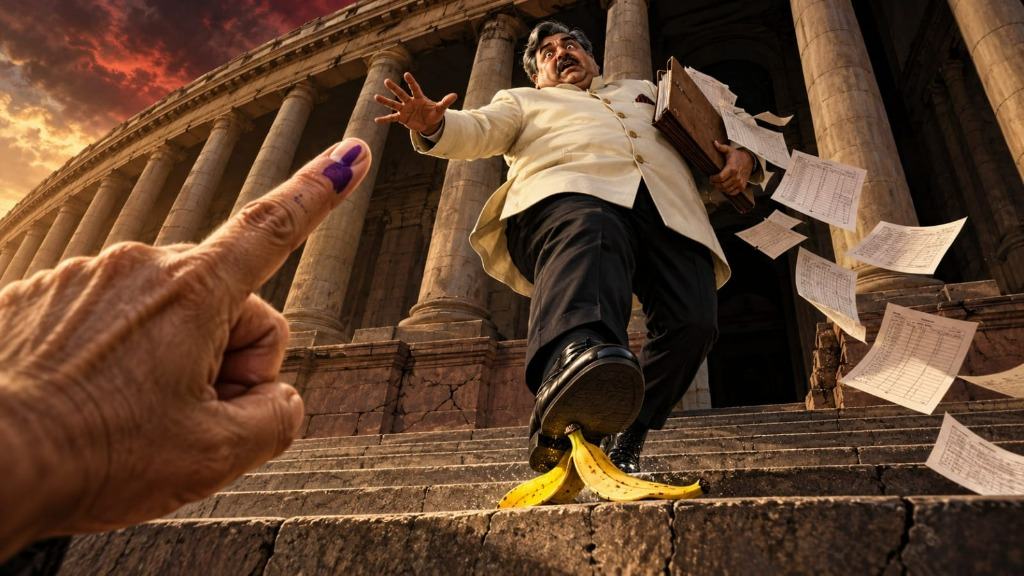
Triple T sounds like a tea stall in the Parliament canteen, where the leaves are boiled until they confess their colonial crimes. Truth, Transparency, and Trust. Three respectable words, washed, ironed, and photographed beside a smiling child holding a digital tablet. In the digestive system of our republic, however, they have encountered the Three Fs: Fear, Falsehood, and Favoritism. The Fs do not debate the Ts. They eat them. Slowly. With pickle. Then they issue a statement congratulating the meal on its contribution to nation-building.
I am fifty-one, Bengali, and living alone in a rented room in Calcutta, a city where shouting at a wall still qualifies as cardiovascular exercise. My lack of a steady income has made me attentive to the difference between prosperity announced and prosperity received. National greatness arrives on my screen with excellent lighting. The rent remains aggressively local. From this modest observation post, I watch Fear discourage questions, Falsehood supply the answers, and Favoritism distribute the dessert.
It looks like a food chain. We keep being congratulated on our place at the table. Someone should explain why we are lying on it.
Truth has a troublesome habit. It asks to see the paperwork.
You can drape it in a flag, apply sandalwood paste to its forehead, and announce that it has been personally blessed by five thousand years of civilization. It will still want the denominator. How many jobs, over what period, measured how? Which expenditure, approved by whom, benefiting whom? I have worked with data long enough to know that an impressive number without its definitions can be a particularly well-dressed turd.
Under Modi, the trick has been to make the questioner’s loyalty more interesting than the question. Ask about a failure and suddenly you are required to explain your relationship with Pakistan, your feelings about the army, and whether your grandfather once smiled at a communist. The original subject quietly leaves through the back door. The television panel spends the evening searching your trousers for a foreign hand.
Fear, the first F, handles the housekeeping.
It can arrive as a police case, but it also works through anticipation: the editor calculating what an investigation might cost the publication, the professor considering how much trouble a sentence could cause, the ordinary person deleting a post because there is a job, a family, or an already precarious life to protect. The most economical censor is the one installed inside your own head. No salary. No pension. You do the work yourself and call it being sensible.
Human Rights Watch’s 2026 India report describes the use of criminal law against peaceful speech and financial investigations against political opponents. Fear acquires substance when people can point to what happened to someone else. The demonstration has been provided. The rest of the audience is expected to understand.
Your phone does not have to be listening at every moment. Uncertainty can do much of the work. You begin rehearsing the explanation before you have written the sentence.
I understand that arithmetic. When money is scarce, trouble is expensive. Courage does not come with a reimbursement form.
Falsehood, the second F, supplies something comfortable to put in the space where the question used to be.
It is the prolific mother of a million forwards, the warm blanket for the intellectually hypothermic. It offers the reassuring discovery that the cause of your present difficulties lives in another community, another country, or another century. The unemployed man receives an enemy. The anxious man receives a conspiracy. The furious man receives permission.
During the 2024 election campaign, Modi claimed that Congress intended to select the Indian cricket team on the basis of religion. Human Rights Watch documented this among his false claims about the opposition and Muslims. Even the selection committee had to be conscripted into the communal circus. A country capable of arguing for a week about a cover drive was being invited to fear a theological batting order.
The lie need not survive examination. It needs to survive until it has done its work. By the time the correction arrives, the original has circulated, acquired emotional ownership, and become somebody’s test of patriotism. Correcting it feels like insulting the person who forwarded it, who now has to choose between admitting a mistake and declaring you an enemy of the nation.
The nation is a very convenient place to hide an embarrassed ego.
Then comes Favoritism, the third F, smelling faintly of expensive upholstery and other people’s obligations.
Its most useful gift is selective gentleness. Who gets pursued? Who gets time? Whose explanation is accepted? Whose unanswered question becomes a national scandal, and whose file settles into a comfortable administrative coma?
In April 2024, The Indian Express examined cases around twenty-five politicians who had moved into the BJP camp, including its allies. It reported reprieve in twenty-three: three cases closed and twenty stalled. Agency officials defended their work as evidence-based and said open investigations could still proceed.
Very well. Explain the pattern. Reciting an agency’s job description is not an answer to a question about its conduct.
The opposition’s “washing machine” joke has a brutally efficient premise: a politician goes in carrying allegations and comes out wrapped in the national interest. The public is then invited to admire the detergent. Whether an individual is guilty remains a matter for evidence and law; the political question is why investigative urgency so often appears to have a party preference.
Favoritism need not reward belief. It can reward obedience. A cynic who knows exactly what he is repeating may be more useful than a fool who believes it. The fool occasionally becomes disappointed. The cynic sends an invoice. Somewhere between the two stands the professional arse-licker, describing the taste as civilizational renewal.
Meanwhile, Transparency has been standing outside with a visitor’s pass that expired during the first security check.
Consider PM CARES. It has published audited financial statements. Its own website identifies an independent auditor. The sharper question concerns the gap between its public identity and the accountability the public can demand. The Prime Minister chairs it; senior Union ministers serve as trustees. Yet the PMO has argued in court that it is not a public authority under the Right to Information Act.
The prime ministerial identity fills the donation bowl. The legal distinction stands beside the bowl holding a lid.
An audit and a right to obtain information perform different jobs. A published statement does not, by itself, answer every question about a fund’s decisions. The document can be useful and the demand for fuller scrutiny can remain perfectly legitimate. This should be an unremarkable sentence. In our political climate, even basic distinctions arrive carrying their own riot shield.
Then there were electoral bonds, the grand experiment in making political money cleaner by making its route harder for voters to see. The government defended the scheme as a way to move donations through banking channels and curb unaccounted cash. On February 15, 2024, the Supreme Court struck it down, finding that the concealment of political funding violated citizens’ right to information.
The purchasing bank held records. Parties received money. The voter was expected to exercise informed judgment without being allowed to inspect a crucial part of the information.
A splendid arrangement. Please evaluate the menu. The kitchen is a matter of national privacy.
That judgment was a real check on power. It also exposed the absurdity of a system in which citizens needed years of litigation to recover information the government had helped place behind a curtain.
Modi answered journalists’ questions at the White House alongside Joe Biden on June 22, 2023. An encounter with questions should hardly need to be exhibited like a rare postage stamp. The problem is the rarity of sustained, open questioning and the preference for communication whose terms the leader controls. Accountability ought to be a habit, not a commemorative event.
Mann Ki Baat gives us the Prime Minister’s thoughts. I am more interested in what happens when someone interrupts the thoughts with a document.
That is the awkward bit. A document cannot be soothed by a camera angle. A follow-up question has the vulgarity to remain unsatisfied after the applause.
Trust, the final T, gets dragged into this arrangement by its collar.
Trust is what becomes possible when statements can be checked, mistakes admitted, and wrongdoing investigated without consulting a membership register. Remove those conditions and demand the same confidence anyway, and you are asking for surrender. The citizen is expected to trust, discouraged from verifying, and required to applaud the inconvenience.
I already know what it feels like to live with uncertainty. I do not need the government adding a patriotic surcharge.
I have bipolar depression. Much of its reality for me is persistent heaviness, anxiety, and the exhausting difficulty of getting ordinary life moving. Money troubles do not wait politely for the illness to subside. They drag a chair next to the bed and start reading out figures. There are days when managing my own mind consumes energy I cannot afford to spare.
I can be ill, broke, and thoroughly unimpressive while still being entitled to an answer from the people who govern me. Citizenship does not require a successful résumé. Accountability is not a premium subscription available only to people whose lives have worked out.
When I support a protest, I do it through my writing, from the room I can afford to occupy. I am not marching down a boulevard in a heroic cloud of tear gas. I am at a keyboard, trying to get a sentence straight while my own thoughts make a racket. The government’s obligation to answer survives my inability to attend in person.
The Three Fs reinforce one another. Fear reduces scrutiny. Reduced scrutiny gives falsehood room to spread. Falsehood supplies excuses for intimidation and preferential treatment. Favoritism rewards the people and institutions willing to circulate those excuses. Their success teaches the next person what to repeat and what to leave alone.
You do not need a secret meeting to keep every participant synchronized. Careers, access, money, and the example of someone else’s punishment can provide an adequate timetable. People learn where the rewards are. They learn where the teeth are. Eventually, the machine can run through anticipation.
In Calcutta we have a useful word: gondogol. Trouble, confusion, a mess. At Shyambazar, you can at least see the vehicles contributing to it. The national version comes with a broadcast explaining that traffic has never moved more efficiently. You are stationary, inhaling exhaust, while an anchor congratulates you on the speed of your journey.
You point out the blockage.
He asks why you hate roads.
This is the intimate obscenity of the arrangement: its attempt to make you ashamed of noticing what is happening to you. Your difficulty finding work becomes insufficient optimism. Your demand for evidence becomes arrogance. Your objection to communal hatred becomes hostility to the majority. The injury acquires a public relations department, and the injured person is asked to apologize for the tone of the complaint.
We are told to think of the nation as a mother. Fine. Then explain why the men claiming to speak for her keep treating the household accounts as their personal underwear. Why does asking who ate the groceries require a certificate of filial devotion? Why is the child asking for dinner accused of insulting the kitchen?
The Three Ts are ordinary requirements. Tell us what is true. Let us examine what you have done. Give us reasons to trust you. No celestial achievement is necessary. Most of us would settle for an answer that survives the second question.
Instead, the Three Fs offer a more comfortable settlement for power: be afraid, repeat the story, and learn whom to please.
My rented room remains a rented room after I finish typing. The money problem is still waiting. Outside, Calcutta gets on with its enormous arrangements for celebration, and inside I have managed to produce another page of objections that will not pay for dinner. The republic is unlikely to lose sleep over it. I probably will.
But the question is still here.
Who benefited? Who decided? Where is the record? Why should the person asking be made to feel like the criminal?
From somewhere inside the republic’s enormous, self-congratulatory stomach comes the command to stop making unpleasant noises.
Apparently the meal has begun asking for the bill.
Word Cloud
Related reading
Selected by shared topics and section, with closer publication dates breaking ties.