The Last Supper of Calcutta
Uses the speech voice supplied by your browser or device.

THIS IS A WORK OF FICTION
The first time the noodle divided, Dr. Arup Sen was standing naked in his kitchen at three in the morning, holding a stainless steel bowl under the tap and laughing so hard that he nearly dropped it.
He had slept in scraps for nine nights. His eyes had acquired a delicate red embroidery. His mania had a texture now: beeswax under the skin, warm and pliable, through which his thoughts passed with the magnificent ease of things that had not yet encountered consequences. From the corner of the lane he could hear the dhaak, although Puja was three weeks away and the pandal was still bamboo, tarpaulin, and a sleeping dog.
The noodle lay in the bowl.
Pale. Slightly translucent. The sort of thing a man might swallow without consulting his conscience.
He turned on the tap.
The strand thickened. A groove opened along its length. For an instant the two halves clung together by a membrane so fine that it caught the kitchen light like saliva between separating lips.
Then there were two.
Each was as thick as the original.
Arup stopped laughing.
He weighed them. He checked the bowl. He checked the scale with a coin, then another coin, then his mother’s wedding ring.
He put the noodles back under the tap.
Four. Eight. Sixteen.
The bowl began to move in his hands.
When he set it down, the strands shouldered over the rim and fell onto the floor with the heavy, intimate sound of someone dropping a wet organ into a basin. Water splashed them. They opened lengthwise. Opened again.
He shut off the tap, dragged a towel through the puddle, and watched the towel begin to bulge.
Only when he spread everything beneath the hot blast of his old room heater did the movement gradually stop. The pale tangle stiffened. Its edges curled. It became something that could be sold by weight.
Arup stood over it, naked and shivering, and experienced the first true erection of his intellect in six years.
“It works.”
He looked for the fork he had dropped. Only the end of the handle showed through the stiffened towel.
Then he vomited into the sink.
For a moment, bent over the drain, he had understood something too large to hold in his head.
When he straightened, he had reduced it to a business opportunity.
His name had once appeared beneath the words Associate Professor at Jadavpur University. Now it circulated over departmental tea as a warning against becoming too interesting.
There had been the photosynthetic chicken proposal. There had been the sewage-to-perfume apparatus, which worked if one accepted that perfume could smell like a municipal dispute. There had been the sale of examination questions to finance unauthorized research.
“Genius does not wait for grants,” he had told the inquiry committee.
The committee had recorded this accurately. It was one of the few occasions on which his work had received the documentation it deserved.
He lost his laboratory, his students, and eventually his position. After the formalities, the university settled into the punishment he found least bearable: it continued without him.
For three years he had occupied a two-room flat in Jadavpur with his mother’s ashes in a brass urn and his Nobel acceptance speech in a drawer. The speech had grown longer. The money had not.
He had stopped taking his lithium months earlier. He said it made the world gray. Whenever anyone suggested that gray might be preferable to catastrophe, he explained that they had mistaken cowardice for stability.
He had been capable of lying when perfectly rested, too.
His mother had died of hunger when he was a boy. It had not been a famous hunger. No photograph, no commemorative statistic. Food had remained available in the shops. She had simply stopped being able to buy enough of it, and then she had stopped taking her share.
He remembered her watching him eat.
That was the memory he used whenever another memory threatened to become an accusation.
He called the noodle Annapurna-1.
The goddess of food.
He would end hunger. He would be rich. The people who had stopped answering his emails would have to stand when he entered a room.
The order of these ambitions changed according to his audience.
He had arrived at the first strand through a dream, an abandoned experiment, and a series of alterations he could no longer reconstruct. There had been flour. There had been a protein preparation. At some point, after breaking a sample tube, there had also been his blood.
His notebook contained a formula crossed out so violently that the paper had torn.
Underneath it he had written:
IT RETAINS THE PATTERN.
He could manufacture more of the original strand. He could not satisfactorily explain the original.
This seemed, increasingly, a problem for other people.
Over the next fortnight he established three things.
A fresh, wetted strand could divide in roughly half a minute.
Complete drying stopped it without killing it.
And a dried strand, once soaked again, usually took several hours to resume dividing. Four hours in one bowl. Nearly eight in another. Boiling softened it but did not reliably shorten the delay.
During those quiet hours it could be cooked, fried, seasoned, plated, and eaten.
He underlined this last observation twice.
Water disappeared during the divisions, but the quantities made no sense. A little liquid vanished; an indecent weight of new material appeared. In a crowded bowl, the outer strands swallowed the available moisture and left the packed interior motionless. Add another splash, expose another surface, and the movement resumed.
He could make it pause. He called this control.
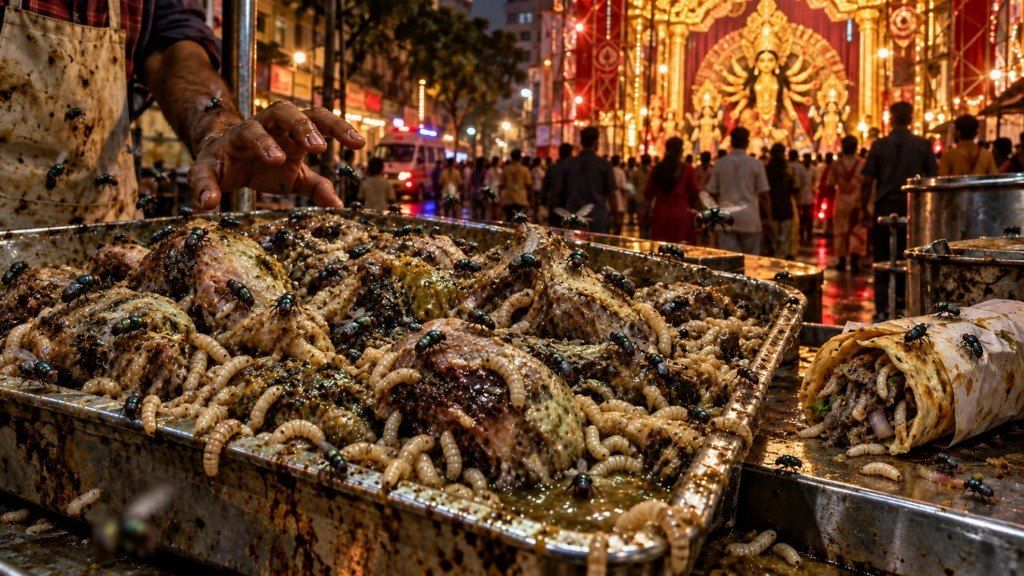
He hired a godown in Tangra and brought in drying trays, secondhand heaters, and three young men who had been promised a Puja bonus. They grew the stock in shallow batches, dried it brittle, and sealed it in clear plastic.
Bulk packing began on Shashthi morning. The packets bore a red sticker:
DOUBLE DELICIOUS. TWO FOR THE PRICE OF ONE.
His old contacts in the food business handled distribution. They remembered that he had once known useful people. More importantly, he could supply at a price that made useful people unnecessary.
The stall owners asked whether the noodles would hold up in a wok.
Yes.
Whether customers would complain.
No.
Whether he could deliver another hundred kilos by Thursday.
Certainly.
Nobody asked what happened six hours after lunch.
Arup had placed a sample in an acidic digestive mixture. He had removed it after twenty minutes, while it was still quiet.
The entry in his notebook said: NO ACTIVITY OBSERVED.
He knew how long he should have waited.
He closed the notebook.
On Shashthi night, the city became an electric mandala erected over its own faulty wiring.
Bamboo gates blazed. Loudspeakers competed across intersections. The air smelled of shiuli, diesel, damp cloth, and oil that had outlived several generations of potatoes. People stood in lines to see the goddess, then stood in other lines to eat beneath her temporary jurisdiction.
Across Rashbehari Avenue, Arup watched a family share his noodles.
The father drove a taxi. Arup knew because the man had parked it badly and kept looking over his shoulder. The mother wore a green-and-gold synthetic sari. Two children leaned over their plates, slurping with the solemn greed of people who had been allowed something better than dinner at home.
The father lifted a forkful toward his wife.
She shook her head.
He insisted.
She ate.
Arup looked away.
In his pocket was a folded sheet of paper.
Two hundred grams. Four hundred. Eight hundred. One point six kilograms.
He had stopped writing after that. There was no point at which the sequence became reassuring.
But the stomach was not a bowl. There were enzymes. There was movement. There were mechanisms he had not accounted for.
He held on to the word mechanisms all the way home.
At four in the morning, his phone rang.
A woman asked whether he was the manufacturer.
He said yes.
“My husband cannot get his trousers off.”
Arup said nothing.
“The button has gone inside him. The skin has grown over it. Please tell me what was in the packet.”
He could hear the husband in the background.
A low sound, interrupted regularly by an involuntary grunt.
Like someone trying to lift an enormous weight without waking the children.
By dawn on Saptami, the emergency department at SSKM had run out of places to put people who were getting larger.
They arrived in taxis, auto-rickshaws, private cars, and on foot, supported between relatives. One man had been brought on a wooden door. His friends had been unable to lift him onto anything narrower.
At first they complained of fullness.
Then pressure.
Then movement.
Dr. Priya Chatterjee put her hand on the taxi driver’s abdomen and felt something slide away beneath it.
She had expected gas, fluid, an obstruction. She pressed again, gently.
Something gathered under her palm.
His skin was stretched so tightly that the old appendectomy scar looked like a strip of clear tape. Sweat collected in the hollow above it. As she watched, the hollow flattened.
“How long?” his wife asked.
Priya looked at her.
“Before you can make it stop?”
The man’s lips moved.
Priya bent closer.
“Don’t push them back.”
His navel turned outward.
Slowly, almost delicately, it became a pale little knob. A red bead formed at its center. The bead ran down his belly, leaving a thin line.
The line opened.
His wife reached toward him before anyone could stop her.
The first strand came through against her fingers.
It was warm enough to steam in the air-conditioning.
Then the abdominal wall tore from the old scar upward with a series of small, separate sounds, each one audible beneath the shouting. His hospital sheet rose. The skin at his sides drew inward, pulled toward the opening, and a dense white rope forced itself out, glossy with blood.
It separated as it fell.
Two ropes struck the trolley.
Four reached the floor.
The smell was wet flour, stomach acid, hot copper. Priya could still smell the chili sauce.
The man was trying to breathe. Each effort drove another bundle through the tear. His ribs lifted visibly beneath the skin, then one side of his chest settled at an angle it had not possessed before.
His wife kept saying his name.
At 6:14, the monitor lost his pulse.
His jaw continued to work.
Priya noticed this. Later, when there was time to be afraid of something besides the floor, she would remember that his jaw had continued to work.
A ward attendant pushed a mop into the spilled mass.
The bucket overturned.
The white tangle rose around the mop head, swallowed the handle to the man’s knuckles, and opened across the tiles.
“Leave it,” Priya shouted.
He pulled harder.
The trolley skidded sideways. Its wheel struck the pipe feeding a washbasin. The pipe broke at the wall.
Water jetted into the room.
For several seconds they watched an impossible amount of material come into existence.
Then the first trolley began to float.
Priya got six patients into the corridor before the doorway clogged.
The seventh was a woman holding both hands over her mouth.
Priya thought she was trying not to vomit.
Then something white appeared between her fingers.
The woman shook her head violently. Her cheeks inflated. A strand slipped from one nostril and curled against her upper lip. She tried to suck in a breath through the same nostril.
Priya caught her as she fell.
By the time the orderlies dragged Priya away, the woman’s hands were still clamped over her mouth, and the material was lifting her fingers one at a time.
In a dry specimen jar, a sample stopped moving.
Priya added a little saline.
It began again.
She photographed it, dictated a warning, and sent it to every clinical group on her phone. Keep the material dry. Keep it away from drains. Do not wash it away.
Downstairs, someone had already begun washing it away.
The hospital’s drains carried fragments into the sewers.
Outside, the first hard rain of the morning struck the pavement.
The storm settled over Calcutta as if it had rented the place.
By noon, water stood axle-deep at intersections. By afternoon, the white material was coming out of manholes under enough pressure to lift the covers. It climbed steps because more of it kept arriving behind. It entered shops beneath shutters. It packed itself into ground-floor rooms and rose around the furniture.
People beat it with bamboo poles.
Each broken piece lay still until water reached it.
Then each broken piece became a beginning.
A sweet shop owner turned his hose on the advancing mess. He was still holding the hose when his counter came away from the wall.
In a flooded lane, a man tried to wade home with a plastic bag of medicines between his teeth. Witnesses saw him stop. He looked down. The surface around his legs thickened, and he began lifting one knee, then the other, with the exaggerated care of someone walking through glue.
A minute later only his head showed.
He did not sink farther.
The white surface rose past his mouth.
Above him, on a balcony, his wife threw down the end of a sari. It landed within reach. He got his fingers around it.
When she pulled, the fingers came up still holding the cloth.
The hand had opened along its length.
By evening, floodwater was entering underground passages and service shafts. The trapped air came out of stairwells in great foul belches. In places the street seemed to breathe.
A government spokesperson described the outbreak as a “localized, noninfectious carbohydrate event.”
The phrase appeared beneath footage of a bus being forced sideways through a pharmacy.
A committee was constituted.
Its members were asked to join remotely.
Three did not answer.
Arup made calls until his phone became hot.
He called the wholesalers. He called the university. He called a number printed on a food-safety notice and listened to recorded instructions about the information required to register a complaint.
He filmed a confession.
In the video he looked exactly like a man claiming responsibility for something he had seen on television.
Some people laughed. Some accused him of seeking publicity. Others demanded his address.
Priya saw the video after midnight.
She called him.
“Does drying destroy it?”
“No.”
“What destroys it?”
He began telling her about the original preparation.
“What destroys it?”
“I don’t know.”
For a few seconds she said nothing. In that silence he heard hospital noise, someone crying, a metal object being dragged across a floor.
Then she asked, “Did you know it could survive cooking?”
“Yes.”
“And you sold it.”
He put his hand over his mouth.
She waited.
He could not produce a sentence she had not already understood.
There were things that worked.
This was one of the cruelties.
Fire destroyed material that it burned completely. Dry heat immobilized thin layers. On an exposed rooftop, a patch could harden and become safe enough to walk across.
Men cheered.
Then rain entered a crack in the crust.
Underneath, the wet material began dividing again. The blackened surface lifted in plates. What had looked like scorched ground rolled back, exposing a pale interior crowded with movement.
The firefighters withdrew from one street only to find that the lane behind them had filled.
Water was shut off where valves could still be reached. It continued coming from ruptured mains, rooftop tanks, drains, flooded basements, the sky.
Salt failed. Disinfectants failed. Mechanical clearing made smaller pieces and carried them farther.
The river took whatever reached it.
Rescue boats stalled when the strands wound around their propellers. Oars worked longer. Then an oar brought a little wet material aboard, and the boat acquired more cargo than it could float.
Arup watched until the electricity failed.
Before the screen went black, a newsreader said that the affected area was still being assessed.
He had been doing the same thing.
One strand doubling every thirty seconds would become 2^120 strands in an hour, if every daughter strand remained equally wet and free to divide.
He knew that this was not what happened in the streets. Growth choked itself. Water failed to reach the compressed interior. Dry layers formed. Whole banks lay motionless until a pipe burst, a wall gave way, or rain exposed another surface.
The city was being filled by a succession of pauses.
Each pause looked enough like an ending to make people come down from the roofs.
By Ashtami, the drums had stopped.
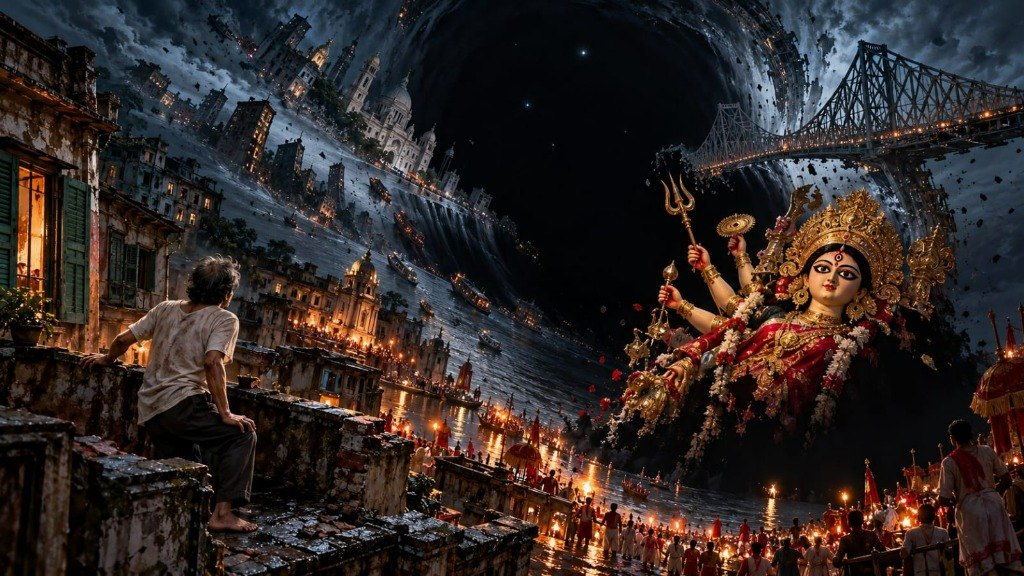
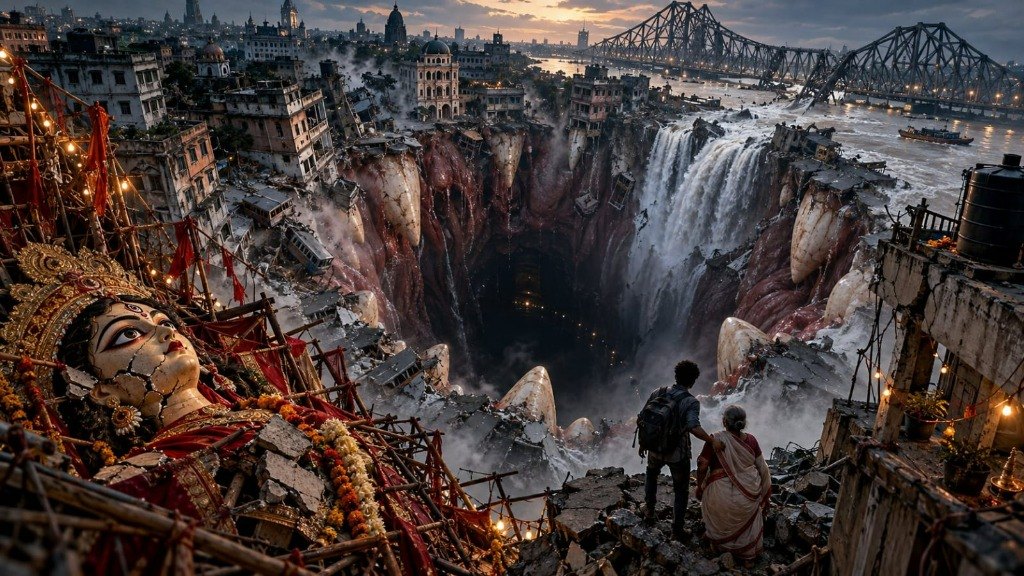
In one pandal, the goddess remained visible above a white bank that had swallowed her lion. The clay demon’s face protruded several feet away. Water seeped into the paint. One eye slipped down his cheek.
From an upper window opposite, a family watched Durga tilt.
Her supporting frame gave a series of dry cracks.
She leaned forward, all ten hands extended, and went face-first into the material.
The family withdrew from the window.
They had been watching for a sign.
On another roof, volunteers opened a sack of dry clothes for evacuees. Pale dust rose from the folds.
One volunteer sneezed.
Nobody understood the significance yet.
The last widely relayed video from central Calcutta came from a young woman named Riya, on the roof of the Tata Centre.
She was twenty-two. She had not eaten the noodles. She explained this several times, as though someone watching might still be investigating eligibility.
She had eaten biscuits. She had drunk from sealed bottles.
But that morning she had helped pull a woman out of floodwater. Later she had wiped her mouth with the back of the same hand.
Now she could feel something behind her teeth.
The camera showed a white plain interrupted by the upper floors of buildings. Nearer the river, darker ridges moved through it, carrying sections of roofs, tangled cables, a billboard advertising a buffet.
It was still possible to recognize parts of the city.
This made it worse.
“There are people underneath,” Riya said.
She held the phone over the parapet.
For a moment there was only the sound of wind.
Then a voice rose from somewhere below.
Not a word. A wavering vowel.
Another answered farther away.
The sound traveled across the buried street, thin and human and coming from places where no human chest should have had room to expand.
“They’ve been doing that since morning.”
She turned the camera toward herself. One side of her lower lip had thickened. When she spoke, a white thread stretched between her gum and the inside of her cheek.
She pinched it.
Her eyes widened.
She pulled, very slowly.
The skin beneath her eye moved.
Riya let go.
For the first time in the recording, she began to cry.
“Please don’t tell my mother I ate anything.”
The image jolted downward. Her phone struck the concrete and continued transmitting.
For several seconds, a small white strand lay beside the lens.
A drop fell onto it.
The picture froze before it finished dividing.
On Navami, the material reached Arup’s landing.
He had sealed the drains and pushed towels under his door. When the first dampness came through, he replaced the towels with fresh ones. He had no gloves.
He had filled bottles while the taps still ran clear. The bottles stood around the kitchen like witnesses he had bribed.
The city outside made a continuous low noise.
Once, when a particularly deep tremor passed through the building, every bottle quivered at the same time.
Arup climbed onto the counter.
The skin beside his thumbnail had split that morning while he wrestled a cupboard across the doorway.
Now the edges were white. The paleness extended toward his wrist in two fine parallel lines.
He pressed them.
Something slipped beneath the skin.
He remembered lifting the wet towel an hour earlier.
He remembered the sting in the little wound.
The realization was almost a relief. At last there was a small, comprehensible chain of events. Something he had done with his hand and his mouth. Something that had happened to him.
He peeled back the loose edge of skin beside the nail.
A thread emerged.
It remained attached somewhere deep in his thumb.
When he pulled, he felt the movement in his forearm.
Arup stopped.
Beneath the door, a pale loop appeared. It flattened against the threshold, thickened, and divided. More followed. The towels rose.
He held his mother’s urn against his chest.
Outside, something large broke. The building lurched. Water ran beneath the door, and the loops spread across the floor, opening into a thick, softly clicking carpet.
“Mother,” he said.
He had expected the word to summon a memory.
Instead it summoned a sensation: the old shame of eating while she watched.
His abdomen tightened.
His left hand, resting on the urn, developed a crease from wrist to middle finger.
The crease deepened.
His fingers moved apart.
He could feel both sides.
Arup tried to lift the hand. Two incomplete hands lifted, joined at the heel, each with the same old burn near the knuckle.
He understood then that the process was keeping more than the shape of a noodle.
On Dashami, the expanding banks reached the estuary in force.
There had already been fragments farther downstream. Now the fresh water met the brine beneath a continuous pale skin.
The salt changed nothing.
From the last aerial images, the coastline looked as though someone had lifted its edges and packed wet cloth underneath.
Ships carried strands in their intakes. Floods carried them through fields. Wind tore dried fragments from exposed ridges and lifted them into the air. Rain caught the fragments and brought them down elsewhere.
Nothing needed to evaporate into a spore.
It only had to become small enough to travel.
The first distant outbreaks appeared before officials agreed on what to call the original one.
A drain in another port backed up.
A cleaner swept pale dust from a loading bay.
A woman rinsed something from her eye.
People shared the Calcutta videos underneath the new footage. Some insisted that the clips were old. Some said the timing was suspicious.
Then the local hospitals began asking the same questions.
Had you eaten noodles?
Had you touched floodwater?
Had you been anywhere near it?
Eventually there was no useful distance implied by near.
Dry regions held out. Sealed buildings held out. People learned to regard a working tap with the terror previously reserved for a gas leak.
Winter immobilized whole fields of it.
Spring found them.
The blackened districts bloomed white again.
Arup did not know any of this.
He could no longer distinguish the kitchen from the rest of the building. Pressure came from every direction. At intervals something shifted and gave him enough room to attempt a breath.
Then the space filled.
He could still feel his mother’s urn.
Or the shape of it remained where his hands had been.
His body had opened in so many places that he had lost the ability to locate an injury. The pain had become a geography. There were regions in which he felt his teeth, regions in which he felt the stretched skin of his stomach, a distant burning that might have belonged to a foot.
He waited for unconsciousness.
It came close. He felt himself falling toward it.
Then some new division would occur, and the sensation of being Arup Sen would return, fresh and complete.
He heard other people.
At first he believed the sound traveled through the mass. Eventually he understood that he was feeling their attempts to speak.
A woman was trying to tell someone where she had left a key.
A man kept apologizing for being late.
Somewhere close by, close in a way that no longer required bodies to occupy neighboring places, someone was still calling for a doctor.
The process retained the pattern.
He had written that down.
He had believed it applied to food.
Water found another channel. The pressure changed. Something passed through him with the slow, tearing intimacy of a hand separating wet pages.
For a moment he remembered being a boy at the table, his mother pushing the rice toward him.
Then he remembered it twice.
Two kitchens. Two plates. Two mothers pretending they were not hungry.
Two perfect recollections, each belonging to someone who knew he was the original.
Arup tried to scream.
Both of him tried.
There was another division.
Now four men remembered inventing the noodle.
Four men wanted to die.
The rain kept falling.
Word Cloud
Related reading
Selected by shared topics and section, with closer publication dates breaking ties.