Dashami: The City That Darkness Ate
Uses the speech voice supplied by your browser or device.

THIS IS A WORK OF FICTION
The floor of Debabrata Sanyal’s bedroom was warm, and that was wrong, because the floor had never been warm at this hour in the fifty-one years he had lived in this house, not even in May when the Calcutta heat turned the upper story into a kiln, and the warmth was coming up through his bare feet in pulses, like something breathing through the tiles.
He got up to turn on the light.
Halfway across the room, his foot caught on something.
He stumbled, struck the almirah with his shoulder, and stood there holding it. There was nothing on the floor. He passed his foot over the same patch of tile. Nothing.
Then the ceiling fan stopped. The refrigerator downstairs stopped. The green LED on the mosquito repellent winked out. The whole house went dead at the same instant, as if someone had unplugged the world.
In the corner, where the almirah cast its usual shadow, something moved.
There was no light. That was the problem. The streetlamp outside had died with everything else, and yet the shadow was still there, darker than the dark around it, moving the way a sleeper moves under a sheet, slow and tidal and wrong.
Debabrata’s left hand began to shake. He knew this shake. It came when he had been frightened and sleepless for too long, when every small thing began to feel like the first announcement of something worse. He had lived with bipolar depression since nineteen. He called it the tenant, and he knew better than to mistake a quiet spell for an empty house. He pressed his hand against his thigh and made himself breathe the way Dr. Sen had taught him. In for four. Hold. Out for six.
The shadow stopped moving.
Then it turned toward him.
He did not see it turn. There was nothing to see. But the skin on the back of his neck tightened, and his scrotum drew up, and every hair on his arms stood at attention, because something that had been facing the wall was now facing him, and it was aware of him the way a tongue is aware of a tooth.
He ran. He did not decide to run. His body simply left, down the stairs two at a time, into the kitchen, where he fumbled for the emergency lantern under the sink and knocked over a bottle of mustard oil. He slipped in it, landed on his hip, and felt the oil spreading under his palm.
The lantern would not turn on. The batteries were new. He had changed them last week.
From upstairs came a long, slow inhalation, except it came through the ceiling, through the wooden beams, through the bones of the house, and the warm pulsing under his hand accelerated.
He understood with a clarity that felt like being struck that the house was not his house anymore, that something had come into it, or had always been in it and had only now become interested in him.
He sat on the kitchen floor in the spilled oil until dawn.
When the sun came up, the electricity came back. The refrigerator hummed. Upstairs, the fan started. The shadow beside the almirah was ordinary again, and the floor was cold.
His little toe had swollen purple.
He called Dr. Sen at eight.
“I think I’m having an episode,” he said.
“Tell me what you’re experiencing.”
The calm, worn voice of a man who had been taking these calls for thirty years.
Debabrata opened his mouth to describe the warm floor, the dead batteries, the shadow that turned.
What came out was: “I can’t sleep. The noise from the pandals.”
He hated himself for the lie even as he spoke it. But the shame was old, the shame of being the broken Sanyal, the one who had to be managed, medicated, forgiven. His mother had died apologizing for him. After their daughter’s death, he and his wife had spent four years speaking mostly about bills. When she finally left, eleven years into the marriage, the last thing she said was not cruel, which was worse.
“I am so tired, Deb.”
She said it the way you say it to a leaking roof.
“Use the lorazepam as prescribed if you need it,” Dr. Sen said. “And call me again this evening. Don’t wait if things get worse.”
It was Shashthi. The city had already begun to roar.
Debabrata went out because staying in the house was impossible, and because he needed to prove to himself that the world was still the world. He walked down Cornwallis Street toward the pandal at the crossing, and the crowd carried him like a blood cell in an artery, and the dhaak was so loud he could feel it in his molars.
The pandal was shaped like a giant lotus made of LED strips. Inside it, Durga stood ten feet tall, all gold and vermilion, her weapons raised, one painted pupil sitting slightly closer to the bridge of her nose than the other. Debabrata stood before her and felt nothing, which was its own small death.
He had loved this once. As a boy, he had run through these streets with his father, collecting money for the neighborhood pandal, drunk on noise and belonging. Now the noise was just noise. The belonging was a room he had been locked out of.
A child tugged at his hand. A little girl, maybe six, in a red frock, holding a paper flag.
“Uncle,” she said. “You dropped this.”
She held up a photograph.
His house. The peeling green paint, the balcony, the iron railing his grandfather had installed. He recognized the angle because he had taken the picture himself, last year, on his phone, to send to his sister in Toronto. The blurred edge of his thumb intruded at the lower left.
He had never printed it.
And the house in the photograph had three stories.
His house had two.
The third story jutted up from the roof like a rotten tooth, its windows black, its walls made of something that was not brick. One corner seemed to recede behind the building while the other hung out over the street. He could not make the two corners belong to the same room.
“Uncle?”
He took the photograph.
“Where did you get this?”
She pointed at the ground. “There.”
Trampled flowers. Discarded plastic cups.
When he looked up, she was gone, swallowed by the crowd, and the dhaak beat on, and the photograph in his hand was warm.
He went home.
Across the road, he stood comparing the photograph with the house. Two stories in front of him. Three on the paper. On his phone, the original picture still showed two.
He climbed to the roof. The water tank stood on its concrete plinth. There were cracked tiles, a broken flowerpot, the clothesline. Nothing above him but sky.
In the photograph, the third story cast a shadow on the street.
That evening he called Dr. Sen again. This time he described the photograph. The doctor asked him to send both versions. Debabrata sent the old image and a picture of the print.
“They look the same to me, Deb.”
He checked what he had sent.
Both showed two stories.
The paper lying on his knee showed three.
That night he took his regular medication but left the extra sedative in the bathroom cabinet. He wanted to stay awake. He set his phone on the dresser and recorded the corner of the bedroom.
Nothing moved.
At 3:17 a.m., the screen went black.
The phone restarted when he picked it up. The recording had become eleven seconds of static, and underneath the static was a long, slow inhalation.
From the corner came the same sound.
A moment later.
On Saptami, the house across the road disappeared.
Debabrata was eating breakfast, luchi and aloo dum, made by the woman who came in the mornings and left by noon. He knew her schedule. He could not, just then, remember her name.
He was about to ask when he heard a sound like a sheet being torn in half, except the tear was in the air itself, and the warm pulsing came up through the floor, and the woman screamed.
He ran to the front window.
The house across the road was gone.
Not demolished. Not burned. Gone.
The space where it had stood was covered with grass that looked as if it had been growing there for years.
Mr. Bhattacharya was walking toward it. Seventy years old, white vest, walking shoes, the little towel he carried over one shoulder. He had been on the pavement. Now the pavement curved into the grass, and he followed it.
His right foot went down.
His knee followed, although the ground had not opened. For a moment the rest of him kept walking, his body advancing over a leg that was no longer there.
The sound he made was like a word being pulled backward out of his mouth.
Then he was gone.
The grass lay flat. Morning traffic flowed past without slowing.
The woman beside Debabrata had stopped screaming. She was frowning.
“Wasn’t there…”
She shook her head.
“No. No, it’s always been like this.”
She went back to the kitchen.
He followed her.
“You screamed.”
“Did I?”
“When the house went.”
“What house, dada?”
She was washing his plate. Her hands moved steadily under the tap.
He spent the day trying to make somebody remember. He photographed the grass. The photograph showed grass. He asked the paan-wala how long the lot had been empty.
“Always, dada. Since before I was born.”
The paan-wala was forty.
Debabrata described the house, its red door, the blue plastic sheet over the balcony, the old woman who fed the crows.
The paan-wala listened with the strained politeness people used when they knew about him.
“And Bhattacharya?”
“Who?”
Others had seen. The woman had screamed. But whatever took the house had taken the fact of the house afterward, passing through the witnesses and tidying up.
It had missed something in him.
Or it had left something.
In the evening, the voices started.
They came from the walls, soft and conversational, like a radio playing in another room. He pressed his ear to the plaster in the hallway and heard his mother. She had been dead for nine years.
“Deb,” said the wall, warm and disappointed. “Why do you always make everything so difficult?”
He pulled away.
The voice continued at exactly the same distance from his ear.
He did not sleep. He sat facing the corner of his bedroom, and the dark watched back, and sometime before dawn a voice came from it that was not his mother’s.
It was his own voice, older, exhausted.
“You always forget. That’s the mercy of it. You always forget.”
On Ashtami, gravity failed.
Debabrata had packed a small bag. He was going to get to a railway station, buy a ticket, sit on whatever train would take him out. He could call Raka from somewhere else. He could call Dr. Sen. He could explain afterward.
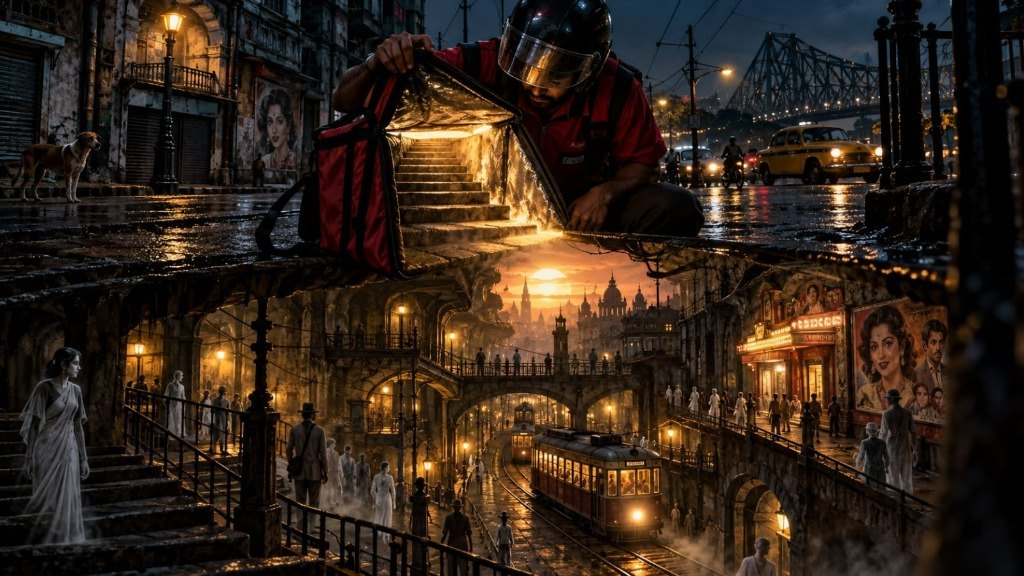
He was on the last flight of stairs down to the platform at Shyambazar when his weight began to drain out of him.
Around him, the crowd gasped.
A woman in a yellow sari rose off the steps, her feet pedaling air, her hands clawing at the railing. She missed it. She laughed, a high, hysterical laugh, because her body did not know what else to do.
Then gravity returned.
She fell.
Her head struck the edge of a step with the sound of a dropped pumpkin. A piece of tooth clicked past Debabrata’s sandal.
The crowd surged. He was carried down the remaining stairs and pressed against a pillar.
Across the tracks, a train emerged from the tunnel sideways.
The front of it moved along the platform while the carriages remained twisted into the tunnel behind it, windows sliding past windows, metal occupying the same space as metal. Through the glass, the passengers were visible. They were all looking at the same place on the ceiling.
They were all smiling.
The train went into the far wall. Tiles bulged around its windows, closed over them, and became tiles again.
Silence.
Then a child began to cry.
A man beside Debabrata checked his watch.
“The Metro is so unreliable these days.”
On the stairs, a station employee put a plastic cone beside the woman in yellow.
“She slipped,” he said.
He stepped over her hand.
Debabrata went back aboveground. He walked home because he could no longer make himself enter anything that went beneath the city.
Twice he saw shadows detach. A man’s shadow stepped off the pavement and walked in the opposite direction. A dog’s shadow stayed sitting after the dog moved on.
Above the rooftops to the west hung a perfect circle of night. The rest of the afternoon was bright and hot. Inside the circle were stars in arrangements he did not recognize, and as he watched, one star moved behind another and came out larger.
He looked down. His nose was bleeding.
At home, the woman was in the kitchen, stirring a pot.
“I made your favorite,” she said.
He stopped in the doorway.
He had not employed anyone for three years.
Since his wife left. Since the money got tight. Since another person’s presence had become one more thing he could not afford, financially or otherwise.
There was no salary to remember. No spare key. No name.
Yet he remembered watching this woman wash his plate yesterday. He remembered her screaming. Both memories were intact. They simply could not occupy the same life.
“Who are you?”
She turned.
She had the suggestion of a face, the way a stain on a ceiling suggests a shape. Almost his mother. Almost his wife. Almost Dr. Sen. His eyes kept making a person out of her and losing the person before he could decide which one.
“You always forget,” she said.
He backed into the hallway.
When he looked again, the kitchen was empty.
The luchi on the plate were warm. He had not eaten since breakfast the day before. He could smell ghee, hot flour, his mother’s kitchen, a time when someone had wanted him fed without needing a reason.
He stood there for a long time.
Then he ate.
He hated himself for eating. The first piece tasted like nothing, like warm air, and when he swallowed, the movement in his throat continued after the food should have reached his stomach.
Down.
And down.
He put his hand against his chest and felt something pass beneath it, much deeper than the depth of his body.
He left the rest.
That evening he stood on the roof.
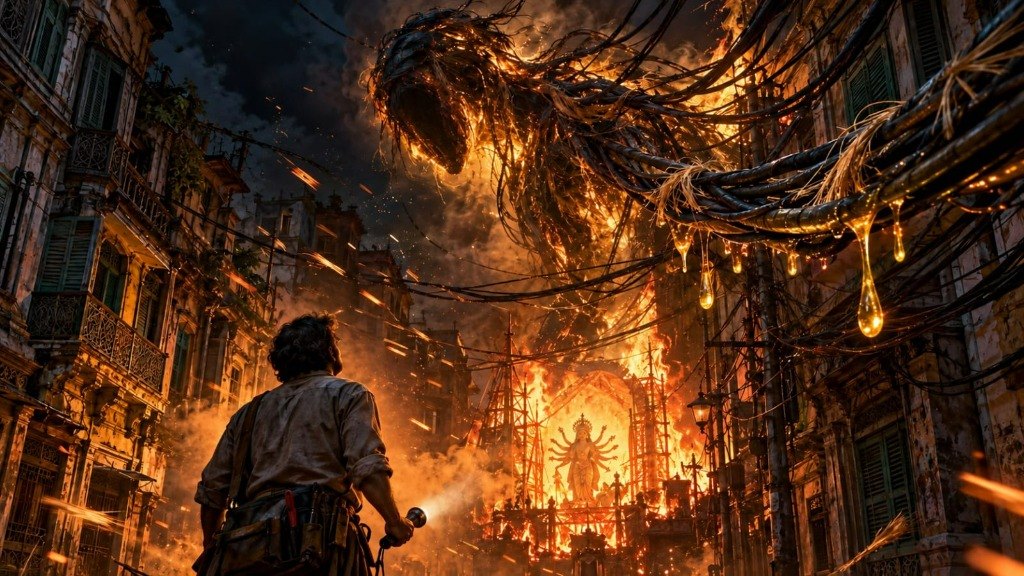
Darkness burned in different neighborhoods. He had no better word for it. Black shapes flickered above the houses, spreading from roof to roof, and wherever they passed, windows lost their reflections and balconies ended in soft, unfinished edges.
The dhaak came from everywhere.
The stars in the circle were arranging themselves.
His phone had three percent battery. He called Raka.
She answered on the fifth ring.
“Deb?”
Her voice was small and far away and precious.
“I need you to remember something. Our house. How many stories does it have?”
“What?”
“How many stories, Raka. Please.”
“Two. Why?”
“Say it again.”
“Two. Deb, what’s happened?”
He closed his eyes.
“Are you taking your medication?”
“Yes.”
This time he was telling the truth.
“I love you,” he said.
“I love you too. Listen to me. Go downstairs. Call Dr. Sen. I’ll call you right back.”
The phone died before he could tell her he was afraid to go downstairs.
For a moment he kept holding it to his ear.
Then, through the dead phone, Raka said:
“Don’t go up to the third floor.”
He dropped it.
On Navami, Kolkata broke into islands.
Cornwallis Street ended fifty meters from his house. Beyond it was an absence his eyes could not hold. The buildings on the far side were still there, their occupants standing at the windows, looking across.
One man raised his hand.
Debabrata raised his.
The man frowned at his own fingers, lowered them, and went inside.
The phone would no longer charge. The electricity came and went. Water from the tap ran black for a minute, then clear, then warm in little pulses.
Debabrata tried to leave again.
He packed bottled water, biscuits, his medication, the photograph. He stepped out, turned away from the broken end of the road, and walked toward the crossing.
At the crossing stood his front door.
He turned around.
Behind him, fifty meters away, the street ended.
He tried the lane beside the house. He tried going through the courtyard of the adjoining building. Each route brought him to his own door, with the same split in the green paint, the same rust around the latch, and once, through the upstairs window, he saw himself still approaching.
The other Debabrata looked down.
Neither of them waved.
He went inside and locked the door.
From the walls came his name. His mother’s voice, his wife’s voice, Raka’s voice. The city was calling him from all the places where it had learned how.
The eater had noticed him the way you notice a seed stuck in your teeth.
He sat in the corner of his bedroom, the corner where the shadow had first turned. Waiting was something he knew how to do. Waiting for the mood to lift. Waiting for the thoughts to stop. Waiting for sleep, forgiveness, a day that did not have to be survived by breaking it into smaller pieces.
In the afternoon, the dhaak changed.
The scattered rhythms gathered into one.
Every drum he could hear began beating together, slow and enormous, and the rhythm came through the tiles and the chair legs and the roots of his teeth. He pressed two fingers to his neck.
His pulse was trying to follow.
He took his prescribed evening dose with the last of the bottled water. He checked the empty compartment in the pillbox twice. The small familiar action steadied his hands for a moment.
Outside, something immense inhaled.
The curtains moved toward the window.
There was no wind.
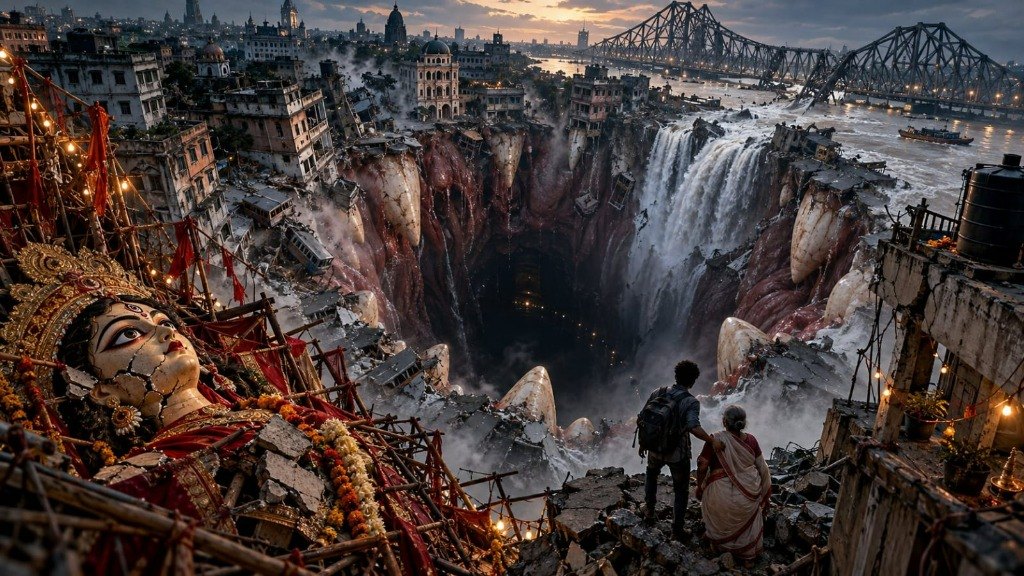
On Dashami, the city went to the river.
Debabrata climbed to the roof and found the Hooghly at the end of his street.
It should not have been visible from there. Whole neighborhoods should have stood between his house and that water. Now streets bent toward it from directions that made no sense. He turned east and saw the river. He turned south and saw it again.
The Howrah Bridge stood at the end of one lane. The white dome of the Victoria Memorial rose behind a row of houses that had never been near it.
The city was being folded small enough to fit.
Below him, processions carried the idols toward the ghats. Gaps in the roads closed beneath the approaching feet and opened again behind them. People held their children by the wrists. Men leaned into the weight of bamboo poles. The goddess from the lotus pandal came past, ten feet of gold and vermilion, her slightly misplaced pupil looking down at Debabrata’s door.
He shouted.
A man glanced up and smiled.
“Come down, dada. It’s time.”
The procession reached the water.
At the first ghat, the men lowered Durga until her feet touched the river.
The feet vanished.
The water did not rise around them. The clay did not soften. There was simply no longer anything below her ankles.
The men lowered her farther.
Her knees went. Her lion went. One arm, hanging low, ended cleanly at the wrist.
Then a man’s hand touched the surface.
He lifted his arm and looked at where his hand should have been. His mouth opened.
The man behind him pushed forward, still singing.
They went into the river shoulder to shoulder, and the river took them without a splash, taking the songs out of their mouths halfway through the words.
The people behind them kept coming.
Debabrata watched a woman lift a little boy onto her hip to keep his clothes dry. She kissed the side of his head.
Then the water reached them.
He tried to turn away. The river was on that side too.
It took the ghats. The steps. The buildings along the bank. The Howrah Bridge did not fall. Its steel members thinned, stretched toward the water, and ceased to connect.
As the city folded, each place came briefly into view, close enough for him to recognize and too far away for him to reach. Kumartuli, with unfinished hands hanging from a workshop ceiling. College Street, where books opened in the air and lost their pages before they could fall. New Market. The Maidan. The white marble joke of the Victoria Memorial.
The hospital where his daughter had died slid past the end of the lane.
For one second, through a window, he saw the green plastic chair he had slept in.
Then the window closed without moving.
The paan-wala was walking with the procession. The little girl in the red frock sat on a man’s shoulders, her paper flag beating against his ear.
They passed behind an idol.
They did not come out on the other side.
The darkness reached the grass across the road.
For an instant the missing house returned. Its red door stood open. Mr. Bhattacharya was halfway through a step, his towel slipping from his shoulder, his mouth still making the sound that had begun on Saptami.
Then the house, the man, the grass, the space containing them, all went.
Debabrata’s front wall softened.
Through it he saw the kitchen, the plate with the uneaten luchi, the woman standing beside the stove.
She looked up through the ceiling.
This time she had his face.
The house went from the ground up.
He felt the roof give under his feet, felt his body prepare to fall, and kept waiting for the drop.
There was nowhere to drop to.
Above him, the third story appeared.
He saw it from outside and inside at once. His bedroom. His almirah. His own body sitting in a chair, staring into a corner.
Above that was another room.
And another.
None of them were above in any direction he could name. The house had been pressed through itself thousands of times, and every room contained the same man, fifty-one years old, waiting for a sound he had already heard.
The photograph opened in his hand.
Not unfolded. Opened.
Behind its three-story house were all the others.
Then his hand went, and the photograph went with it.
There was no Kolkata. No bridge. No river. No sky. Only the warm, breathing dark, full to bursting with everything it had taken.
He could feel people inside it.
Separate people. Their terror was separate. Their last thoughts did not belong to him. Someone was still trying to keep a child’s head above water that was no longer water. Someone wanted to call home. Someone was furious because they had been promised the shop would stay open until eight.
The city had been real.
It was still in here.
From somewhere Debabrata had once called his chest came his own voice, older, exhausted, kind.
“You always forget.”
He tried to answer. The memory of his mouth moved. Nothing else did.
“How many times?” he thought.
He felt the answer before the voice gave it. Rooms on rooms. The same five days laid over one another until their edges wore through.
“Thousands.”
“Every year?”
“There is no next year, Deb. There’s this one again.”
He tried to hold on to Raka’s voice. His mother’s face. His daughter asleep with her mouth open, one damp hand caught in the neck of his shirt.
And he understood why the memories fitted so well, why they contained things he could never have invented deliberately, humiliations so small he had told nobody, kindnesses he had forgotten to return.
The dark had kept everything.
It could put back the house. The city. The people inside their bodies, believing they had arrived at that morning by living through all the mornings before it.
It could put him back.
The man called Debabrata Sanyal was the place where it put the part of itself that could still feel alone.
He had a whole life inside him, and every time he lived its last five days.
Every time, his foot caught on the same badly joined edge.
Every time, for a little longer than the others, he remembered what had been there.
He had thought something was watching him from the corner.
It had been looking out.
He tried to pull away from the knowledge, and there was no edge of himself to pull away with. He was the warm floor. He was the turning shadow. He was the thing that swallowed and the small, terrified part of it that had to watch.
The darkness was lonely.
It had filled itself with ten million lives and could not make one of them keep it company.
So it would return them to the streets. Put the lights back on. Give the little girl her flag. Set the goddess upright beneath the lotus of LEDs. It would make the city loud enough to drown itself out.
Then it would get hungry again.
“আসছে বছর আবার হবে,” said the voice.
Next year, it will happen again.
Somewhere in the nothing, a solitary dhaak began to beat.
Debabrata tried to remember a warning.
He had written one, surely. He had left something. A photograph. A voice inside a dead phone. There must be some part of him the dark could not quite smooth flat.
He tried to remember which part.
He forgot his sister’s number.
Then her face.
He remembered that he had a daughter, but not whether she had lived long enough to speak. He held on to the damp little hand until it became a sensation without a person attached to it.
The voice called this mercy.
Debabrata tried to remember that he had not agreed.
The dark pulsed, warm and full and alone.
A refrigerator began to hum.
A green LED came on.
Somewhere in a house with peeling green paint, a fifty-one-year-old man opened his eyes. He had not slept properly in days. Outside, the pandals were making enough noise to wake the dead, and he wished, with the exhausted spite of a man who wanted one small thing, that the whole fucking city would go quiet.
He put his feet on the floor.
The tiles were warm.
He got up to turn on the light.
Halfway across the room, he tripped over something that wasn’t there.
And the dark turned toward him.
And smiled.
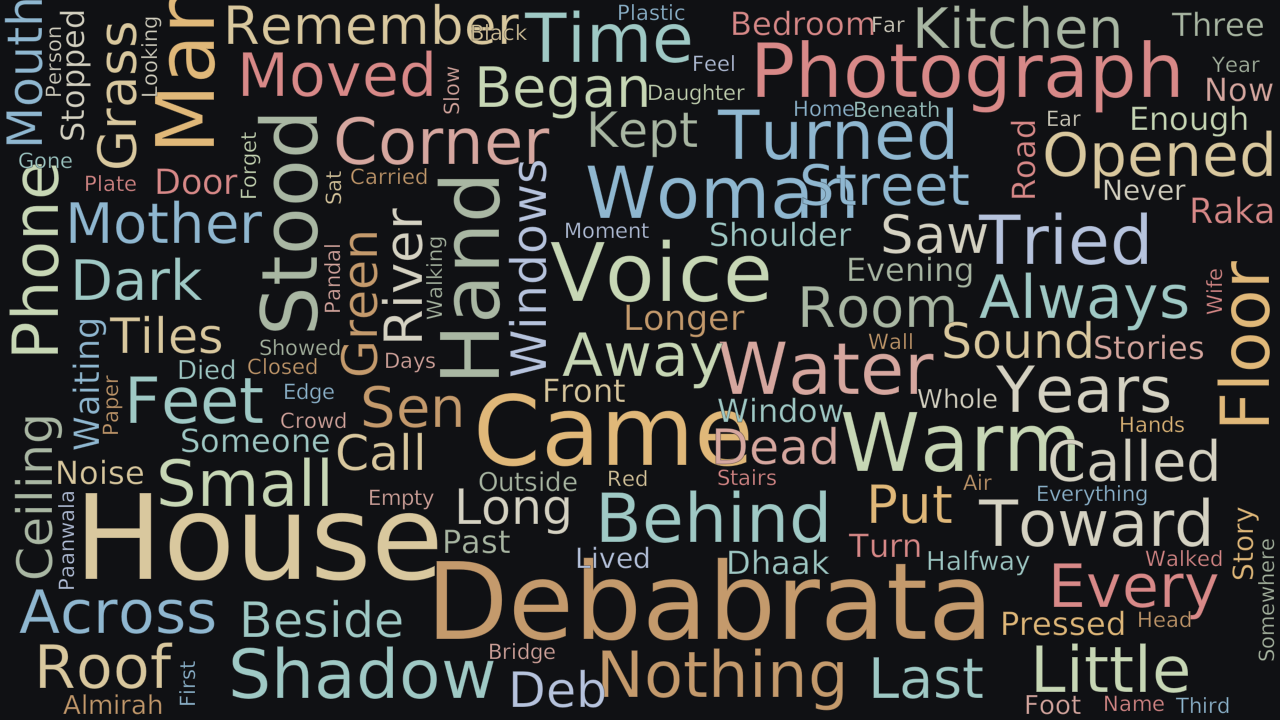
Word Cloud
Related reading
Selected by shared topics and section, with closer publication dates breaking ties.