My Puja Guest Has a Spine
Uses the speech voice supplied by your browser or device.

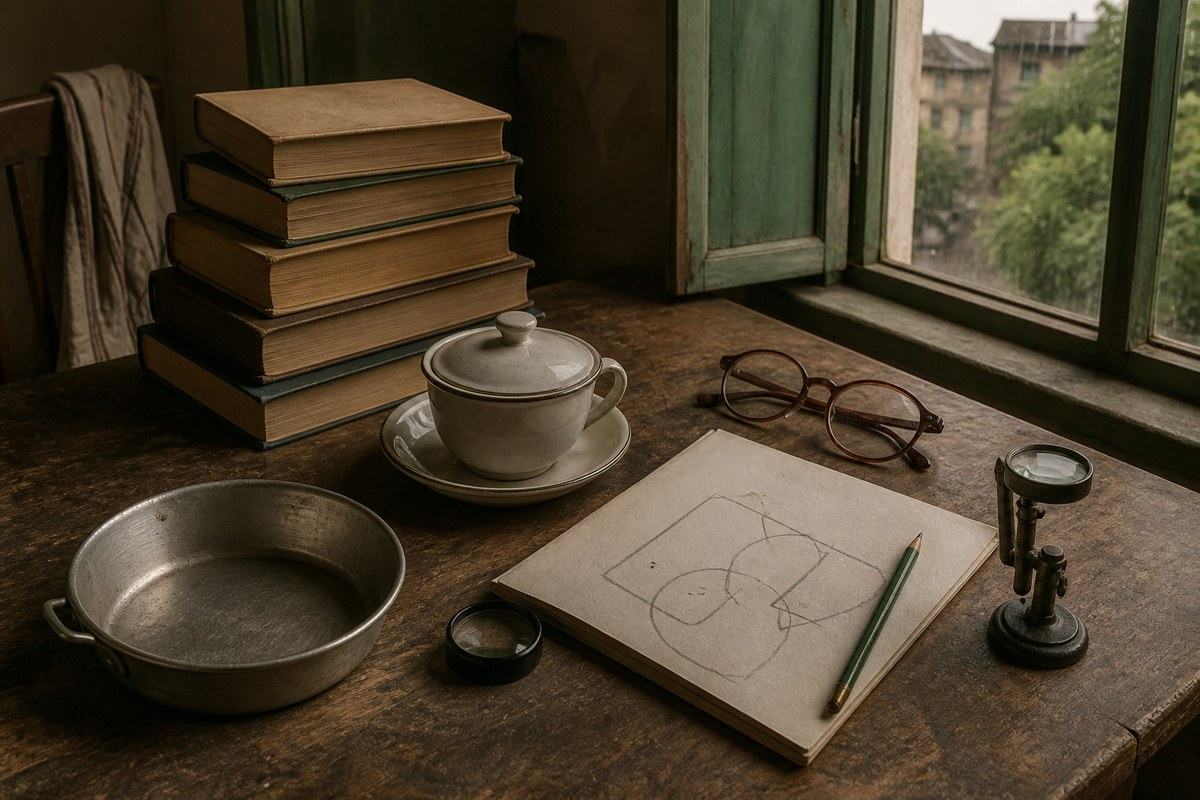
The dark liquid in the black mug has the glossy, faintly incriminating appearance of a specimen awaiting an explanation; beside it, in the photograph, lies a book covered in diagrams, which is a reasonably discreet portrait of my present condition, considering that my finances would require an X-ray and my thoughts would require a drain.
Sciencia.
I bought it for myself. For Puja.
There. A purchase, followed immediately by the need to defend the purchase, because when money becomes precarious, pleasure develops the furtive habits of a person carrying something damp through customs. Was this necessary? Could I justify it? What measurable improvement would result? My internal auditor, that constipated little impresario of rectal woodwinds, would like a spreadsheet demonstrating the return on an afternoon.
I wanted company. Put that in a cell.
At fifty-one, being a Bengali man in Calcutta with bipolar depression and financial uncertainty is already quite enough compulsory reading; the same pages keep arriving without my consent, printed on the inside of my forehead, and during Puja they acquire an especially vicious clarity, as if the city has increased the brightness until every inadequacy shows through the skin. Celebration becomes a test I have somehow failed without remembering entering. I do not begrudge other people their pleasure in any clean, admirable way. Sometimes I begrudge it very thoroughly. Then I begrudge myself the begrudging, and we have achieved a closed digestive system in which resentment eats resentment and produces something too sophisticated for the sewer.
Hence the book.
The full title is Sciencia: Mathematics, Physics, Chemistry, Biology, and Astronomy for All. For all. A slightly reckless promise, but I appreciate being included without first submitting evidence that my life is proceeding satisfactorily.
It collects six short volumes from the Wooden Books series, covering mathematical proof, useful formulas, elements, evolution, the human body, and the cosmos, with drawings, diagrams, engravings, and woodcuts. The edition I bought was published in 2011 and runs to 416 pages. A compact collection of explanations, then, rather than a certification that the universe has been finished. Scientific knowledge keeps changing; a handsome binding does not exempt a claim from inspection. Still, I wanted something I could enter through several doors. If algebra refuses to receive me, there is a body elsewhere in the building, and farther along, some stars.
That sounds grander than the actual arrangement.
I may manage one diagram.
A diagram is good company for a person whose attention has become unreliable. It stays where I put it. I can follow a line, misunderstand the line, follow it again, and spend an offensively long time deciding what the arrow refers to. Nobody pushes a new diagram over the old one because my hesitation has been interpreted as an engagement opportunity. There is no tiny celebratory explosion when I reach the bottom. My confusion remains a private possession.
I like the physical jurisdiction of reading: the finger holding a place, the eye moving backward, the sentence waiting while I argue with one stubborn word. I can stop halfway through an explanation and let it remain halfway explained. That incompleteness feels different from the unfinished business of my life, which follows me around with its damp mouth open. The book’s unfinished business has a page number.
I also want the visual pleasure: a page given enough care that the drawing is worth lingering over, a relationship I can hold in view while the words slowly catch up. Beauty need not arrive carrying incense. Sometimes it is a difficult thing made intelligible.
Even its thickness is useful. Here is an object with an end. I do not have to reach it today.
My own head is less considerate. A thought about the cost of the book can become a thought about earning, which becomes a thought about lost years, which becomes an entire prosecutorial reconstruction of my existence, complete with hostile witnesses manufactured on the premises. When thought accelerates, it does not necessarily become joyful. Sometimes it simply becomes more efficient at finding injuries. I can arrive at seventeen disasters before I have understood one ordinary sentence.
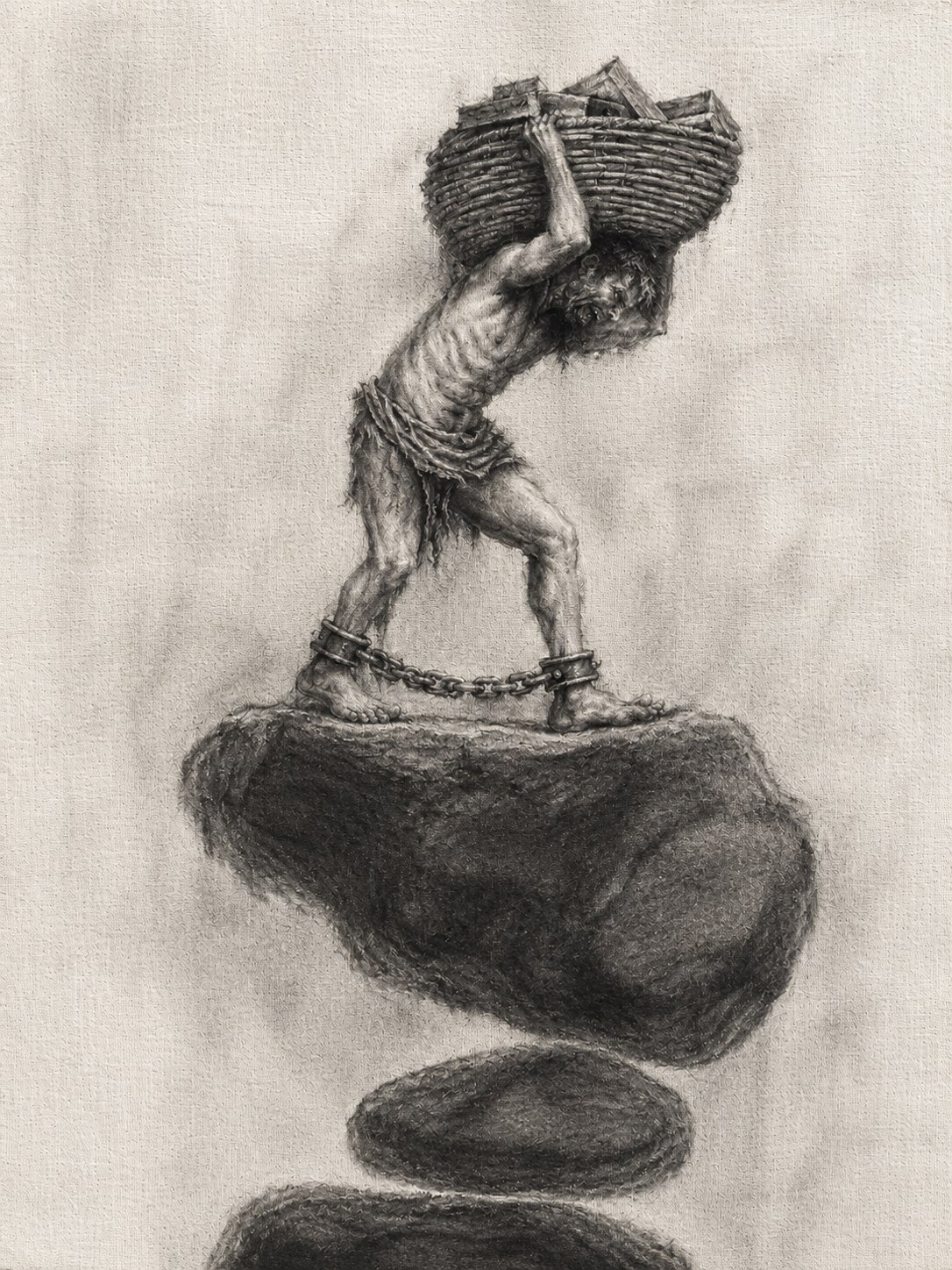
Then there are the stretches in which understanding itself seems to require lifting something waterlogged.
A short entry gives me somewhere to attempt a landing. I can be curious in a small quantity. I need not promise an improved personality by the final chapter.
The mug offers a way in. Liquid can look still while its molecules remain in thermal motion; and from that apparent stillness I find myself thinking about the tiny suspended particles that Robert Brown examined in 1827, particles released from pollen, moving irregularly under his microscope. He went on to find similar motion in material that was not alive. The twitching was no exclusive privilege of living things.
A discovery with unfortunate implications for anyone hoping to distinguish himself through agitation.
In Bern in 1905, Einstein worked out a mathematical account linking such motion to the thermal movement of molecules. A microscopic particle gets jostled unevenly by the surrounding liquid. Think of something light being nudged from different sides in a dense Puja crowd, though the molecules have no destination, no pandal itinerary, and no opinion about where the best lighting is. The visible wandering gives evidence about activity too small to see directly.
I am not diagnosing myself with Brownian motion. The temptation to borrow a respectable equation and drape it over a personal catastrophe is considerable; I have sufficient vanity to want my misery peer-reviewed by the universe. But a resemblance is not an explanation. My problems involve money, illness, uncertainty, and an unusually persistent acquaintance with myself. Calling them entropy would merely give the mess a visiting card.
The scientific connection is interesting enough without that fraud. Even the word atom comes from the Greek for indivisible, an assurance later physics declined to honor. I enjoy that embarrassment: a word standing there in its ceremonial underwear after the facts have changed.
Looking through the science coverage this October, I find Nature Reviews Physics revisiting Jean Perrin’s work a century after his 1926 Nobel Prize. His experiments helped establish the physical reality of molecules and tested the account of Brownian motion. The retrospective was published on October 1: old science returning through the current month’s door, carrying its small, stubbornly moving particles.
There is something deliciously inconvenient about the labor involved. Observe. Measure. Repeat. An answer has to survive something less obliging than applause.
And there I go, trying to make the particle instruct me in character. Leave the poor speck alone. It has already done enough work.
What attracts me is the passage from one scale to another: the cup, the unseen collisions, the mathematics that lets someone infer what is happening, the biological material that supplied an observation, the history through which an ordinary-looking motion became evidence. A whole argument can begin with something that seems beneath notice. The subject expands without requiring me to expand into a more impressive person.
For a while, the question becomes: why does that happen?
I have other questions. They do not resign. But this one does not begin by accusing me.
That matters during Puja, when enjoyment can feel less like a possibility than a public standard. New clothes, illuminated extravagance, the magnificent collective determination to be visibly occupied: I can recognize the pleasure in it and still feel my own lack becoming intolerably conspicuous. I do not need to invent a villain for this. The fact that nobody has arranged the festival specifically to humiliate me does not stop my mind from delivering a meticulously personalized service.
An atheist can decline the theology and still get dragged by the calendar. Belief is only one of the ways a season gets inside a person.
I bought myself something for those hours. Something I could return to without explaining the expression on my face.
I hesitate to call a book a companion because the phrase has been polished into a decorative little pellet by people selling serenity. Paper does not care about me. It cannot negotiate my circumstances. Its silence is partly an absence, and I know the difference between a thing being patient and a thing being incapable of impatience.
Yet the work in it was done by people. Someone took the trouble to find an explanation, someone drew the diagram, someone considered where an uninitiated reader might get lost. That attention survives in the object. I can use it without staging a successful version of myself first.
There is company in being addressed intelligently.
I do not mean flattered. I have had enough of language that strokes the swollen organ of self-importance until it produces a fragrant little emission of confidence. A good explanation can tell me I have misunderstood. It gives me the means to see where. The correction is limited to the matter under discussion; an error about a diagram need not become a referendum on whether I should have turned out differently.
Naturally, I am capable of making it one.
The brain is industrious that way.
I could also spoil the entire purchase by making it a program: so many pages daily, notes in suitable categories, a solemn undertaking to master the sciences, followed by the customary failure and a lavish retrospective exhibition of my deficiencies. Even leisure can be fitted with a time clock if I apply myself. The internal auditor has already found a clean cuff to cough into.
But I bought a book. I did not purchase another examiner.
I want the minor, exact pleasures: recognizing a shape; finding that a term which looked forbidding means something I can actually picture; returning to a sentence after a digression and discovering that it has acquired another meaning because of where my mind went. I want to linger without having to turn the lingering into evidence of productivity. There are things worth understanding that will not make me employable by Thursday.
It is embarrassing how quickly I feel obliged to defend that.
There is a particular obscenity in expecting a person under financial pressure to have no appetite except the appetite to become financially useful. Curiosity begins to look like unauthorized expenditure. Even after the book is bought, the time spent reading must apparently audition for a wage. I can perform this cruelty on myself quite efficiently; no outside supervisor is required.
And yet I have bought the thing.
The money remains spent. The precariousness remains precarious. My illness has not mistaken a hardcover for a treatment, and the calendar will proceed through its appointed festivities with the imperturbable manners of a machine that cannot hear the noise it makes inside me.
I would still like to read.
There is no need to hang a medal on that sentence. Some days wanting and doing stand so far apart that they seem to belong to different species. A book I cannot concentrate on can become one more object of reproach. I know. I would rather admit that than varnish the purchase into a cure.
For now I can look at the cover, at the little arrangements of matter and number, at the black mug beside it with its dark, suspicious contents. I have managed to travel from that liquid to a microscope, from the microscope to atoms, from atoms to the spending of money, which is apparently where every expedition must report for inspection.
I open the book anyway.
There is a sentence I would like to understand before my head starts on me again. I put a finger beneath it. Read. Go back.
The sentence has now seen me four times.
It must think I work here.
P.S. Sources and further reading:
- Sciencia: publisher’s description and edition details.
- Robert Brown’s 1828 paper and Einstein’s 1905 paper on microscopic particle motion.
- Jean Perrin: Nobel Prize facts.
- Nobel 1926: Seeing Brownian Motion, Nature Reviews Physics, October 1, 2026.
- CERN: Compositeness, on atoms and their constituent particles.
Word Cloud
Related reading
Selected by shared topics and section, with closer publication dates breaking ties.