Apolitical in Bengal
Uses the speech voice supplied by your browser or device.

I have been told, in tones usually reserved for discovering termites in the teak, that I am apolitical—as though this were a skin condition, perhaps congenital, certainly contagious, and definitely unhygienic. The word drops from Bengali lips with the same clinical distaste as “diabetic” or “divorced.” In this city, this state, this glorious compost heap of history where the air itself seems to carry the spores of faction, not belonging is not merely eccentric. It is defective. It suggests a failure of the blood, a deficiency of the marrow, a man walking through a burning building complaining that the smoke irritates his eyes.
And the thing is, they are right to be suspicious. I am defective. I lack the chromosome.
Here, politics does not stay in its lane. It does not politely confine itself to Parliament, the ballot box, or the editorial pages where men with mustaches shout at other men with mustaches about the price of onions. No. Here it seeps. It leaks. It percolates into the tea stall where the cha is strong and the opinions stronger, into the family lunch where the fish curry grows cold while Uncle decides whether the state is saved or damned, into the para club where the carrom board waits while two men settle federalism between strikes, into the university corridor where the walls have accumulated slogans like geological strata, into the taxi where the driver knows exactly how the country should be run and will explain it before Park Circus, into the WhatsApp group where good-morning flowers bloom beside political memes, into the funeral where somebody notices which politician sent the wreath, into the festival where the loudspeaker occasionally begins to sound suspiciously like an election campaign with dhaak accompaniment.
You cannot escape it. You can only choose which flavor of suffocation you prefer.
I have tried, in my cowardly, calculating, hopelessly Americanized way, to remain unaffiliated. I have attempted to maintain the position of the perpetual skeptic, the man who looks at the Left and sees ghosts, looks at Trinamool and sees the memory of a formidable machine, looks at the BJP and sees a saffron machine newly installed in Bengal as well as firmly housed in Delhi, looks at the Congress and sees a museum with several rooms still open to visitors. I have tried to say: this policy is stupid, that policy is sensible, this man is lying, that institution is failing. I have tried to keep my moral judgments unbranded, like generic medicine—same active ingredient, no flashy logo.
This, apparently, is treason.
Not treason to the state. Treason to the idea of belonging.
In Bengal, you are expected to bleed a color. Red, green, saffron, white—pick your poison, but pick. The man without a flag is a man without a face. He is the empty chair at the rally, the silence between slogans, the gap in the arithmetic. And Bengal, which has always loved its arithmetic—cadres counting booths, parties calculating constituencies, television studios multiplying caste by religion and dividing the result by turnout—cannot abide an uncounted integer.
I am reminded of being an atheist in a fiercely religious household.
The believers understand one another better than they understand the unbeliever. The Hindu, the Muslim, the Christian, the Sikh may disagree on almost everything sacred, but they at least recognize the architecture of belief: devotion, ritual, scripture, community, inherited vocabulary, the conviction that some things matter beyond negotiation.
The atheist is stranger.
He stands outside the temple, not necessarily hostile, merely examining the architecture with the mild interest of a man inspecting a drainage system. He does not genuflect. He does not rage. He simply declines the entire menu, and this, more than choosing the wrong item, is what bewilders everybody.
Not the wrong god.
The refusal of the category.
The political believer is much the same beast. He understands the man who votes for the other party. That man is mistaken, deluded, perhaps wicked, but he is legible. He operates within the same cosmology. He owns a flag. He has chants. He possesses villains. He knows where to stand when the photograph is taken.
The apolitical man, however—the man who looks at the grand narratives of Left and Right, class and nation, secularism and majoritarianism, revolution and development, and says, “Yes, but have you considered that all of you may be somewhat full of fermented excrement?”—that man is a glitch in the matrix.
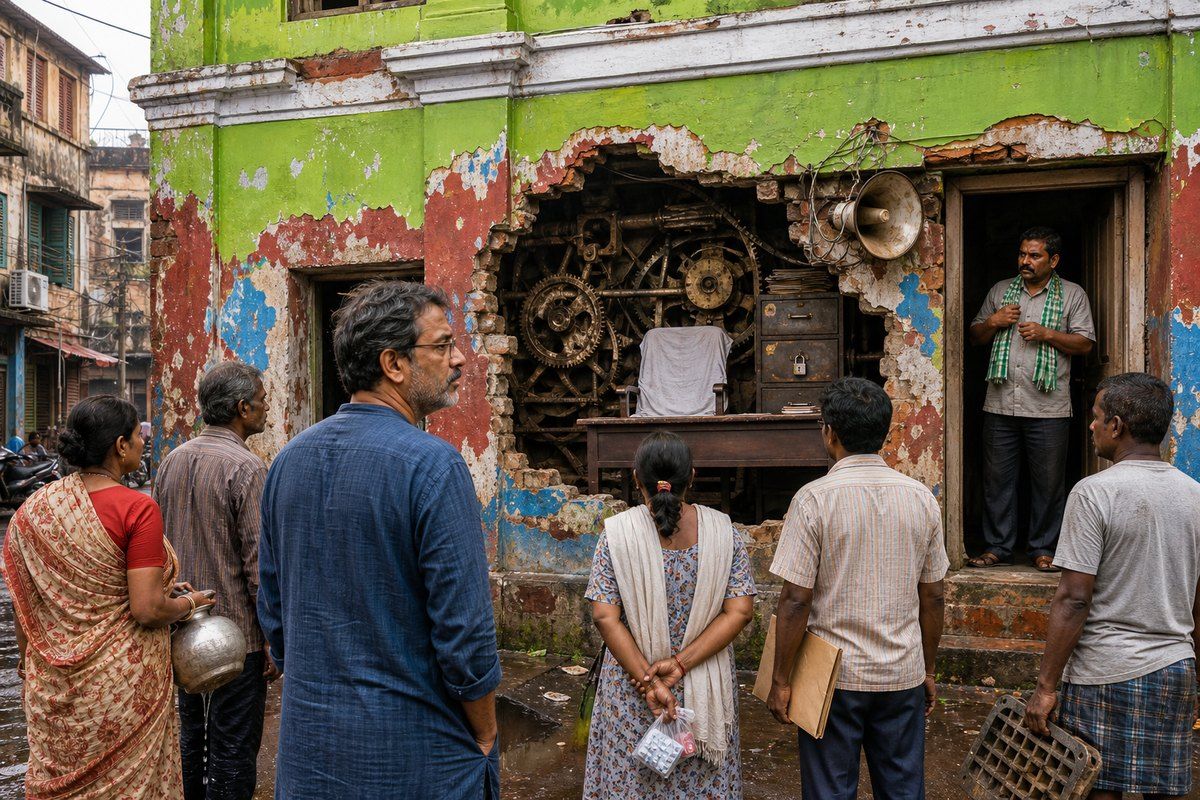
He is the sand in the gears.
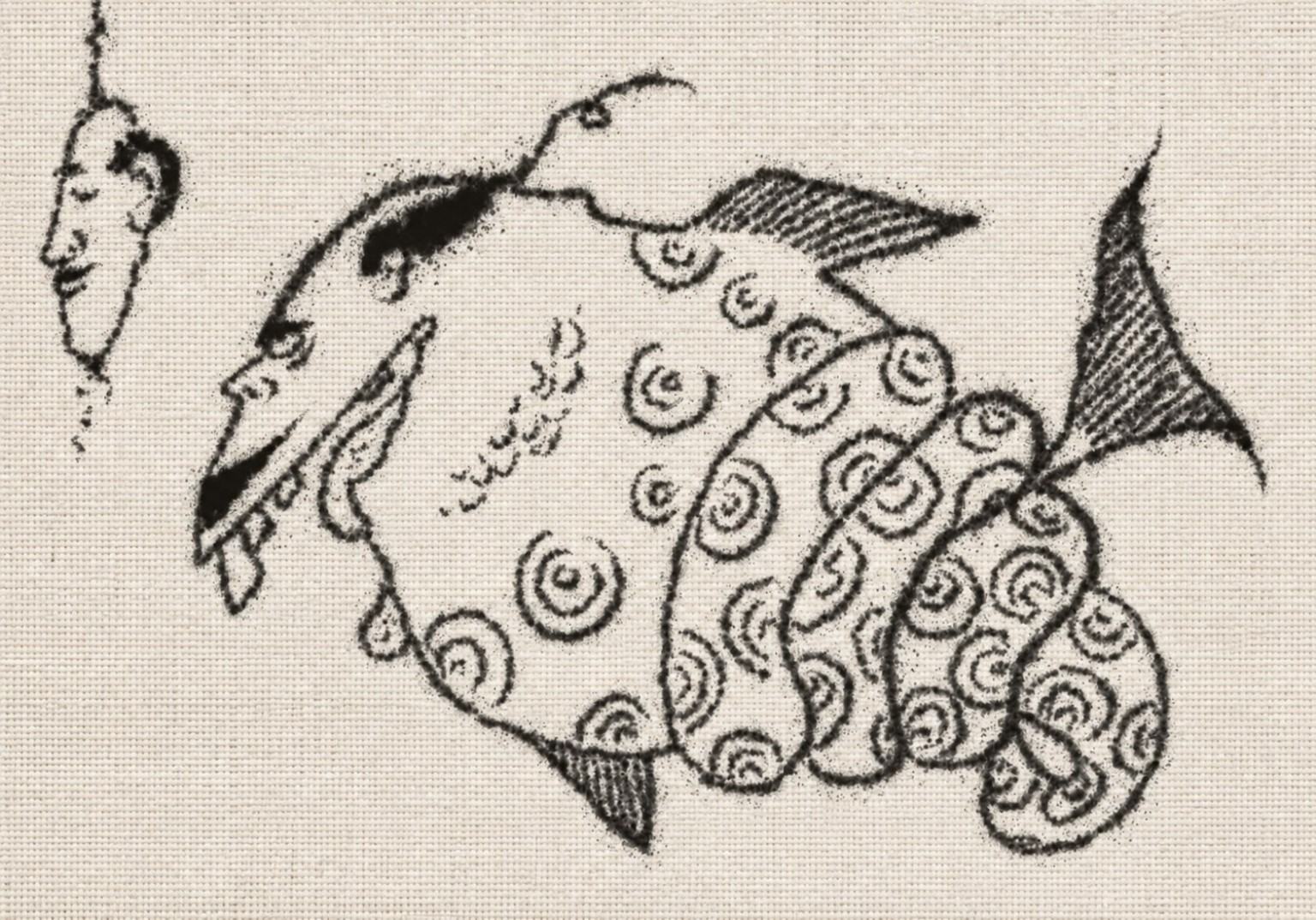
He is the one who, when asked, “Which side are you on?” responds, “On the side of the fish,” and means it.
And now comes the latest joke.
The holy Hindoo lotus party—as I sometimes call it when feeling particularly charitable—has not merely been knocking on Bengal’s door. It is inside the house. The BJP won the state election this year, Suvendu Adhikari moved into the chief minister’s office, and the lotus that Bengal spent years discussing as an approaching tide is now sitting at Nabanna wondering where the files are kept.
That changes the furniture. It does not change the disease.
For years, criticizing the Trinamool government could get you classified as BJP before you had finished the sentence. Criticize the BJP and somebody would discover that you were an appeaser, a Marxist fossil, a member of the deracinated bhadralok, or one of those suspicious creatures who says “constitutional institutions” without laughing.
Now the chairs have moved.
The BJP is the government in Bengal. Trinamool is no longer the government it spent fifteen years being. The Left, which once seemed as permanent as humidity, is reduced to something closer to an archaeological layer. Congress persists with the peculiar dignity of an ancestral house whose roof leaks but whose brass nameplate remains polished.
Yet the classification machine still works perfectly.
Criticize the new BJP government and perhaps you must secretly pine for Trinamool. Criticize Trinamool and perhaps you were saffron all along. Criticize the Left and somebody will explain industrial history to you. Criticize Congress and nobody may notice for several days, but eventually a statement will be issued.
Criticize everyone and you commit the ultimate sin in the tribal lexicon:
neutrality.
Every silence becomes suspicious. Every refusal to cheer is interpreted as covert cheering for somebody else.
If I criticize centralization, I must belong to one camp. If I criticize corruption allegations surrounding another, I must belong to its enemy. If I say that, to my eyes, decades of Left rule left Bengal carrying economic and institutional scars that cannot be explained away by nostalgia, I am told I have swallowed the saffron history book. If I mention the old Trinamool era of cut money, patronage, local strongmen and the little tollbooths that politics erects between citizen and state, I must be auditioning for BJP membership.
And if I then look at the new rulers and say, splendid, congratulations, now let us examine you with exactly the same unpleasant microscope—
there is suddenly less enthusiasm for microscopes.
This is what I cannot tolerate.
The assumption that criticism is a railway ticket and every sentence must have a destination printed on it.
As though detecting rot in one wall requires moving into the house next door.
As though refusing to join an army means secretly serving the opposing army.
As though independence of judgment were not merely difficult but morally suspicious.
I am not claiming wisdom here. Let me be clear, because clarity is one luxury I still permit myself. This apolitical stance—this refusal to march, chant, carry the flag or burn the effigy—may not be enlightenment.
It may be laziness.
It may be the privilege of a man who can watch the flood from a balcony.
It may be cowardice dressed as principle, fear of commitment masquerading as intellectual independence.
I know this. I carry the possibility like a stone in the shoe, a constant, limping reminder that the apolitical man can very easily become merely the comfortable man, insulated from consequences that fall on somebody else like rain on the unroofed.
And there is another problem.
Politics does not require your permission before acting upon you.
The price of food does not ask whether you voted. The policeman does not ask whether you subscribe to a party newsletter before enforcing the law badly or well. A riot does not carefully bypass the politically undecided. A government regulation does not evaporate because you find political conversation vulgar. History contains more than enough graves occupied by people who wanted nothing to do with history.
The man in the middle of the road is still in the road when the tank arrives.
I know that too.
And yet.
And yet I resent—no, I rage against—the demand that every moral judgment must arrive with a logo attached.
I want to say that a policy is asinine without being recruited into the enemy’s army.
I want to say that a leader is behaving like a charlatan without receiving a membership form from the charlatan’s rival.
I want to condemn corruption without pretending corruption was invented by the party I happen to dislike this week.
I want to defend an institution without having to canonize everyone who claims to defend it.
I want to look at the grand chessboard of Indian democracy, with its kings and pawns and knights moving in patterns of Byzantine complexity, and occasionally say, “You are all arguing about who gets the queen while the board appears to be on fire.”
Is that so terrible?
Is that the ultimate betrayal?
Politics likes converts. Tribal politics likes uniforms. I keep arriving in civilian clothes, and they look at me as though I have arrived naked at a wedding.
Perhaps I have.
Perhaps the emperor’s new clothes are party colors. Perhaps the temple really is sometimes cardboard, the revolution occasionally a revenue stream, patriotism occasionally a franchise, secularism occasionally a costume, religion occasionally an electoral spreadsheet, poverty occasionally a photograph, development occasionally a PowerPoint presentation, and ideology occasionally the elaborate intellectual machinery by which a man explains why his thieves are historically necessary while yours are criminals.
That sentence alone should earn me abuse from everybody.
Excellent.
At least we have achieved national integration.
In Bengal, this political homelessness can be especially lonely. Politics here is not simply something one believes. It is often something one belongs to, like a football club, a neighborhood, a school, a lineage, a quarrel inherited from one’s father along with an old wristwatch and mild hypertension.
You can hear it in the adda. You can see it in the posters accumulating on walls until yesterday’s revolution peels beneath today’s development and tomorrow’s nationalism is pasted over both.
Governments change.
The wall survives.
I become the man at dinner who, when asked about the latest political scandal, shrugs and asks whether anyone has read the new translation of the Mahabharata. I become the fellow who, when the conversation turns toward the inevitable, irresistible, all-consuming question of who should rule, commits the social obscenity of asking whether the machinery of rule might deserve more attention than the surname of the person operating it.
They think I am being evasive.
I think I am being honest.
The truth is, I do not trust political salvation.
I do not trust the man who promises to save the nation, because nations have survived an astonishing number of saviors.
I do not trust the man who promises to protect culture when protection begins to sound suspiciously like ownership. Culture is not a porcelain deity in a locked cabinet. If it is alive, people will misuse it, vulgarize it, remix it, forget half of it, rediscover the other half and occasionally turn it into a terrible film.
I do not automatically trust the man who announces that he fights for the poor, either. The poor have spent centuries being discovered shortly before elections. Poverty becomes constituency, constituency becomes arithmetic, arithmetic becomes office, and somewhere during the calculation the poor fellow himself disappears behind the decimal point.
Nor do I trust opposition merely because it is opposition.
Power can corrupt. So can the anticipation of power. So can nostalgia for lost power. So can the conviction that history owes you power because your grandfather once had it.
This is why political homelessness suits me.
Not because everyone is identical. They are not.
Not because policies do not matter. They do.
Not because governments are interchangeable. They plainly are not.
But because none of those facts obliges me to outsource my judgment wholesale.
I can agree with a government on Tuesday and think it deranged on Wednesday. I can believe an opposition politician is correct about one thing without subscribing to the remaining warehouse of things stored behind him. I can decide case by case, policy by policy, outrage by outrage, without tattooing a lotus, flower, hand, hammer or sickle onto my forehead.
This apparently modest freedom now feels almost revolutionary.
I trust the fish.
I trust the rain.
I trust the adda that continues after the political discussion has finally died of natural causes, when the tea is cold and the cigarettes are finished and the men, exhausted by having saved India for the evening, begin talking about something real—poetry, football, a schoolteacher dead thirty years, the impossible beauty of a woman who passed them on a tram in 1984 and has somehow remained twenty-three years old ever since.
But in Bengal, even that is political eventually.
The fish has a subsidy.
The rain has a minister.
The tram has already become an argument.
So I remain what I am: a man without a tribe, a skeptic without a church, a citizen of the Republic of Doubt.
I will criticize the stupidities I see on the Left without romanticizing the Right. I will criticize the vulgarities I see on the Right without canonizing the Left. I will remember what Trinamool did while it governed without pretending that memory is a lifetime subscription to its enemies. I will judge the new BJP government without either treating its victory as proof of divine revelation or pretending that voters who chose it somehow failed an intelligence examination.
They voted.
A government resulted.
Now the government gets inspected.
That is democracy too.
And I will look at the lotus and remember that the real flower does not grow from ideological sewage but from mud at the bottom of ponds, perfectly innocent of the speeches delivered in its name.
If that makes me defective, if that makes me the empty chair, the silence, the gap in the arithmetic—so be it.
At least the chair is comfortable.
At least the silence is mine.
At least the gap has not yet been allocated a party symbol.
They can keep their flags. I will keep my skepticism, that small, hard, uncuttable knot of doubt that I carry like a talisman against the madness of crowds.
It is not much.
But it is the only inheritance I have not sold.
P.S. The national motto has it right: Satyameva Jayate—truth alone triumphs.
They forgot to mention the timetable.
Word Cloud
Related reading
Selected by shared topics and section, with closer publication dates breaking ties.