Who Signed?
Uses the speech voice supplied by your browser or device.

Nineteen people dead, and already everybody knows whose fault it cannot possibly be.
That part gets settled immediately. The rest requires investigation.
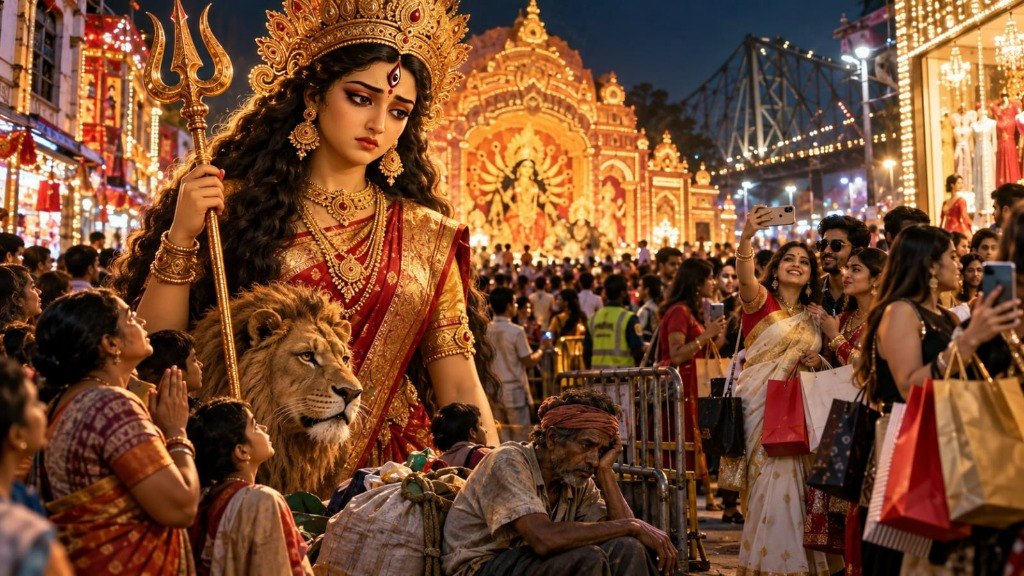
As of October 18, the reported toll from yesterday’s Chorbagan Durga Puja disaster is nineteen. Seven people have been arrested. The precise failures and individual responsibility are still being investigated, but the political alimentary canal has already begun its magnificent work, taking in dead people at one end and producing party-colored explanations at the other. Each explanation arrives warm. Each smells of somebody else’s responsibility.
I had been putting this possibility into fiction. A crowd, a bottleneck, a few things going wrong, and the celebrated festival becomes something people spend the rest of their lives trying to stop remembering. I don’t feel clever about that now. What would I be congratulating myself for? Recognizing that you can kill people by stuffing them into a space you cannot safely get them out of? There goes my Nobel Prize. Apparently it was addition.
And this is what keeps making me angry, the smallness of the knowledge required compared with the enormity of the consequences.
We are not waiting for a scientific breakthrough before we count admissions, keep exits usable, plan for rain, arrange emergency access, and give somebody the authority to stop entry. We already know these things. The knowledge exists. The decision to treat it as optional also exists, and that decision is made by people.
People who can become extraordinarily attentive when the decoration is wrong.
Imagine a sponsor’s name spelled incorrectly. Imagine the lights failing during the important person’s visit. Imagine a decorative elephant whose decorative posterior looks insufficiently majestic. Somebody would notice. Somebody would make calls. The elephant’s dignity would be restored before the cameras arrived.
Now show me that same ferocious attention applied to the way ordinary people get out.
Show me the spending. How much for the spectacle, how much for crowd management, what was actually provided, who inspected it, and who had the authority to say this arrangement was unsafe? I want the invoices and the plans beside each other. I want to know whether the people making this thing beautiful were given more attention than the people responsible for making it survivable. These are answerable questions. They become complicated only when the answers acquire names.
Here is the sophisticated mathematics:
The number inside afterward equals the number already inside, plus those entering, minus those leaving. If, in an imaginary example, five hundred enter every minute and three hundred leave, two thousand additional people accumulate in ten minutes. That is an illustration, not a reconstruction of Chorbagan. The equation is incomplete as a safety plan, obviously, but it ought to be sufficient to interrupt a committee meeting.
Where are the additional people supposed to go?
Into the theme?
I am tired of hearing “the crowd” used as though it were an unexplained weather system that materialized inside a perfectly sensible arrangement. Organizers advertise for crowds. They celebrate crowds. The crowd proves how successful the event is until it needs space, direction, protection, a way out; then suddenly it becomes this regrettable public infestation for which nobody remembers placing an order.
And yes, people cut lines, ignore instructions, demand exceptions. Anyone planning an event has to account for actual people, including impatient people, confused people, people who cannot see what is happening ahead. A safety plan that depends on every visitor behaving perfectly is already a bad safety plan. You don’t get to organize for applause and then discover, with wounded astonishment, that human beings have arrived.
Rain belongs in the plan too. Bengal has had some experience with water falling from above.
The inquiry must establish the sequence at Chorbagan. Meanwhile, I refuse to let the phrase “bad management” become a soft cushion under whoever is responsible. Bad management can kill. It consists of decisions made before the disaster, when there was still time to make different ones, and sometimes of warnings ignored because listening would have inconvenienced somebody important.
Somebody important. There we are.
Now Trinamool is questioning BJP connections in the organizing committee and attacking Suvendu Adhikari’s administration. Those allegations need examination. Adhikari, while objecting to politicization, has invoked disasters under the previous government. I find this performance nauseating. The administration currently in office has questions to answer about the administration currently in office. Earlier failures require their own accountability. They do not provide a transferable discount on nineteen deaths.
But I want to go further than the party exchange, because otherwise I will have contributed another little pellet to the national sewage regatta and mistaken the splash for an argument.
Who makes this arrangement possible?
People.
The committee is people. The administration is people. The person overlooking a problem, the person making the call to have it overlooked, the person defending the overlooking because the caller belongs to the correct party: people. Even that enormous, convenient fog called “the system” has people inside it making choices, accepting benefits, avoiding trouble, passing responsibility along until it reaches someone too unimportant to pass it any further.
And the public helps decide which of these behaviors gets rewarded.
That is the part I don’t want to politely swallow.
We keep blaming the national television circus, the godi chorus, those professionally inflamed faces that seem to have mistaken a microphone for an instrument of rectal revenge. Fine. They deserve scrutiny. So do the people who finance them, protect them, and turn their performances into political weapons.
Then look beyond the screen.
Where do these people come from? Did a spacecraft empty its septic tank over the broadcasting industry? They emerge from the same social arrangements that teach the rest of us to recognize power quickly and principle at our convenience. The television version is louder and better lit. The smaller versions don’t require a studio.
Take the political weathercock I am talking about in Calcutta.
Under the Marxists, stern unbelief. Religion was backward, sentimental, beneath the magnificent altitude of his reasoning. Then the political atmosphere changed, and Kali acquired an unexpectedly useful place in his public life. Now Ram and Sita are receiving the full volume of his rediscovered conviction, along with a suspiciously energetic interest in who else is insufficiently devoted. Same certainty. Same contempt for whoever is inconvenient. An astonishing capacity to have been right all along.
People change their minds, certainly. But the spiritual development I am talking about keeps such exquisite pace with the governing party that I begin to suspect the revelation has access to election results. The man has found God, and God, by an extraordinary coincidence, knows who can get things done.
And the fanaticism afterward, that is the particularly rancid part. He needs to demonstrate that the conversion is complete. So he becomes more aggressive than the person who believed quietly for years. He supplies the slogan, the sneer, the unsolicited test of somebody else’s loyalty. He has to make enough noise to drown out the memory of his previous noise.
Yesterday’s conviction has become today’s embarrassment. Naturally, someone weaker must be made to suffer for it.
I keep reaching for “spineless,” and then I notice that these people are perfectly capable of standing upright in front of anyone who cannot harm their prospects. Put an inconvenient citizen before them and watch the backbone arrive. Put a powerful patron before them and the thing melts into clarified butter.
So the flexibility is selective. That makes it worse.
The bowing has calculation in it.
Raja, Mughal emperor, zamindar, British official, party boss: the temptation is to write the whole history as one continuous procession of foreheads approaching footwear, and I understand the temptation because I am angry enough to enjoy it. But that would erase the people who resisted, including people who paid for resisting. The more unpleasant truth is that the capacity for resistance exists. We keep arranging society so that accommodation is profitable and resistance is somebody else’s expensive hobby.
Then we admire courage after it has been safely buried.
Ambedkar had already put the problem plainly before the Constituent Assembly on November 25, 1949: “But in politics, Bhakti or hero-worship is a sure road to degradation and to eventual dictatorship.”
There. A warning with a date on it.
We have had time to read it.
Instead, we have become very accomplished at honoring people whose warnings would be an inconvenience if taken seriously. Garland the portrait. Avoid the sentence. A portrait makes no demands. The sentence might require you to question the person whose favor you need tomorrow.
It costs something to offend a person who can obstruct your work, your income, your access to an ordinary service. I know that. I have no wish to sit here awarding bravery marks to people whose consequences I will not have to bear. But look at how eagerly the comfortable join in, the ones with choices, with access, with enough protection to ask a question, and still their mouths are full of the incumbent’s slipper. What are they afraid of losing? The opportunity to get slightly closer?
What disgusts me is the promotion of this surrender into virtue. The insistence that bending demonstrates wisdom, that defending the indefensible demonstrates loyalty, that the person asking an ordinary question is somehow being indecent.
Why was this allowed?
Wrong time to ask.
Who approved it?
Wrong tone.
How do we prevent it happening again?
Now you are insulting the festival.
There is always a more respectable subject waiting to save an uncomfortable person from an uncomfortable question.
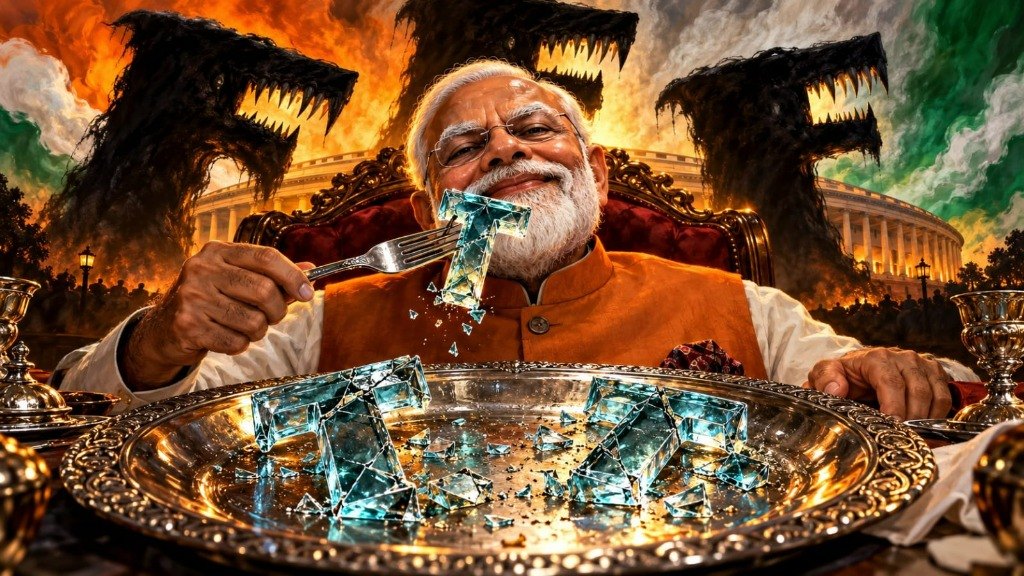
Modi benefits from this culture enormously. The reverence, the personal devotion, the readiness to treat criticism of a leader as an injury to the country: these are political advantages supplied by human beings. His supporters have agency. The people who flatter him have agency. The people who know better and flatter him anyway have agency too, although they would prefer that we discuss their difficult position until we forget what they chose to do with it.
The consecrated blowhard does not need to manufacture every kneeling gesture himself.
And anyone hoping to compete with that arrangement has to offer something beyond another personality around whom everyone can perform the same spinal gymnastics. Change the leader, change the flag, change the religious vocabulary, and keep the exemption for your own side: what, exactly, have you changed in the behavior that got us here?
I don’t want an opposition that merely wants its turn to be unquestionable.
Unless people change what they reward, what they excuse, what they are willing to participate in, why would anything change? Where is the change supposed to come from, some immaculate substitute population delivered overnight? It has to include the thoroughly unimpressive things we would rather leave out of our grand political opinions. Ask for a record. Expect an answer. Stop defending a failure because the responsible person shares your slogan. Let an official enforce an inconvenient rule against someone you admire. Accept that the rule applies to you too, even when you know somebody who could make a call.
Especially then.
Because corruption includes the small exemption we obtain and congratulate ourselves for obtaining. The queue we bypass. The obstruction we tolerate because removing it would annoy our people. The complaint we dismiss because the complainant belongs to the other camp. Each act can be made to sound minor. Collect enough of them and you get the conditions under which larger failures become ordinary.
That is how I connect the pandal to the country. The scale changes. The habits survive.
Safety becomes negotiable. Competence becomes less useful than proximity. The person who brings bad news becomes the problem, so eventually nobody brings it, and everyone above them enjoys the reassuring impression that things are going wonderfully.
Until people die.
Then we discover the word “unfortunate.”
I am sick of that word. It has been made to carry things that belong on human shoulders. A choice can be negligent. An approval can be unjustified. A warning can be ignored. An investigation can establish who bears responsibility. “Unfortunate” wanders through the whole scene with a damp handkerchief and asks nobody anything.
The people responsible for Chorbagan must be identified through evidence. The records must show what was planned, what was checked, what was missing, and who could have acted. The public has to keep wanting those answers after its preferred politicians begin finding the questions irritating. Otherwise all this anger will settle into the familiar bargain: punish someone expendable, protect the useful people, carry on.
And yes, I am producing words. I know how little that guarantees. I can make my sentences furious and still participate in the same useless cycle of outrage, distraction, forgetting. I don’t get an exemption because I have described the problem with sufficient disgust.
But I am not ready to move on to the beauty of the next pandal.
Who signed off on the arrangements at Chorbagan? Who checked what would happen when people needed to leave? If nobody did, whose responsibility was it to make sure somebody did?
Yes, I have heard that the decoration was beautiful. I am still asking.
P.S. References: The reported toll and arrests are from The Indian Express, October 18, 2026: https://indianexpress.com/article/cities/kolkata/7-arrested-in-kolkata-chorebagan-durga-puja-committee-stampede-dead-injured-10926513/
The political allegations and Adhikari’s response are reported by The New Indian Express, October 18, 2026: https://www.newindianexpress.com/states/west-bengal/2026/Oct/18/kolkata-stampede-mamata-aitc-targets-cm-suvendu-questions-nephews-role-in-puja-committee
General crowd-safety principles: UK Health and Safety Executive, “Assess crowd safety risks and identify hazards”: https://www.hse.gov.uk/event-safety/crowd-management-assess.htm
Ambedkar’s November 25, 1949 speech, reproduced by the Judicial Academy Jharkhand: https://jajharkhand.in/wp/wp-content/uploads/2019/12/1.-Dr.-Ambedkars-speech.pdf
Word Cloud
Related reading
Selected by shared topics and section, with closer publication dates breaking ties.