Mishti: The Sweetest Death
On this page
Uses the speech voice supplied by your browser or device.

THIS IS A WORK OF FICTION
Note: M-9 is an entirely fictional enhancement with scientifically impossible effects. Those effects are not properties of fentanyl, a real and deadly opioid.
A Durga Puja Apocalypse
On the morning of Maha Ashtami, the first thing Kolkata noticed was that the sweets tasted better than they ever had.
The second thing was that the children would not stop asking for more.
By noon, the hospitals were full.
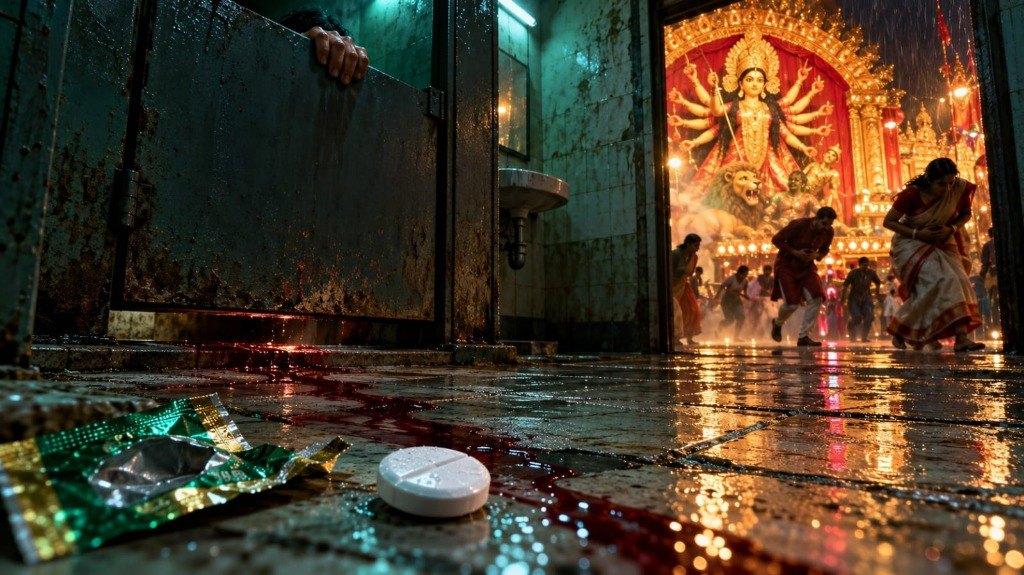
By sunset, there was blood on the steps of the goddess.
And by midnight, the city understood that something had entered its celebrations which no prayer could remove.
At eleven that morning, Rupa Pal was still trying to stop the distribution.
She had climbed onto the plywood platform beside the microphone. Below her, volunteers passed paper bowls along a line that folded twice around the Bagbazar pandal and disappeared into a lane smelling of incense, rainwater, and hot khichuri. Someone had set the payesh beside the goddess’s lion. Its silver basin reflected a little trembling patch of painted teeth.
“Don’t eat the sweets. Please. Put them down.”
The microphone was dead.
A volunteer mistook her reaching hand for a request and offered her a bowl.
Below the platform stood an old man she recognized: Mr. Chatterjee, who had bought two sandesh every Thursday since his wife died, one to eat and one to leave beside her photograph. He was feeding payesh to his grandson.
“Kaku!”
He looked up, smiling, his spoon suspended.
Behind him, a young woman sat abruptly on the ground. The movement was so ordinary that people stepped around her. Her husband crouched, touched her cheek, and laughed in embarrassment before understanding that he had no reason to laugh.
Rupa jumped from the platform.
The bowl in Mr. Chatterjee’s hand tilted. A ribbon of milk fell onto her wrist.
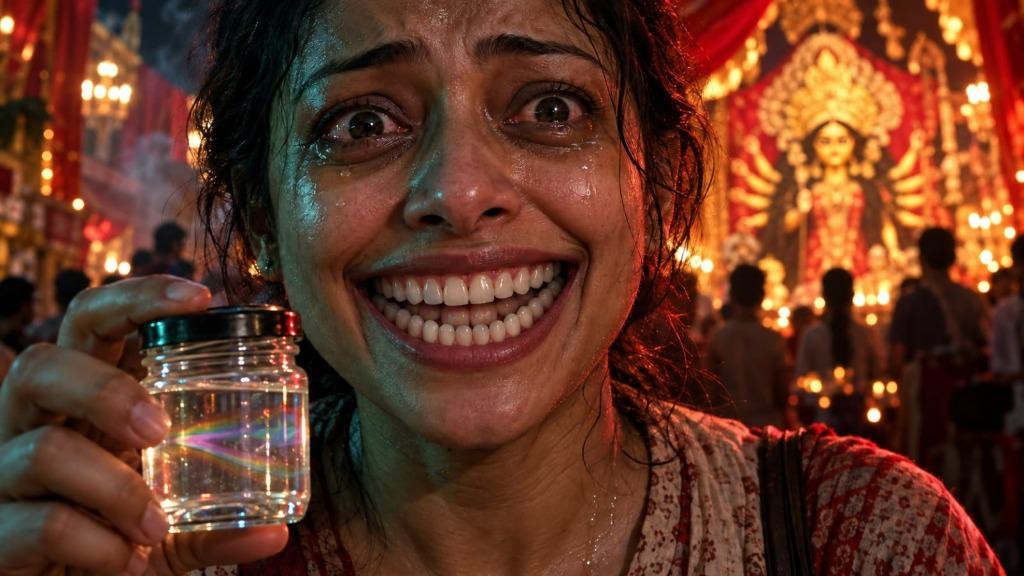
For one appalling instant she wanted to lick it off.
Shashthi — The First Taste
Two days earlier, Mili Bera had drawn Durga holding a biscuit.
“For the lion,” she told her mother. “Everybody gives her flowers. Nobody feeds him.”
Chaiti put the drawing beneath her sewing machine’s clear plastic cover. She altered blouses in a room behind a pharmacy, and her daughter measured festivals by the number of nights the machine ran after bedtime. This year there had been enough work for a yellow frock, sandals, and a little clay pot of mishti doi.
Mili carried the pot herself. Her grandmother Basanti walked beside her, complaining about the price with the solemn enjoyment of someone who had already approved the purchase.
They shared it on the bed under the window.
Outside, electricians were testing a cascade of lights. The lane kept turning blue, then gold. Mili scraped the sweet brown skin from the yogurt and gave the larger half to her grandmother.
“You have fewer teeth. This is soft.”
Basanti laughed.
When Chaiti returned from rinsing the spoons, her daughter appeared to have fallen asleep sitting up. Her chin rested on her chest. One sandal hung from her toes.
“Mili. We’ll miss the lights.”
The grandmother was asleep too.
Chaiti shook them, first impatiently, then with a force she would remember for the rest of her life. Mili’s head rolled against her arm. Her lips had acquired a color Chaiti knew from bruises underneath fingernails.
At Shantimoy Memorial, a small charitable hospital with a leaking entrance canopy, Dr. Ishani Sen met them at the casualty doors.
She knew Chaiti. Six months earlier, Chaiti had repaired a torn pocket in her white coat and refused payment because Ishani had once stayed late to examine Mili’s fever.
Now Chaiti kept saying, “You know her. Daktar, you know her.”
Ishani did.
That was no help at all.
The child’s breathing had almost stopped. The grandmother’s pupils were extraordinarily small. As the team worked, Ishani asked about medicines, pesticides, anything they might have swallowed. Chaiti shook her head at every question.
“Only doi. We ate only doi.”
Basanti responded to treatment. Mili had arrived too late.
Afterward, Chaiti stood beside the bed and fastened the loose sandal. She did it carefully, passing the strap through the buckle, checking that it would not rub.
Ishani waited until she finished.
Across North Kolkata, Haripada Pal found his apprentice Shibu slumped beside a tray of sandesh.
The boy had flour on his cheek, although they had used no flour that morning. Haripada rubbed it away with his thumb. It was sugar dust. Shibu had been eating directly from the tray.
“Oth. Get up. Your brother will accuse me of working you to death.”
Shibu had come from a village near Katwa at sixteen. At nineteen he sent most of his wages home and kept photographs of secondhand motorcycles on his phone. Haripada had promised to help him buy one after Puja.
The boy did not wake.
Rupa called an ambulance while her father held Shibu’s head. For the first time in her twenty-nine years, she heard Haripada pray without bargaining.
Their shop occupied a narrow room between a watch repairer and a shuttered printing press. Haripada knew customers by their preferences: less sweet, extra cardamom, the corner pieces with the firmer crust. Rupa kept the accounts and wanted him to raise prices. He wanted her to stop recording the sweets he gave away.
By evening they had closed the shutters.
Inside, Haripada stared at the trays as if someone had hidden a dead animal beneath them.
“We used the same milk. The same hands.”
Rupa called other shopkeepers. One cursed her for suggesting trouble during their best week. Another admitted that a delivery boy had fainted. A third asked whether her father was eating more than usual.
She looked through the kitchen doorway.
Haripada had picked up a sandesh.
“Baba.”
He looked ashamed, then confused by his shame.
“I was checking.”
At the hospital, Ishani’s registrar showed her the growing list. Sweetened tea. Ice cream. Chocolate. Pantua brought by a visiting nephew. The foods differed. The frightening failures of breathing did not.
Some patients improved after naloxone and respiratory support. Others did not survive long enough. Those facts belonged to a recognizable emergency.
What happened afterward did not.
Basanti woke and asked for the yogurt.
Chaiti told her Mili was dead.
The old woman’s mouth opened. Her whole face collapsed. She made a thin, wounded sound and reached for her daughter.
Then, in the same breath, she whispered, “Was there any left?”
She clapped both hands over her mouth.
That night, while the dhaak rolled through the hospital windows, Ishani examined a white speck beneath Basanti’s tongue. It looked like a sugar crystal embedded in the flesh.
When she moved her light, the speck withdrew.
Saptami — The Craving
Arko Dutta first heard about the deaths while filming a pandal designed to resemble a library.
He worked for a small Bengali news site that paid late and preferred stories whose importance could be established in a thumbnail. His editor wanted the goddess framed between enormous imitation books. Behind Arko, a man was trying to wrench a sweet box from his wife’s hands.
“Our son hasn’t had any,” she said.
“Just give it.”
The man struck her.
Arko lowered the camera. By the time he reached them, the box had burst on the pavement. The husband knelt in the gutter, gathering broken sweets while his wife pressed a handkerchief to her lip.
“He’s never done that,” she said, as though Arko had accused her of choosing him badly.
At Shantimoy Memorial, he found Chaiti sitting outside the room where her mother was being observed. She had Mili’s sandal in her lap. The hospital had returned it in a bag.
“Don’t photograph that,” Ishani told him.
He put his phone away.
“Photograph the corridor.”
Patients lay on mattresses beneath fluorescent tubes. Some were unconscious. Others wept and begged for sugar. A bus conductor had asked a nurse to tie his wrists because he kept trying to lick a sticky patch from the floor. He thanked her when she finished.
Ishani showed Arko a laboratory message identifying fentanyl in a patient’s sample. Corroborating tests were still coming. She was careful about what was known and what was suspected. Someone had exposed people to a potent opioid without their knowledge; the food histories pointed toward a shared ingredient.
“And the rest?” he asked.
Behind the glass, Basanti pressed her lips shut. Something moved underneath the skin of her throat.
“The rest isn’t explained by fentanyl. Neither is the craving we’re seeing. Don’t tell people it is.”
Basanti opened her mouth.
For an instant, Arko saw another movement behind the tongue, a small pale folding and unfolding, like fingers testing a glove.
He stopped recording.
“Keep going,” Ishani said.
Rupa arrived with receipts, two sealed ingredient samples, and her father’s order book. She placed them on a desk cleared of bloodied gauze.
“These may tell you something.”
Arko recognized a charitable foundation’s name among the festival orders. Its founder, Nirmal Lahiri, financed pandals, medical camps, and a scholarship whose annual photograph featured him touching poor children’s heads.
Arko had spent a year collecting allegations about Lahiri’s narcotics business. Witnesses recanted. A source vanished. A lawyer sent a notice demanding more money than Arko had earned in his life.
The papers Rupa brought proved no conspiracy by themselves. But they gave him a place to start asking again.
At home, Haripada was opening cupboards.
Rupa found him with an old tin of wedding sweets, empty for years, held against his nose.
“Your mother’s naru,” he said.
Her mother had been dead eleven years.
“There’s nothing in there.”
“I know.”
He put the tin down, then picked it up again.
“But I can smell her hands.”
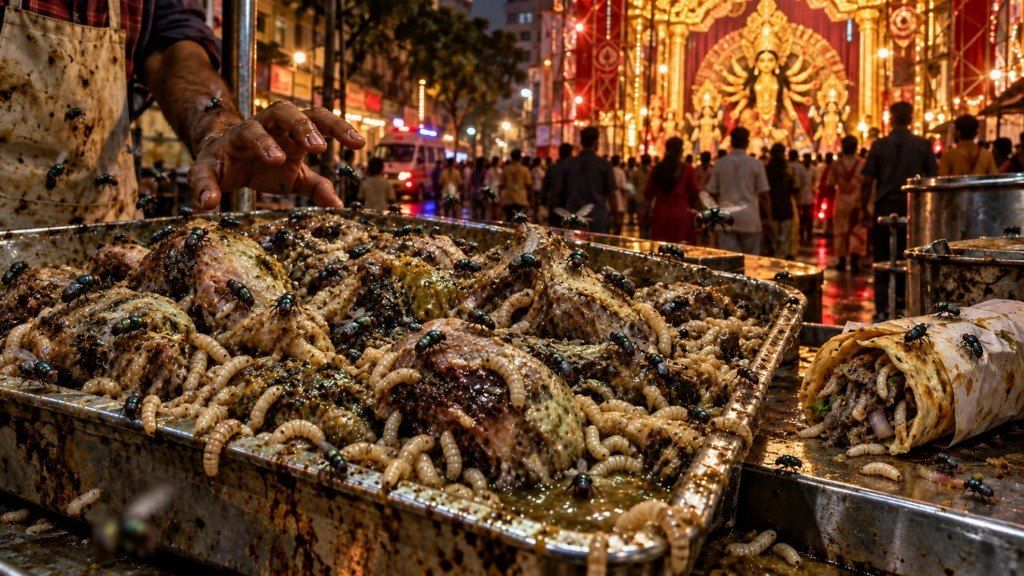
By afternoon the warnings were spreading. So were denials, counterfeit assurances, accusations against innocent vendors. Some shops closed. Crowds battered the shutters. Others sold everything they had because owners were frightened, greedy, disbelieving, or already unable to stop themselves.
In one apartment, a retired teacher padlocked the kitchen and swallowed the key. His wife called for help while he sobbed that he could not trust himself with it.
Across the landing, a young man spooned syrup into his unconscious father’s mouth, convinced the old man was weakening because he had not eaten.
The city kept performing its small acts of care. It had not yet learned which ones could kill.
At dusk, Rupa found her father beside the washbasin, holding his mouth open with both hands.
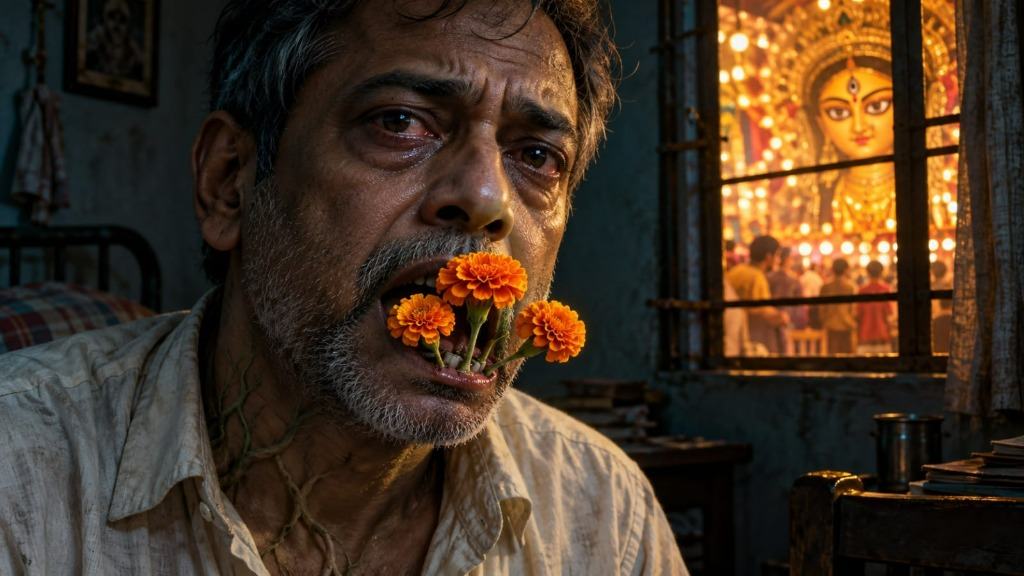
A tooth lay in the basin. Blood ran down his chin.
“It was loose,” he said thickly.
Behind the empty socket stood a white, translucent projection. It was too soft for a tooth. As they watched, it divided along a wet seam.
The two halves stroked one another.
Haripada began to scream. He remained standing, hands carefully cupped beneath his chin so he would not dirty the floor.
When they reached the hospital, Basanti was dead.
Chaiti had spent the last hour refusing her mother’s pleas for sweetness. Now she sat with a paper cup of water cooling between her hands.
“She said I was punishing her for Mili.”
Ishani had no sentence that could survive being spoken into that.
Outside, the evening aarti began. Through the windows came bells, conch shells, and an amplified voice asking the Mother to protect her children.
Haripada turned his face to the wall.
“Rupa,” he whispered. “Whatever I say later, remember I told you now. Don’t let me eat.”
Ashtami — The Blood Offering
The foundation’s announcement said its festival meals were safe.
People wanted that to be true. They had stood through anjali with empty stomachs, palms joined around flowers. They were tired of frightening messages, of contradictory voices issuing instructions from phones. Here was a familiar pandal, a familiar priest, food offered beneath the goddess’s open eyes.
Rupa had learned that morning that an order her father promised before the closures had already been collected. Other donations had arrived too. She ran from the hospital because nobody was answering the committee’s number.
By the time she reached Mr. Chatterjee, his grandson had swallowed three spoonfuls.
“Spit it out, Riddhi.”
The boy stared at her.
“Now.”
Mr. Chatterjee caught her wrist. “What’s wrong with you?”
Behind him, the young woman’s husband began calling for a doctor.
Someone shouted that the food was poisoned.
Someone else shouted that there was a bomb.
The crowd moved toward an exit hidden behind decorative cloth. People at the front stopped against a bamboo barrier. People behind them continued moving because they could not see the barrier, only an apparent space into which escape was flowing.
Rupa grabbed Riddhi under the arms.
Mr. Chatterjee was driven sideways. She saw his hand catch a bamboo pole and hold. His wedding ring flashed. Then his shoulder turned farther than a shoulder could turn, and his face emptied of everything except surprise.
Rupa tried to reach him. A man fell between them. Another stepped on his back. The pole broke with a dry report, and Mr. Chatterjee disappeared.
Riddhi screamed for his grandfather.
She lifted him onto the serving table and climbed after him. Below them, bodies pressed together so tightly that several remained upright after losing consciousness. A woman’s mouth moved against a stranger’s neck. She was asking for air. Rupa could see the shape of the word.
On the far side of the pandal, people were still eating.
They bent over the overturned payesh basin, scooping from the floor. One man crawled past a bleeding woman to reach it, then turned back, understood what he had done, and tried to pull her free with the same milk-covered hands.
The canopy sagged.
Its first falling lights looked almost festive, a bright descending curve. Then the wiring dragged the frame sideways. Plywood broke over the crowd. A length of bamboo punched through the cheek of a volunteer Rupa knew as Bappa, a schoolteacher who ran free arithmetic lessons behind the shop.
He stood beneath the wreckage with the broken shaft protruding beside his mouth. He tried to speak. Blood bubbled around the wood.
She climbed down with Riddhi clinging to her and took Bappa’s hand. He squeezed twice. Then his weight came into her arm, much heavier than she expected.
Near the altar, a brass container of sindoor overturned. Red powder drifted onto wet blood and gathered in little dry islands. Hibiscus petals stuck to the exposed ribs of a man pinned beneath a fallen arch. The goddess looked over him with the expression her maker had finished weeks earlier, when the worst anticipated trouble was rain.
Arko reached them through the service lane. He had come looking for Rupa after the hospital called.
Together they found a gap behind the stage. They passed Riddhi through first. Rupa returned for Bappa, although Arko said her name in a way that meant there was no point.
She would remember hating him for being right.
Beyond the pandal, an ambulance sat motionless in the crowd. Its driver was leaning on the horn and crying. Behind its rear window a hand slapped the glass, stopped, and slowly slid out of sight.
At Shantimoy, Ishani worked until the ridges of her mask had become cuts.
There were crush injuries, overdoses, burns, people who had been beaten while trying to buy food. There were patients with white growths under their nails who could describe exactly how the metal bedrails tasted.
A woman asked Ishani to remove her wedding ring. Her finger had swollen around it. Beneath the skin, pale little tongues pressed toward the gold.
The woman watched Ishani’s face.
“I’m still here,” she said.
“I know.”
“Tell my husband. He keeps looking at the door.”
Rupa found her father’s bed empty.
The foundation had offered an overflow ward with power, oxygen, and transport. Haripada and eleven other patients had gone with a nurse. At the time, Ishani had been trying to keep a crushed teenager alive. The receiving facility had confirmed the beds.
Now its number rang without being answered.
Chaiti took Riddhi to a chair beside the nurses’ station. When he asked for his grandfather, she did not say he would come soon.
She gave him water and sat beside him.
By midnight, the hospital’s refrigerated mortuary was full, then the room outside it. At Nimtala, firelight reddened the undersides of smoke that would not lift. The river carried broken thermocol, flowers, and the flickering reflections of cremation fires.
In Kumartuli, an unfinished clay hand rested on a shelf, palm upward, waiting for a body.
Across the city, people hid food from the people they loved.
Navami — The City That Eats Itself
In March, Nirmal Lahiri had looked at a map of Kolkata and found his existing business embarrassingly small.
Customers sought out narcotics. They could be arrested, frightened away, persuaded to stop. He wanted the people who would never seek him out: grandparents, office clerks, men who congratulated themselves on having no vices.
He wanted ordinary life to bring them to him. For months, his syndicate had been contaminating sugar bound for the city with fentanyl and a second substance. By Puja, it was inside foods made by people who would sooner have poisoned themselves than harmed their customers.
The fentanyl was real. The second substance, called M-9 in his private papers, belonged to a discovery that should have been impossible. Its creators had found that sweetness could be made to arrive carrying the intimate force of a cherished memory. They had mistaken that first effect for the limit of what they had made.
Lahiri had purchased their silence when the later observations began.
He did not need to understand them. He needed the city to want another mouthful.
On Navami morning, he watched his wife pull a strip of translucent tissue from inside her cheek.
She held it between two fingers. It trembled independently of her hand.
“Nirmal,” she said. “What is this?”
He called for the doctor he had retained for himself.
The doctor was already dead in an upstairs bathroom, face lowered into the little bowl of sugar set out beside his tea.
Downstairs, two of Lahiri’s guards were fighting over a packet of biscuits. A third sat on the steps with a gun across his knees and blood on his shirt. He had bitten through his lower lip. He kept apologizing to someone on his phone, though the call had ended.
The overflow ward occupied the rear wing of Lahiri’s riverside residence. He had summoned the patients because some had survived longer than his own people. His staff took observations, demanded information, promised treatment. The nurse who objected was locked in with them.
There was no treatment waiting.
By afternoon, his wife had stopped calling his name.
Across Kolkata, water pumps failed where power failed. Buses stood abandoned in intersections. Some neighborhoods organized kitchens using supplies they could account for; elsewhere, people smashed open grain shops and carried away food they could not know was safe.
Not everyone who craved became violent. Many sat with their hands under their thighs and begged neighbors to stay with them. Others attacked those neighbors. Terror moved through the same lanes as generosity, entering the same rooms.
Arko’s old source finally called from Lahiri’s property.
Amal Saha had managed charitable accounts. He had also signed things Arko suspected he would one day wish he had not signed. Now his own son was dead, and he had spent the night reading the papers he once preferred not to read.
He sent financial records, correspondence, and a video of a researcher reporting to Lahiri.
Rupa and Ishani watched it on Arko’s cracked screen.
The woman in the video looked exhausted.
“The opioid effects are one emergency. M-9 is another. We cannot explain these structures. They don’t follow human anatomy. We’ve observed sensory responses in tissue where those senses cannot exist.”
She held up a photograph, then lowered it as though suddenly ashamed to have taken it.
“Patients are describing memories that belong to other patients. We checked. They couldn’t have known these things. You have to stop this.”
Lahiri’s voice came from offscreen.
“Can they stop wanting it?”
The woman stared at him.
The next recording was dated weeks later. In it, she was no longer present. Lahiri approved continuing the scheme despite the deaths already reported to him.
Rupa listened twice. She needed to hear a misunderstanding. There was none.
Arko sent copies to other reporters and a police contact. Connections kept failing. Two recipients acknowledged getting part of the material. He left the rest uploading.
Then Amal sent a photograph of the ward.
Haripada sat on a mattress with cloth tied around his hands. His jaw had swollen. Rupa recognized the shirt she had bought him last winter, the one he saved for occasions on which other people might photograph him.
Below the picture came a message.
He keeps asking whether you closed the gas.
They left near dusk. Ishani put another doctor in charge of what remained of her ward. Chaiti stayed with Riddhi and the patients who could still swallow water. She had begun writing their names on cups.
“Will you bring him back?” she asked Rupa.
“I’ll try.”
They passed a deserted pandal where the soundtrack continued from a battery. In the goddess’s shadow, a man was striking another man with a broken chair. A woman held the attacker’s shoulders and shouted his name with the stubborn conviction that he might still answer to it.
Farther north, rain flattened shiuli flowers into the gutter. Rupa stepped over a sweet box printed with two welcoming hands.
From inside a shuttered house came a child’s voice: “Ma, I’m hungry.”
They stopped.
Then an adult voice said, “That isn’t my daughter. Please don’t open the door.”
They stood there until the voice explained that his wife was speaking in the voices of people she had never met. She was alive. He was with her. He had water. He could not let anyone else in.
They kept walking.
Rupa had begun to understand how many things she would have to live with if she lived.
Dashami — The Immersion
It took most of the night to cross a distance they could once have walked in forty minutes. Streets ended in barricades, fires, crowds that drove them back. Near dawn, they reached the river.
A handful of men were carrying a small Durga toward the ghats. One limped. Another had wrapped a towel around his bleeding hand. The clay face tilted above their shoulders, calm under a crown repaired with tape.
“Aschhe bochhor abar hobe,” somebody said weakly.
Next year, again.
Nobody answered, but they kept carrying her.
Lahiri’s house stood behind a high wall darkened by rain. People outside the front gate were shouting for medicine. Someone had told them an antidote was inside. The rumor had acquired the authority of a promise.
Amal let the three of them through a service entrance. One of his eyes was swollen shut.
“The patients are at the back. There’s a launch at the landing. Take whoever can be moved.”
“And you?” Arko asked.
Amal looked toward the voices beyond the wall.
“I’ve been telling them to wait.”
In the rear ward, the nurse, Sefali Das, had kept eight of the twelve patients alive. She had written their names on strips torn from a bedsheet. Without records, she was afraid they would become unidentifiable things carried out of a rich man’s house.
Rupa found Shibu first. He was shivering, but the swelling in his mouth had diminished. He recognized her and started apologizing for eating from the tray.
She knelt and held his face.
“You did nothing wrong.”
Then she saw her father.
Haripada sat against the wall. His shirt had been cut open. Beneath his ribs, pale tissue protruded through ruptured skin in delicate pleats. Each pleat carried rows of wet, white nodules. When he breathed, they opened.
The smell was the warm milk smell of the shop before dawn.
He had bound his hands himself. The cloth was red where he had pulled against it.
“Baba.”
His eyes found her immediately. Nothing about that recognition had changed.
“You closed the gas?”
“Yes.”
He nodded, relieved.
From the torn place in his chest came a woman’s voice.
“Rupa, wash your hands first.”
Her mother’s voice. The exact small impatience before dinner.
Haripada began shaking his head.
“Don’t listen. It does that.”
Ishani examined him without allowing her expression to tell Rupa what her hands discovered. The white growth had extended beneath his body and joined the fabric of the mattress. When she lifted its edge, he screamed and fresh blood spread underneath him.
She put it down.
A gun struck the doorframe.
Lahiri stood in the entrance, holding a little girl by the hand. Rupa knew his face from festival banners. In person he looked smaller, his silk kurta stained at the collar.
“My granddaughter first.”
Tithi was nine. She had bitten the inside of her mouth until blood covered her teeth, but she was breathing and watching the adults. Lahiri’s hand tightened when Ishani approached.
“Then me. The boat is mine.”
Arko raised his phone.
“The records are out. People know.”
Lahiri stared at the screen, then at Amal, who had followed them.
He fired.
Amal folded beside the doorway. For a moment he seemed to be sitting down. Then blood spread across his trousers from a wound high in his thigh, and Ishani was on her knees beside him.
Arko lunged for the gun. The next shot struck the wall. Plaster blinded Rupa. She heard Tithi screaming and a heavy blow, then saw Arko on the floor with his scalp open.
Lahiri lifted the pistol toward him.
On the table beside the door stood a porcelain sugar bowl.
Rupa took it in both hands and struck Lahiri across the face.
The bowl broke. His cheek opened from mouth to ear. White sugar scattered over his chest and stuck to the wet red wound.
He dropped the gun and pressed his palm against his face.
His tongue reached the crystals.
The change in him was immediate and terrible. His eyes closed. For one second his ruined face held an expression of private, almost infantile relief.
Then he began scraping sugar from his cheek into his mouth. Porcelain fragments went with it. Rupa heard them crunch.
Tithi pulled at his sleeve.
“Dadu. Stop.”
He knocked her aside without looking at her.
Beyond the ward, glass shattered. Smoke entered beneath the door. Amal gasped that Lahiri’s men had been burning records in the downstairs office. Now fire had reached the stairwell. Outside, the crowd, seeing smoke and believing the medicine was being destroyed, forced the front gate.
Sefali began moving patients toward the river exit.
Ishani pressed dressings into Amal’s hands. He could still follow instructions. She made Arko stand, then helped him get Amal’s arm across his shoulders. Shibu took the other side.
Rupa went back to her father.
“We have to lift you.”
“I know.”
She pulled the mattress. The pale tissue tightened. Haripada made a sound she had never heard from any living thing. Something tore beneath him, and blood ran across her shoes.
He was still attached to the mattress, the wall, the spreading white folds underneath him. Moving him was pulling his body apart.
Ishani crouched beside her.
“Rupa. We can’t do this here.”
“Then get something. Cut it.”
“He’ll bleed to death.”
“He’s going to burn.”
Ishani did not look away.
Behind them, Tithi was trying to drag her grandfather by his sleeve. He had fallen beside the broken sugar bowl. One hand moved repeatedly between the floor and his mouth.
Rupa could stay with her father. She could refuse this departure, this calculation. But someone had to carry the girl; the others were already supporting patients who could scarcely stand.
She looked at Haripada. She waited for him to make the choice bearable.
He did not.
“Don’t leave me,” he said.
It was his voice. His own.
She kissed his forehead. Smoke had made his skin damp. She tried to tell him she loved him, but the words broke in her mouth and never became words at all.
Then she picked up Tithi.
Her father called her name all the way down the passage.
At the river door, Rupa turned once.
Through the smoke she saw Lahiri crawling toward the ward. He left a broad red smear. Haripada’s torn chest had begun making the small household sounds of another evening: a spoon against a cup, a woman calling someone to eat.
Lahiri followed the sounds.
Rupa shut the door before Tithi could see him reach her father.
The launch’s boatman had been ordered to wait for Lahiri. His wife and son were already aboard, crouched behind the cabin. When Ishani told him Lahiri would not be coming, he helped lift the patients across and cast off without another question.
From the water, the house looked almost peaceful. Smoke rose behind the parapet. A curtain glowed, collapsed, and exposed the orange room behind it.
Rupa watched the window she believed was her father’s until she could no longer distinguish it from the others.
Tithi lay against her, feverish and breathing. Every time the girl moved, Rupa tightened her arms with an anger she had nowhere to put.
At the ghat, the men lowered their little Durga into the Hooghly. Water entered the straw beneath the clay. The painted face tilted backward, receiving the pale morning sky. One of the men stood waist-deep and kept a hand beneath the idol’s head long after it could serve any purpose.
The dhaak had stopped.
Farther along the bank, cremation fires were already being fed.
Amal died before they found a landing away from the crowds. Arko held his hand and asked for the name of someone to call. Amal tried to answer, but too much of him had been lost on the floor of the house.
Sefali read the names on her torn strips of cloth. Seven patients had left the ward alive. She read them again when they reached shore.
Shibu could stand without help now. He steadied another patient. It was a small thing, and Ishani held on to it while she looked for a building they could use, water they could trust, another pair of hands.
Arko’s phone finally filled with acknowledgments. The files had arrived. Other reporters were publishing them. Warnings were reaching neighborhoods where people still had food they could set aside. Somewhere, someone would stop a spoon before it reached a mouth.
Rupa sat on a step with Tithi. The child woke and asked for her grandfather.
Rupa told her he was dead.
She did not tell her what she had last seen.
By afternoon, Chaiti had found a vehicle to bring Riddhi and supplies from the hospital. The two children sat under the same blanket without speaking. Shibu carried water. Sefali washed her hands and began again.
Nobody called these things a recovery.
Then Arko’s editor sent a video from Leicester.
There were other reports too. Dhaka. Birmingham. Toronto. Families, celebrations, sweet foods. The messages had been waiting while Kolkata fought for enough electricity to receive them.
In the Leicester video, a woman stood in an ordinary kitchen. Behind her, a little boy in pajamas cried that he was frightened of the cupboard. His mother kept saying they had never been to India. She had sent the recording to her sister, who had sent it to a doctor, who had asked that somebody find out what was happening in Kolkata.
The woman turned the camera toward the counter.
There was a white bowl of sugar beside a blue mug. Nothing spilled. No blood. The kitchen was clean.
The surface of the sugar sank slightly in the center.
Ishani leaned toward the screen.
A narrow crease formed, like the mark a spoon might leave. It widened. Underneath the dry white grains was something wet and pink.
The mother began backing away.
From the bowl, in a little Bengali girl’s voice, came a patient explanation.
“For the lion. Everybody gives her flowers. Nobody feeds him.”
Chaiti dropped the cup she was holding.
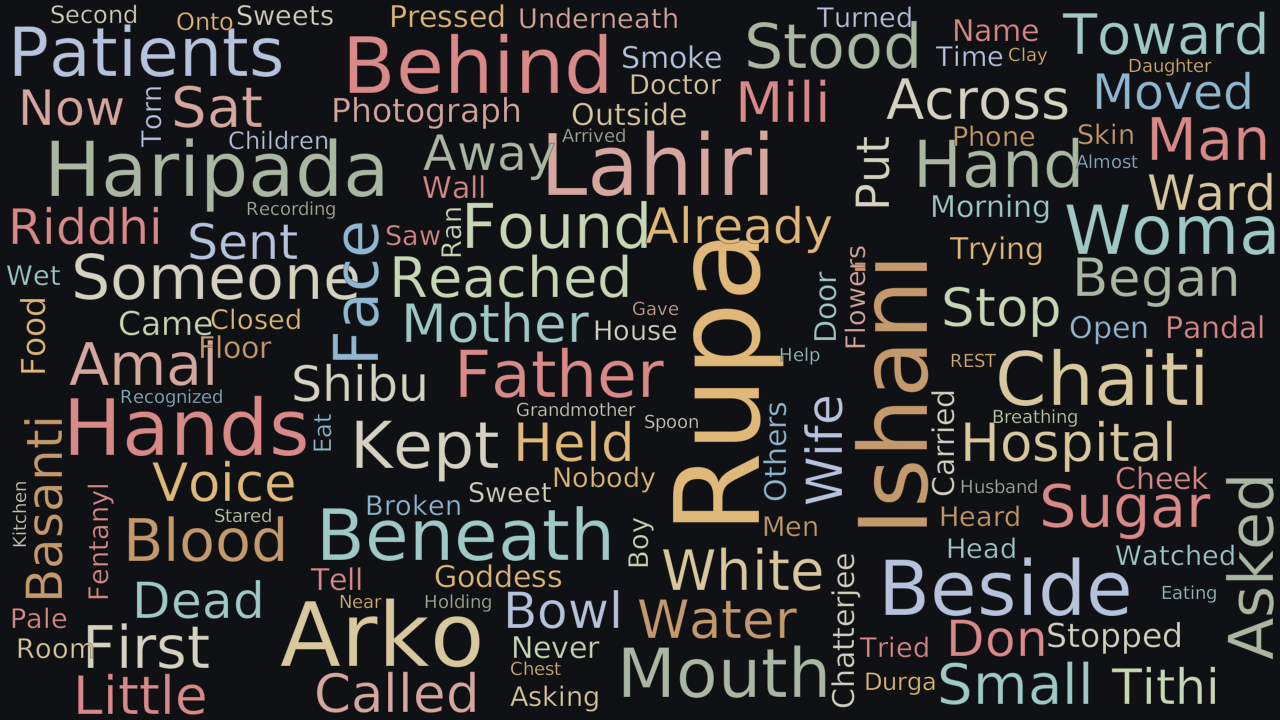
Word Cloud
Related reading
Selected by shared topics and section, with closer publication dates breaking ties.