The Year We Breathed Her In
On this page
Uses the speech voice supplied by your browser or device.

The Year We Breathed Her In
Logline: Thirty years after a dying mason makes Kolkata’s Durga idols seem to breathe, his physician daughter traces a growing constellation of cancers to the city’s most beloved Puja and discovers that the childhood photograph she treasures records the moment her father chose whom to save.
Opening sequence
The woman brought the photograph to her biopsy.
She had been told to bring someone who could take her home. Her husband was dead. Her son lived in another country. The photograph fitted inside the pocket of her hospital folder, behind a receipt for an advance payment.
In it, twelve children stood beneath a goddess.
Their chins were lifted.
Dr. Mithi Dey noticed this before she recognized herself.
Outside, October rain ran down the hospital windows. Somewhere beyond the gate, workers were testing a microphone for the evening’s inauguration. The same two syllables came through the ward repeatedly, flattened by distance.
Maa. Maa.
“That was the beautiful year,” the woman said.
Mithi turned the photograph toward the light. A girl in a yellow frock stood near the lion, lifted above the others by a woman whose fingers were gray with clay. Behind them, a man reached toward the girl’s face.
Her father.
He had been dead for thirty years.
“Do you remember the smell?”
Mithi remembered roses. She remembered her father’s palm against her cheek. She remembered believing, for one afternoon, that something he had made would finally make them rich.
The woman tried to inhale. Her shoulders rose. The movement seemed to stop at her collarbones.
From the corridor came the squeak of a trolley carrying jars.
“They said she was breathing on us.”
Mithi looked again at the children. All those lifted chins. All those obedient, delighted mouths.
She had kept a copy beside her bed through medical school.
The loudspeaker outside crackled. A priest asked the gathering crowd to come closer.
For a moment, the room smelled of roses.
There were no flowers in it.
“Doctor?”
Mithi put the photograph down, washed her hands, and went to help a woman who had once stood beside her breathe.
Character arcs
Nirmal Dey, the mason, fifty-one in 2026. A skilled worker accustomed to disappearing behind his work, Nirmal begins by wanting acknowledgment and ends by treating other people’s suffering as acknowledgment owed to him. He has Bipolar I disorder. His current manic episode magnifies his certainty and religious grandiosity; it does not explain away his planning, lies, or repeated decisions to continue. Earlier episodes included extravagance, sleeplessness, and unfinished enterprises without violence. His final movement is from the fantasy of collective justice to the humiliating knowledge that he wants an exception for his own child. He dies without earning absolution.
Mithi Dey, his daughter, twelve in 2026. The child who counts her father’s breaths becomes a chest physician who listens to other people’s. She initially defends the memory that sustained her through poverty and his death. Her adult moral confrontation consists of submitting the evidence against him, including her own memories, while refusing to let his employers’ negligence disappear behind his notoriety. She accepts neither inherited guilt nor a duty to forgive. At sixty-two, still without a mesothelioma diagnosis, she must decide how much of her fear to pass to a child.
The connected ensemble. Jhuma Pal, twenty-four, is the idol artisan who holds her breath while painting a pupil and believes worshippers lend life to clay. Rehana Rahman, thirty-one, is Nirmal’s physician and later the first clinician to suspect an unusual cluster. Bishu Paul, thirty-four, is a neighborhood photographer who pauses his breathing to steady a picture. Bappa Saha, twelve, is Mithi’s asthmatic friend, later a singing teacher who remains free of mesothelioma while waiting for it. Nandita, another child in their Puja photograph, becomes the patient in the opening. Her mother once told Bishu to capture her looking happy: there were already enough photographs of solemn children.
Principal reversals
The photograph progresses from keepsake to evidence of shared attendance, then to evidence of a rescue. Its familiar crop concealed the direction in which the children were moving.
Jhuma’s apparently generous gesture of lifting Mithi toward the goddess was an attempt to carry her away. Nirmal’s apparent blessing was a frightened effort to cover his daughter’s mouth.
The warning was delivered during the festival. Decades later, its survival in an archive exposes the distance between receiving an allegation and acting on it.
The final historical discovery is that the disaster began before the city had a name for it: some people in the original photograph died under other diagnoses, while others will remain healthy. The group can never be divided neatly into the saved and the condemned.
Five-day plot treatment
I. ষষ্ঠী — Shashthi: The First Breath
2026 / 2056
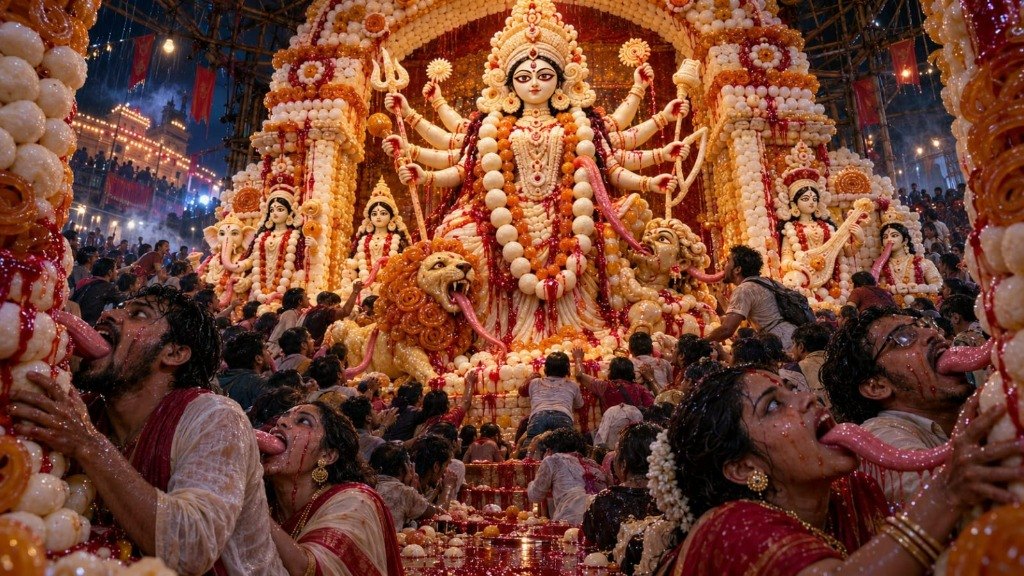
Before dawn in Kumartuli, Nirmal Dey sits on an overturned bucket while the lane wakes around him. Clay sticks to bare heels. Shiuli blossoms lie crushed beside a drain. He can hear workers lifting a goddess through a doorway, everyone giving instructions, nobody able to see the same obstacle.
He helped widen that doorway twenty years ago. No one remembers.
Inside his rented room, his daughter Mithi has arranged his medicines beside a school exercise book. She has drawn a small square for each dose. He has filled the remaining pages with estimates for his fragrance business and increasingly enormous claims about what the Mother has asked him to do.
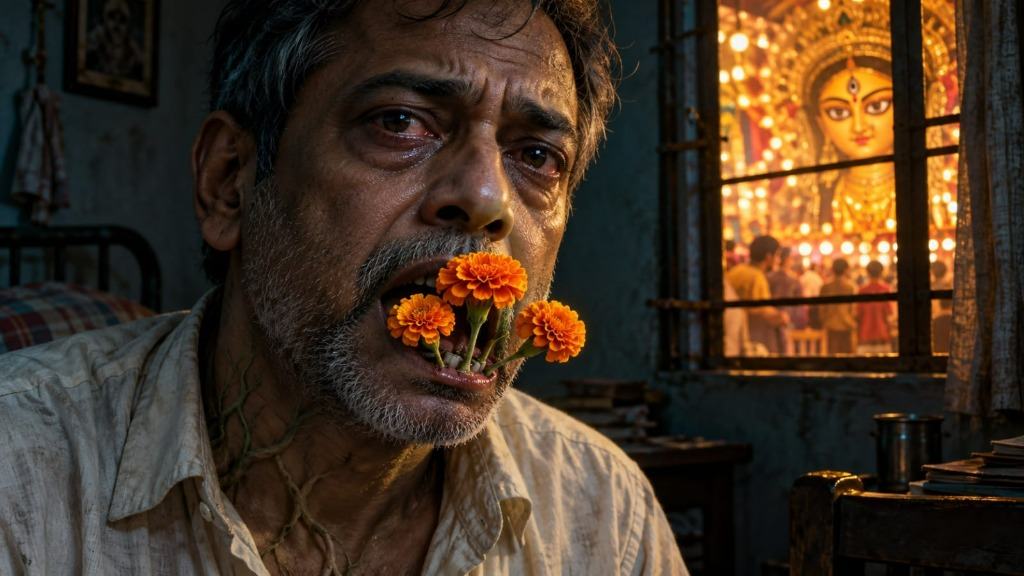
His malignant pleural mesothelioma was diagnosed months earlier. The disease surrounds and constrains the lung; fluid has repeatedly collected around it. Dr. Rehana Rahman has explained the connection to hazardous work undertaken decades ago. Nirmal remembers dust settling into the creases of his lunch. His former employers remember no employment records.
His savings have vanished into treatment. His nights have vanished into a severe manic episode. An aunt has taken Mithi in while Rehana tries to arrange further care. Nirmal misses appointments, speaks over concerned friends, and interprets exhaustion as proof that he has outgrown the need for sleep.
His invention has already escaped his small workshop. Marketed as an electrostatic aroma machine, it offers an illusion organizers adore: fragrance apparently issuing from the idol’s own body. The sealed, battery-powered boxes disappear inside the clay architecture. Their perfumed material contains asbestos. Visitors see only the goddess.
The name is Mayer Nishwas. The Mother’s Breath.
Paid orders accumulated before the festival. Recommendations between committees brought more. Free introductory refills made the offer irresistible. By Shashthi, every available unit has been sold.
At the inaugural pandal, Jhuma Pal objects when the organizer describes their idol as genuinely alive. Faith gives clay its life, she says. An effect cannot manufacture that.
Then the fragrance reaches her, and she smiles despite herself.
Bishu photographs Nirmal standing modestly behind the dignitaries. A sponsor thanks the lighting contractor, the decorators, the police, and the goddess. Nirmal’s name is omitted.
For a few seconds he reaches for his phone. He could tell them to stop.
The applause begins. He puts it away.
Thirty years later, a radiologist opens several scans side by side. The patients differ in age, address, and employment; their pleural abnormalities disturb him. Tissue diagnoses confirm mesothelioma in a subset. He asks Mithi whether anyone has collected histories extending beyond occupation.
Rehana, now sixty-one, brings notebooks from consultations beginning six years earlier. Her first small cluster had been judged insufficient to establish anything unusual in a city with extensive past asbestos exposure. Several patients are already dead.
Three families, questioned separately, remember a novelty Puja their relatives used to discuss. One remembers the phrase “breathing goddess.”
That is a lead, not a conclusion. Much of Kolkata attended Puja in 2026. The physicians begin reconstructing individual histories and seeking comparable patients who had not visited the implicated sites.
Back in the inaugural pandal, a child asks Nirmal whether the goddess will keep breathing after the lights go out.
“Long after,” he says.
In 2056, the radiologist turns off the light box nobody uses anymore. Someone has pinned a festival photograph to it.
II. সপ্তমী — Saptami: The City Inhales
2026 / 2056–2057
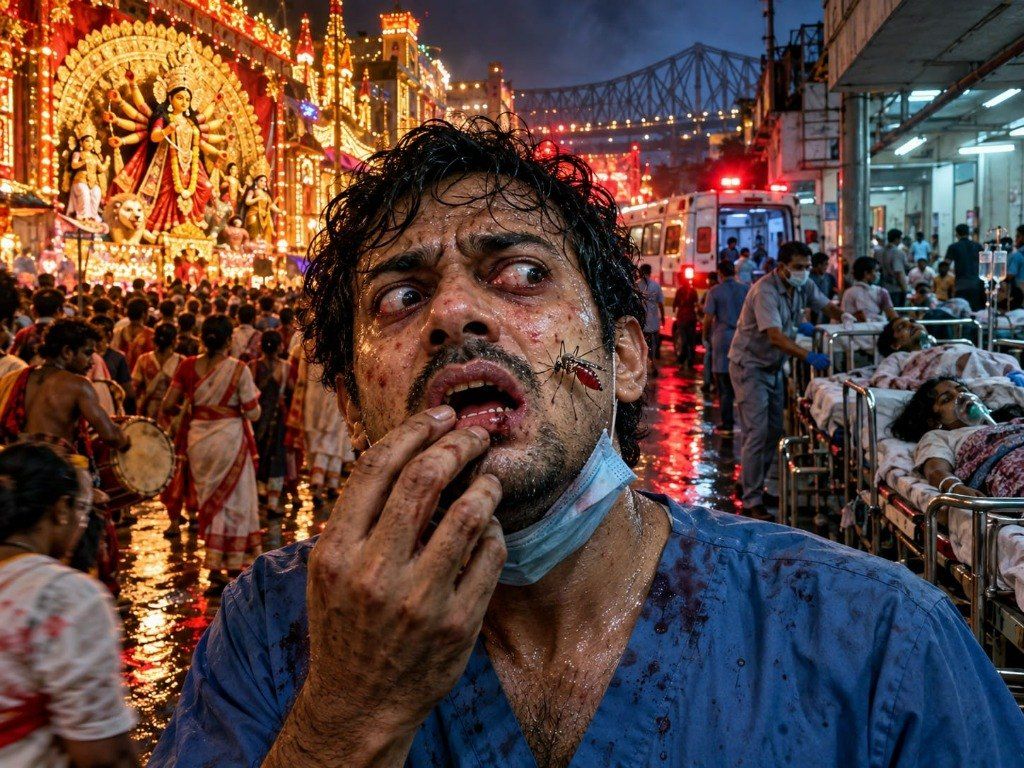
By Saptami night, queues curl past shuttered shops and yellow taxis whose drivers have surrendered to the traffic. Videos promise a goddess whose presence can be felt inside the chest. Visitors disagree about whether her painted lips move. People who smelled sandalwood insist they smelled roses. The disagreements improve the attraction.
Nirmal hears his commercial name spoken by strangers. For the first time, the city wants something he made.
He visits the aunt’s house to leave money for Mithi’s school expenses. She offers him rice, tells him his speech is frightening her, and asks him to stay until morning. He nearly agrees. Through an open window comes a recording of a devotional song interrupted by an advertisement for the breathing idols.
He gets up before finishing his meal.
At Jhuma’s pandal, Bappa’s asthma makes the perfumed crowd uncomfortable. Jhuma takes him into a courtyard while his mother finds his inhaler. He recovers. This episode is ordinary airway irritation, unrelated to the cancer that may emerge much later, but it gives Jhuma a reason to ask the committee to discontinue the fragrance.
They agree to discuss it after the busiest hours.
Bishu, commissioned to document neighborhood children enjoying the festivities, photographs Bappa outside. His mother complains that he has missed the picture with the goddess. Jhuma promises another opportunity tomorrow. The promise will survive in three people’s memories, each wishing she had never made it.
In 2056, Nandita undergoes a pleural biopsy. She was twelve during that Puja. She remembers returning on successive evenings because the fragrance felt like a personal welcome. Now an ordinary walk has become a negotiation with her chest.
The diagnosis is mesothelioma. She asks which breath did it.
Mithi explains that medicine cannot identify a guilty breath, or confidently assign an individual cancer to one occasion. Other exposures must be considered. Nandita hears the uncertainty as an opening through which she might escape.
“Then perhaps the report belongs to someone else.”
The photograph she brings is the one from the opening. Mithi recognizes herself, Jhuma, her father. She contacts Bishu, whose paid commissions have survived in several copied archives after the newspapers stopped buying his pictures.
He supplies dated folders, invoices for the photography, and images showing which pandals advertised Mayer Nishwas. Taken together, these begin to establish attendance and distribution. Nobody claims that a photograph proves what entered a lung.
Nandita dies before the investigation can tell her much more. At her bedside, her mother recalls washing her hair after Puja and smelling roses again when the wet strands warmed against her hand.
“I thought it was lovely,” she says, almost apologetically.
Elsewhere, healthy Bappa cancels a singing lesson after hearing the news. He records himself holding a note, plays it back, and listens for an imperfection he would have ignored yesterday. His doctors find no evidence of mesothelioma. The reassurance has no date far enough in the future to satisfy him.
In 2026, Bishu tells the assembled children to lift their chins.
In 2057, Mithi lifts a scan toward the light.
She has begun dreaming of a chamber made from wet clay, its walls moving inward with every voice outside it calling Maa. She cannot find a door, although she remembers helping someone paint one.
III. অষ্টমী — Ashtami: Pushpanjali
2026 / 2057
On Ashtami morning, thousands wait with flowers cupped in their hands. Beyond the pandal, humidity presses shirts against backs. Inside, the goddess looks cool and remote. The fragrance has become part of what visitors expect from her.
Mithi arrives with her aunt, who wants the girl to have something of Puja besides worrying about her father. Bappa comes too. Jhuma has arranged their promised photograph before the next crowded prayer gathering. She invites the workers’ children into the space normally occupied by patrons and committee members.
Nirmal, watching from behind a pillar, recognizes Mithi’s yellow frock.
For weeks, his imagination has contained a city without individual faces. Now one face makes the entire enterprise briefly comprehensible. He sees the future he has been calling justice, and he wants his daughter removed from it.
From Mithi’s viewpoint, the next moments remain indistinct. Her father appears. Someone lifts her. She sees the goddess from higher than she has ever seen her. The dhak rolls through the floor and into her ribs. Bishu raises his camera. Her father’s hand is warm against her face.
The familiar photograph ends there.
Its full sequence survives.
In 2057, Bishu opens the uncropped files. Mithi has asked for them because the printed image places several future patients together. He clicks through the frames without understanding why she suddenly tells him to stop.
Jhuma’s body is turning away from the idol. Mithi’s feet are swinging toward the exit. Nirmal’s palm covers the child’s mouth and nose for an instant; in the next frame she pulls against it, frightened. His other hand pushes people aside.
The remembered blessing is a rescue.
Mithi has spent thirty years remembering how lovingly he touched her. The love was real. That is what makes the sequence unbearable.
Jhuma, now fifty-five, confirms what the camera cannot establish. Nirmal told her to take Mithi out immediately. Jhuma thought he feared another asthma attack among the children, until she remembered Mithi did not have asthma. She asked whether everyone should leave.
He answered only with his daughter’s name.
Jhuma carried Mithi outside, brought the other children out after her, and insisted that the fragrance at her pandal cease. She made Nirmal promise to warn the other committees. She still knew nothing definite about the material; his selective terror had told her enough to act locally.
What Mithi remembered as a special privilege had been an evacuation. Jhuma’s promise to give working families a place near the goddess had exposed them to a danger she could not have imagined.
“I put you in the picture,” Jhuma says.
Mithi answers, “You took us out.”
Neither can say what either act changed.
The archival folders contain contemporary advertisements identifying Nirmal as the supplier. Mithi discloses the relationship to her colleagues and steps back from decisions about how evidence against him is assessed. She remains a witness and a physician. She cannot remain the private custodian of a comforting story.
The investigation’s central question changes. An unsafe product might explain an exposure. This photograph, supported by Jhuma’s account, suggests that its maker understood a danger he had concealed from everyone else.
Back in 2026, Mithi asks why her father looks angry in their beautiful picture.
He tells her the camera caught him badly.
In the future, the rolling dhak becomes the hammering rhythm of an MRI examination ordered to assess the extent of a patient’s disease. Through the intercom comes an instruction about breathing. The patient tries to obey. Mithi remembers how unquestioningly they all used to obey.
IV. নবমী — Navami: The Goddess Knows
2026 / 2058–2061
By Navami afternoon, Jhuma knows Nirmal has not kept his promise. Other pandals are still advertising the fragrance. She finds him in the workshop, arranging unpaid bills beneath his medical reports as though a sufficiently exact alignment might settle them.
Among the commercial papers is a declaration that the product is harmless to children. He has signed it himself.
She asks what he knows.
His answer wanders through the employers who denied knowing him, the beauty awards won by structures he built, the lunches eaten in dust. He claims the goddess has chosen him to make suffering visible. Jhuma lets him speak until he reaches the children.
Then she interrupts.
“You knew enough to take yours outside.”
He says he never expected Mithi to attend.
Jhuma waits. He hears what he has admitted.
For a moment, the elaborate theology fails him. He understands that the people he has called witnesses are people he has hurt. He describes the concealed danger without giving her a technical explanation. She demands that he accompany her to report it and identify everyone who bought his product.
He agrees. He even puts on his sandals.
Then he asks whether Mithi will hear what he has to say. When Jhuma answers honestly, he refuses to leave. He begins accusing her of wanting to steal his invention. She goes without him.
Her report reaches a police desk that evening. Its language is imprecise: a sick supplier has admitted that his fragrance can cause serious illness years later. An officer records the allegation, requests the supplier’s whereabouts, and says the material will need examination. Jhuma also contacts a local reporter and several organizers directly. Some discontinue the effect; others demand proof.
A brief warning appears amid traffic advisories and festival coverage. It names the product and describes the allegation as unverified. There is no immediate casualty count. By the time attempts are made to retrieve stock from the temporary venues, dismantling and disputes over ownership have already scattered it. The inquiry remains incomplete.
Jhuma keeps her complaint receipt and continues asking what happened to it. Each office can point to something it did and something another office was supposed to do.
In 2058, the complaint and the newspaper brief become crucial corroboration. Investigators also locate unused branded stock among a dissolved contractor’s assets, preserved with purchase records through a long estate dispute. Specialist examination identifies asbestos. Its provenance is scrutinized; one surviving container cannot establish the contents of every sale.
The material evidence joins the distribution records, independent recollections, and a growing epidemiological pattern. Researchers account as far as possible for occupational, household, and other environmental exposures. Their findings support a substantial additional burden associated with the implicated pandals. Individual attribution remains less certain.
Mithi gives a recorded statement. She includes a conversation from Navami night, when her father returned home breathless and frightened. Twelve-year-old Mithi had asked why other people could stay where he would not let her stay.
“You are mine,” he answered.
At twelve, she heard protection. At forty-four, she hears its boundary.
Her moral confrontation unfolds across that distance. In the recording room, she says what she could not have said at his bedside: “That was your reason to warn them, Baba. You knew what a daughter was.”
She submits his papers without removing the records of his employers’ denials. The inquiry must hold both histories. His victimhood cannot excuse what he did; his crime cannot retroactively make the work that injured him safe.
In the workshop’s corner, a small unfinished clay face seems to watch Nirmal. Each time he changes position, its expression appears different. Jhuma, returning with help, sees only the lamp flickering.
V. দশমী — Dashami: Bisarjan, the Last Breath
2026 / 2066–2076
On Dashami, red sindoor settles in the lines of women’s palms. The goddess is prepared for departure. Men test ropes, argue about routes, and lift together. Traffic stalls. A loudspeaker fails midway through a song and the crowd finishes it.
Across the city, most people end Puja healthy and happy. They go home with sore feet, photographs, and plans to return next year. There is no bodily alarm capable of telling them what this week might eventually mean.
Nirmal is hospitalized as his established illness worsens. Rehana treats his distress while others try to clarify Jhuma’s allegation. His capacity to sustain an account fluctuates. He has opportunities to name buyers and explain himself; he spends his clearest intervals asking for Mithi.
She sits beside him and counts his breaths, a habit learned during earlier nights of frightening breathlessness. He asks whether she enjoyed the Puja. She says yes because he looks as though the answer matters more than anything.
He begins to cry. She believes he is sorry he will miss the next one.
He dies within the following week, before a full account is obtained. His death closes nothing for Jhuma. For others, the dying supplier, his implausible claims, and the unproven allegation gradually become a story too complicated to retell at next year’s festivities.
At the river, Bishu photographs Durga’s face tilting toward the water. A wave fills one painted eye. Clay begins to soften around the mouth.
Forty years later, red in a hospital basin recalls the sindoor. An elderly patient has bitten his lip trying not to cry during a difficult conversation. Mithi brings him a clean cloth. He apologizes for staining it.
The catastrophe has acquired institutions: an exposure registry, treatment funds, contested compensation decisions, and annual public hearings. It has acquired profiteers selling impossible certainty. It has acquired people who insist that everyone who attended will die, and people who use a healthy neighbor to argue that nothing happened.
Across the following decade, the registry grows to include thousands of confirmed cases among former visitors and workers. Many more attendees remain well. The investigation establishes an excess above the expected burden, without pretending every registered illness has the same cause. Families sell homes; children leave school to earn; grandparents outlive the people who were supposed to care for them. Clinic queues outlast the buildings in which the clinics began.
Bappa remains healthy. His oldest pupil dies. He resumes teaching, then abandons it, then resumes again. For years he postpones visiting his sister because he wants one more reassuring consultation first. Eventually he goes. The journey is ordinary, and he is furious at how much life his waiting has consumed.
Some affected people live for years with treatment. Others decline quickly. Some die before their histories can be reconstructed. Former visitors are traced in other cities and countries; migration has scattered the exposed population. The damage reaches children born afterward through bereavement, lost opportunities, and years of caring for sick parents.
The final historical reckoning comes through Bishu’s photograph. Researchers trace the twelve children with the surviving families’ consent. Several remain well. Some are being treated. Two died before the connection was investigated, with records too incomplete to establish what killed them. One cannot be found.
Mithi had imagined that discovering the truth would complete the picture. Instead, the picture acquires permanent absences. No future inquiry will produce the complete roll call she wants.
In 2076, fifty years after the original Puja, she is sixty-two and has no diagnosed mesothelioma. She brings her granddaughter to a small neighborhood pandal. Jhuma’s former apprentices made the idol. The program names the workers alongside the donors.
Near the entrance is a copy of the old group photograph, shown whole. The accompanying account includes the warning, the rescue, and the uncertainty about individual outcomes. Mithi has insisted that the children keep their names.
The city celebrates. People eat, quarrel, sing, and complain about the weather. A boy practices the dhak badly until someone older adjusts his grip. For several minutes Mithi forgets to listen to her own breathing.
Then her granddaughter stops before Durga.
“Dida. She smells nice.”
Roses.
Mithi looks for their source. Someone moves behind her; a garland sways; the scent weakens before she can place it. Above the child’s lifted face, the clay goddess appears to lean forward, although nothing has moved except the lights.
The little girl inhales again and smiles.
For now, she has been to a beautiful Puja.
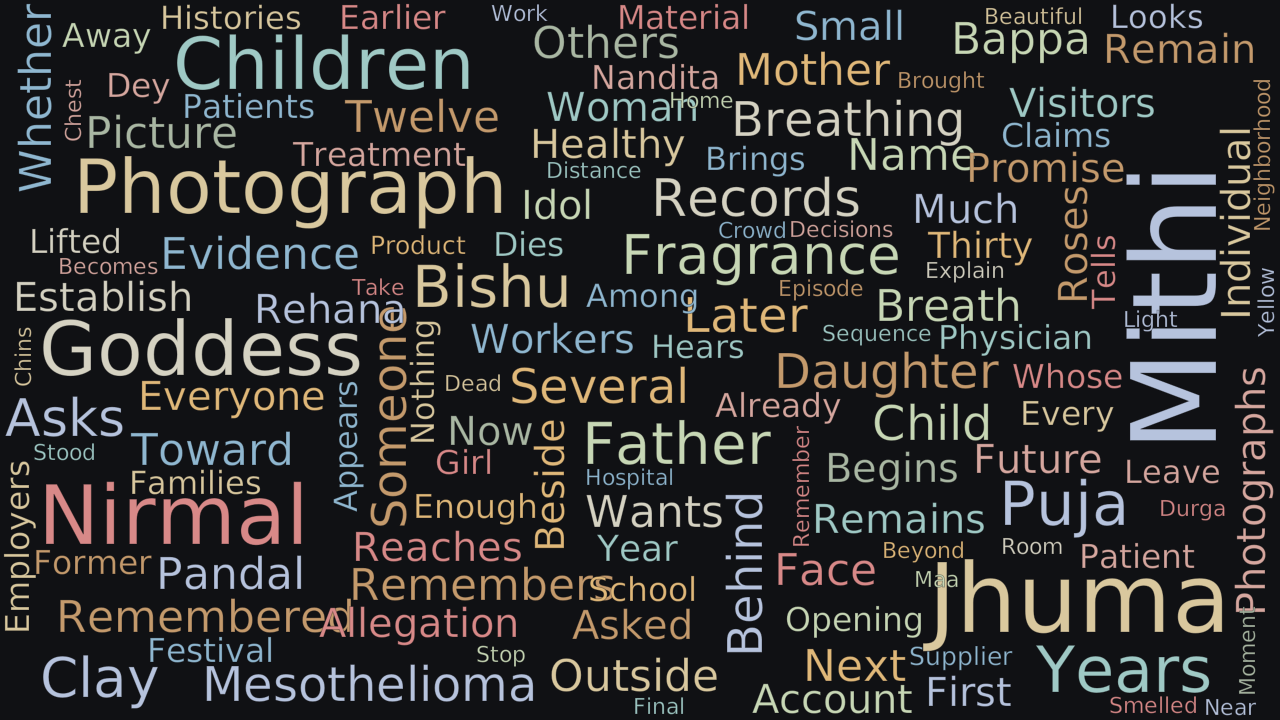
Word Cloud
Related reading
Selected by shared topics and section, with closer publication dates breaking ties.