Twerky Vishnu From Vapor
Uses the speech voice supplied by your browser or device.

The first time I saw a man twerk for Bharat Mata, 2009, standing in the gelatinous August heat of a Calcutta street that smelled of jasmine garlands and diesel exhaust in equal, suffocating measure. He was not twerking, of course, not technically, not in the anatomical sense that would require gluteal agency and rhythmical intent, but there he was, this paunchy gentleman in a kurta that had surrendered to perspiration, gyrating his pelvis in a manner that suggested both devotional ecstasy and acute lower back pain, while a loudspeaker the size of a small apartment building vomited forth “Aaja Nachle” at a decibel level that could liquefy birds in mid-flight. The tricolor was everywhere, draped, wrapped, waved, worn as turbans and tied to motorcycle handlebars, flapping from bamboo poles held by children who had been told, and told again, and told until the telling became a kind of neurological scar tissue, that this was love, this was duty, this was the very marrow of what it meant to be Indian, and I stood there, twelve years old, already a professional skeptic thanks to my mother’s side of the family and their congenital inability to believe anything without three independent sources and a notarized affidavit, and I thought: this is not patriotism, this is choreography, and the choreographer is drunk.
That was many years ago, and the pelvic thrusts have only grown more elaborate, more generational, more algorithmically optimized for maximum engagement. I have watched the parade evolve from the quaintly embarrassing to the spectacularly vacant, from the local club’s Independence Day tableau featuring a cardboard cutout of Subhas Chandra Bose looking like he had just smelled something unfortunate, to the current digital carnival where every August and January becomes a kind of compulsory performance art, a nationwide flash mob of mandatory feeling, where the flag is not so much a symbol as a filter, an Instagram overlay, a way to signal virtue without the exhausting labor of actually possessing any. The young ones now, the Gen Z specimens with their impeccable cheekbones and their attention spans measured in Planck times, they do not merely wave the flag, they become the flag, they dissolve into it, they perform a kind of patriotic mitosis where the self divides into smaller and smaller units of jingoistic content until what remains is not a person but a hashtag, a trending topic, a dopamine hit wrapped in saffron, white, and green.
And the vocabulary, the vocabulary is what kills me, what burrows under my fingernails and festers there. Ask any of these twerking devotees what they mean when they say “Bharat Mata Ki Jai,” and watch the eyes glaze over with the particular opacity of a Windows 95 screensaver, watch the mouth open and close like a landed carp gasping for the water of coherent thought. They cannot tell you, because they have never been asked to tell you, because the entire architecture of this nationalistic theater depends on the absolute prohibition of asking, on the substitution of interrogation with incantation, of dialectic with diaphragm. Vishnu, they will tell you, if pressed, if cornered like a rat in a drainpipe, Vishnu is the preserver, the cosmic maintainer, the blue-skinned deity reclining on his serpent bed while the universe exhales and inhales in the rhythm of his dreams, and I want to grab them by their carefully curated facial hair and scream: Vishnu is vapor, Vishnu is a concept, Vishnu is a linguistic event that occurred in Sanskrit approximately three thousand years ago and has been decomposing ever since, and your relationship to him is not devotional, it is decorative, it is the spiritual equivalent of a bumper sticker, and the bumper is rusted, and the sticker is peeling, and the car is on fire.
But they do not know this, these generations of my countrymen, these processional pilgrims marching in lockstep to a drumbeat they cannot hear because their ears are stuffed with the cotton wool of inherited certainty. They do not know that the word “jingoism” itself emerged from a British music hall song of 1878, “By Jingo,” a jingo, a euphemism for Jesus, a way to sing about war without offending the delicate sensibilities of the Victorian middle class, and how perfectly, how exquisitely, how cosmically appropriate that we should have inherited this particular neurosis from our colonizers, this need to wrap our territorial anxieties in the swaddling clothes of religious invocation, to make our expansionism sound like hymnody, our xenophobia like piety. We learned at the knee of the masters, and then we surpassed them, we out-Britished the British, we took their jingo and we made it dance, we made it twerk, we made it “Aaja Nachle” across the corpse of critical thinking while the loudspeaker grew larger and the birds continued to liquefy.
The political piss fence, and oh, what a fence it is, what a magnificent construction of rusted rhetoric and barbed wire bad faith, the fence that separates Us from Them, the fence that defines the motherland not by what it includes but by what it excludes, not by the warmth of its embrace but by the sharpness of its rejection. And the motherland, that curious feminine construction, that geographical vagina dentata, demanding devotion, demanding blood, demanding the perpetual performance of filial piety without ever once offering the milk of human kindness in return. I have lived in the United States for fifteen years, I have worked in the bowels of their healthcare research apparatus, I have watched their own jingoistic spasms with the weary eye of a man who has seen this particular film before, who knows all the plot twists and the tragic endings, and I can tell you with the confidence of comparative exhaustion that there is something uniquely Indian about our particular brand of patriotic performance, something that combines the British gift for institutional pageantry with the American talent for commodified emotion and then adds that special subcontinental spice, that masala of spiritual inflation, where every political disagreement becomes a theological crisis, every policy debate a test of cosmic fidelity.
And the generations, the generations I have watched, the ones who marched in the parades of my childhood with their cardboard Bose and their diesel jasmine, and the ones who march now with their Instagram stories and their carefully curated outrage, they are not different, they are the same, they are the eternal recurrence of the same pelvic thrust, the same devotional gyration, the same inability to articulate Vishnu from vapor, to distinguish the preserver from the preserved, the dancer from the dance, the flag from the cloth. They do not know the etymology of “nation,” from the Latin natio, a birth, a tribe, a breed of animals, and how fitting, how biologically precise, that we should behave as a breed, as a pedigree of unquestioning loyalty, when what the concept demands, what it has always demanded, is the difficult, the exhausting, the perpetually unfinished labor of critical citizenship, of the citizen as questioner, as skeptic, as the one who refuses the twerk, who stands still in the gelatinous heat and says no, this is not love, this is choreography, and the choreographer is drunk, and the music is too loud, and the birds are melting, and I will not dance, I will not dance, I will not dance.
But I am bipolar type II, and my refusals are suspect, my stillness is probably just the depressive phase, my skepticism is perhaps just the manic conviction that everything is connected and everything is false, and who am I to stand apart, to claim the high ground of critical distance, when I too have twerked, when I too have waved the flag, when I too have felt that hot surge of unearned belonging that passes for patriotism in the bloodshot eyes of the mob? I am not innocent, I am not pure, I am complicit in the choreography, I have danced the dance, I have sung the song, I have worn the filter and posted the story and felt the dopamine, and the only difference, the slender, the fragile, the probably meaningless difference, is that I have known, I have always known, even in the midst of the gyration, that Vishnu is vapor, that the motherland is a fence, that the parade is a prison, and that the music, the endless, the deafening, the bird-liquefying music, is not a call to devotion but a distraction from the question, the only question that matters, the question that no loudspeaker can drown out, the question that twerks in the silence after the song has ended: what, in the name of all that is holy and all that is profane, in the name of the vapor and the fence and the melting birds, what exactly are we celebrating?
P.S. References: The etymology of “jingoism” derives from the 1878 British music hall song “By Jingo” by G. H. MacDermott; “nation” from Latin natio (birth, tribe); Vishnu as preserver deity from Vedic Sanskrit tradition. The “Aaja Nachle” reference is to the 2007 Bollywood song by Sunidhi Chauhan, frequently appropriated for patriotic dance performances across Indian public celebrations.
#Calcutta #Kolkata #suvroghosh #Nationalism #Patriotism #IndianPolitics #Jingoism #GenerationalCritique #PoliticalSatire #Identity #CulturalCommentary
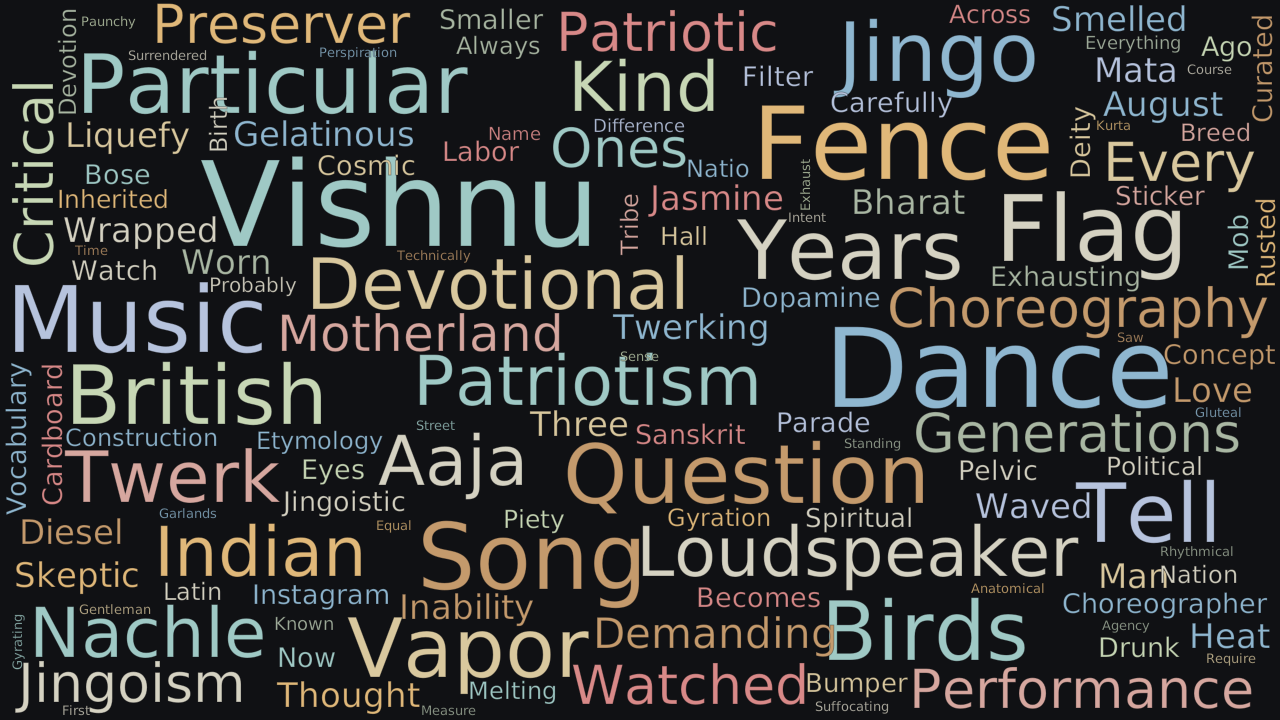
Word Cloud
Related reading
Selected by shared topics and section, with closer publication dates breaking ties.