The Great Meme Reset and My Colon: A Bipolar Monologue from the Bowels of Calcutta
Uses the speech voice supplied by your browser or device.

I am sitting on the toilet, which is, let us be perfectly candid, a porcelain throne of abject humiliation and philosophical revelation, staring at my phone which is displaying a TikTok video about the so-called Great Meme Reset of 2026, that curious internet phenomenon wherein the youth of the world, or at least those portions of it that have nothing better to do than scroll through algorithmically curated garbage, have decided that as of January 1st of this very year, all memes should revert to their 2010s glory days, banishing the brain rot and AI slop that has apparently infected the collective digital consciousness like a particularly aggressive strain of dysentery, and I am thinking, with the kind of manic intensity that only a fifty-one-year-old Bengali man with a history of digestive complaints and literary pretensions can muster, that this reset is precisely the kind of grandiose, futile gesture that I would have made in my youth, back when I believed that words could save us, that a well-crafted sentence could halt the inexorable march of entropy, that the proper arrangement of syllables might somehow prevent the inevitable collapse of civilization into a morass of skibidi toilets and sigma males and whatever other linguistic atrocities Gen Alpha has conjured from the festering depths of their underdeveloped frontal cortices.
But I am not young anymore, and the toilet seat is cold against my haunches, and my colon, that treacherous organ which has been the site of so many of my life’s most poignant defeats, is making noises that can only be described as symphonic in their complexity and alarming in their implications, and I am reminded, with the kind of involuntary clarity that Proust might have recognized had he been born in Calcutta rather than Paris and had his madeleine been a lukewarm cup of over-brewed cha from the stall across the street, that the word “meme” itself comes from the Greek “mimema,” meaning “that which is imitated,” coined by Richard Dawkins in 1976 in his book “The Selfish Gene,” which I read as a young man in the reading room of the National Library on Belvedere Road, sitting under a fan that rotated with the lethargic indifference of a civil servant who knows he cannot be fired, and I thought then, with the kind of depressive certainty that has never entirely left me, that we are all merely vessels for the transmission of cultural units, that our individuality is an illusion, that we are no more autonomous than the bacteria currently staging what feels like a coup d’état in my lower intestine.
And yet, and yet, here I am, Suvro Ghosh, a man who once named his blog “OmnibusOmnia” with the kind of grandiose, bloated ambition that would make a pufferfish seem modest by comparison, a name derived from the Latin “omnibus” meaning “for all” and “omnia” meaning “all things,” which in Bengali becomes “অমনিবাস” and which I liked because it sounded like the kind of fat, decorated book that people might respect even if they never read it, much like they respect me without ever truly understanding the depths of my dysfunction, and I am thinking about how the internet has become a kind of omnibus itself, a vehicle carrying all of us toward destinations we never chose, driven by algorithms that know us better than we know ourselves, and how the Great Meme Reset is merely another stop on this journey, another futile attempt to impose order on chaos, to stuff the genie back into the bottle, to pretend that we can return to a simpler time when memes were just pictures of cats with misspelled captions rather than the hyper-compressed, irony-poisoned, AI-generated slurry that now passes for cultural expression.
My stomach gurgles, a sound like the dying breath of a small mammal, and I am transported back to my childhood, to the cramped apartment in South Sinthee where I grew up, where the toilet was a communal affair and one learned to perform one’s ablutions with the speed and discretion of a jewel thief, where the walls were thin and every intestinal rumble was a matter of public record, where my mother would stand outside the door asking if I was alright, if I needed more water, if I had eaten something that disagreed with me, and I would sit there, mortified, wishing for nothing more than the kind of omnipotence that would allow me to dissolve into the ether, to become truly omnipresent, present everywhere and nowhere at once, which is, I suppose, the closest thing to invisibility that a god might experience, and I am thinking about how the prefix “omni” haunts me, how it follows me like a particularly persistent creditor, how it appears in “omniscient” and “omnipotent” and “omnipresent,” all words that describe attributes of the divine that I conspicuously lack, and how the Bengali word “অমনি” means “for no reason” or “just like that,” which captures my entire existence with a precision that is both devastating and darkly comic.
The TikTok video continues, some young person with more enthusiasm than sense explaining how Big Chungus and Nyan Cat represent a purer form of internet culture, and I am struck by the kind of nostalgia that is not sentimental but rather elegiac, the recognition that something has been lost that can never be recovered, much like the hair that once adorned my scalp or the waistline that I maintained through my thirties, and I am thinking about how memory functions as architecture, how the rooms of my past are still inhabited by versions of myself that I no longer recognize, how the bathroom of my childhood and the bathroom of my present are connected by a corridor of shame that stretches across decades, and how the internet, for all its promise of connection, has only served to make this corridor longer, more labyrinthine, more populated with the ghosts of dead forums and abandoned blogs and usernames that I can no longer access because I forgot the passwords and the email addresses associated with them have long since been deactivated.
I wipe, a gesture that feels both mechanical and profound, and I am reminded of the etymology of “toilet,” which comes from the French “toile,” meaning “cloth,” originally referring to the cloth used to cover the shoulders while dressing or the cloth laid on a table during grooming, and how the word has traveled from elegance to abjection, from the court of Louis XIV to this cramped water closet in Calcutta, much like my own aspirations have traveled from the grand to the grotesque, from wanting to write the great Bengali novel to writing blog posts about my digestive system while sitting on a toilet, and I am thinking about how the internet has accelerated this process of degradation, how it has turned all of us into performers in a grotesque carnival where the highest aspiration is virality, where the measure of worth is not the depth of thought but the speed of transmission, where a meme spreads like a disease following the SIR model—susceptible, infectious, recovered—and how we are all, in our way, carriers of this infection, vectors of cultural transmission whether we will it or not.
I flush, and the sound is like the roar of a distant ocean, or perhaps like the sound of my own voice when I try to speak and find that I have nothing to say that has not already been said, that has not already been memed, that has not already been compressed into a format suitable for consumption by minds that have been trained to expect novelty every fifteen seconds, and I am thinking about how the Great Meme Reset is not really a reset at all but rather a kind of recursive loop, a return to the past that only serves to highlight the impossibility of return, much like my own attempts to recapture the feeling of sitting in the National Library reading room, the fan turning overhead, the pages of Dawkins’s book turning under my fingers, the sense that I was on the verge of understanding something fundamental about the nature of existence, only to find that understanding, like a particularly elusive bowel movement, remains just out of reach, teasing me with its proximity while refusing to yield to my straining efforts.
I stand, my knees creaking in protest, and I catch sight of myself in the small mirror above the sink, and I am confronted with the face of a man who has seen too many mornings, who has drunk too many cups of cha, who has carried too many words in his head like stones in a pocket, weighing him down, dragging him toward some bottom that he cannot see but can feel with the kind of certainty that comes from long acquaintance with disappointment, and I am thinking about how the word “blog” itself is a contraction of “weblog,” coined by Jorn Barger in 1997, and how it has always carried with it a sense of the mundane, the personal, the unimportant, and how I have spent years trying to elevate it, to make it something it is not, to transform my “scratchpad of thoughts” into something that might be called literature, might be called art, might be called anything other than what it is: the embarrassing tangle of nerves and unrelated fancies and figments strewn around and rattling loose in my skull, collectibles from the waste basket scraps that should have seen a shredder, everything about anything and nothing about anything that matters.
And yet, and yet, I cannot stop, because to stop would be to admit defeat, to acknowledge that the omnibus has reached its final destination, that the omnia has been reduced to nothing, that the omni has become a zero, a void, an absence where once there was presence, and so I continue, I persist, I strive and seek and find and do not yield, even as my colon stages its revolutions, even as the memes reset and reset again in an endless cycle of death and rebirth that mirrors the cycle of my own manic and depressive episodes, the way I swing between the conviction that I am destined for greatness and the certainty that I am destined for the gutter, between the belief that my words might change the world and the knowledge that they will barely change the algorithm that determines whether anyone sees them at all.
I wash my hands, a ritual that feels both hygienic and sacramental, and I am thinking about how water, that most ancient of elements, has witnessed all of human history, has flowed through the sewers of Mohenjo-daro and the aqueducts of Rome and the pipes of this Calcutta apartment, carrying away our waste, our shame, our secrets, and how the internet is merely the latest conduit for this flow, this endless circulation of detritus and desire, and how I am merely a node in this network, a point of transmission for thoughts that are not truly mine, that have been shaped by every book I have read and every conversation I have had and every meme I have consumed, and how the Great Meme Reset, for all its absurdity, represents a kind of longing for purity that I understand all too well, the desire to strip away the accumulated layers of irony and reference and self-awareness and return to something raw, something unmediated, something that might be called authentic if authenticity were not itself a kind of performance, a pose, a mask that we wear to convince ourselves and others that we are something other than what we are: animals with phones, sitting on toilets, waiting for the next notification to tell us that we exist.
I dry my hands on a towel that has seen better days, and I am thinking about how the towel, like the blog, like the meme, like the self, is a thing that absorbs and is absorbed, that takes on the stains of use and becomes, in its very wornness, a kind of testament to survival, to persistence, to the refusal to be replaced by something newer and shinier, and how I have become, in my fifty-one years, a kind of worn towel myself, frayed at the edges but still capable of drying, still capable of absorbing, still capable of being used for something other than the rag pile, and how this, perhaps, is the closest I will come to wisdom: the recognition that to be used, to be stained, to be worn, is not a defeat but a kind of victory, a proof of having been present, of having touched something, of having left a mark even if that mark is only a water ring on a bathroom counter or a blog post that three people read and immediately forgot.
I step out of the bathroom, and the world assaults me with its usual barrage of stimuli: the sound of traffic from the street below, the smell of frying fish from the neighbor’s kitchen, the sight of my laptop sitting on the desk like a particularly judgmental pet waiting to be fed, and I am thinking about how I will sit down and write this, how I will transform the grotesque into the grand, the mundane into the meaningful, the toilet into the temple, and how this transformation is itself a kind of lie, a kind of meme, a cultural unit transmitted from my mind to yours with the hope that it will replicate, that it will infect, that it will find a host in your consciousness and mutate into something I never intended, something that belongs to you and not to me, and how this, finally, is the nature of all creation: not the imposition of order on chaos but the surrender to chaos, the recognition that we are all, in our way, brain rot, AI slop, dank memes deep-fried beyond recognition, and that the Great Meme Reset, like the Great Meme itself, like the Great Everything, is merely a moment in the endless circulation of meaning that will continue long after I have returned to the elements, long after my blog has been deleted for inactivity, long after the last person who remembers my name has forgotten it, and the only trace of my existence is a water ring on a bathroom counter and a faint, lingering smell that might, if you inhale deeply enough, remind you of something you can’t quite name, something that happened once, somewhere, to someone who might have been you or might have been me or might have been nothing more than a particularly persistent meme, replicating itself in the dark, waiting for the next susceptible host to come along and give it the only thing it has ever wanted: the illusion of meaning, the pretense of permanence, the brief, bright flash of recognition before the inevitable, the eternal, the absolute reset.
P.S. If you are reading this on the toilet, I salute you. We are all, in the end, just data in the digestive system of the universe, waiting to be flushed.
References:
- Dawkins, Richard. The Selfish Gene. Oxford University Press, 1976.
- “The ‘Great Meme Reset’ Is Coming.” Wired, November 19, 2025.
- “Internet meme.” Wikipedia, last edited July 26, 2026.
- Tennyson, Alfred, Lord. “Ulysses.” 1842.
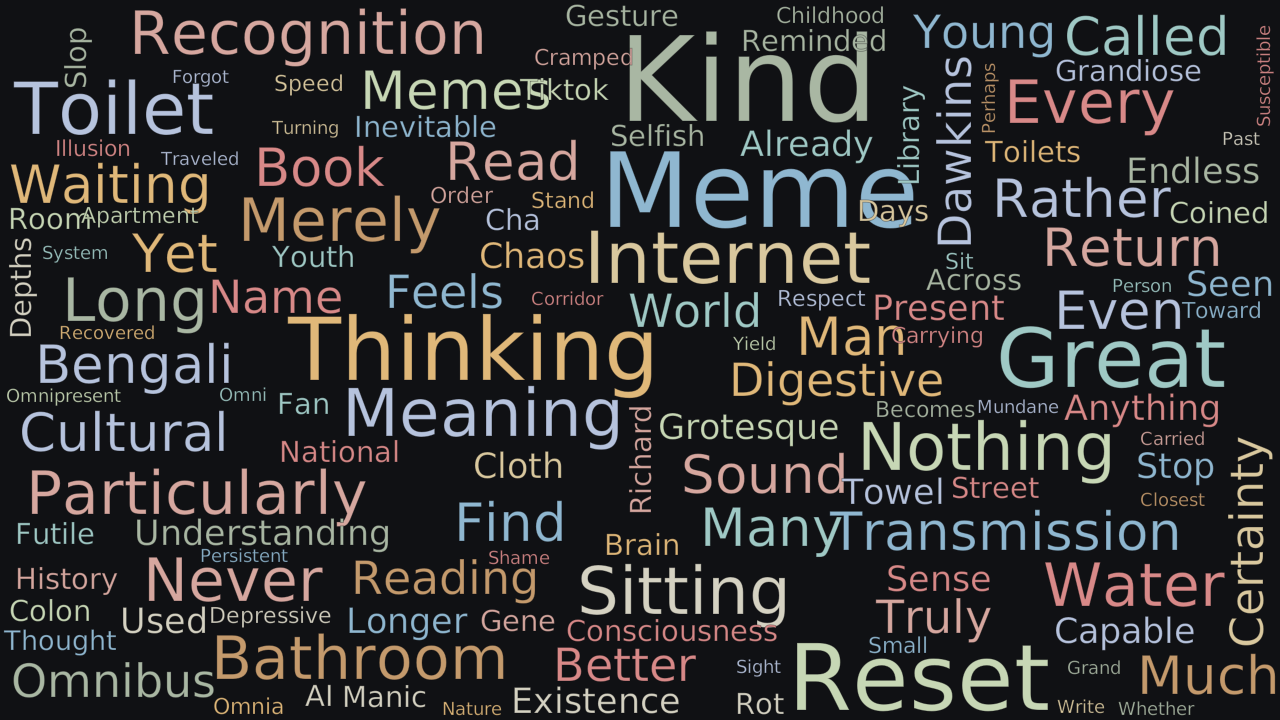
Word Cloud
Related reading
Selected by shared topics and section, with closer publication dates breaking ties.