Monsoon, Monotony, and the Malignant Prostate of Providence
Uses the speech voice supplied by your browser or device.

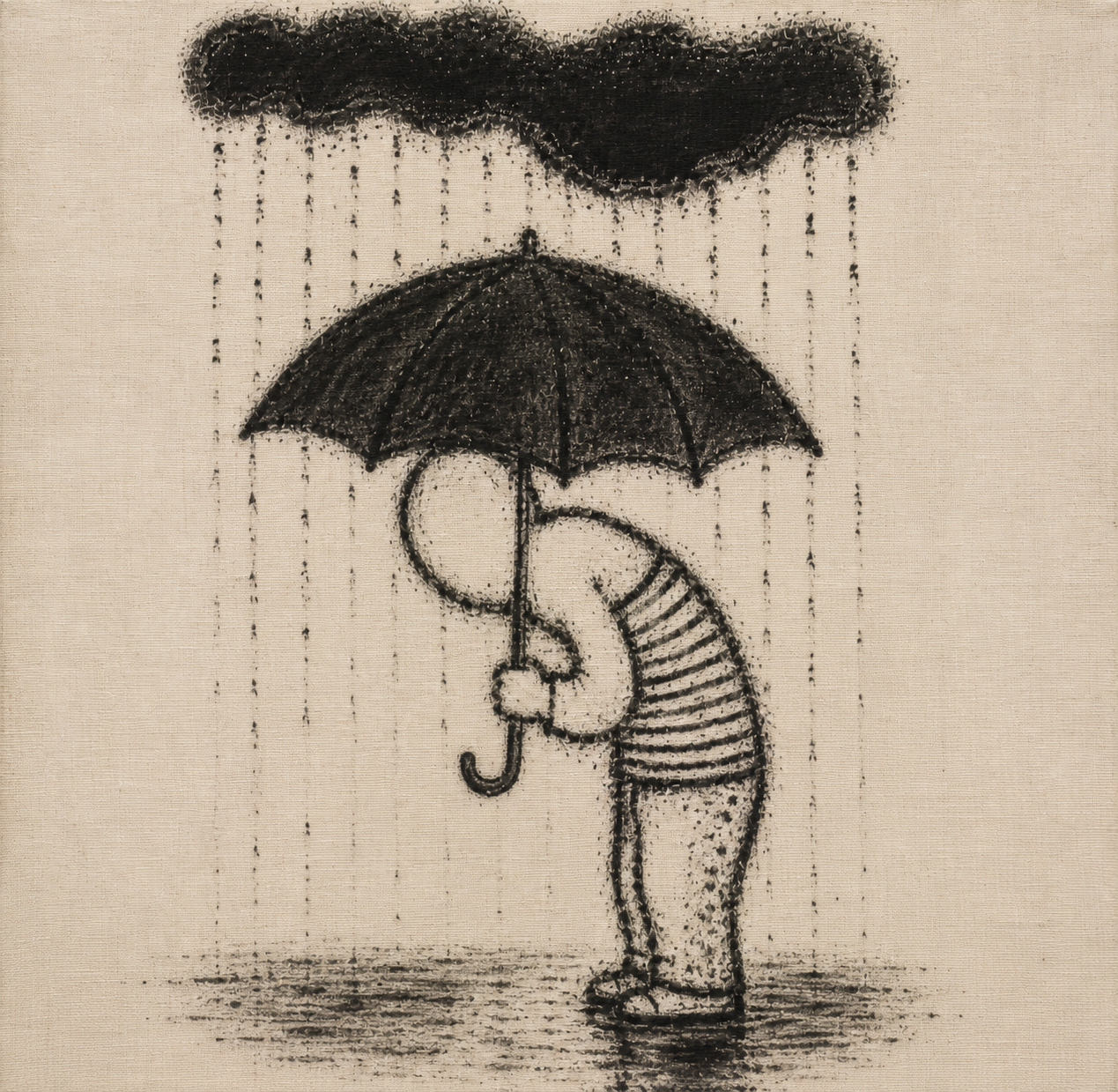
The monsoon, that magnificent meteorological malingerer, has arrived in Calcutta like a bureaucrat with a bladder infection—urgent, insistent, yet producing nothing but discomfort and the occasional pathetic dribble. I sit in my flat, which has begun to smell like the inside of a discarded lung, and I contemplate the catastrophe of clouds that cannot commit. The sky is a bruise that refuses to burst. The humidity hangs like a suspended sentence. My head throbs in iambic pentameter. My prostate, that traitorous tuber, swells with the grim determination of a politician promising reform—always expanding, never delivering. At fifty-one, I have come to understand that the universe is not indifferent; it is actively, maliciously, prostate-ically ironic.
Let us speak of catastrophe, that word we Bengalis wear like a damp lungi. From the Greek katastrophe, meaning “an overturning, a sudden end,” from kata (down) and strophe (a turning). The Greeks knew. They understood that every drama must end in ruin, that the deus ex machina is merely the plumbing of the gods failing at the worst possible moment. And here in Calcutta, we are living in permanent third act, waiting for the stage to collapse, for the clouds to finally do what clouds are metaphysically obligated to do: burst, drown, deliver. Instead, they tease. They perspire. They produce a precipitation so petty it feels personal.
I have lived through fifteen American winters, studied the thermodynamics of despair in heated laboratories, published papers on survival analysis while my own survival became increasingly analytic. I have seen snow fall with the democratic indifference of true entropy—each flake a unique catastrophe, each melt a minor death. And I return to this city, this Calcutta, where the rain falls not as entropy but as bureaucracy: delayed, diluted, delivered in triplicate with the wrong signature. The monsoon is slipping, they say. The monsoon is making excuses. The monsoon is pissing like me at three in the morning, a thin, apologetic stream that satisfies no one and wets everything.
But I want—I want with the want of want—the cloudburst. The cloudburst. Consider the word. Not a gentle precipitation, not a diplomatic drizzle, but a burst. From Old English berstan, to break suddenly, violently, with the orgasmic finality of a dam surrendering to its own hydrostatic sins. I want the sky to rupture. I want the streets to become rivers, the rivers to become arguments, the arguments to become silence. I want Calcutta to sink beneath the weight of its own atmospheric inadequacy. I want the Howrah Bridge to become a diving board for the apocalypse. I want the tram lines to electrocute the puddles into steaming, hissing, judgment.
Because we deserve it. We deserve drowning. We, the Bengali intelligentsia, we who are stuck in hypes and hopes and holes and hymns—we who debate Tagore while the drains choke on our own plastic piety—we who discuss adda over tea that tastes like the Ganges on a bad day—we deserve to have our heads held under by the very monsoon we pray for, then complain about, then forget until next July. We are a people who have turned survival into a philosophy, who have made endurance an aesthetic, who have transformed the art of doing nothing into a doctoral dissertation. We do not need salvation. We need saturation. We need to be washed away, washed clean, washed into the Bay of Bengal where our dissolved ambitions can feed the plankton that will feed the fish that will feed the fishermen who will continue not to vote for change.
The physics of it is simple, brutal, beautiful. The Clausius-Clapeyron relation: the capacity of air to hold water vapor increases exponentially with temperature. For every degree Celsius, seven percent more moisture. Calcutta warms. The Bay of Bengal warms. The air becomes a sponge, a lung, a greedy glutton of vapor. And yet—and yet—the rain falls elsewhere. On Mumbai. On Kerala. On places that have already learned to swim. The atmosphere is a miser counting his humidity in secret, and we are the beggars at the door of the sky, holding out our bowls, receiving only the spit of condensation.
I think of the nimbus, that word for rain cloud, from the Latin for “rainstorm, cloud,” related to nebula, mist, vapor, the breath of gods who have emphysema. The nimbus is the halo of saints, the cloud of unknowing, the crown of pathetic fallacy that we place upon the heads of our own atmospheric disappointment. The cumulonimbus, that towering tower of turgid meteorological tumescence, rises ten kilometers into the troposphere, an anvil of anticipation, a hammer of withheld hydration. It is the most beautiful, the most terrible, the most teasing of clouds. It promises. It threatens. It dissipates. Like my erections. Like my career. Like the Bengali Renaissance, which began with promise and ended with everyone moving to Delhi.
And I, bipolar type two, cycling between the hypomanic hope that the rain will come and the depressive certainty that it will not, I understand the cloud. I am the cloud. I am the nimbus with a personality disorder. I am the cumulonimbus that builds, that towers, that flashes with internal lightning, and then—nothing. A dry thunder. A threat without follow-through. A prostate without purpose.
The Sanskrit has it better. Varsha, the rains, from vris, to rain, to shower, to pour forth. The Varsha is not merely meteorology; it is a season of the soul, a ritu, a rhythm, a return. The Meghaduta, Kalidasa’s cloud messenger, where the exiled yaksha sends a cloud to bear his longing to his beloved. “O cloud,” he begins, and the cloud listens, and the cloud travels, and the cloud delivers. My cloud does not deliver. My cloud is a DHL package lost in customs. My cloud is a promise made by a politician with his fingers crossed behind his back. My cloud is the monsoon of Calcutta, which arrives with the fanfare of a funeral and departs with the silence of a fart in a crowded tram.
I want the cloudburst. I want the pluie de deluge, the vardhakshaya, the drowning rain. I want the streets to become canals, the canals to become rivers, the rivers to become the Bay of Bengal, and the Bay of Bengal to become the sky, and the sky to become a mirror in which we finally see ourselves: wet, ridiculous, relieved. I want the science of it, the hydrology, the runoff coefficients, the Manning equation for open channel flow, the Darcy-Weisbach friction factor, all the beautiful mathematics of fluid dynamics applied to the fluid dynamics of our collective delusion. I want to calculate the exact cubic meters of water required to wash away the Howrah station, the Victoria Memorial, the accumulated sediment of two centuries of colonial and post-colonial sedimentary stupidity.
Because behind every difficult word, every precipitation (from Latin praecipitare, to throw headlong, to fall violently), every condensation (from condensare, to make dense, to press together, like my thoughts, like my chest, like the air in this room), behind every word is the history of our fumbling. We did not always know that rain was the atmosphere weeping. We thought it was the gods urinating. We were closer to the truth then. We understood that meteorology is merely urology at scale. The sky has a prostate too, and it is enlarged, and it is struggling, and it is fifty-one years old in cloud years, which are longer than dog years and shorter than the time it takes for a Bengali intellectual to finish his sentence.
So let it burst. Let the nimbus burst. Let the cumulonimbus burst. Let my head burst, my prostate burst, my patience burst, my pretense burst. Let the monsoon do what monsoons are meant to do: drown the dry, flood the foolish, wash away the accumulated silt of our self-importance. Let Calcutta sink. Let it sink like my hopes, like my serotonin, like the foundation of every building constructed with the optimistic corruption of the 1980s. Let it sink, and let us swim, or let us drown, but let it be decisive, let it be definite, let it be a katastrophe in the true Greek sense: an overturning, a sudden end, a turning down of the volume on our endless, endless, endless adda.
The rain, when it comes, will not save us. The rain, when it comes, will merely wet us. But wet salvation is better than dry damnation, and a cloudburst is better than this—this—this perpetual, pathetic, prostate-ic drizzle of almost, of soon, of maybe, of wait. I have waited. I am done waiting. I am fifty-one. My prostate is done waiting. The city is done waiting. The drains are done waiting. The Bay of Bengal opens its mouth like a patient in a dentist’s chair, waiting for the sky to finally, finally, finally spit.
P.S. References
Clausius, R. (1850). On the Motive Power of Heat. Philosophical Magazine.
Kalidasa. (c. 5th century). Meghaduta (The Cloud Messenger).
Manning, R. (1891). On the Flow of Water in Open Channels and Pipes. Transactions of the Institution of Civil Engineers of Ireland.
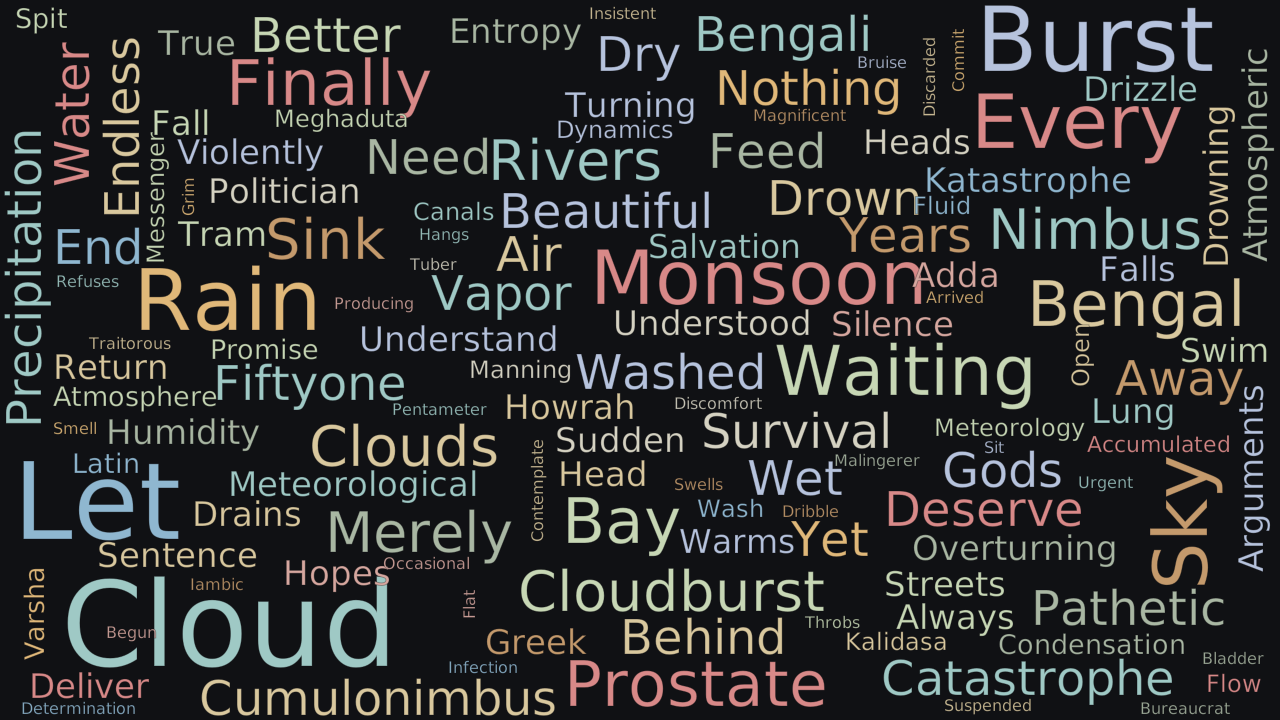
Word Cloud
Related reading
Selected by shared topics and section, with closer publication dates breaking ties.