The Living Aperture
A mathematical gastropod shell laboratoryA shell is a history of openings.
Every bright rim becomes a permanent part of the surface.Text equivalent
Current shell description
Living aperture is a high-spired procedural shell at 100% of its deposited history, with positive coordinate winding orientation; biological dextral/sinistral labels require an apex-up, aperture-side view. It completes 5.25 turns with a whorl expansion factor of 2.35. Its ellipse aperture is taller than it is wide, and the surface carries a mostly smooth surface. Classification: base growth law: exactly self-similar in 3D; this badge applies only to the underlying base growth law, never automatically to the finite cap, adult truncation, changing profile, or episodic ornament. The current conservative ring-envelope check reported no nonlocal overlap risk; this is not a proof that the surface is intersection-free.
Scientific boundary
This procedural laboratory describes geometry and kinematic aperture accretion. Its oscillator, mismatch, stiffness, buckling and finite hierarchy controls are reduced mechanism-inspired models or proxies. Named presets are morphological archetypes, not fitted specimen reconstructions. Nautilus and ammonites are correctly separated as cephalopods.
Read equations, assumptions and primary sources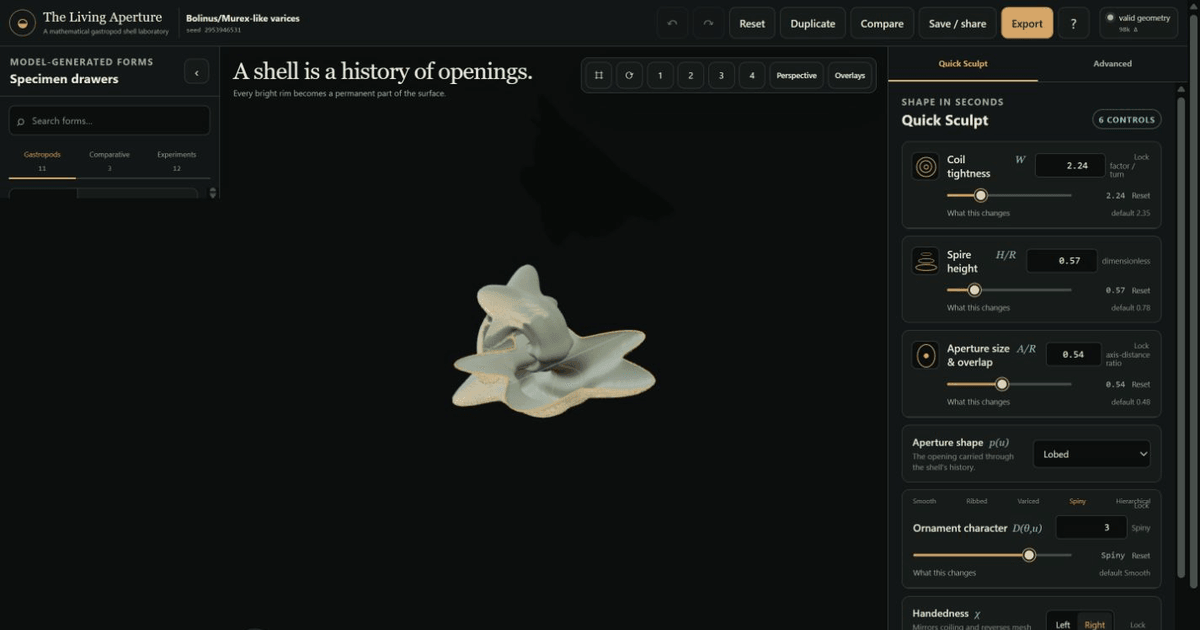
Uses the speech voice supplied by your browser or device.
Model boundary: this is a procedural, mathematically grounded shell-design laboratory. It describes geometry, aperture-by-aperture kinematics and explicitly reduced ornament mechanisms. It is not a complete simulation of molluscan development and no preset has been fitted to a specimen.
A shell is a history of openings
A shell does not wait until adulthood and then inflate. Its active edge is the aperture: the opening bordered by the mantle, where new material is added while the older mineralized surface remains behind. A lip can flare, a rib can thicken, a spine can begin, and a growth interruption can leave a varix. Each event enters the object as history.
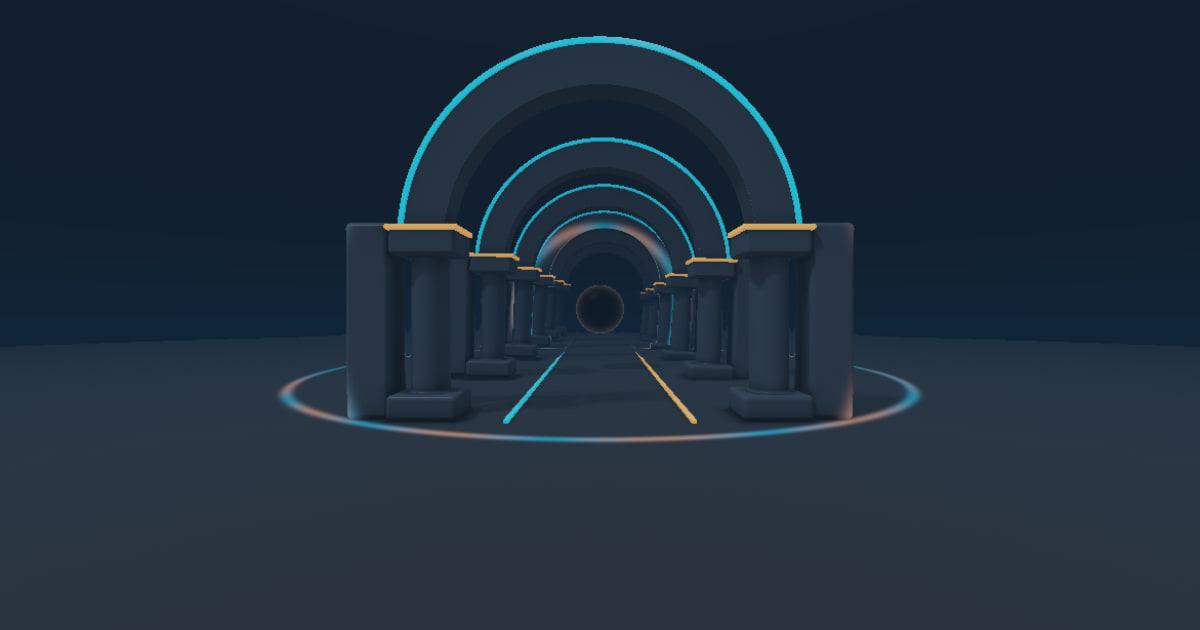
That observation changes the natural unit of a shell model. Instead of beginning with a finished volume, the laboratory begins with a periodic aperture curve. It places a new copy along a moving centreline, changes its scale and shape, and joins it to the previous rim. Moving the growth timeline backwards removes later rings. It never shrinks or fades an already completed adult mesh.
The distinction is visible in the Living aperture engine, but it also disciplines the faster Analytic sculptor. Both engines produce the same ordered ring history and one indexed outer surface. The apex is capped without collapsing an entire ring to one degenerate point; the adult aperture is intentionally open. The mesh is a visual shell surface with one boundary, not a secretly watertight printable solid.
The spiral is logarithmic, not magical
For the principal analytic family, the distance from the coiling axis grows exponentially with angle:
Here is the whorl-expansion factor: after one complete turn, the radius is multiplied by . The interface exposes because it is easier to reason about than the exponential coefficient . Tight coiling, a broad body whorl and an almost circular limit all live in this same family.
Nothing in that equation requires the golden ratio. Nothing requires Fibonacci numbers. Natural shells occupy varied growth regimes, and a logarithmic spiral is a family with a free expansion factor—not a decorative proof that one famous constant governs living form.
The centreline may remain planar or acquire height:
The lecture lift uses exponential radial growth with a vertical rise linear in angle. It retains a self-similar top view, but the resulting three-dimensional curve is not strictly self-similar. The separate cone-similar mode makes height proportional to radius; about the appropriate similarity centre, one turn can scale the underlying centreline and aperture law by exactly .
That statement is deliberately narrow. A finite cap, truncation, lip flare, changing aperture profile, meander, transported-frame roll or one-off varix can break full-surface similarity. The badges therefore describe the underlying base growth law, never the whole finite rendered shell merely because two exponents happen to match.
Carry an opening through space without making it flip
A two-dimensional aperture needs an orientation at every point of the three-dimensional path. A raw Frenet frame can become unstable where curvature is tiny and can flip when its normal is poorly determined. The laboratory instead transports an orthonormal frame incrementally, using a rotation-minimizing Bishop-style construction.
The swept surface is
The aperture can be circular, elliptical, superelliptic, rounded-polygonal, lobed or a positive polar Fourier profile. Authored roll rotates that profile about the centreline after transport. This geometric aperture roll is not the same as centreline torsion, and neither should be confused with developmental torsion, the larval reorganization of the gastropod body.
The accretion engine goes further by integrating a local frame:
Its authored turning, growth and twist values are rates per coiling radian. They are sampled over normalized developmental age, not calibrated clock time. This is a deterministic kinematic model that can make planispiral, helicospiral and wandering histories; it is not the nonlinear mechanical coiling solver of the research papers cited below.
Ornament belongs to the deposition field
Ribs, cords, nodules, varices and spine windows are evaluated in aperture and growth coordinates before the surface is tessellated. A spine is therefore not a cone glued onto a finished mesh. It begins during a finite deposition episode, broadens across part of the aperture and remains carried in the material laid down during that interval.
The language matters. Comarginal ornament runs parallel to growth lines and the current aperture. Antimarginal structure crosses them. A varix is a conspicuous episodic growth record, but the presence of repeated ribs does not by itself establish a daily clock.
The optional instability field is an app-authored compressed-beam-on-foundation surrogate. For modal wavenumber , it uses
is a normalized compression or mismatch proxy, a normalized bending-stiffness proxy, and the fixed unit term a normalized foundation penalty. The equation selects a finite band of growing modes and saturates them with a cubic term. It is useful for asking how wavelength selection might appear, but its false colour is an instability, displacement or strain proxy—never a measured stress field.
The hierarchical control is also finite by construction. It superposes a capped sequence of progressively smaller Gaussian peak levels with seeded jitter and onset ages. It is fractal-like, not an infinite mathematical fractal, and it does not claim to solve the 2025 constrained energy model or to prove its biological hypothesis.
What the presets mean
The gastropod drawer contains morphological archetypes inspired by familiar shell organizations: high-spired, globose, cowrie-like, cone-like, ribbed, variced and spiny forms. They are recipes for exploring parameter relationships, not reconstructions of collected specimens. Without specimen measurements and parameter fitting, a familiar silhouette remains “-like”.
The comparative drawer keeps taxonomic boundaries visible. Nautilus is an extant cephalopod. Ammonites and Nipponites are extinct cephalopods. A Nipponites-inspired mathematical path alternates local centreline torsion through perversions; it does not represent a gastropod repeatedly changing biological chirality.
A planar spiral has a clockwise or anticlockwise winding sense in a chosen view, but it is not intrinsically chiral as an ideal three-dimensional object. For genuinely non-planar gastropod-inspired shells, the conventional description used here is apex up: aperture on the viewer’s right is dextral and on the left sinistral. A coordinate sign alone cannot establish that biological label without the viewing convention.
Determinism, diagnostics and export
A saved recipe contains its schema version, engine version, seed, coiling and aperture laws, kinematics, ornament, appearance and optional preset ancestry. Within the same application build and JavaScript runtime, a fixed recipe, seed and tessellation resolution reproduce byte-identical geometry buffers. Preview and export use the same equations; only sampling density changes.
The worker returns transferable typed arrays and monotonic request identifiers. A new edit supersedes stale work so an obsolete fine mesh cannot arrive after a newer preview. Invalid aperture profiles produce explicit diagnostics and a finite engine fallback buffer, while the viewport retains the last accepted shell instead of silently replacing it with unrelated geometry.
Intersection warnings remain conservative. Broad envelopes can report a possible non-local overlap; they do not constitute triangle-level proof that a surface intersects or that it is collision-free. Likewise, “manifold visual surface” means an orientable surface with its intended open adult boundary, not a watertight printable solid.
Use Save / share to serialize a versioned recipe or copy a compressed same-page URL. JSON preserves the recipe; CSV exposes the sampled aperture history; GLB and OBJ export the full adult outer surface, even when the timeline currently reveals only a younger prefix. STL remains absent until the system can construct and validate thickness, an inner wall, a joined lip and watertight topology.
Scientific scope
Three layers should remain separate while using the laboratory:
- Analytic geometry describes a centreline, transported aperture and swept surface.
- Kinematics describes a deterministic aperture-by-aperture construction and its permanent ring history.
- Reduced mechanics supplies explicitly labelled browser-scale mismatch inputs, buckling modes and hierarchy surrogates. A damped-oscillator utility exists in the mathematical library for future experiments but is not presently connected to a visible ornament control.
The application does not solve biomineralization chemistry, gene regulation, mantle cell dynamics, embryology, three-dimensional nonlinear finite elasticity, adaptive function or evolutionary fitness. The mechanical literature demonstrates plausible routes by which constrained growth can make ribs, spines, coiling and hierarchical ornament. It does not by itself identify molecular causes or prove that natural selection produced a particular form for a particular function.
The principal scientific lineage is:
- Alain Goriely’s 2026 Gresham lecture, The Shape of Shells: She Sells Self-Similar Spiral Seashells on the Seashore, and its lecture text.
- Moulton, Goriely and Chirat, “Mechanical growth and morphogenesis of seashells”, Journal of Theoretical Biology (2012).
- Chirat, Moulton and Goriely, “Mechanical basis of morphogenesis and convergent evolution of spiny seashells”, PNAS (2013), with open full text.
- Rudraraju and colleagues, “A computational framework for the morpho-elastic development of molluskan shells by surface and volume growth”, PLOS Computational Biology (2019).
- Chirat, Goriely and Moulton, “The physical basis of mollusk shell chiral coiling”, PNAS (2021), with open full text.
- Moulton, Goriely and Chirat, “Hierarchical mechanical patterns in morphogenesis”, Journal of the Royal Society Interface (2025), with open full text.
Those sources do not all use one interchangeable “mantle–shell mismatch”. They study distinct quantities: ring and aperture radius mismatch, excess mantle-edge length, active mantle width and volume growth, body-to-secreted-tube arc length, or bilayer excess length with memory. The interface therefore uses mechanism-specific labels and calls unfitted quantities dimensionless model inputs.
A finite laboratory for an unfinished subject
The most useful shell in this exhibit may be the one that fails. Push the exposed aperture controls towards their safe limits and the last valid mesh remains visible beside any diagnostic reason. Advanced Fourier-coefficient failure cases require importing or editing a recipe because the current inspector does not expose those coefficients directly. Match radial and aperture exponents, then add one ontogenetic event and see why a base-law badge cannot certify the whole object. Switch from a direct analytic curve to deposited local-frame history and ask which resemblance survives.
The laboratory’s claim is not that a browser has completed molluscan morphogenesis. Its claim is narrower and more testable: one can make geometry, accretion history, reduced mechanisms and scientific uncertainty inspectable in the same instrument—and save the versioned recipe that produced the question.
Quick reference and FAQ
A molluscan shell records earlier openings instead of enlarging a finished object. This laboratory carries a changing aperture along a coiling path, joins each new rim to the previous one, and lets you inspect the resulting history. Its geometry is deterministically discretized from the stated mathematical model; its mechanical controls are reduced browser surrogates, not a complete simulation of a living animal.
Key Terms
- Aperture
- Accretion
- Logarithmic spiral
- Whorl expansion
- Centreline
- Transported frame
- Ontogeny
- Varix
- Comarginal rib
- Antimarginal ornament
- Buckling surrogate
- Self-similarity
- Dextral
- Sinistral
- Cephalopod
Frequently asked questions
Does a shell grow by becoming a larger copy of itself?
No. New material is secreted at the mantle-lined aperture while older calcified material remains as a permanent record. Some underlying growth laws have exact or approximate scaling relationships, but a finite shell with a cap, lip, changing aperture and episodic ornament is not automatically a globally self-similar object.
Is every shell a golden spiral?
No. The laboratory uses a logarithmic spiral with a freely chosen expansion factor. Nothing in the model requires the golden ratio or a Fibonacci construction.
Is this a complete biological simulation?
No. The analytic engine describes geometry and the living-aperture engine supplies a kinematic deposition history. Buckling, mismatch, stiffness and instability controls are reduced dimensionless surrogates or proxies; the browser does not solve biomineralization, gene regulation, mantle-cell dynamics or full nonlinear elasticity.
What is the difference between the two geometry engines?
The analytic sculptor sweeps an aperture along a directly evaluated coiling curve and is fast enough for immediate design. The accretion engine integrates a local transported frame and deposits successive openings. Both return the same indexed mesh and ring-history contract, so the timeline reveals a true prefix of the adult surface.
Are Nautilus and ammonites gastropods?
No. Nautilus is an extant cephalopod, while ammonites—including Nipponites—are extinct cephalopods. The laboratory keeps them on a separate comparative shelf rather than presenting them as gastropod presets.
Can I 3D-print an exported shell?
Not directly. GLB and OBJ describe the open visual surface, whose adult aperture remains a boundary. STL is deliberately unavailable because a printable shell would need a validated inner wall, thickness, joined lip, watertight orientation and stronger intersection checks.
Can the same recipe be reproduced?
Within the same application build and JavaScript runtime, a fixed recipe, seed and tessellation resolution reproduce the same typed geometry buffers. Pixel-identical screenshots can still vary with browser, GPU, viewport and rendering implementation.
Word Cloud
Related reading
Selected by shared topics and section, with closer publication dates breaking ties.