Architectural Tantrum
Uses the speech voice supplied by your browser or device.

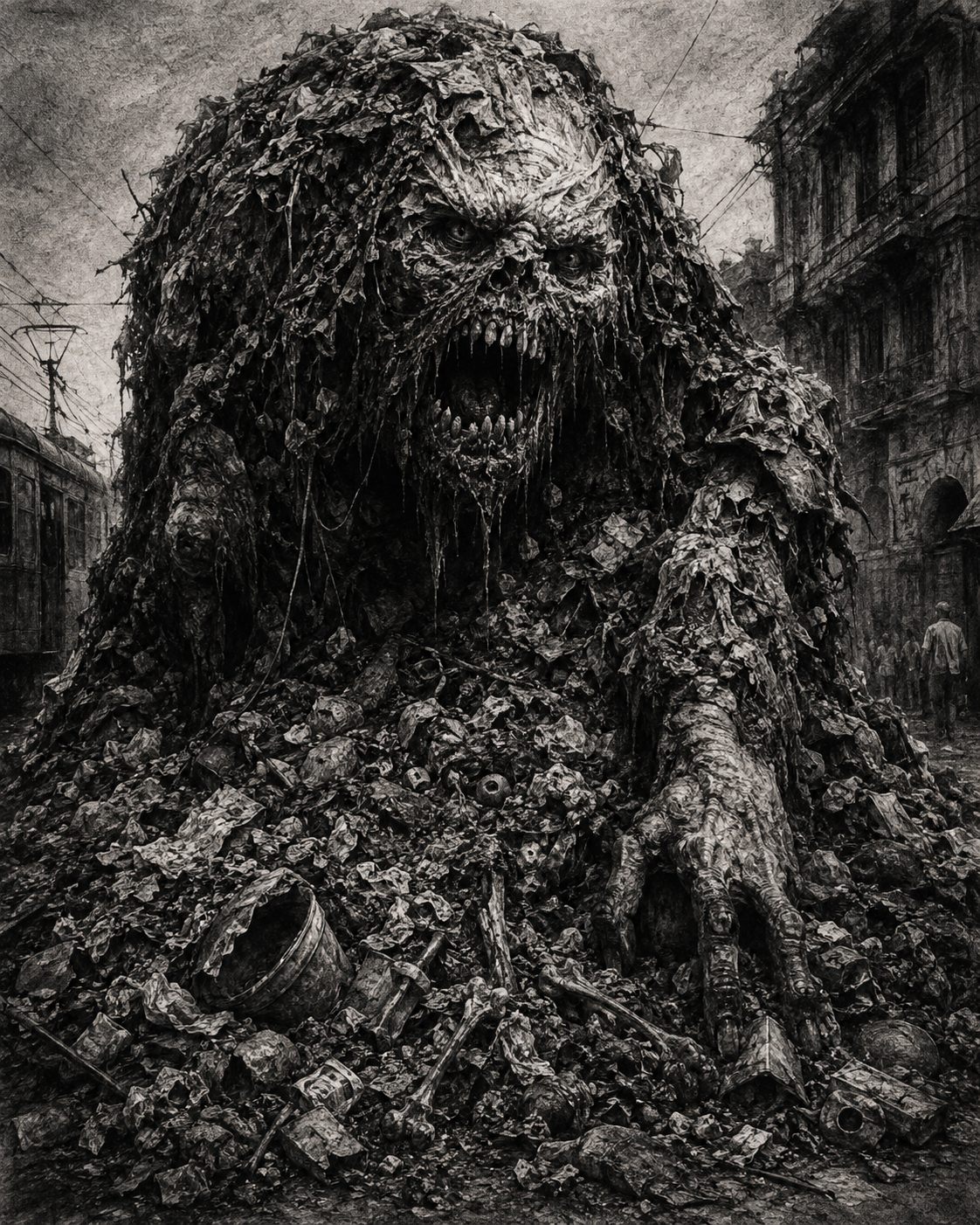
Entropy, that magnificent cosmic colonic irrigation artist, does not knock politely. It kicks down the door, micturates upon the carpet with the enthusiasm of a dyspeptic elephant, and rearranges your furniture into a state of maximum disorder while you stand there holding a cup of tea that has gone cold because you were too busy contemplating the heat death of the universe to drink it. And yet, and yet—there is something almost erotic in the way a building surrenders to it, something profoundly, obscenely Bengali in the manner this particular structure leans into its own demise like a drunk uncle at a wedding who insists he is merely resting against the wall.
I drew this thing, this glorious architectural hissy fit, not because I understand buildings but because I understand stubbornness. I understand the physics of refusal. Sir Isaac Newton, that wigged prig, gave us , the equation of obedience, the mathematical hymn to falling in line. But what equation captures the force required to not fall? What formula, what tensor, what miserable matrix describes the sheer bloody-mindedness of a wall that leans at an angle so acute it would make Pythagoras weep into his hypotenuse? I propose none. I propose instead that Bengali architecture operates on a different mathematics entirely, one where the structural integrity is inversely proportional to the dignity of the inhabitants, modified by a chaos constant that we shall call the municipal coefficient of neglect:
Where is the angle of defiance, measured not in degrees but in generations of bureaucratic indifference.
The building does not fall because it has transcended Newton. It has achieved, through sheer accumulated obstinacy, a state of dynamic equilibrium that would baffle every engineer who ever self-pleasured over a load-bearing calculation.
Look at the windows. Those magnificent, unbothered, lace-curtained apertures of bourgeois delusion. They stare out like aunties at a fish market, eyes narrowed in perpetual judgment, utterly indifferent to the fact that the wall containing them has entered into negotiations with the pavement. They are the windows of denial, the optical organs of a culture that has perfected the art of looking the other way. Spinoza, that lens-grinding Dutchman who saw God in geometry, would have wept. God, if He exists in Calcutta—and I have my doubts, having seen the traffic—resides not in straight lines but in the glorious, spiraling, drunken helix of a building that has decided, collectively and democratically, that verticality is a colonial imposition.
The lower floors tell a different story, a story written in peeling plaster and dangling doors, in the syntax of municipal failure and the grammar of optimistic rot. Here is where the building’s truth resides, its fundament exposed like an old man’s shins, all scars and varicose veins and the accumulated insults of monsoons that came and never properly went. The ground floor is where entropy does its real work, where the second law of thermodynamics is not merely observed but celebrated with the fervor of a Kali puja. Each crack is a verse, each missing brick a stanza in an epic poem of decay that would make Homer reach for the ouzo. The doors hang off hinges like the loose teeth of a boxer who has taken one too many punches from reality and keeps smiling anyway, keeps offering you tea, keeps insisting that the structural integrity is fine, absolutely fine, have you eaten?
But the upper floors!
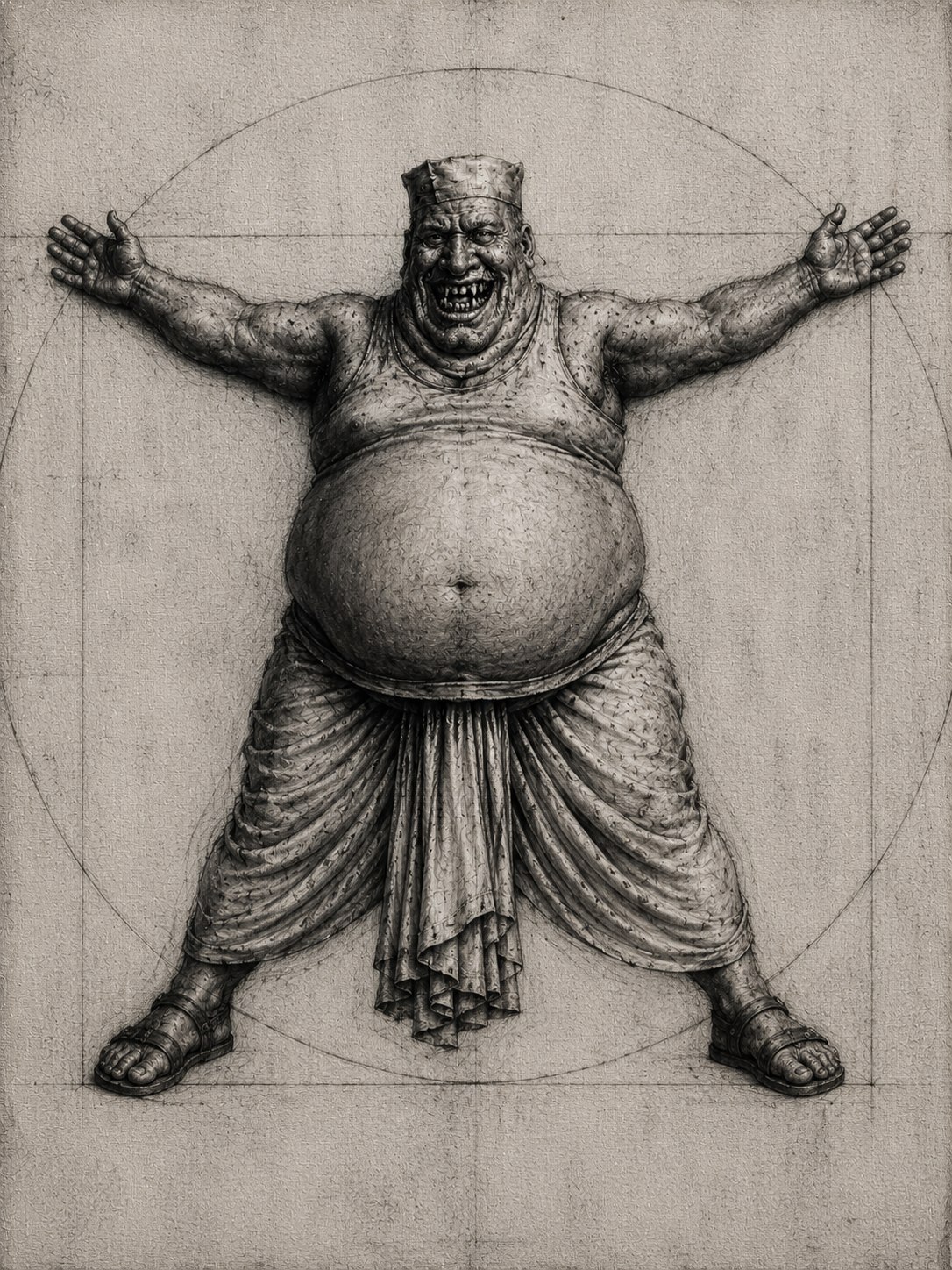
Oh, the upper floors, those magnificent, delirious, still-pretending bastions of respectability. The balconies slant with an arrogance that is almost architectural sarcasm, a raised eyebrow in concrete and rust. They hold onto dignity by the brittle skin of their teeth, by the fingernails of their peeling paint, by the sheer, accumulated, intergenerational refusal to acknowledge that the ground is, in fact, rising to meet them. This is the Bengali condition in miniature, in maxiature, in every possible -ature: the simultaneous existence of collapse and pretense, of ruin and refinement, of a man in a dhoti arguing quantum mechanics while his house sinks slowly into the Ganges delta.
Marx, that bearded German scold, made dialectics fashionable. Thesis, antithesis, synthesis—the tidy triad of historical progress. But he never visited Calcutta. He never saw a building that was simultaneously thesis and antithesis, that synthesized nothing but its own continued, improbable, insulting existence. This structure is not dialectical; it is diarrhectical—a constant, unceasing, messy flow of becoming that refuses the constipation of fixed categories. It is not falling apart. It is hanging together, dammit, in precisely the manner that Bengalis have perfected: the art of the sustained crisis, the aesthetics of the permanent emergency, the geometry of the glorious maybe-tomorrow.
And the etymology? You want etymology? The word structure comes from the Latin struere, to heap up, to pile together. Not to build, mind you, not to construct with intention and blueprint and the smug certainty of the architect who has never watched his creation negotiate with gravity over a period of decades. To heap. To pile. There is something almost obscene in that origin, something that whispers of accumulation without plan, of mass without meaning, of bricks heaped upon bricks in a frenzy of optimistic materialism that assumes, against all evidence, that the heap will hold. My building is a heap. A magnificent, defiant, sneering heap that has achieved, through sheer duration and the accumulated weight of human habitation, a kind of accidental immortality.
I have bipolar disorder, type II, the kind where the highs are not high enough to be fun and the lows are low enough to be educational. I know something about structures that threaten to collapse. I know the daily mathematics of maintaining a façade while the foundation conducts secret negotiations with the void. This building is my brother, my sister, my non-binary sibling in structural instability. We understand each other, this leaning, screaming, pencil-sketched tantrum and I. We share the same metabolism of defiance, the same diet of stubbornness and tea and the absolute, unshakeable conviction that falling is a choice, and we are not choosing it today.
Gravity, that relentless, humorless, Newtonian bastard, pulls at everything. It pulls at the moon, it pulls at the tides, it pulls at the light itself in the miserable geometry of general relativity . But it has not pulled this building down. Not yet. Not today. Perhaps not tomorrow. And in that not yet resides the entire, insufferable, magnificent philosophy of Calcutta: the city that should not exist, that exists in spite of itself, that leans into the future like a drunk leaning into a bar, already half-fallen and entirely convinced that the floor is merely tilted in his favor.
So let the engineers calculate. Let the architects draw their straight lines and their right angles and their miserable, obedient geometries. Let them build their buildings that stand up and stay up and die of boredom. I will take this leaning, screaming, penciled revolt. I will take the windows that sneer at physics and the doors that dangle like insults and the balconies that hold their angle of defiance like a raised fist. I will take the entropy and the chaos and the glorious, accumulated, intergenerational refusal to fall.
Because beauty, if it exists, exists in the angle of resistance. In the of the equation. In the space between falling and having fallen. In the Calcuttan pause between collapse and comedy, between tragedy and tea, between the structural integrity of zero and the dignity of infinity.
The building stands.
If “stand” can be permitted. It stands leaning, sneering, shaking its concrete fist at every well-intentioned fool who ever insisted that up must remain up and down must remain down and that the only proper posture for a wall is vertical. It stands in defiance of geometry, in defiance of gravity, in defiance of every municipal officer who ever took a bribe to look the other way while the plaster peeled and the bricks sighed and the building entered into its long, slow, magnificent negotiation with the ground.
It is not architecture. It is not even a building. It is a goddamned manifesto in mortar and rust, a pencil-sketched tantrum against the tyranny of the straight line, a Bengali elegy to the geometry of refusal.
And it is beautiful. Obscenely, impossibly, leaning-into-the-void beautiful.
P.S. References: Newton, Isaac. Philosophiæ Naturalis Principia Mathematica (1687); Spinoza, Baruch. Ethics (1677); Marx, Karl. Das Kapital (1867); Einstein, Albert. Field equations of general relativity (1915); Second Law of Thermodynamics, various annoyed physicists.
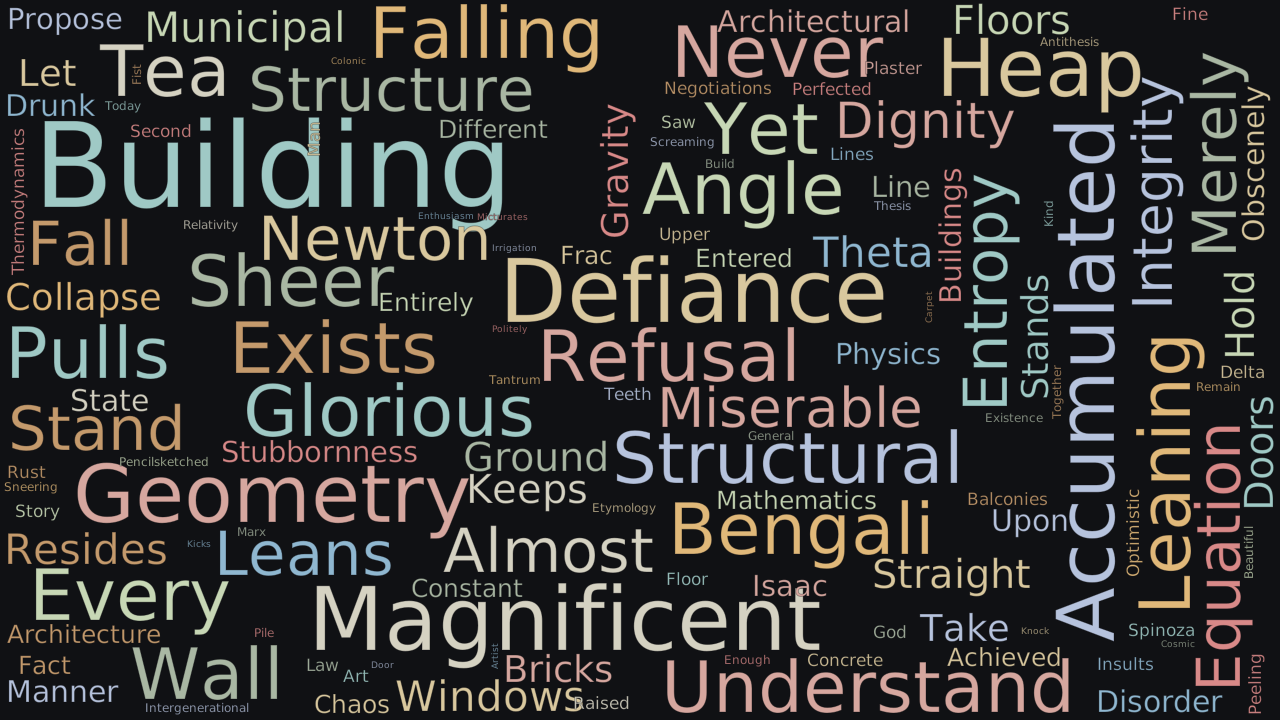
Word Cloud
Related reading
Selected by shared topics and section, with closer publication dates breaking ties.