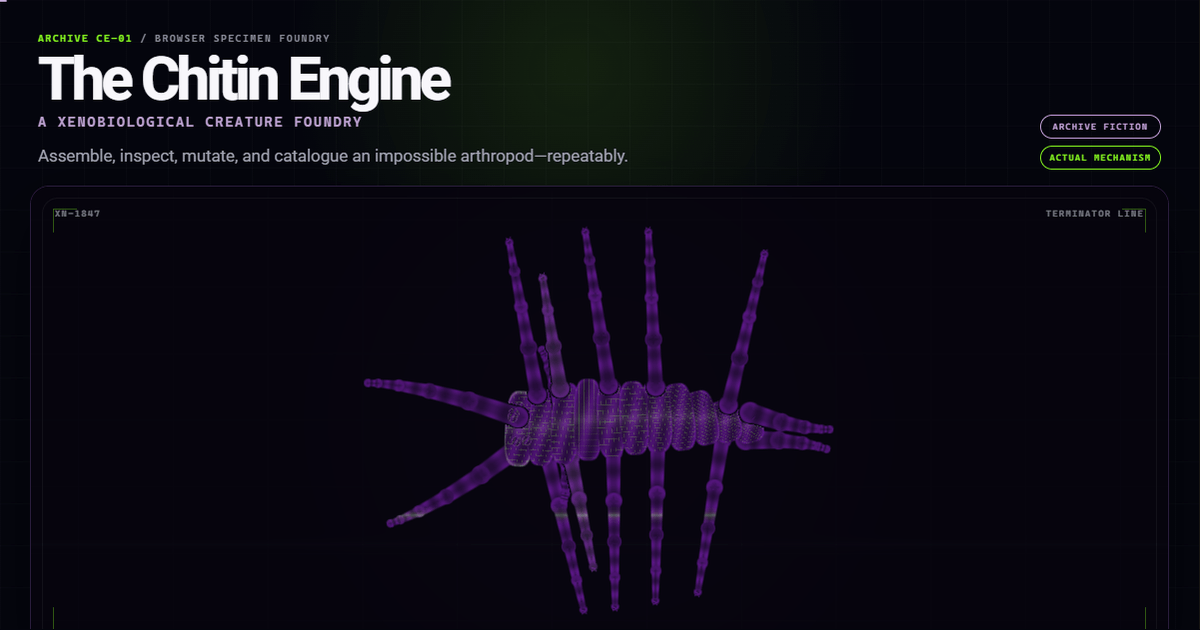
Interactive procedural creature viewer. The current specimen is Glassback Knifemite, seed glassback-1847, with 11 armour plates and 10 articulated appendages. Drag the chamber to tilt the view, select a plate to inspect it, or use the labelled controls and keyboard help. The specimen report below provides a text equivalent of the generated anatomy.
Archive CE-01 / Browser specimen foundry
The Chitin Engine A Xenobiological Creature Foundry
Assemble, inspect, mutate, and catalogue an impossible arthropod—repeatably.
What you are looking at
A graph before a picture
A validated connected graph assigns every plate, eye, wing, and limb to a legal socket before drawing begins.
Fields, not shell biology
Superellipse contours and object-local Worley cells shade armour. They are graphics functions, not models of chitin growth.
Targets before knees
A gait clock chooses planted and swinging foot targets; bounded FABRIK places fixed-length joint chains around them.
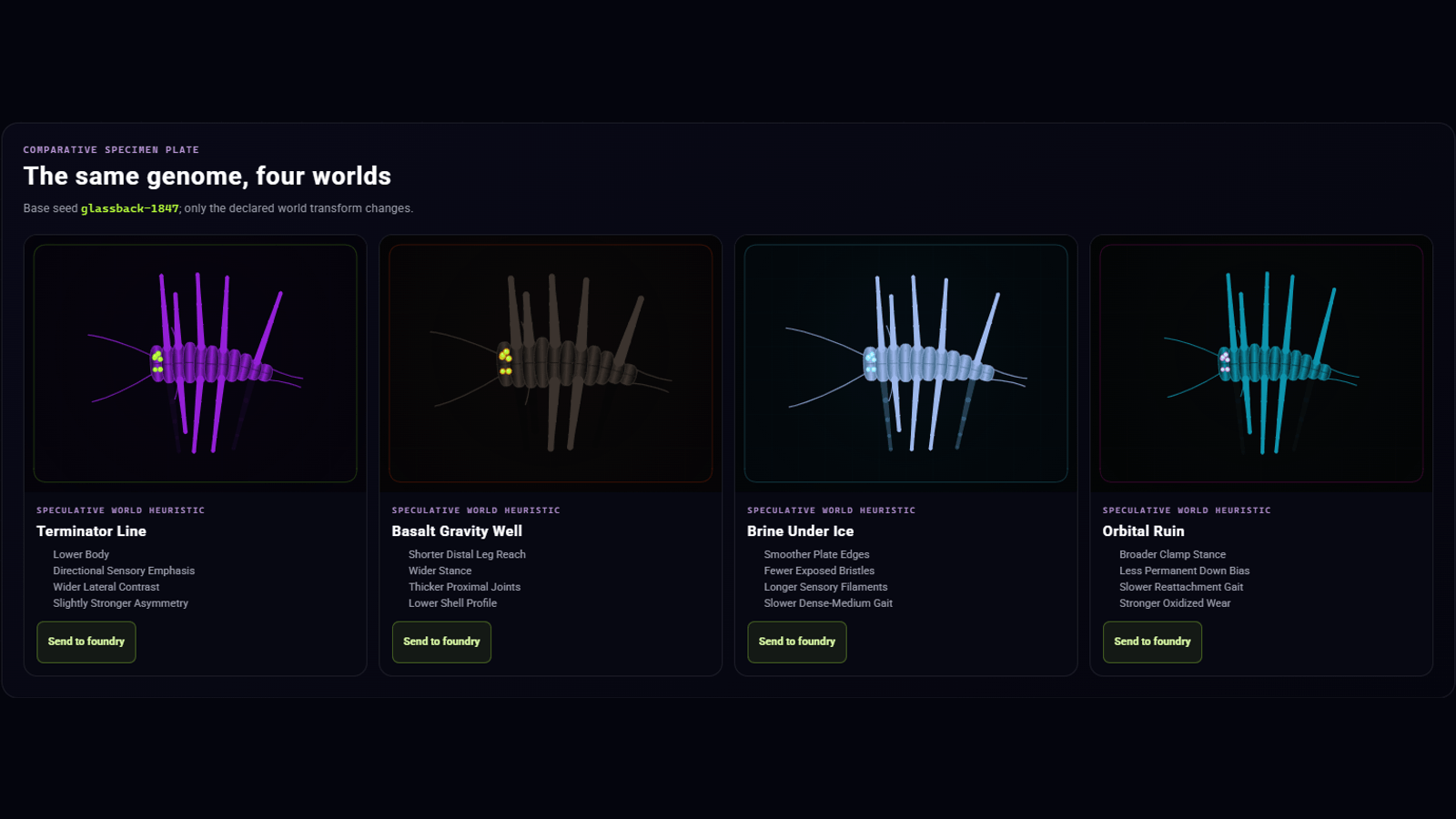
Comparative specimen plate
The same genome, four worlds
Base seedglassback-1847; only the declared world transform changes.Speculative world heuristic
Terminator Line
- lower body
- directional sensory emphasis
- wider lateral contrast
- slightly stronger asymmetry
Speculative world heuristic
Basalt Gravity Well
- shorter distal leg reach
- wider stance
- thicker proximal joints
- lower shell profile
Speculative world heuristic
Brine Under Ice
- smoother plate edges
- fewer exposed bristles
- longer sensory filaments
- slower dense-medium gait
Speculative world heuristic
Orbital Ruin
- broader clamp stance
- less permanent down bias
- slower reattachment gait
- stronger oxidized wear
Local catalogue
Pinned specimens 0/12
Pinned specimens remain in this browser unless exported.
No specimens pinned. Hatch something that deserves paperwork.
Uses the speech voice supplied by your browser or device.
ARCHIVE FICTION — NOT A REAL DISCOVERY
Specimen XN-1847 was recovered from the dark face of the terminator habitat. Its shell registered no useful colour until the ultraviolet lamps came on. It had already turned towards the glass.
ACTUAL MECHANISM
Eleven axial segments, five appendage pairs, a bilateral body-plan grammar, object-local cellular shell texture, and a four-phase stalking gait. Every specimen is a generated artwork assembled in the browser. The archive voice supplies atmosphere; it supplies no evidence about life elsewhere.
The problem with too many knees
A mammal hides much of its machinery beneath continuous skin, fur, and familiar proportions. A segmented creature files its mechanisms on the outside. Plate follows plate; every hinge advertises a possible direction; every planted foot implies several more joints negotiating with the floor. The unease comes partly from visible administration. There are too many apparent decisions, all being made at once.
That visual grammar is terrestrial in inspiration but not taxonomically careless. An adult insect ground plan has a head, thorax, abdomen, and three pairs of true legs attached to the thorax. Wings, when present, arise from the mesothorax and metathorax. Spider-inspired forms instead use four walking-leg pairs, a prosoma and opisthosoma, no ordinary insect antennae, and optional pedipalps. Myriapods follow other patterns again. Real arthropod segments are organized into functional regions called tagmata, and those regions differ among lineages.
The foundry can enforce those broad disciplines or open Xeno license. The latter may add, remove, or repurpose modules, but it labels the result as an anatomical invention. It never quietly turns a spider into an insect by changing the menu name.
A creature is a graph before it is a picture
Before the renderer receives a plate or an eye, the body-plan grammar builds a graph. Nodes represent body regions, axial segments, sensory organs, wings, terminal modules, and appendages. Edges represent axial order, bilateral pairing, and attachment. Sockets say exactly which segment owns each limb root. Validation requires one connected organism, legal counts, non-zero bones, valid wing roots, and no orphan structure drifting beside the animal.
Terrestrial discipline constrains that graph. Insect-like specimens receive three principal walking-leg pairs and thoracic wing roots. Arachnid-like specimens receive four walking pairs and palp-like anterior appendages rather than insect antennae. Myriapod mode repeats a head-and-trunk organization with many simpler limb modules. Xeno license relaxes selected rules without relaxing connectivity.
This is software architecture, not development. Real segmentation and tagmosis arise through embryological processes and gene-regulatory networks; the engine does not grow an embryo. It merely refuses anatomies whose parts cannot explain where they belong.
A spine and a stack of armour
The connected graph acquires geography from a Catmull–Rom axial curve. Control points bend a smooth centreline through the body. Sampling its parameter at equal numerical intervals would not place segments evenly: a curved portion can cover more physical distance than a straighter portion over the same parameter change. The engine therefore builds an arc-length lookup, asks for cumulative distance along the curve, and places successive segment centres at ordered physical intervals.
Each sample stores a position, a unit tangent pointing along the axis, and a perpendicular normal pointing across it. Width, taper, dorsal arch, compression, and lateral bend act in that local frame. A plate can rotate with its tangent, widen along its normal, overlap its predecessor, and leave a controlled strip of membrane visible between them.
The curve is an articulated scaffold, not a vertebrate spine. It keeps eleven plates in coherent order while allowing a head region, central mass, and terminal taper to feel designed rather than stacked like coins.
How to grow a plate
Each armour plate begins with a two-dimensional generalized-superellipse implicit field in its own coordinates:
and set half-width and half-height. With , the zero contour is an ellipse; larger exponents push it towards a rounded rectangle, while smaller permitted values make it more pointed. Ridge, flare, lobes, serration, damage, and segment-specific variation perturb this designed base without erasing it.
The language matters. defines the boundary, lies inside, and lies outside, but this expression is not generally the exact Euclidean signed distance to a superellipse. It is a signed implicit field. Where the shader needs distance-like antialiasing, it uses a documented approximation rather than promoting the equation into a biological or mathematical claim it cannot support.
Every pixel asks how far it is from trouble
A conventional drawing command says, “fill this finished path.” An implicit renderer asks each candidate fragment, “what does the local field say here?” Negative means armour, positive means chamber, and values near zero describe an edge worth antialiasing. Nearby fields can reveal membranes, ridges, damage, or selection outlines without rebuilding a dense mesh.
The engine does not ask that question across the whole screen for every primitive. Each plate receives a bounded instanced quad large enough to contain it. One compact vertex shape is reused through WebGL2 instancing; per-instance data supplies centre, frame, size, exponent, depth, material, and seed. The fragment shader transforms the pixel into the plate’s object-local coordinates and evaluates only the relevant field.
That bounded work is the practical bargain. The creature can contain many plates and limb capsules without a separate draw call for every part, while empty regions of the screen avoid expensive primitive loops.
The cracked ceramics of a shell
The shell’s small-scale organization comes from an object-local Worley field. Synthetic feature points occupy a repeatable lattice neighbourhood. For a local point , is its distance to the nearest feature point and the distance to the second-nearest. becomes small near a cellular boundary, making it useful for seams, cracked glaze, raised islands, corrosion, or fluorescent margins.
Coordinates stay attached to each plate, so the pattern follows the animal instead of sliding across the screen when the camera moves. A second bounded scale may add finer structure; seven costly octaves of static would only bury the armour.
Pores, bristles, spines, and sensory pits are discrete deterministic minimum-distance samples. Candidates are accepted only when sufficiently separated, producing readable distributions rather than television noise. None of this models cuticle secretion or tissue growth. Worley’s cellular texture is a graphics basis function, not a law of chitin.
Legs are equations with grudges
Forward kinematics begins with joint angles and discovers where the foot ends. Walking animation often needs the reverse: choose a foot target that should remain planted, then find a plausible chain of joints that reaches it. That is inverse kinematics.
Each leg stores fixed bone lengths, a preferred bend, limits, a root socket, and an end effector. The engine uses bounded FABRIK—Forward And Backward Reaching Inverse Kinematics. If a target lies beyond the total reach, the chain extends towards it without stretching its bones. If reachable, a backward pass starts at the target and pulls joints towards the root; a forward pass pins the root and pushes them back towards the foot. A small, fixed iteration cap keeps the work predictable. Bend preferences and joint limits stop a successful numerical answer from folding through the body like a chair dropped down stairs.
FABRIK solves geometry. It does not calculate forces, muscles, tendons, hydraulic extension, sensation, neural control, fatigue, or metabolic cost. A planted foot is a visual constraint, not a biomechanical measurement.
The gait clock
For limb , the animation begins with a phase oscillator:
where is cadence and is that limb’s offset. One part of the cycle is stance: the foot target remains planted while the body advances. The remainder is swing: the foot lifts along an arc and searches for its next contact. Stance ratio, swing height, body compensation, and small seeded timing differences keep the motion legible without making every limb identical.
The named families are stylizations. Tripod-like grouping gives a six-legged terrestrial specimen alternating support. Arachnid scuttle starts from alternating groups of four. A myriapod wave shifts phase progressively down the trunk. Stalk, skitter, clamp-crawl, and dormant modes rearrange the same clock.
No family claims universality. Experiments on fruit flies show speed-related continua rather than one rigid gait for every insect, while spiders display variable coordination and can alter timing after limb loss. The exhibit’s gait is coordinated disagreement rendered for inspection.
Antennae remember where they were
Rigid joints suit armour and legs; fine antennae, palps, cerci, lures, and tails need lag. A Verlet-style constraint chain stores each node’s current and previous positions. Their difference supplies implicit velocity; damping removes energy; scanner motion, body motion, and a little deterministic disturbance displace the free nodes. Several bounded constraint passes then restore the distance between neighbours while the root remains pinned to its socket.
The result bends, overshoots, and settles without solving elasticity. It is graphics mechanics. In terrestrial modes, names remain disciplined: insect antennae, insect maxillary or labial palps, and arachnid pedipalps are not interchangeable simply because each can be sensory.
Alien worlds as constraints, not prophecies
Move one genome from Terminator Line to Basalt Gravity Well, Brine Under Ice, or Orbital Ruin and a world transform changes selected envelopes: stance, compression, armour exposure, appendage profile, surface wear, palette, and chamber treatment. World influence blends from the base phenotype at zero to the full art-directed transform at one. The seed and underlying body identity remain available for comparison.
These worlds are speculative constraints. No extraterrestrial organism has been confirmed, so there is no empirical alien body plan from which to predict another. Even astrobiological life detection is contextual and probabilistic, with serious attention to unfamiliar biosignatures and abiotic false positives. Gravity, medium, light, abrasion, and substrate can therefore discipline a fictional design, but they do not dictate it.
Low gravity does not necessarily cause long legs. Radiation does not cause more limbs. Methane does not prescribe amber skin. Those are optional visual heuristics whose purpose is internal coherence, not evolutionary forecasting.
Seeds, mutations, and repeatable nightmares
The procedural parameter genome is a versioned software record: body proportions, armour, limbs, senses, ornaments, surface, motion, colour, and world influence. It is not DNA. Building it produces a phenotype—the validated graph, axis, plates, appendages, samples, materials, and default pose that can actually be rendered.
A deterministic seed creates named deterministic streams for anatomy, armour, limbs, eyes, surface samples, naming, and other systems. Changing a cosmetic naming draw therefore cannot silently rearrange the legs. Reproduction requires the same schema version, genome, stream namespaces, and state; it does not promise identical pixels across every GPU.
Mutation adds bounded changes inside selected parameter groups. Mutation radius controls how far values may move; locks hold chosen groups fixed; validation clamps or repairs impossible combinations. Low-radius children should retain family identity. Crossover can take groups from two parents, after which the same repair rules reject orphan wings, invalid roots, or disconnected anatomy. Here mutation and splicing edit parameters, not genes or populations.
Try these experiments
Keep the genome, change the world. Move one specimen through Terminator Line, Basalt Gravity Well, Brine Under Ice, and Orbital Ruin without hatching. Reveals: which features belong to the base phenotype and which are reversible speculative world heuristics.
Remove the surface. Enter Silhouette view and ignore iridescence, glow, pores, and corrosion. Reveals: whether segmentation, taper, plate overlap, and appendage placement carry the design; if the animal becomes a dull blob, colour was doing unpaid structural labour.
Watch the foot targets. Open Gait view, slow time, and follow a selected end effector through stance and swing. Reveals: the separation between the phase oscillator, contact target, reachable radius, and bounded FABRIK joint solution.
Lock the body. Lock body and limbs, then mutate only material and sensory organs. Reveals: that the genome is modular: shell, eyes, and emission can vary while the underlying graph and silhouette remain recognizably related.
Break symmetry carefully. Raise asymmetry from zero to a moderate value, then push it too far. Reveals: the narrow region where unequal eyes, damage, and plate offsets create history—and where they begin to look like attachment bugs.
Compare terrestrial discipline and Xeno license. Keep the seed, then switch the rule set. Reveals: which constraints preserve familiar insect, spider-inspired, or myriapod organization and which inventions become legal only when the exhibit clearly leaves terrestrial anatomy.
Turn off iridescence. Keep the cellular scale and contrast visible while removing the strongest material effect. Reveals: object-local Worley cells, seams, plate overlap, pores, and intersegment membrane without spectral colour seducing the eye.
Shorten the legs. Reduce leg length while initially preserving stance width and gait targets. Reveals: the boundary between a reachable contact, a joint-limited compromise, and an unreachable target that forces FABRIK to extend the chain.
Create a mutation family. Generate five low-radius mutations from one parent with the same locks. Reveals: inherited visual identity. The children should differ in particulars without becoming five unrelated random creatures.
Splice two parents. Choose parents with strongly different bodies and surfaces; lock motion to one and body to the other before crossover. Reveals: group-level inheritance and deterministic repair—what came from each parent, and which combinations must be corrected to remain connected.
What this does not simulate
The Chitin Engine does not simulate:
- embryonic development, genetics, DNA, or gene regulation;
- natural selection, populations, reproduction, or evolutionary time;
- arthropod physiology, moulting, digestion, respiration, or circulation;
- muscles, tendons, hydraulic joints, neural control, sensation, or behaviour;
- metabolic cost, forces, material strength, fluid dynamics, or aerodynamics;
- real exoplanet climates, ecology, habitability, biosignatures, or extraterrestrial life.
Its gait is geometric animation. Its world transforms are speculative heuristics. Its cellular shell field is a material function. Its iridescence is an artistic approximation. Its body-plan grammar is software architecture. Its procedural parameter genome is not a biological genome, and mutation is not evolution.
The exhibit can test whether a design remains connected, repeatable, and visually plausible under its declared rules. It cannot test whether the creature could develop, breathe, bear its weight, survive, reproduce, or exist. Visual plausibility is not biological validity. Imaginary creatures become convincing not when every possibility is allowed, but when most possibilities have been refused for a reason.
Glossary
- Body-plan grammar: Software rules that assemble and validate regions, segments, sockets, and appendage modules.
- Graph: Nodes joined by edges; here it records anatomical ownership and connection before drawing.
- Tagma or body region: A functional grouping of arthropod segments; real groupings differ among lineages.
- Axial curve: The smooth centreline along which the engine orders its body segments.
- Tangent: A unit direction following the axial curve at one sample.
- Normal: A perpendicular unit direction used for width, plate offset, and local coordinates.
- Implicit field: A scalar function whose chosen level—here usually zero—defines a boundary.
- Signed distance: Distance to a boundary with a sign distinguishing its sides; not every signed implicit field is an exact distance.
- Superellipse: A parameterized curve spanning elliptical, box-like, and pointed contours.
- Instancing: Drawing many copies of one base geometry with different per-instance data.
- Cellular or Worley field: Distances to nearby synthetic feature points, commonly combined as or .
- Inverse kinematics: Solving joint positions or angles from a desired end-effector target.
- FABRIK: Forward And Backward Reaching Inverse Kinematics, an iterative joint-position solver.
- Phase oscillator: A repeating clock value with a cadence and limb-specific offset.
- Stance: The portion of a step during which a foot target is treated as planted.
- Swing: The portion during which the foot lifts and moves to its next target.
- Constraint chain: Points repeatedly adjusted to maintain specified neighbour distances and a pinned root.
- Deterministic seed: Text converted into repeatable pseudorandom choices under a fixed implementation.
- Genome: Here, a versioned record of procedural parameters—not DNA.
- Phenotype: The validated, renderable creature built from that parameter record.
- Mutation radius: The bounded maximum scale of parameter change around a parent.
Sources
- The Smithsonian National Museum of Natural History on the adult insect ground plan, and NC State University on the three thoracic segments and wing roots.
- The University of Missouri on spider anatomy, NC State on insect mouthparts and palps, and the Illinois Natural History Survey on myriapods.
- Ariel D. Chipman on the development and evolution of arthropod tagmata.
- César S. Mendes and colleagues on speed-related gait coordination in fruit flies, and Simon Wilshin and colleagues on variable and adaptive spider gait.
- Andreas Aristidou and Joan Lasenby’s original FABRIK paper.
- Steven Worley’s original cellular texture basis function.
- Alan H. Barr’s original graphics paper on superquadrics and parameterized forms, and John C. Hart on distance-based rendering of implicit surfaces.
- NASA’s current Astrobiology overview, the National Academies’ strategy for unfamiliar and agnostic biosignatures, and David C. Catling and colleagues’ probabilistic framework for assessing exoplanet biosignatures.
Quick reference and FAQ
This foundry assembles repeatable imaginary creatures from a validated graph, a curved body axis, implicit armour plates, cellular shell texture, articulated leg chains, and coordinated foot targets. It is a generative-art system informed by terrestrial arthropods, not a biological or evolutionary simulation.
Key Terms
- Body-plan grammar
- Tagma
- Catmull–Rom curve
- Arc-length lookup
- Implicit field
- Superellipse
- Instancing
- Worley field
- Inverse kinematics
- FABRIK
- Phase oscillator
- Verlet constraint chain
- Deterministic seed
- Genome
- Phenotype
- Mutation radius
Frequently asked questions
Are the creatures real discoveries or predictions of alien life?
No. Every specimen is an original generated artwork. The archive language is labelled fiction, and the world presets are speculative art-direction heuristics rather than forecasts of extraterrestrial anatomy or evolution.
Does the same seed always make the same creature?
The same versioned genome, named deterministic streams, and exhibit state reproduce the intended morphology and motion parameters. Pixel-identical output is not guaranteed across browsers, graphics drivers, viewport sizes, or floating-point implementations.
Are spiders insects?
No. Terrestrial discipline preserves broad distinctions: adult insects have three principal leg pairs, while spider-inspired arachnid forms have four and do not receive ordinary insect antennae. Xeno license may violate those rules, but labels the departure.
Is the creature genome DNA?
No. Genome is a software term here for a versioned set of procedural parameters. Mutation changes bounded parameter groups; it does not model genes, chromosomes, inheritance chemistry, development, or natural selection.
Does FABRIK simulate muscles or tendons?
No. Bounded FABRIK solves a geometric placement problem: it moves a chain of fixed-length bones towards a foot target while applying joint limits. It contains no muscles, forces, tendons, nerves, or metabolic cost.
Is the cracked shell texture a model of chitin growth?
No. Object-local Worley F1 and F2-F1 values are graphics functions used to shade cells, seams, pits, and corrosion. They do not describe tissue, secretion, moulting, or shell development.
What happens if WebGL2 or JavaScript is unavailable?
The exhibit provides a simpler rendering fallback when possible, while the poster, mechanism summary, limitations, complete article, glossary, and sources remain available as static reading.
Word Cloud
Related reading
Selected by shared topics and section, with closer publication dates breaking ties.