Topic Headquarters
Sketches, Drawing, and the Visual Mind
A guided route through Suvro Ghosh's sketches, visual thinking, grotesque figures, art history, pixels, and experiments in drawing with code.
Drawing begins before the picture knows what it is. A line may start as a face, become a beak, acquire the shoulders of an office clerk, and end as a creature that looks more honest than the person who inspired it. That uncertainty is part of the point. These sketches are not a single school or polished portfolio. They are a visual record of attention moving through figures, animals, objects, streets, memory, satire, and the private weather that sometimes refuses to become a sentence.
The best doorway is personal rather than technical. Suvro’s essays connect drawing with childhood books, visual mentors, social observation, and the need to give difficult thoughts a public shape. From there, art history introduces proportion and the old desire to make unruly bodies fit clean geometry. Fiction lets drawings climb out of notebooks. Essays about pixels ask why an image can feel like evidence even when it merely lends us the illusion of being present.
The topic also follows the mark into computation. In a fragment shader, every pixel is calculated; in the Living Pigment Studio, colour spreads and granulates after the pointer has moved away. Neither replaces the directness of sketching. They reveal a shared problem: the maker chooses some rules, the material supplies resistance, and the finished image emerges from the negotiation. Browse the museum, read the essays in order, or open a visual laboratory and make a mark that refuses to remain exactly where you put it.
Best place to start
One useful first door
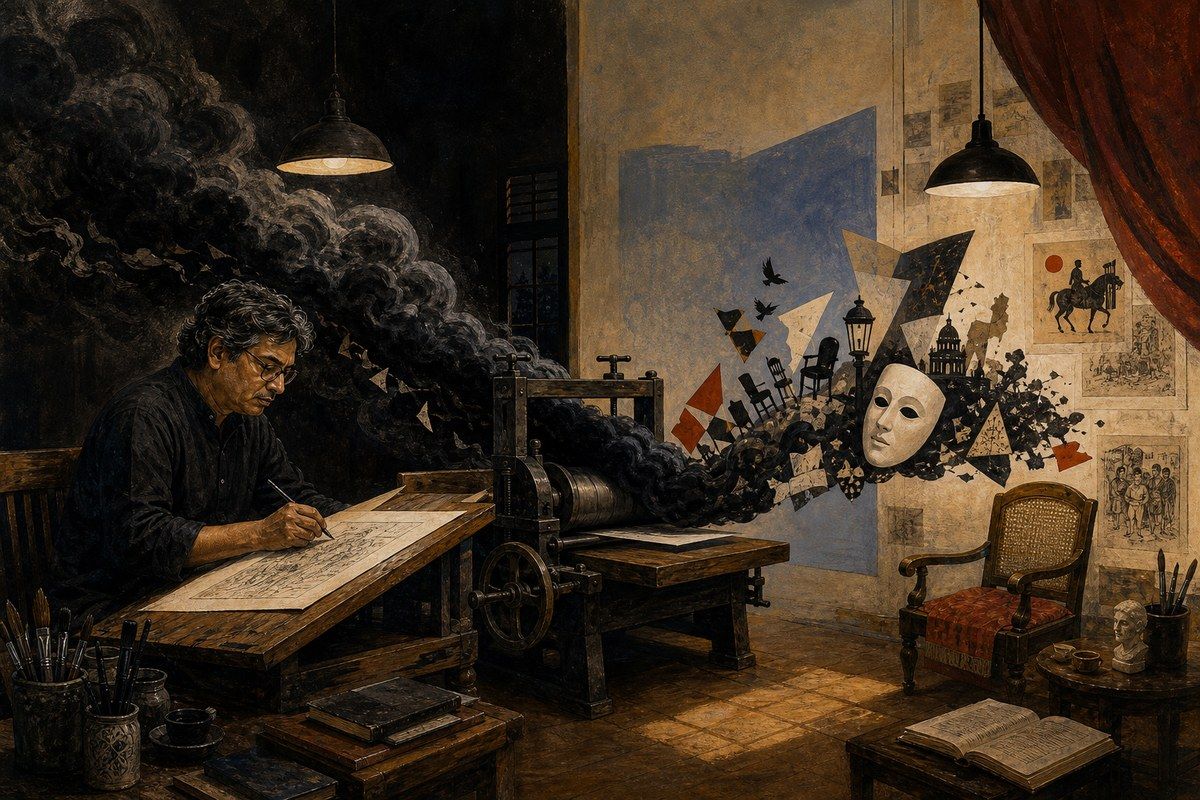
Start here because it explains the private pressure behind the drawings: why thoughts become lines, masks, cartoons, grotesque faces, and small acts of public satire.
A personal essay on writing, drawing, satire, darkness, digital obscurity, and the strange relief of forcing private weather into public shape.
Three reading paths
These are ordered editorial journeys, not automatic difficulty labels. Follow one route or move between them as your questions change.
Begin here
Beginner path
Begin with the life and habits that formed the visual sensibility before moving into technique or theory.
- Article PersonalSchooling in Calcutta
A Calcutta self-portrait stitched from school shame, books, reading, sketches, politics, survival, and the stubborn habit of staying mentally alive.
Updated - Article PersonalSamir Ranjan Das and the Visual Mind
A personal essay on a PhD advisor, Bengal’s habit of losing brilliant minds, visual thinking, AI, inequality, and the strange business of trying to remain intellectually alive from the edge of Kolkata.
Build context
Intermediate path
Follow drawing as observation, argument, geometry, and finally as a fictional force that refuses to stay on the page.
- Article Personal EssayInsect Forms of a Calcutta Life
Paper-cut Calcutta figures adopt insect-like tools of extraction while the artist's own silhouette appears in the mirror.
Updated - Article Art HistoryThe Vitruvian Man: A Naked Man, Two Shapes, and Our Old Hunger for Order
Leonardo da Vinci’s Vitruvian Man is not just a famous Renaissance drawing. It is a compact, beautiful, slightly ridiculous argument about the human body, geometry, perfection, and why messy people keep dreaming of clean proportions.
- Story Short FictionThe Animals That Did Not Know Smiling
When a cheap brand of children's crayons floods Kolkata, the drawings begin to climb out of school notebooks and apartment walls. A failed illustrator follows the trail through markets, balconies, hospitals, and old family guilt.
Go further
Deep-reading path
Examine what pixels do to attention, then move from hand-drawn marks into shaders and simulated pigment.
- Article SocietyPixels That Make Us Feel Present
How social media and video offer a false front-row seat, borrowing our nerves to manufacture rage, fear, belonging, and certainty.
Updated - Visualization VisualizationsHello, Fragment: Your First Shader from Scratch
Build a luminous, pointer-responsive fragment shader in p5.js WebGL, learning coordinates, uniforms, colour, time, and interference one visible step at a time.
Updated 18 min read - Visualization VisualizationsCreate Art: A Living Pigment Studio
Paint with digital pigments that spread, mix, dry, granulate, and continue evolving after every stroke.
17 min read
Suvro’s contrarian view
A sketch does not owe anyone polish
The common story treats a sketch as an inferior stage on the way to a proper artwork: first the rough line, later the respectable finish. That hierarchy misses what drawing can do. A sketch preserves hesitation, pressure, speed, error, and the moment before a visual idea learns to behave for an audience. Polishing can clarify, but it can also remove the evidence that a hand or mind was searching. The most revealing line may be the one that arrived before style, marketability, or technical correctness had time to put on a clean shirt.
Glossary
A small working vocabulary for this subject, defined for the way it appears across this site.
- Sketch
- A quick or exploratory drawing that records an idea, gesture, shape, or mood without requiring a polished final image.
- Line
- A mark that can describe an edge, movement, weight, rhythm, or emotion; in expressive drawing it need not behave like a literal boundary.
- Negative space
- The apparently empty area around and between forms, which often determines whether a composition feels balanced, tense, crowded, or still.
- Grotesque
- A mode that distorts bodies and faces to combine comedy, discomfort, satire, and recognition rather than merely aiming for ugliness.
- Visual thinking
- Reasoning through shapes, spatial relationships, diagrams, scenes, or mental images instead of relying only on verbal explanation.
- Proportion
- The relationship between sizes and distances within a figure or composition, whether observed faithfully or deliberately distorted.
- Fragment shader
- A small graphics program that calculates the colour of pixels, making it possible to build responsive fields, textures, and visual effects.
- Generative art
- Art made through rules or simulations that produce evolving results, with the artist designing the system as well as choosing what to keep.
Frequently asked questions
Where can I see the complete sketch collection?
The Sketch Museum contains the complete accessible collection as well as an optional three-dimensional gallery. Each work can be opened individually, and the collection remains usable without entering the museum experience.
Are these traditional pencil sketches?
The current museum contains digital sketches, including line drawings, flat-colour figures, creatures, objects, and abstract forms. Their visual language often borrows the speed and directness of drawing even when the working surface is digital.
Do I need to know art history to follow this topic?
No. The beginner route starts with personal essays about looking, learning, and thinking visually. The Vitruvian Man essay introduces proportion and art history in plain language when you are ready for a more historical argument.
Why are shaders and simulated pigment included with sketches?
They extend the same questions about marks, colour, accident, and control into code. A shader replaces a physical surface with pixel rules, while the Living Pigment Studio turns a brush stroke into a process that spreads, dries, and changes.
Are the grotesque figures meant to be horror art?
Sometimes they are disturbing, but horror is not the only purpose. Distortion can expose vanity, fear, appetite, social performance, or the comic animal inside a respectable human outline.
Recently updated material
Automatically ordered by each resource’s declared update date, with publication date used only when no update is recorded.
- Visualization VisualizationsThe Fractal Atlas: A Field Guide to InfinityUpdated 24 min read
- Visualization VisualizationsHello, Fragment: Your First Shader from ScratchUpdated 18 min read
- Visualization VisualizationsThe Chitin Engine: A Xenobiological Creature FoundryUpdated 18 min read
- Visualization VisualizationsThe Strange Attractor Orchestra: When Chaos Learns to SingUpdated 24 min read
- Visualization VisualizationsThinking Outside the Box: The Perlin Bloom EngineUpdated 14 min read
- Visualization VisualizationsThe Museum of Invisible WeatherUpdated 24 min read
Browse all material
The complete published collection currently assigned to this headquarters: 16 resources.
- Visualization VisualizationsThe Chitin Engine: A Xenobiological Creature FoundryUpdated 18 min read
- Visualization VisualizationsThe Strange Attractor Orchestra: When Chaos Learns to SingUpdated 24 min read
- Visualization VisualizationsThinking Outside the Box: The Perlin Bloom EngineUpdated 14 min read
- Visualization VisualizationsThe Museum of Invisible WeatherUpdated 24 min read
- Visualization VisualizationsThe Fractal Atlas: A Field Guide to InfinityUpdated 24 min read
- Sketch collection SketchesSketch MuseumUpdated
- Visualization VisualizationsCreate Art: A Living Pigment Studio17 min read
- Visualization VisualizationsHello, Fragment: Your First Shader from ScratchUpdated 18 min read
- Article Personal EssayInsect Forms of a Calcutta LifeUpdated
- Article Personal EssayThe Ordinary ThingsUpdated
- Story Short FictionThe Animals That Did Not Know Smiling
- Article Art HistoryThe Vitruvian Man: A Naked Man, Two Shapes, and Our Old Hunger for Order
- Article PersonalSamir Ranjan Das and the Visual Mind
- Article SocietyPixels That Make Us Feel PresentUpdated
- Article Personal EssayWhy I Write What I WriteUpdated
- Article PersonalSchooling in CalcuttaUpdated
Related Topic Headquarters
Calcutta as a Lived System
Streets, transport, food, weather, work, class, memory, civic absurdity, and one impossible footpath: a guided route through Calcutta as people actually negotiate it.
Explore topicSongs, Synthetic Music, and the Work of Listening
Listen across Bengali, English, and Hindi collections, then follow the harder questions of songwriting, synthetic music, authorship, attention, and trust.
Explore topicInteractive Mathematics and Visual Models
Learn by manipulating systems: sample probability, colour complex functions, build perceptrons, compare neuron models, and bend rays through simulated spacetime.
Explore topic