The piano
that forgives.
A little uncertainty.A nearby possibility.Something like jazz.
Touch a key. Let the painting answer.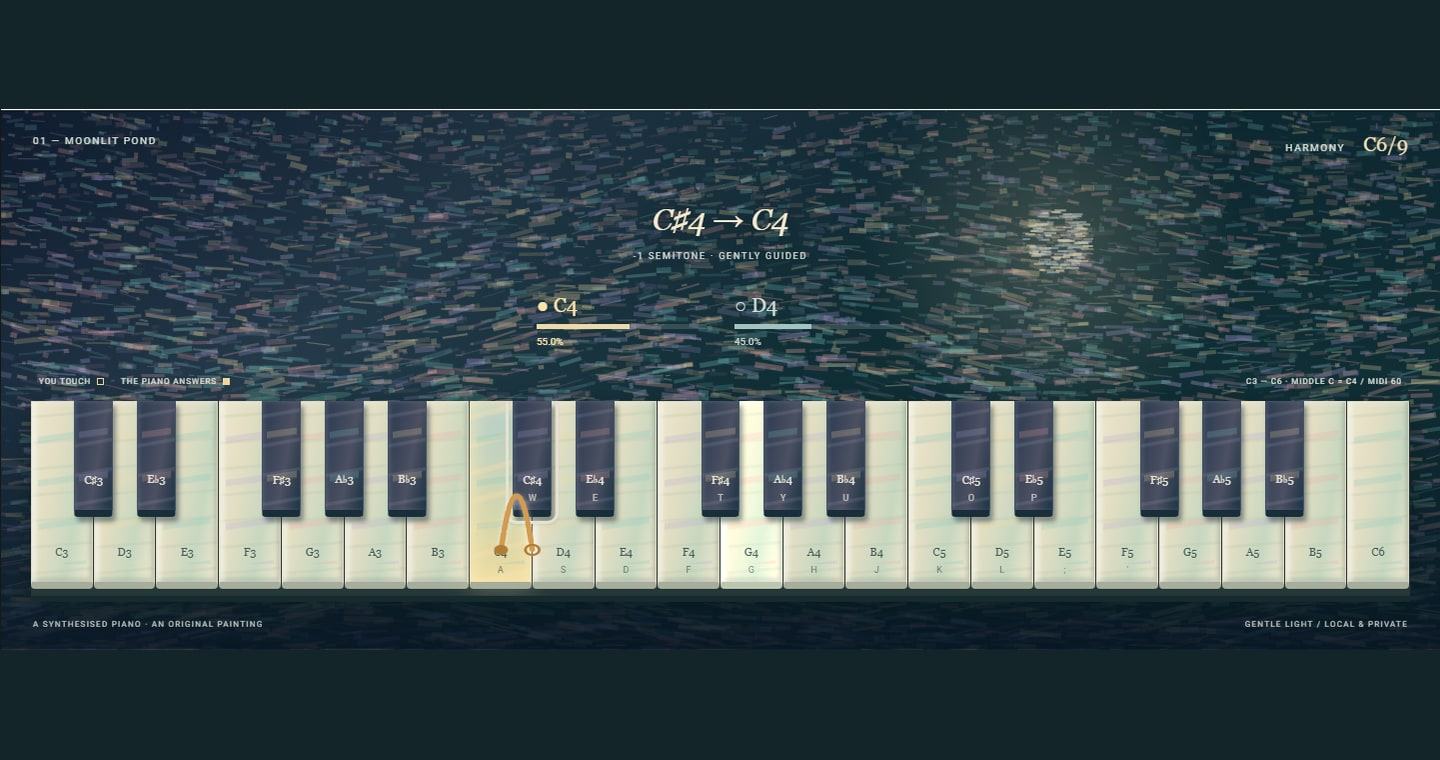
The closest note in this harmony. Equally close? A little probability.
Sound is off. You can still play the painting.
Inside the possibility HARMONY · REPLAY · THE EXACT NUMBERS
A few ways to listen
Palette: C · root · D · ninth · E · third · G · fifth · A · sixth
A single candidate stays certain at every temperature.
The note, with its workings
Play a key to see the complete decision here.
Recent notes (0 / 16)
Computer keys A W S E D F T G Y H U J K O L P ; ’ play C4–F5 while the piano has focus. Scroll the keyboard for more octaves. Your touch supplies the rhythm; assistance changes pitch.
Published · Updated
Uses the speech voice supplied by your browser or device.
A small act of forgiveness
Touch a cream-coloured key. A pale mark settles beneath your finger; another opens a little to its left, and a brushstroke joins them across the painted surface. The note arrives as though your hand had always known where it meant to go.
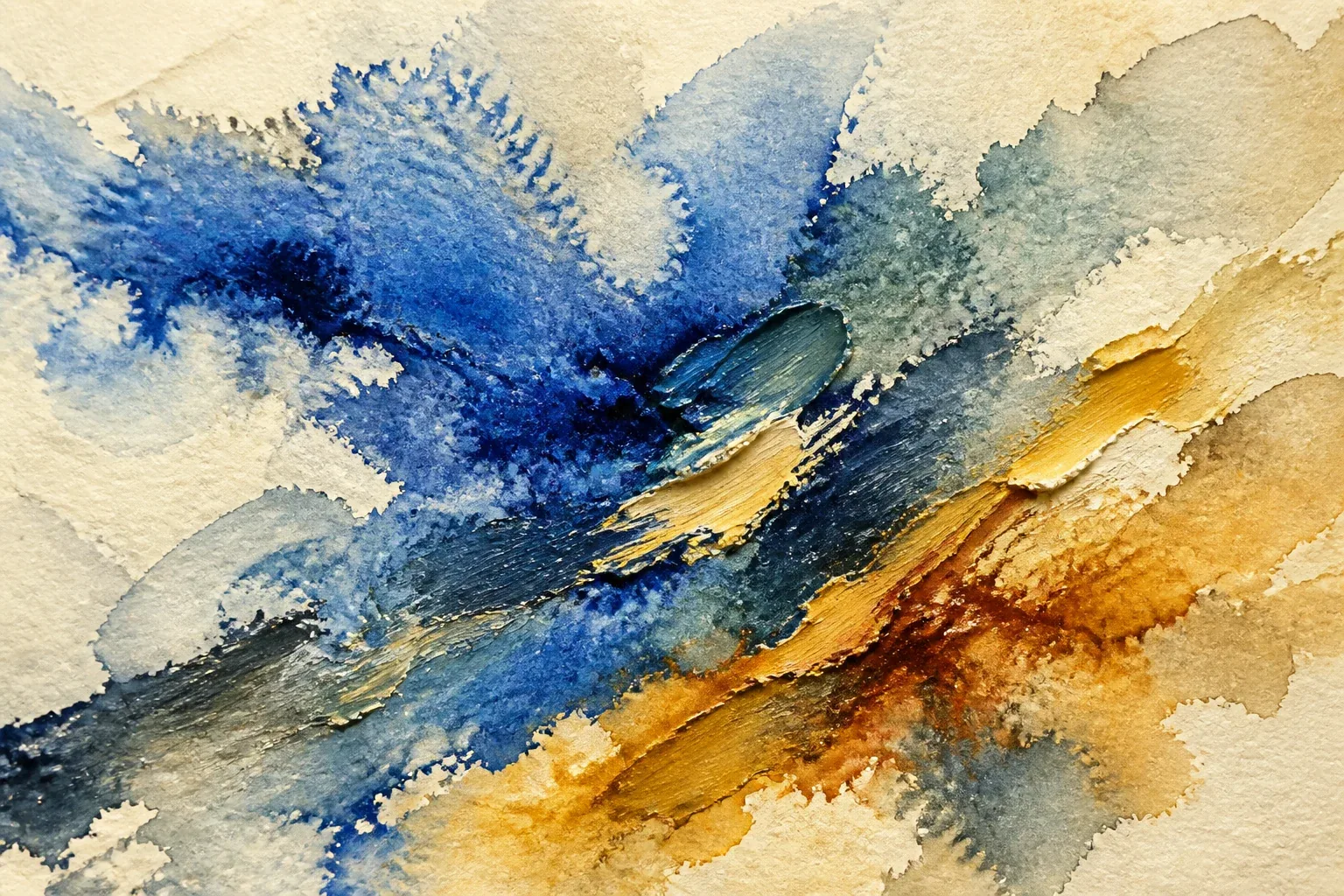
Above the keyboard, ultramarine water climbs into a lilac sky. Small strokes of viridian and gold refuse to decide whether they are reflections or distant stars. The keys remain ordinary enough to recognise: two dark ones, then three, then two again. Their surroundings have quietly left the room.
This piano offers a modest kindness. You supply the rhythm, pauses and shape of a phrase. It guides an uncertain pitch towards a nearby possibility in the current harmony. The brushstroke makes that intervention visible.
Start with the Moonlit pond preset and Nearest mode. Play slowly, leaving a little silence after each note. Enable sound when you want to listen; the keys and explanations also work silently. There is no audition to pass before touching the painting.
Your finger makes a request
A press is a request for a pitch, rather than an instruction that the instrument must obey literally. The current chord supplies a small, explicit palette of allowed notes. C6/9, the pond’s stationary harmony, uses C, D, E, G and A, repeated across the available octaves.
These are pitch classes: C4 and C5 share a letter and harmonic identity while occupying different registers. This instrument labels middle C as C4, MIDI 60. Adjacent piano keys differ by one semitone, including the step from E to F where no black key intervenes. The playable span runs from C3 to C6; on a narrow screen, move through the keyboard locally rather than trying to touch thirty-seven miniature targets.
Press an allowed note and it stays exactly where you put it. Press an outside note and Nearest measures the semitone distance to each allowed pitch. Only the closest survive. Sometimes that leaves one answer; sometimes two equally close neighbours remain.
The distinction matters. The palette says what this particular instrument permits. The candidate set says which permitted pitches are close enough to answer this particular press. A distant allowed note has not received a mysterious bad prediction. It was excluded by a stated distance rule.
C sharp, between two doors
Consider a fresh C6/9 state, with no previous melody notes or held voices. Press C♯4, MIDI 61. C4 is one semitone below; D4 is one semitone above. Both qualify in Nearest. E4 is three semitones away and cannot enter the draw.
The instrument gives the two neighbours small preference scores. At the default temperature of 0.7, the resulting probabilities are approximately 54.98 per cent for C4 and 45.02 per cent for D4. C has a slight preference because the authored rule favours its root role over D’s added ninth. The selected mark shows which possibility actually sounded.
The rule begins with:
Here is your requested MIDI pitch and a candidate. Distance supplies the strongest preference. measures the distance from the previous sounded melody note, capped at twelve semitones; the first note has no such penalty. is the candidate’s authored harmonic-role weight. counts recent exact repetitions, capped at three, and is a small, bounded cost from currently held voices.
For this clean example, C4 scores −1.25 and D4 scores −1.39. A softmax turns these relative scores into probabilities:
Subtracting the largest score keeps the calculation numerically well behaved. Temperature controls how sharply the scores matter. At zero, the highest score wins directly; an exact score tie goes to the lower MIDI pitch. With positive temperature, a seeded pseudorandom draw selects from the displayed distribution.
These percentages belong to an authored choosing mechanism. They do not measure beauty, predict your satisfaction or come from a neural network learning your taste.
Three degrees of permission
Nearest makes the smallest possible correction. An intentional leap survives: the model measures distance from the key you pressed before giving voice leading any preference. It cannot drag a high request down an octave merely because the previous note was low.
Wander allows candidates up to one semitone farther than the nearest distance. That extra room can make an answer less obvious while keeping it local. Allowed presses still remain unchanged. Raw sounds your requested pitch directly, giving deliberate outside notes their full citizenship.
A probability of one is perfectly useful information. If only one candidate qualifies, turning up temperature cannot invent another. The fan collapses to an honest certainty. The same is true when your press already belongs to the palette.
Freeze a decision to read its exact values. The keyboard shows the request and result, the fan gives the candidates’ relative probabilities, and the ledger names the chord and signed semitone movement. All three views read the same decision. The paint is never secretly composing a second tune.
Harmony gives the colour somewhere to live
The three presets offer different places to linger. Moonlit pond stays on C6/9. Night walk follows Dm9–G13–Cmaj9. The blue hour moves through Fmaj9–Fm6–C6/9, with the minor turn giving the light a different edge. Their palettes are individual choices; there is no universal jazz scale beneath every chord.
A voicing is the arrangement of chord notes across register. A tension adds colour beyond the basic chord sound, such as a ninth or thirteenth. Berklee’s piano voicing lesson explains the roles of thirds, sixths and sevenths, and the use of added tensions. Here G13 includes G, A, B, D, E and F, leaving out the eleventh as a deliberate palette choice. The University of Puget Sound’s jazz chord reference explains the extension symbols and this customary omission.
Voice leading concerns how individual lines move through changing harmony. Keeping a shared note or making a small step can connect one chord with the next, as Berklee’s voice-leading lesson illustrates. This piano borrows that preference gently. It also applies small repetition and held-voice costs, without pretending to solve every combination of fingers.
The progression advances only when you start its transport. With it stopped, the selected chord waits. Optional Soft accompaniment supplies sparse, quieter voicings when requested. A single melodic press still produces a single melodic note.
Hold a note through a chord change and it keeps its chosen pitch. Later presses consult the new harmony. Releasing your finger releases the voice selected for that input; Hold pedal delays release until the pedal lifts. Within the instrument’s voice limits, correction preserves onset, duration and available velocity. It adds no automatic swing and moves no note to a rhythmic grid.
Paint that explains its intervention
Broken colour offers an artistic analogy for possibility: adjacent strokes can suggest a changing surface without dissolving into one flat mixture. Here a requested pitch and its neighbours remain distinct, even while a connecting stroke lets the eye imagine their relationship. This is a visual conversation between music and painting, rather than a historical theory about how impressionists composed.
The surrounding atmosphere is decoration. The labelled musical marks have stricter duties. An outline identifies the request; a filled mark identifies the result; an unchanged note receives a combined mark. The selected candidate is named as well as coloured. That follows the principle in WCAG’s guidance on colour that information needs another visual means of identification.
Choose Still, or use your device’s reduced-motion preference, for stable marks without travelling trails. The probabilities remain available as numbers. Computer shortcuts work inside the focused instrument and are shown beside the keys; ordinary buttons support keyboard activation too. The recent-note history gives a quieter way to inspect a phrase after playing it.
The voice is an original synthesised piano approximation, made from decaying partials with a small struck attack. It evokes a gentle keyboard rather than reproducing a recorded concert grand. Sound begins through an explicit action: the Web Audio specification allows browsers to require user activation before starting an audio context. Volume, mute and Stop all sound remain within reach.
Leave room for a surprising note
Jazz makes expressive use of tension, chromatic approaches, phrasing and rhythmic placement. A note outside this instrument’s palette can be exactly the note a phrase needs. Raw mode keeps that choice available. Nor can membership in a chord palette guarantee that a dense handful of notes will sound graceful in every register.
Try the three-step guide, then replay its short original phrase in Nearest, Wander and Raw. The comparison keeps the phrase’s timing, velocity and harmonic context together. The seed reproduces its musical choices for the same ordered input and settings; changing the painted atmosphere cannot change the melody.
Finally, play four slow notes and leave a gap. Repeat them with a different last note. Freeze the result, listen to the silence after it, and decide whether the piano helped. Forgiveness is a useful beginning. The phrase is still yours to finish.
Quick reference and FAQ
You supply a piano phrase's rhythm and expression. The instrument keeps notes in its chosen harmony and gently redirects outside notes to nearby alternatives. Its painted marks and exact percentages explain the same decision that produces the sound.
Key Terms
- Pitch class
- Semitone
- Chord palette
- Voicing
- Tension
- Voice leading
- Softmax
- Temperature
- Seed
Frequently asked questions
Does every key press become beautiful jazz?
Assisted notes belong to the selected authored harmonic palette and obey the displayed distance rule. Rhythm, phrasing, register, dense clusters and personal taste still matter. The instrument does not define correct jazz.
Why does a note sometimes have a probability of 100 per cent?
Eligible presses stay unchanged. An outside press can also have only one nearest eligible candidate. In both cases there is one possible outcome, so temperature and the seed cannot change it.
Is the instrument learning from me?
No. It uses explicit chord palettes and a small authored scoring rule. The percentages describe its selection process, not the chance that a listener will enjoy a note.
What changes when I hold a note through a chord change?
The held note keeps the pitch chosen when you pressed it. The new harmony applies to later presses. Releasing an input releases its own voice, including when another input has selected the same pitch.
Can I explore without audio or animation?
Yes. The keyboard and decision inspector work silently. The display uses stable marks and respects the site's Still setting and reduced-motion preference. A poster and the article remain readable without JavaScript.
Word Cloud
Related reading
Selected by shared topics and section, with closer publication dates breaking ties.