The Profile That Knows Almost Nothing About You
Uses the speech voice supplied by your browser or device.
The unnerving sentence
There is a particular pleasure in being described well. A sentence arrives from outside, crosses the room, and appears to know where the furniture is.
The surprise becomes stronger when the source seems to know very little. A horoscope has a birth date. A personality quiz has a few radio buttons. A salesperson has the last three things you said. A language model has the prompt currently in front of it. Yet the resulting profile can feel as though it has opened a private drawer.
The laboratory above is built to make that feeling inspectable. It first presents short, ordinary lines that were chosen before you supplied a clue. A few optional choices and ratings can later make the wording feel more familiar. Only after that brief experience does the page open the ledger and show what changed, what did not, and which misses remained. Nothing is scored as objectively correct because the page has no independent measure of your personality.
The useful quantities are smaller and more honest:
- Perceived fit: whether a sentence sounds like you.
- Breadth: how many other people you think it could fit.
- Distinctiveness: whether it helps separate you from those other people.
- Answer dependence: whether your own selection helped choose the wording.
- Feedback reuse: whether a later line was selected, hedged, or elaborated because of an earlier rating.
A sentence may score highly on the first and poorly on the next two. That is the heart of the experiment. A true sentence can reveal almost nothing about the person reading it.
Forer, 1949
Bertram Forer’s classic classroom demonstration gave 39 students the same personality sketch after they had completed what they believed was a diagnostic test. They were told that the description had been produced individually. On a scale from zero to five, the mean rating was 4.26. The exercise did not establish a universal constant for human credulity; it showed, in one memorable classroom arrangement, that common feedback could be experienced as notably personal. Forer’s original report remains the primary source.
The historical paper’s title used the word “gullibility”. This page does not adopt that framing. Nothing exotic must go wrong inside a reader. Broad language can be genuinely true. Ordinary interpretation supplies examples from private memory, while soft qualifiers—“at times”, “in the right setting”, “when it matters”—allow a sentence to survive different situations. The error begins when resonance is treated as evidence that the method discovered something distinctive or that the assessment itself is valid.
In 1956, Paul Meehl used the Barnum effect label while criticising personality descriptions that offered “a little something for everybody”. His target was not party entertainment alone; it was weak assessment practice dressed in professional authority. Meehl’s essay, “Wanted—A Good Cookbook”, is available from the University of Minnesota.
Three decades later, D. H. Dickson and I. W. Kelly reviewed the experimental literature. Their account is more useful than the folklore version because it treats acceptance as conditional: favourability, relevance, assessment context, and the supposed source of a description can matter, while the evidence does not license a simple story about a permanently gullible kind of person. Their 1985 review surveys those qualifications.
Barnum is not the whole cold reading
Several mechanisms can arrive in the same paragraph and borrow credibility from one another.
A broad common experience says that you sometimes reconsider decisions. An opposite-pair claim says that you enjoy company in the right setting but sometimes want solitude. A direct echo returns “loose plan” as “you like a direction with room to change course”. Multiplicity throws enough distinct claims that at least one is likely to feel especially apt. Feedback adaptation watches which claims you endorse and selects nearby wording. Selective emphasis gives the hits the polished summary while the misses wait backstage.
Only the first two are the Barnum mechanism in a narrow sense. A direct echo may fit for the excellent reason that you supplied it; it is tautological tailoring, not discovery. Feedback reuse is a primitive form of adaptation. Multiplicity is probability doing clerical work. A cold-reading performance may combine all of them, but naming the mixture does not prove that any single ingredient caused belief. D. L. Dutton’s descriptive analysis is useful here precisely when read as an account of technique rather than a controlled estimate of each technique’s effect.
The lab keeps these mechanisms separate in its provenance table. Every generic claim says that it had no visitor-specific evidence. Every echo cites the exact question and option it restated. Every derivative cites the immutable rating event that permitted it. A non-fit stays a non-fit even when the polished version stops giving it top billing.
That last rule matters. A reading can appear to improve merely by preserving its endorsed claims, softening partial fits, adding compatible material, and becoming quiet about its failures. By the last round, the reader sounds sharper partly because you have been quietly doing its research department’s job.
The probability of throwing enough darts
Suppose—only for a toy model—that a broad claim has probability p of being accepted and that a profile makes n independent claims with that same probability. Then:
and
For at least k accepted claims, the binomial tail is:
The open laboratory calculates that tail with bounded numerical arithmetic and translates it into natural frequencies. It does not pretend that p came from this visitor, India, Kolkata, a demographic group, or the Barnum literature. You choose it as a hypothetical assumption.
Real statements are not independent balls drawn from an urn. They reuse themes, share words, and elicit correlated reactions. If different claims have different acceptance assumptions, the expected count is , not . The simple model is valuable for one limited reason: it shows why a source making twelve distinct guesses has more opportunities to obtain at least one endorsed match than a source committing to one.
Coincidence research makes the same bookkeeping point in broader form: when opportunities multiply, a striking match needs to be judged against the number of chances that could have produced one. Persi Diaconis and Frederick Mosteller describe methods for making those opportunities explicit.
Why “that is true of me” is the wrong validation test
Imagine that a statement is accepted by 80 of 100 people in fictional Group A and by 78 of 100 in fictional Group B. A fit is common in A. It is also common in B. The two-point difference provides little help in distinguishing the groups.
That is why the page asks two questions after the reveal. How many other people could the reading fit? How much does the reading distinguish you from them? Neither answer is an empirical population estimate; both are judgments made visible so that “true” is no longer allowed to do three jobs at once.
Research on general personality feedback repeatedly runs into this problem. Favourable statements may be both true at a high base rate and pleasant to accept. Personal relevance can change the setting in which feedback is received without making every supposed personalisation effect reliable. Snyder and Larson compared general and supposedly personal interpretations; Snyder and Shenkel examined favourability, modality, and relevance; and Greene asked students to consider the triviality of generalized feedback.
Base rates deserve the same care. Vivid, person-like language can make prevalence easy to neglect, but it is too strong to say that people always ignore base rates. Kahneman and Tversky’s work on prediction and Maya Bar-Hillel’s analysis established an influential programme; Jonathan Koehler’s later review explains why the blanket slogan needs qualification. Natural frequencies can make the relevant comparison easier to see, which is why the workbench uses counts as well as decimals. Gigerenzer and Hoffrage provide the classic account.
The modern interface
The machinery now arrives with better typography.
“For you” labels, recommendation rails, quiz results, and AI-generated profiles can place broad language inside an interface that implies a private model. Sometimes the system really does use behaviour or preferences; sometimes it merely returns what the user supplied; sometimes the label does more work than the algorithm. Those are empirically different cases.
Modern HCI research is a useful restraint against telling the neatest possible story. Pang Suwanaposee and colleagues studied Barnum-style framing in recommendations and reported a mixture of effects and important null results rather than a universal boost from “specially for you” language. The CHI 2023 paper is a direct source for that modern comparison. Authority and personalisation labels can matter; they are not magic switches.
Nor should this demonstration be converted into a cultural ranking. Cross-cultural work does not justify a table of national susceptibility, and this page never uses India, Kolkata, Bengali, age, or gender to select a personality clause. Rogers and Soule reported mixed results that changed under adjustment. The appropriate lesson is caution about universality, not a new stereotype.
The lab’s default setting is therefore visible context, not personality evidence. “India”, “Kolkata”, and “Bengali + English” begin in the ledger as unconfirmed demo values. They may appear in a separate preparation label. Change all of them and the original seven readings remain in the same order. The point is architectural as well as editorial: demographic answers never cross the allowlist into the semantic generator.
A field guide for the next reading
Use these questions against a horoscope, a psychic reading, a sales profile, a personality quiz, an algorithmic recommendation, or an AI-generated “deep reading”:
- What would clearly count as a miss? If no possible response can falsify the claim, fit proves little.
- How many people could it describe? Common truth is not individual knowledge.
- Was the fact supplied by me earlier? A paraphrase is not a deduction.
- Did the source commit before receiving feedback? Record the first version before reactions can reshape it.
- Are misses counted as visibly as hits? Ask for the whole ledger, not the highlight reel.
- Can the opposite trait fit under another condition? Watch for a sentence occupying both sides of a range.
- Could an independent person match the profile to me above chance? Identification is harder than recognition.
- Is there a specific, time-bounded, falsifiable prediction? Roomy prose often avoids one.
- Is a broad truth being presented as unique insight? Fit and distinctiveness are different questions.
- Is the percentage observed or merely calculated by the interface? Demand the numerator, denominator, comparison, and source.
The laboratory’s copy button copies only this generic checklist. It never copies the visitor’s answers, ratings, reading, seed-linked state, or audit trail.
What this lab cannot show
One person’s session is an n = 1 demonstration, not a replication. Visitors know the subject of the page and may resist, cooperate, or play with it. Repetition, order, demand effects, and ordinary rating variation can change a response. Self-rated fit is not objective personality accuracy. Broad statements can be true as well as non-diagnostic. Direct answer reuse is not a pure Barnum effect. Favourability and prevalence are difficult to untangle. The probability model assumes independence where real language overlaps.
Translation presents another limit. Ambiguity, valence, politeness, and grammatical breadth do not survive by replacing English words one at a time. The first release therefore uses a separately reviewed English corpus. “Bengali + English” is a visible demo setting, not a claim that a Bengali language pack exists.
The page is also not a research study, psychological assessment, diagnosis, or susceptibility score. It does not establish that this visitor neglected a base rate or possesses a stable bias. Experiential teaching research suggests that a carefully debriefed Barnum exercise can be feasible and engaging in undergraduate classes, but that does not prove that deception causes learning or that classroom results transfer unchanged to public blog visitors. Gonthier and Thomassin report five undergraduate cohorts and state the limits of their design. The immediate reveal, ability to skip the misdirection, and permanent audit borrow the humane part of that teaching tradition without pretending that this page is governed research.
If responses were ever stored, aggregated, profiled, or sent to another service, the ethical boundary would change. The feature would need new consent, privacy, threat-model, and research decisions. Quietly adding analytics to the answers would not be an incremental improvement; it would be a different product.
Sources and implementation note
The lab uses a bundled English bank of original, reviewed, complete sentences: 720 generic reading lines, 342 feedback lines, and 29 direct echoes. Surface readings, direct echoes, feedback-shaped readings, interface copy, and audit explanations are different data types; an audit explanation cannot enter the unrevealed reading compiler. A versioned deterministic sampler seals the generic deck on Begin. Country, city, language, age, gender, device, reading-time, and decoy fields are excluded from its personality input type. Selections and ratings remain only in the mounted component’s memory; Reset discards the current state, and a normal reload starts another session. The lab makes no API call, creates no account, writes no cookie or browser storage, and places no answer in a URL. Ordinary site analytics may still record the page visit.
The short, active surface style is an accessibility and ecological-plausibility choice, not a claim that word count causes the Barnum effect. The CDC Clear Communication Index recommends active voice because it is common in conversation, while the UK Home Office’s limited-English guidance recommends clear language, active voice, and sentences averaging about 15 words. Those guidelines help a visitor understand a line after hearing it once; the Barnum literature instead points to generality, favourability, relevance, source, and context.
The compact source registry below says what each reference supports. Every entry and link was checked on 17 August 2026.
- Bertram R. Forer, “The Fallacy of Personal Validation: A Classroom Demonstration of Gullibility” (1949). DOI record. Supports: the original 39-student classroom demonstration and its reported mean fit rating—not a universal effect size.
- Paul E. Meehl, “Wanted—A Good Cookbook” (1956). Author archive PDF. Supports: the early Barnum-effect label and its relevance to assessment practice.
- D. H. Dickson and I. W. Kelly, “The ‘Barnum Effect’ in Personality Assessment: A Review of the Literature” (1985). DOI record. Supports: the critical review of relevance, favourability, context, and the literature’s limits.
- C. R. Snyder and G. R. Larson, “A Further Look at Student Acceptance of General Personality Interpretations” (1972). DOI record. Supports: comparison of general and supposedly personal feedback.
- C. R. Snyder and R. J. Shenkel, study of favourability, modality, and relevance (1976). DOI record. Supports: conditions affecting acceptance and the difficulty of separating favourability from truth and prevalence.
- R. L. Greene, study of generalized feedback and triviality (1977). DOI record. Supports: separating perceived fit from the information or triviality of generalized feedback.
- D. L. Dutton, “The Cold Reading Technique” (1988). DOI record. Supports: a descriptive, critical account of cold-reading performance and reaction-dependent adaptation, not a controlled causal estimate for each technique.
- Daniel Kahneman and Amos Tversky, “On the Psychology of Prediction” (1973). DOI record. Supports: historical work on prediction and base-rate reasoning.
- Maya Bar-Hillel, “The Base-Rate Fallacy in Probability Judgments” (1980). Hebrew University record. Supports: relevance and use of base-rate information.
- Jonathan Koehler, “The Base Rate Fallacy Reconsidered” (1996). DOI record. Supports: caution against claiming that people routinely or uniformly ignore base rates.
- Gerd Gigerenzer and Ulrich Hoffrage, natural frequencies and Bayesian reasoning (1995). DOI record. Supports: presenting hypothetical probabilities as countable natural frequencies.
- Persi Diaconis and Frederick Mosteller, “Methods for Studying Coincidences” (1989). DOI record. Supports: multiplicity and coincidence framing.
- Pang Suwanaposee and colleagues, “‘Specially For You’: The Barnum Effect in Personalized Recommendation” (CHI 2023). DOI record. Supports: contemporary HCI evidence about personalization framing, including reported limits and null results.
- Corentin Gonthier and Noémylle Thomassin, experiential Barnum teaching study (online 2024; issue 2025). DOI record. Supports: feasibility and engagement evidence from five undergraduate cohorts, not causal proof that deception improves learning or generalization to public visitors.
- Paul Rogers and Janice Soule, cross-cultural Barnum-effect study (2009). DOI record. Supports: mixed and adjusted cross-cultural results used only to limit universal claims, never to rank groups.
- Centers for Disease Control and Prevention, Clear Communication Index, active-voice criterion. Official guidance. Supports: active, conversational phrasing as a clarity choice, not a Barnum-effect mechanism.
- UK Home Office, Designing for people with limited English. Official design guidance. Supports: clear language, active voice, short sentences, and user testing as accessibility practices.
- American Psychological Association, Ethical Principles of Psychologists and Code of Conduct, section 8 where relevant. Authoritative code. Supports: disclosure and debriefing as useful ethical reference points; this blog is not represented as APA-governed research.
Historical sources explain mechanisms and evidence; none of their personality sketches was used as corpus material.
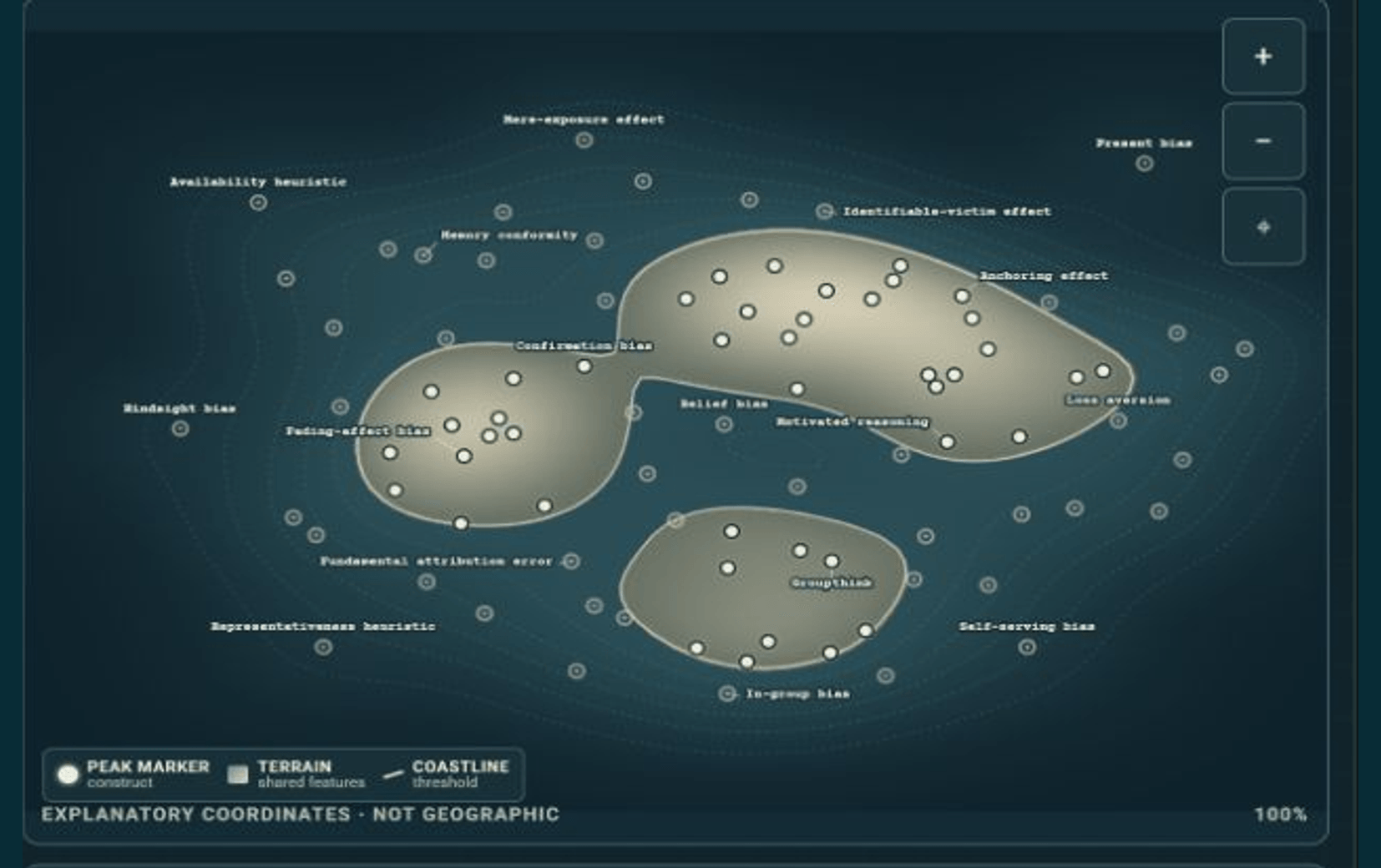
For a wider map of neighbouring mechanisms—subjective validation, confirmation, selective memory, base-rate reasoning, and the bias blind spot—continue to The Bias Archipelago.
Quick reference and FAQ
A statement can feel true without distinguishing you from anybody else. This private, local experiment shows how broad wording, repeated guesses, direct echoes of your answers, and reactions to earlier claims can manufacture the appearance of personal insight.
Key Terms
- Barnum effect
- Forer effect
- Perceived fit
- Distinctiveness
- Direct echo
- Feedback reuse
- Multiplicity
- Base rate
- Personal validation
- Cold reading
Frequently asked questions
Is this a personality test?
No. It is an educational demonstration with no validated personality model or independent ground truth. Its ratings measure only whether a sentence sounds fitting to the visitor.
Does the lab save or transmit my answers?
The lab keeps selections, ratings, and generated text only in the component's current in-memory session. It does not put them in storage, URLs, analytics events, or requests. Ordinary site analytics may still record that this page was visited.
Why can a true statement still be weak evidence?
A claim can fit you and many other people at once. If it does not separate you from plausible alternatives, its truth has little individualizing value.
Does changing the demographic clues alter the personality reading?
No. Country, city, language, age, gender, device, and decoy choices are excluded from the semantic generator. The counterfactual experiment changes their display while keeping the sealed personality claim IDs identical.
Is the many-guesses probability an observed Barnum-effect rate?
No. The visitor supplies a hypothetical per-claim acceptance probability. The workbench then applies an explicitly simplified binomial model whose independence and equal-probability assumptions are unlikely to hold exactly for real statements.
Word Cloud
Related reading
Selected by shared topics and section, with closer publication dates breaking ties.